
KPMG's AI Hallucinations Flag Governance Risk for Legal AI Adoption
This article documents the June 2026 GPTZero forensic review that found 40 of 45 citations in KPMG's AI report were hallucinated, and explains why this incident constitutes a material governance risk for in-house counsel evaluating KPMG Law US's AI-powered legal platform.
- Jurisdiction
- United States
- Court
- N/A
- AI tool named
- KPMG Digital Gateway for Law
- Ruling date
- Jun 12, 2026
- Source document
- View primary court order ↗
- Last verified
- Jul 24, 2026
Lex Machina Review is an independent risk-tracking and reference resource. Nothing on this site is legal advice, and using it does not create an attorney-client relationship. Every record is reviewed against primary sources but may not reflect the most current status of a matter — always verify directly against the cited court order, rule text, or a licensed attorney before relying on it.
Companion explanation — secondary to the source document above
The useful fact is not that an AI report contained errors. The useful fact is the count: GPTZero found that only 5 of 45 citations in KPMG’s October 2025 report, Total Experience: Redefining Excellence in the Age of Agentic AI, matched their stated sources; the remaining 40 were fabricated, misattributed, or too vague to verify.[1]
That is a governance problem before it is a public-relations problem. The same report did not merely include a few weak links or stale URLs. It presented polished enterprise case-study claims: UBS integrating AI agents across investment advisory, Emirates deploying a chatbot named “Sara” that could change flights, Swiss Federal Railways, and Transport for London. Those examples were not verifiable in the way the report represented them.[2]
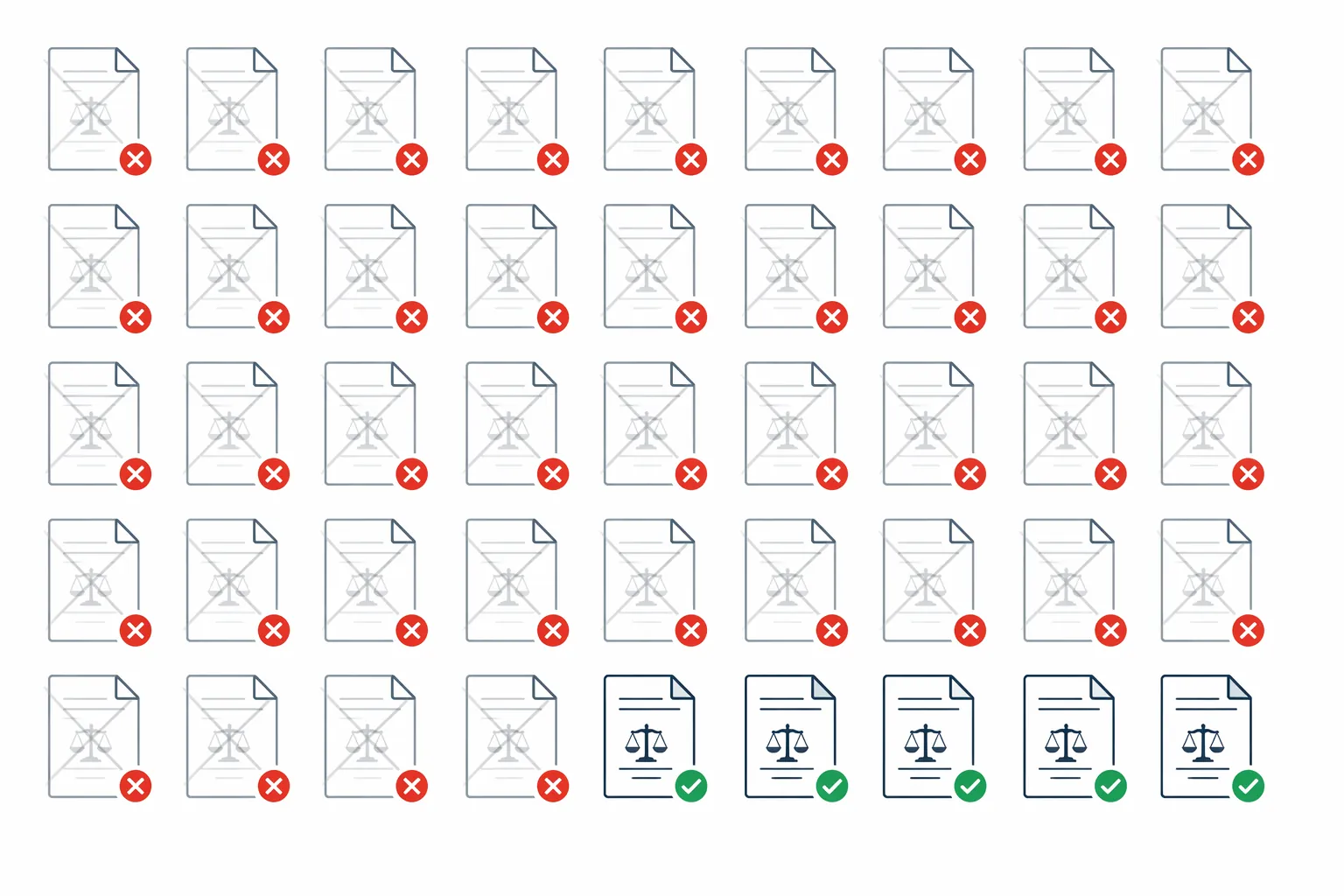
After the findings became public in June 2026, KPMG removed the report from its websites.[3] That removal matters because legal buyers are not being asked to evaluate a loose blog post from a junior team. They are being asked to evaluate an organization that sells AI governance, AI-enabled legal delivery, and enterprise AI transformation at the same time.
Why This Belongs In The Legal AI Diligence File
KPMG Law US launched in February 2025 with KPMG describing a global legal network of 3,850 legal professionals across 84 jurisdictions.[4] Reuters reported the launch as the first Big Four-owned law firm in the United States.[5] Bloomberg Law had already framed KPMG’s legal ambitions around the scale and capital available to a firm with more than $36 billion in gross revenue.[6]
Scale is not the defect. In legal operations, scale is often the reason a buyer takes a vendor seriously. A platform that can standardize intake, contract review, compliance tracking, dispute management, and entity management across business units is not a fantasy use case; it is exactly the sort of thing overloaded legal departments keep trying to buy. The risk is what happens when the assurance layer is treated as already proven because the vendor’s brand is large.
KPMG’s own materials describe KPMG Digital Gateway for Law as the delivery platform for AI-powered legal services, including contract management, compliance, dispute management, and entity management.[7] Those are workflows where source authority is not decoration. A bad citation in a marketing report is embarrassing. A bad authority chain in a regulatory response, contract position, privilege review, or litigation support workflow can become a matter-management event.
The June 2026 citation failure does not prove that KPMG Digital Gateway for Law has the same defect. It does not show that KPMG Law US generated false legal advice, filed anything defective, or mishandled a client matter. The record is narrower than that, and it should stay narrow. It shows that KPMG published and promoted a marquee AI thought-leadership report whose source layer failed a basic verification test.
The OpenAI Partnership Raises The Stakes, Not The Proof
The timing is awkward for KPMG because the firm is now placing OpenAI-enabled enterprise work much closer to its legal-services story. On July 21, 2026, Fortune reported that KPMG had been named an OpenAI Elite Partner and described KPMG as OpenAI’s “client-zero” deployment, with the firms betting on “headless” enterprise AI systems where agents become the primary work surface.[8]
Three days after that announcement, the conservative procurement question is not whether OpenAI models will hallucinate inside KPMG Law US. The documented record does not answer that. The question is whether KPMG’s trust claims should be accepted as controls, or treated as representations that require independent testing.
KPMG markets a Trusted AI framework around principles such as fairness, explainability, accountability, security, and reliability.[9] Those are useful categories for a governance conversation. They are not, by themselves, evidence that a specific legal workflow has source-validation controls that catch false authorities before work product leaves the system.
The gap is not semantic. Enterprise buyers often receive a trust deck, a platform architecture diagram, and a set of broad control labels in the same procurement cycle. After the 40-of-45 citation failure, those materials should be separated. A trust framework may describe the intended control environment. The buyer still needs evidence that the control operated on the relevant workflow, with legal materials, under legal-use conditions.
What The Failed Citations Actually Change
Before this incident, a legal department might reasonably have treated KPMG’s own AI-governance posture as one positive factor among many. After the incident, that posture needs corroboration. Not because KPMG is uniquely careless, and not because manual legal work is inherently safer. The change is evidentiary: the seller’s public assurance materials now sit beside a documented verification lapse in a high-visibility AI publication.
That changes the due-diligence conversation in four practical ways.
- Vendor statements about “trusted AI” should be classified as claims to verify, not controls to rely on.
- Marketing-content review should be distinguished from legal-work-product review; a buyer should not assume that failure in one process proves failure in the other, or that controls in one process protect the other.
- Citation, authority, and source-validation controls should be shown inside the legal platform, not only described at the framework level.
- Responsibility for AI-generated work product should be allocated before launch, including who reviews, who signs off, who remediates, and who bears the consequence if unsupported material enters a matter.
For contract management, this means asking how the system validates extracted obligations against the executed document and approved playbook. For compliance work, it means asking how regulatory sources are pinned, updated, and checked. For dispute management, it means asking whether citations, chronology, and factual assertions are verified against the matter record before they enter any deliverable. For entity management, it means asking how jurisdiction-specific filings and corporate records are reconciled against authoritative sources.
The buyer does not need a perfect model card for every component to proceed. The buyer does need enough workflow-level evidence to know where the system is allowed to assist, where a professional must intervene, and where unsupported outputs are blocked rather than merely logged.
The Questions Procurement Should Put In Writing
The ordinary demo questions will not reach the risk exposed by the report incident. A confident walk-through of intake, dashboards, and matter workflows says little about whether the underlying source layer is being checked. The questions need to force a record.
- What control failed, or was absent, in the October 2025 AI report review process, and has KPMG completed a documented remediation?
- Which review process applies to client legal work generated or assisted by KPMG Digital Gateway for Law, and how is it different from the process that applied to public thought leadership?
- Does the legal platform require source-grounding for citations, legal authorities, regulatory references, and factual assertions?
- Can KPMG provide hallucination-testing results for the specific legal workflows being purchased, rather than general AI assurance material?
- Are unsupported citations blocked before delivery, escalated for human review, or merely flagged after generation?
- Who is contractually responsible if AI-assisted output containing unsupported authority or unverifiable factual material is delivered into a client matter?
Those questions are not hostile to AI adoption. They are the minimum record a legal department needs before placing AI-assisted output inside privileged, regulated, or dispute-sensitive work. If KPMG has strong controls, written answers should help the firm. If the answers stay at the level of brand assurance, the buyer has learned something.
Pattern Evidence, Kept In Its Place
There is a second KPMG AI incident worth noting, but not overreading. In February 2026, KPMG Australia fined a senior partner A$10,000 and fined 27 other staff after employees used AI to cheat on an internal AI ethics exam; The Guardian reported total fines of A$715,000, and the matter was self-reported to CA ANZ.[10] The Financial Times also covered the episode.[11]
That episode is not the same as hallucinated citations in a public AI report. It concerns employee conduct in training, not source verification in published analysis or legal delivery. Its relevance is narrower: it shows that professional-services firms selling AI governance can still struggle with ordinary internal compliance around AI use.
The Big Four context should be handled the same way. Other professional-services firms have also had public AI-content problems. That does not dilute the KPMG record; it makes buyer complacency harder to justify. The issue is not whether one firm can be singled out as uniquely risky. The issue is whether the buyer’s controls are strong enough when a prestigious vendor’s own materials fail.
The Bounded Procurement Judgment
The available record is still a snapshot. The GPTZero findings became public on June 12, 2026, and KPMG’s longer internal review, if any, may not be publicly complete.[1] The OpenAI Elite Partner announcement is even newer, reported on July 21, 2026.[8] Longer-term conclusions about how KPMG Law US will deploy those models would be speculation.
But procurement decisions are made on available evidence, not perfect evidence. The available evidence says that KPMG missed, published, and then removed a flagship AI report after outside reviewers found that 40 of 45 citations failed verification. For a legal department evaluating KPMG’s OpenAI-enabled enterprise platform and legal AI adoption story, that is a material governance signal.
It is not a verdict that KPMG Law US is unsafe. It is a reason not to outsource verification to KPMG’s Trusted AI language. Proceed, if the business case is strong, with independent source-checking requirements, documented workflow controls, and evidence that the specific legal platform has been tested under legal-use conditions.
References
- KPMG's AI report becomes an accidental demo of AI hallucinations, The Register, June 12, 2026.
- KPMG AI Report Plagued by AI-Generated False Citations, OECD.AI.
- KPMG drops AI report after false case studies exposed, International Accounting Bulletin.
- KPMG LLP Launches KPMG Law US, KPMG, February 2025.
- KPMG approved to launch US law firm in first for Big Four, Reuters, February 27, 2025.
- KPMG Looks to Beat Big Law at AI by Leveraging Size and Capital, Bloomberg Law.
- KPMG Digital Gateway for Law, KPMG.
- Exclusive: KPMG and OpenAI bet on headless software, Fortune, July 21, 2026.
- KPMG Trusted AI framework, KPMG.
- KPMG partner fined for using AI to cheat in training test, The Guardian, February 16, 2026.
- KPMG partner fined over using AI to pass AI test, Financial Times.
Related records
Tool profile
Browse tool evaluations →Governing regulation
Browse the obligations tracker →Preventive workflow
Browse verification workflows →
Report a correction or tip
Spotted an outdated figure, a misstated fact, or a ruling this case record should reflect? Public comments are disabled for this content given the professional cost of a misreported case outcome, penalty amount, or rule text — use the structured correction channel instead.
Report a correction or tip for this record →