
Who Bears Liability in the Kroger Egg Recall?
The July 2026 Kroger egg recall raises a textbook strict liability question: does the supplier who detected the contamination or the retailer whose brand appears on the carton bear the greater financial risk? This article examines how liability allocates between Midwest Poultry Services and Kroger under existing tort law, and what that means for claimants seeking compensation.
- Jurisdiction
- United States
- Court
- No court assigned
- Judge
- Not yet assigned
- AI tool named
- None involved
- Ruling date
- Jul 22, 2026
- Source document
- View primary court order ↗
- Last verified
- Jul 25, 2026
Lex Machina Review is an independent risk-tracking and reference resource. Nothing on this site is legal advice, and using it does not create an attorney-client relationship. Every record is reviewed against primary sources but may not reflect the most current status of a matter — always verify directly against the cited court order, rule text, or a licensed attorney before relying on it.
Companion explanation — secondary to the source document above
Searches for “kroger egg recall salmonella refund lawsuit 2026” collapse three different questions into one line: whether consumers can return the cartons, whether sick purchasers can sue, and whether Kroger or Midwest Poultry Services carries the heavier legal risk. The refund question is the least difficult. The harder question is what happens when the supplier appears to have found the Salmonella problem through monitoring, the recall moved quickly, and the carton still carried a retailer-facing brand.
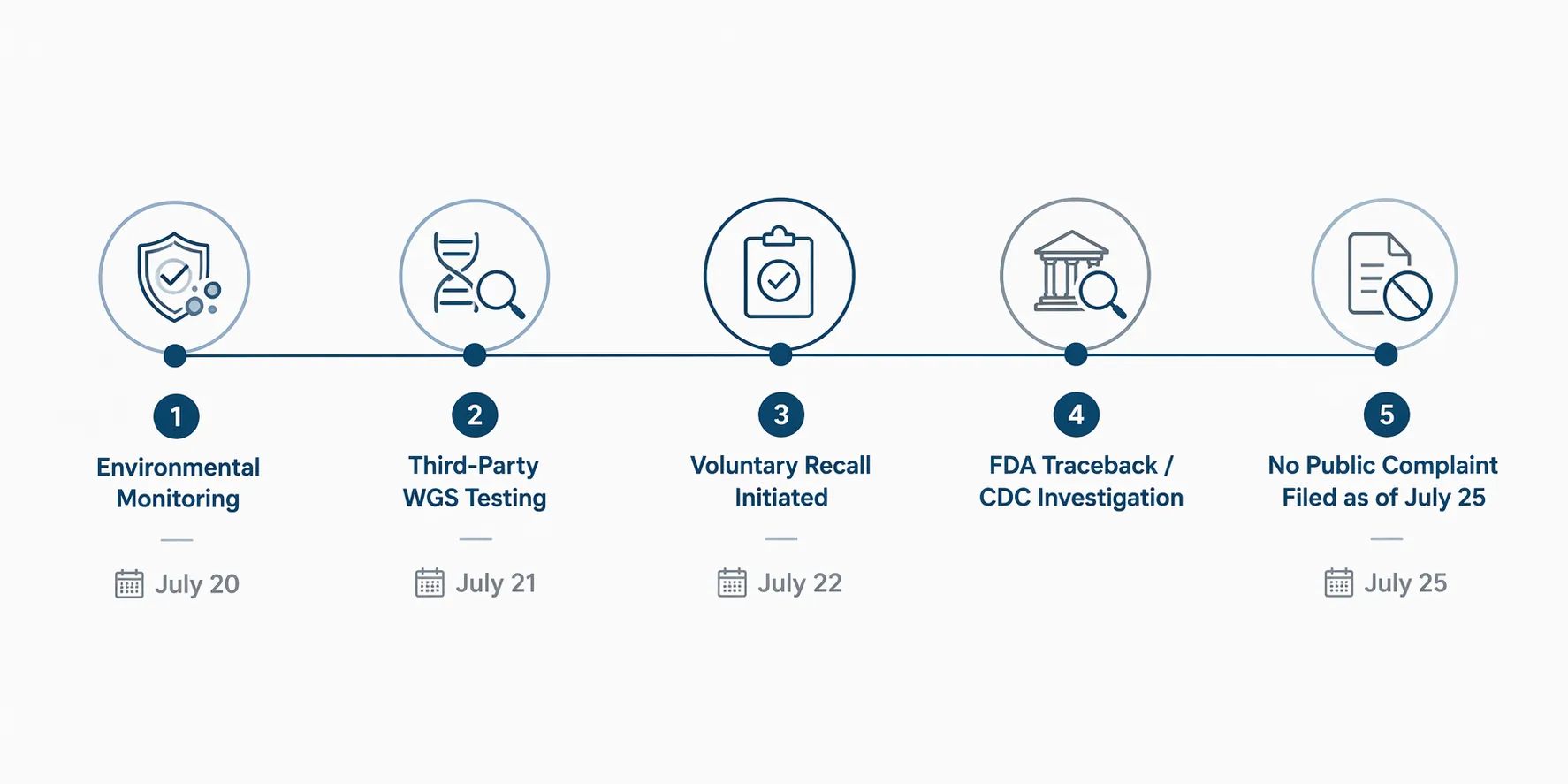
As of July 25, 2026, the public record supports a narrow but serious analysis. Midwest Poultry Services announced a voluntary recall of shell eggs after environmental monitoring and third-party whole genome sequencing testing on July 21 identified Salmonella Enteritidis concerns; the recall was initiated July 22 and covered about 1.59 million dozen eggs.[1] FDA’s outbreak page separately reports 98 confirmed illnesses across 17 states, 26 hospitalizations, and interviews in which 91% of patients reported eating eggs before becoming ill.[2]
That is enough to make litigation risk real, and Reuters has already treated the recall as a legal story rather than only a consumer-safety notice.[3] Plaintiffs’ firms are also advertising for potential claimants, even though no class action or individual complaint has been publicly docketed as of July 25, 2026.[4][5][6] That timing matters. Intake pages are not pleadings, and pleadings are not proof.
The Recall Record Does Not Give Either Company a Clean Exit
The cleanest fact for Midwest Poultry is also the fact that places it in the liability chain: the recall notice identifies the company as the recalling firm and describes the detection sequence that led to the voluntary action.[1] In a food case, that does not read like a press-release flourish. It tells counsel where to begin subpoena planning: monitoring records, WGS reports, lot tracing, sanitation logs, customer shipment records, and the communications that moved the matter from test result to recall.
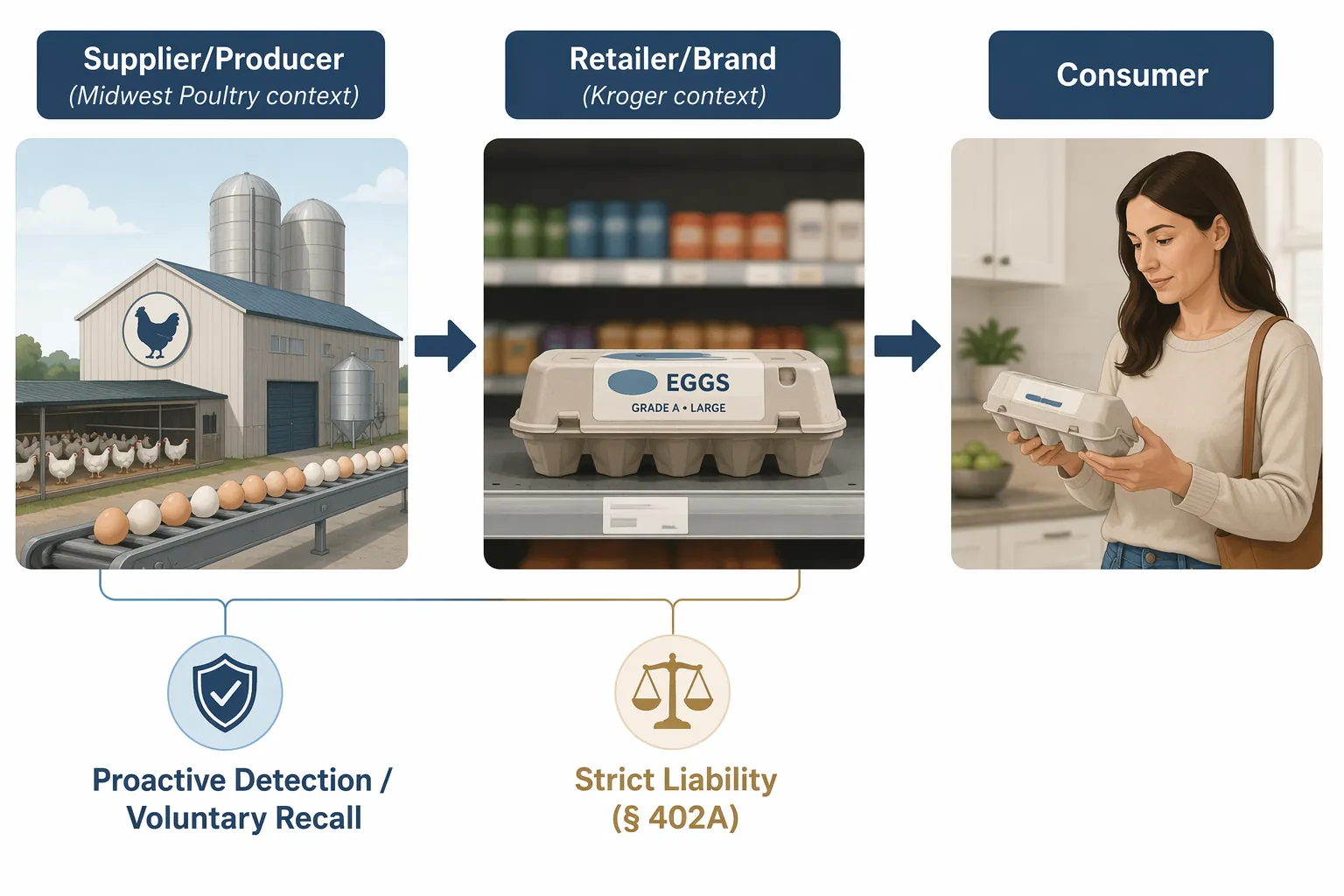
The cleanest fact for Kroger is that it did not produce the eggs. That fact is useful for indemnity and allocation, but it does not end the consumer-facing claim. If Kroger-branded or retailer-associated cartons reached grocery shelves, the retailer sits in the chain of distribution. Under the strict-liability theory usually associated with Restatement (Second) of Torts Section 402A, the injured consumer does not have to prove that the retailer personally created the contamination. The claim is about selling a defective food product in a condition unsafe for ordinary consumption.
That is why “the supplier found it” is not the same as “the retailer is out.” A grocery customer buys the carton from the store, sees the retailer’s merchandising and brand presentation, and eats the eggs as food. The retailer can later pursue contractual indemnity, tender the claim to the supplier, or argue comparative allocation among commercial defendants. Those are real defenses in the business-to-business layer. They do not make the injured consumer prove Kroger’s microbiology practices before recovering for Salmonella illness.
Why the Epidemiology Helps Personal-Injury Claimants
The outbreak numbers do not prove any individual plaintiff’s case by themselves. They do, however, change the posture. FDA reports 98 confirmed illnesses across 17 states and 26 hospitalizations, and the egg-consumption interview figure is not a vague association: 91% of interviewed patients reported eating eggs before illness.[2] For a personal-injury lawyer screening claims, that is the difference between an abstract recall and a causation file worth building.
A viable claimant will still need individual evidence: purchase location, carton or lot information if available, timing of consumption, symptom onset, medical testing, and records showing treatment or lost wages. Hospitalization will matter because it converts the harm from inconvenience to documented injury. So will a positive Salmonella test, especially if it can be matched to the outbreak strain through public-health work.
The FDA’s caution is equally important. Its outbreak investigation page identifies Midwest Poultry Services as “a likely source,” but also states that Midwest Poultry “does not account for all illnesses.”[2] That sentence is not boilerplate for defendants. It preserves the possibility that other sources, other sellers, or other exposure pathways may explain part of the outbreak. A plaintiff tied to the recalled cartons has a cleaner route than a consumer who only ate eggs somewhere during the relevant period.
| Issue | What the Public Record Supports | What Remains Unresolved |
|---|---|---|
| Recall status | Voluntary recall after July 21 third-party WGS testing and July 22 recall initiation | How each lot moved through specific stores and customers |
| Outbreak link | 98 confirmed illnesses, 17 states, 26 hospitalizations, and 91% egg-consumption interviews | Whether every illness traces to Midwest Poultry products |
| Retailer exposure | Kroger may face strict-liability claims as a seller of contaminated product | Contractual indemnity and allocation between Kroger and supplier |
| Litigation status | Plaintiff-firm solicitation is live | No publicly docketed complaint as of July 25, 2026 |
Kroger’s Brand Position Matters More Than Its Distance From the Farm
Retailers sometimes talk about recalls as if their role is merely logistical: receive notice, pull product, refund customer. That is operationally true and legally incomplete. A retailer that sells food is not a bystander to the sale. It places the product into commerce, collects the purchase price, controls shelf access, and in private-label arrangements often controls the consumer-facing trust signal even when another company produces the goods.
That distinction is especially hard to avoid when the package uses a retailer brand or retailer-associated presentation. Consumers do not stand in the aisle reviewing supplier audit files. They rely on the carton in front of them. In strict-liability terms, Kroger’s strongest defense is not “we did not lay the eggs.” It is likely to be downstream allocation: if Kroger pays claims, who reimburses it, and under what supply agreement, insurance program, vendor warranty, or indemnity provision?
That business-layer fight can be expensive and important, but it is not the first question for an injured consumer. The first question is whether the product was defective, whether the defendant sold or distributed it, and whether that product caused the illness. On the facts currently public, Kroger has exposure because retailer status is enough to bring it into the distribution chain. Midwest Poultry has exposure because the recall record places it at the production-source end of the same chain.
Midwest Poultry’s Best Fact Goes to Punitive Damages, Not Basic Compensation
The most legally interesting fact in the recall notice is not the volume. It is the detection sequence. Midwest Poultry’s own environmental monitoring led to third-party WGS testing on July 21, and the company initiated a voluntary recall on July 22.[1] That sequence does not defeat a compensatory claim by someone who became ill from contaminated eggs. A person hospitalized with Salmonella is not made whole because the supplier later acted responsibly.
But the same sequence may matter sharply if a complaint tries to plead punitive damages. Punitive damages usually require something more morally charged than distribution of a defective product: conscious disregard, reckless indifference, concealment, or refusal to act after knowing the danger. A company that identifies a hazard through monitoring, obtains third-party genomic testing, and initiates a voluntary recall the next day has a materially different punitive-damages file than a company that ignores positives, ships through warnings, or hides results.
That is not praise dressed as legal analysis. The facts may change. Discovery could reveal earlier warning signs, slow internal escalation, inadequate sanitation practices, or a recall narrower than the evidence justified. If those facts emerge, the punitive analysis changes with them. On the public record as of July 25, however, Midwest Poultry’s proactive detection is more likely to help it resist reckless-disregard allegations than to eliminate ordinary injury claims.
Refunds Are Not a Substitute for Injury Claims
The recall notice’s consumer instructions belong in the file, but they should not be mistaken for the litigation remedy. Returning or discarding eggs addresses product possession and purchase price. It does not resolve medical bills, hospitalization, lost income, or pain and suffering for a consumer who can connect illness to recalled product. Refund mechanics are useful evidence that the company gave public notice; they are not a release of personal-injury claims unless a separate, enforceable settlement mechanism exists.
That is why plaintiff-firm advertising appeared quickly. Schmidt Firm, Pritzker Hageman, and ClassActionLawsuitHelp.com have posted pages seeking potential Salmonella claimants tied to the recall.[4][5][6] Those pages are signals of market interest, not proof that a certified class will exist. Foodborne-illness claims often turn on individualized medical evidence, exposure evidence, and damages. A refund class for purchasers and a personal-injury inventory for sick consumers are not the same litigation animal.
Prior Egg Outbreaks Are Benchmarks, Not Settlement Math
Two prior egg-related events are useful only if handled with restraint. The 2025 August Egg Company outbreak has been described in available benchmark materials as involving 134 illnesses, 38 hospitalizations, and 1 death.[7] The 2010 nationwide egg recall has been described as involving more than 500 million eggs, MDL No. 2172, and a settlement fund exceeding $6 million.[8] Those numbers show that egg recalls can produce serious illness and coordinated litigation. They do not predict what the Kroger and Midwest Poultry matter is worth.
The comparison breaks down quickly. Claimant volume may rise or remain limited. The FDA has not attributed all illnesses to Midwest Poultry.[2] No complaint is publicly docketed as of July 25, 2026. The recalled volume, the retailer-brand posture, the supplier’s monitoring record, the number of hospitalized claimants, and the defendants’ indemnity arrangements all matter. A settlement figure built before those facts are known would look precise and be mostly theater.
Where the Liability Stands on July 25
The strongest current claimant path is compensatory recovery for documented Salmonella illness tied to recalled eggs. The public-health numbers make causation plausible at the outbreak level, and the hospitalization count makes damages concrete for at least some claimants.[2] The strongest retailer-risk point is Kroger’s position in the chain of distribution: if contaminated eggs were sold under a retailer-facing brand, strict liability does not require proof that Kroger caused the contamination.
Midwest Poultry’s exposure is direct because the recall record identifies it as the recalling supplier and FDA identifies it as a likely source.[1][2] Its better argument is narrower. The environmental monitoring, July 21 WGS testing, and July 22 voluntary recall may become the company’s strongest answer to punitive-damages allegations. That answer is not a bar to compensation for injured consumers; it is an argument about culpability beyond compensation.
For now, the Kroger egg recall is less a finished lawsuit than a live allocation problem. Kroger remains financially exposed as the retailer that put branded product into commerce. Midwest Poultry remains exposed as the supplier tied to the recall and outbreak investigation. The open questions are not whether Salmonella illness matters, but which illnesses trace to which cartons, whether other sources enter the case, and whether discovery preserves or undermines the supplier’s best punitive-damages defense.
References
- Midwest Poultry Services, L.P. Recalls Shell Eggs Due to Possible Salmonella Enteritidis Contamination, U.S. Food and Drug Administration.
- FDA Outbreak Investigation Page for Salmonella Enteritidis Linked to Shell Eggs, U.S. Food and Drug Administration.
- Reuters legal coverage of Kroger egg recall and litigation risk, Reuters.
- Kroger Egg Salmonella Recall Investigation, Schmidt Firm.
- Kroger Egg Salmonella Lawsuit Investigation, Pritzker Hageman.
- Kroger Egg Recall Salmonella Lawsuit Information, ClassActionLawsuitHelp.com.
- 2025 August Egg Company outbreak benchmark.
- 2010 nationwide egg recall benchmark, MDL No. 2172, and settlement fund reference.
Related records
Tool profile
Browse tool evaluations →Governing regulation
Browse the obligations tracker →Preventive workflow
Browse verification workflows →
Report a correction or tip
Spotted an outdated figure, a misstated fact, or a ruling this case record should reflect? Public comments are disabled for this content given the professional cost of a misreported case outcome, penalty amount, or rule text — use the structured correction channel instead.
Report a correction or tip for this record →