
Kroger Egg Recall 2026 Refund List and Legal Risk Assessment
Assess Kroger's legal exposure from the 1.6M-dozen egg recall using precedent, litigation history, and legal theories — a risk framework for counsel tracking emerging food-safety liability.
- Jurisdiction
- federal-court
- Ruling date
- Jul 22, 2026
- Source document
- View primary court order ↗
Lex Machina Review is an independent risk-tracking and reference resource. Nothing on this site is legal advice, and using it does not create an attorney-client relationship. Every record is reviewed against primary sources but may not reflect the most current status of a matter — always verify directly against the cited court order, rule text, or a licensed attorney before relying on it.
Companion explanation — secondary to the source document above
As of July 23, 2026, the Kroger egg recall is still in its earliest procedural posture: a voluntary, company-initiated recall by Midwest Poultry Services, LP, tied to possible Salmonella Enteritidis contamination identified through proactive environmental testing at two Texas farms. The FDA notice identifies 1,589,577 dozen shell eggs, not 1.6 million individual eggs, and states that no illnesses have been reported in connection with the recalled products as of the notice date.[1]
That is the proper starting point for any Kroger egg recall 2026 refund-list analysis. The recall record is not just a consumer alert; it is the first document a later claimant, retailer, insurer, or claims lawyer will use to reconstruct notice, product identity, distribution, timing, and mitigation. On the present record, there is no reported lawsuit, no reported FDA enforcement action, and no reported illness cluster tied to this recall.[1][2]
The Verified Recall List Comes First
The FDA recall notice identifies the affected brands as Kroger, Simple Truth, Country Morning, Brookshire's, and Sunups. It lists distribution in Texas, Louisiana, Oklahoma, Arkansas, Mississippi, and New Mexico, but the Kroger-specific confirmation in the notice is narrower: Kroger stores in Texas and Louisiana. Brookshire stores account for the broader six-state distribution identified in the notice.[1]
| Recall identifier | FDA-listed detail |
|---|---|
| Total volume | 1,589,577 dozen shell eggs |
| Brands | Kroger, Simple Truth, Country Morning, Brookshire's, Sunups |
| Plant codes | P-1950 or 0840962 |
| Julian date range | 157-184 |
| Sell-by dates | July 20-August 17, 2026 |
| Overall states listed | TX, LA, OK, AR, MS, NM |
| Kroger stores specifically identified | TX and LA |
The plant-code and date-code details matter more than the brand name alone. In any later claim, a plaintiff would need to connect a purchase to the recalled product universe. A retailer evaluating exposure would need the same information to assess whether returns, customer contacts, shelf pulls, and inventory holds were directed at the right goods.
The refund path should be treated as part of that mitigation record, not as customer-service decoration. Kroger's recall-alert page was not directly available for review here, so any store-level refund instruction should be verified against Kroger's current posted recall materials before counsel relies on it. For legal monitoring, the key point is narrower: if recalled eggs are returned, refunded, or discarded under retailer instruction, the records of those steps may later bear on notice execution and loss mitigation.
What Has Not Happened Yet
The absence of reported illness is not a defense finding. It is a time-stamped status fact. The recall was announced only one day before this assessment date, and the FDA notice does not report consumer illnesses linked to the eggs.[1] Reuters likewise reported the recall as involving nearly 1.6 million dozen eggs over possible Salmonella contamination, without identifying filed litigation or an enforcement action in connection with this recall.[2]
That distinction is important because food-safety litigation usually turns on what can be proven after the recall notice: illness, purchase, product match, causation, damages, and the adequacy of warning and recall execution. A recall can supply a documentary anchor, but it does not by itself establish that Kroger injured a customer or violated a legal duty.
The better current description is conditional exposure. The recall creates a live liability vector because contaminated food allegedly entered the stream of commerce under retailer brands and through retailer stores. Whether that vector becomes a lawsuit depends on facts not yet documented in the recall record.
Why Prior Egg Outbreaks Matter, and Where the Comparison Stops
The most useful precedent comparison is not between headlines. It is between procedural sequences. In the FDA's 2025 August Egg Company Salmonella egg investigation, the matter escalated beyond a recall posture because confirmed illnesses were reported: 134 people became ill, 38 were hospitalized, and one death was reported.[3] Those numbers are not available for the 2026 Midwest Poultry Services recall. That is the difference between a current recall-monitoring file and an outbreak litigation file.
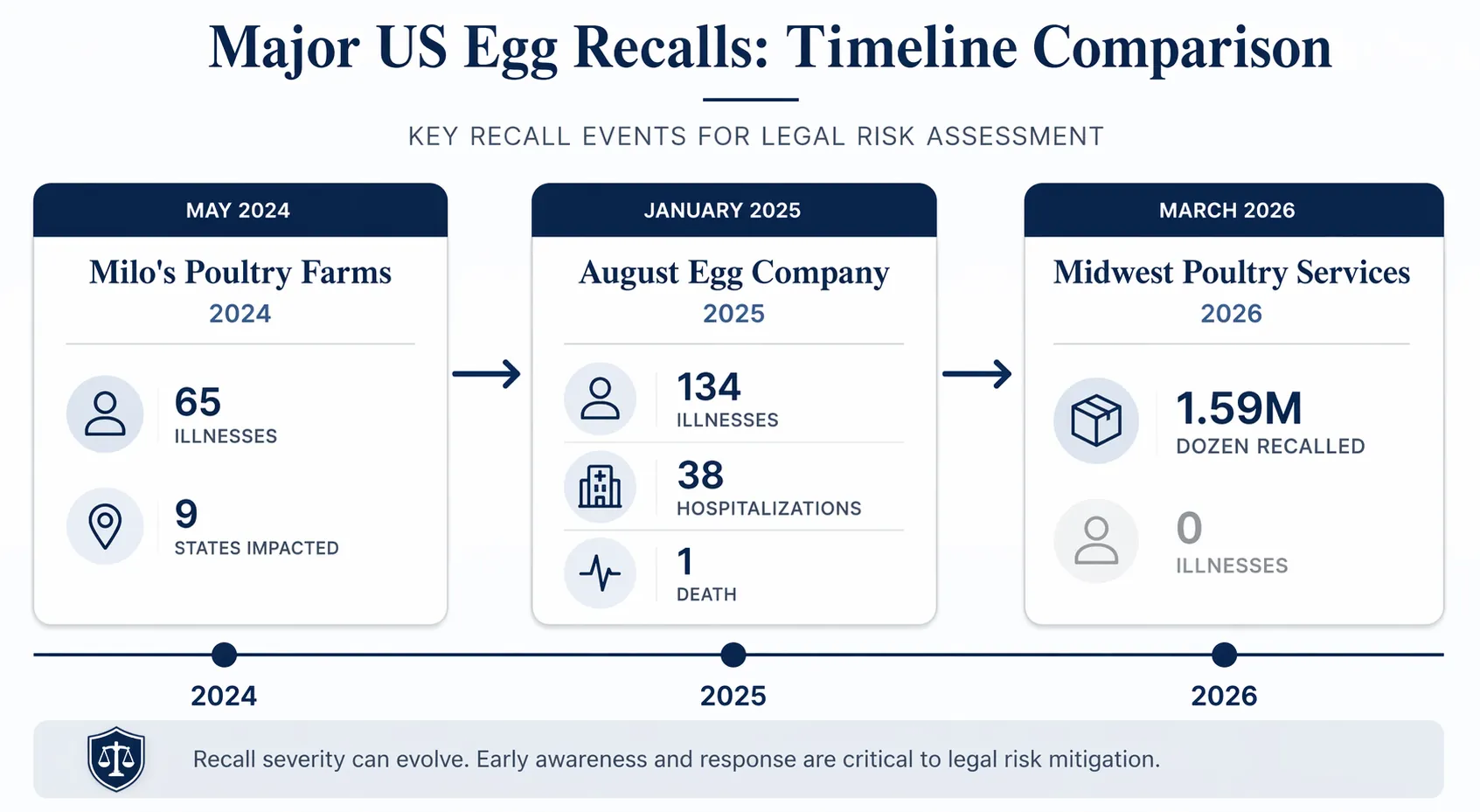
Milo's Poultry Farms provides a second, narrower signal. Public plaintiff-firm materials describe a 2024 egg recall connected to 65 illnesses across nine states and active class action litigation.[4] That source is useful for identifying litigation theories and plaintiff-side framing, not for proving facts in the present Kroger recall. The point is not that every Salmonella egg recall becomes a class action. The point is that once illnesses are documented, plaintiffs have a recognizable path for converting recall facts into product-liability allegations.
| Matter | Documented posture | Use in this assessment |
|---|---|---|
| Milo's Poultry Farms 2024 | 65 illnesses across 9 states, with plaintiff-side materials describing active class action litigation | Shows how illness-linked egg recalls can generate litigation theories |
| August Egg Company 2025 | 134 illnesses, 38 hospitalizations, 1 death in FDA outbreak materials | Shows escalation from recall/outbreak investigation into serious injury exposure |
| Midwest Poultry Services 2026 | 1,589,577 dozen recalled; no illnesses reported in FDA notice | Shows current documented exposure without the illness condition needed for stronger tort claims |
This is where prediction tends to get sloppy. Prior egg outbreaks show a litigation pattern after illness confirmation. They do not prove that the Midwest Poultry Services recall has caused illness, that Kroger missed a duty, or that a class action is imminent. They are useful because they identify the trigger points counsel should watch: outbreak investigation updates, state health department reports, amended recall notices, and first-filed complaints that plead purchase and exposure facts.
How the Recall Facts Could Map Onto Liability Theories
If illness or economic-loss claims later emerge, the FDA notice would likely become a foundational exhibit. It identifies the product universe, brands, date codes, plant codes, distribution channels, reason for recall, and the voluntary nature of the corrective action.[1] Those facts do different work depending on the theory.
Negligence
A negligence claim would need more than the existence of a recall. Plaintiffs would try to show that Kroger or another defendant owed a duty in sourcing, receiving, labeling, selling, warning, or removing the eggs; breached that duty; and caused injury or loss. The current recall facts could support the notice and product-identification portions of that theory. They do not yet supply the missing injury and causation facts.
Proactive environmental testing is also not a one-directional fact. It may help defendants show detection and mitigation rather than concealment. At the same time, if later documents show earlier positives, delayed notice, incomplete store withdrawal, or poor refund execution, the same recall timeline could become evidence plaintiffs use to argue that reasonable care was not exercised.
Strict Liability
Strict liability would focus less on Kroger's state of mind and more on whether a defective or contaminated food product entered the stream of commerce and caused harm. Retailers can be targets in that chain even when they did not manufacture the product. The FDA's identification of Kroger and Simple Truth branded eggs in the recalled product set would be the kind of document plaintiffs use to tie retailer-facing goods to the recall universe.[1]
That still leaves proof problems. A consumer would need to show that the eggs purchased were within the recalled codes and that the alleged illness or loss is traceable to those eggs. A general purchase of eggs from Kroger in July 2026 would not carry the same evidentiary weight as a receipt, carton photograph, plant code, Julian date, and medical or laboratory support.
Breach of Warranty
Warranty theories would likely center on merchantability: food sold for ordinary consumption is expected to be fit for that use. A recall for possible Salmonella contamination gives plaintiffs a way to argue that the product failed that basic expectation. But warranty claims, especially in a putative class setting, still encounter questions about purchase proof, state-law variation, refund availability, and whether the claimed loss is personal injury, overpayment, discarded product, or another economic theory.
Failure to Warn and Recall Execution
Failure-to-warn allegations would turn on the content, timing, and reach of recall communications. That is why the refund list and recall-alert mechanics matter. A retailer's ability to show when stores were notified, when product was removed, how customers were instructed, and how returns were handled can become part of the liability record.
For monitoring purposes, counsel should preserve the exact public notices as they appeared, including any later amendments. A clean FDA notice on day one does not answer whether the notice reached all relevant stores, loyalty-card customers, online shoppers, or customer-service channels. It only establishes the starting point.
Kroger's Litigation Environment Is Context, Not Causation
Kroger is not a stranger to class-action pursuit. ClassAction.org materials identify multiple matters involving the company, including a $20.8 million wage settlement, a $17 million prescription drug settlement, and ongoing labeling litigation.[5] Those matters do not prove anything about the egg recall. They do show that plaintiffs' counsel are familiar with Kroger as a defendant and that the company operates in a litigation environment where consumer, employee, and pricing or labeling theories have been actively pursued.
Prior food-poisoning litigation materials also indicate that Salmonella claims against Kroger have been framed under negligence and strict liability theories.[6] That is precedent signal, not present liability. The current recall still lacks the factual condition that usually changes the file: identified consumers alleging illness tied to recalled product codes.
This is the line worth keeping clear in any monitoring memo. Kroger's past litigation profile may affect plaintiff interest, settlement posture, and pleading strategy. It does not substitute for proof that the July 2026 recalled eggs caused a compensable injury or loss.
Monitoring Triggers for Counsel
The next meaningful developments will not be generic commentary about Salmonella. They will be source-backed updates that change the evidentiary posture of the recall. Counsel tracking the matter should separate consumer-facing response from litigation-risk movement.
- FDA updates: amended recall scope, added brands, expanded geography, revised date codes, or an outbreak investigation page tied to the recalled eggs.
- Illness reports: confirmed public-health reporting that links Salmonella Enteritidis cases to the recalled product universe.
- Retailer execution: evidence of when Kroger stores received notice, removed product, processed returns, and communicated refund instructions.
- Complaint filings: any first-filed lawsuit alleging purchase, product-code match, exposure, illness, damages, and a theory against Kroger.
- Refund and economic-loss framing: claims that consumers overpaid for recalled eggs, discarded product, or were denied adequate refund access.
The refund record deserves particular attention because it can move in two directions. A clear, accessible refund process may help demonstrate mitigation. A confusing or inconsistently applied process can give plaintiffs a consumer-protection or economic-loss theory even where personal-injury claims remain undeveloped.
Current Risk Assessment
The present record supports a moderate monitoring posture, not a conclusion that Kroger faces active recall litigation. The strongest facts are documentary: the FDA-listed brands, plant codes, Julian dates, sell-by dates, recall volume, and store/geography distinctions. The weakest facts, because they are not yet facts at all, are illness causation and damages.
If no illnesses are reported and the recall execution is clean, the matter may remain a product-withdrawal and customer-refund event. If confirmed illnesses appear, the posture changes quickly. At that point, August Egg Company and Milo's Poultry Farms become more than distant comparators; they become the procedural map for how recall facts are converted into pleadings, class allegations, and settlement pressure.
As of July 23, 2026, there is no reported illness record, no reported lawsuit, no FDA enforcement action, and no legal conclusion against Kroger. There is, however, a documented recall involving Kroger-branded eggs and related brands, with enough product-identification detail to support future claims if the missing injury, causation, and damages facts later appear.
References
- Midwest Poultry Services, LP Recalls Shell Eggs Due to Possible Salmonella Enteritidis Contamination, FDA
- Poultry firm recalls nearly 1.6 mln dozen eggs over potential salmonella, US FDA says, Reuters, July 23, 2026
- Outbreak Investigation of Salmonella: Eggs June 2025, FDA
- Milo's Poultry Farms and Tony's Fresh Market Egg Recall Lawsuit, Johnson // Becker
- The Kroger Co., ClassAction.org
- Can I Sue Kroger for Food Poisoning?, Pritzker Hageman
Related records
Tool profile
Browse tool evaluations →Governing regulation
Browse the obligations tracker →Preventive workflow
Browse verification workflows →
Report a correction or tip
Spotted an outdated figure, a misstated fact, or a ruling this case record should reflect? Public comments are disabled for this content given the professional cost of a misreported case outcome, penalty amount, or rule text — use the structured correction channel instead.
Report a correction or tip for this record →