
What Inconsistencies Were Found in the Kyren Lacy Police Report?
A Lafourche Parish DA independent review documented multiple inconsistencies between the Louisiana State Police crash report and video evidence in the Kyren Lacy case, leading to a failed prosecution and a subsequent wrongful death lawsuit.
- Jurisdiction
- Louisiana
- Court
- Lafourche Parish District Court
- AI tool named
- None
- Ruling date
- Apr 11, 2025
- Source document
- View primary court order ↗
- Last verified
- Jul 26, 2026
Lex Machina Review is an independent risk-tracking and reference resource. Nothing on this site is legal advice, and using it does not create an attorney-client relationship. Every record is reviewed against primary sources but may not reflect the most current status of a matter — always verify directly against the cited court order, rule text, or a licensed attorney before relying on it.
Companion explanation — secondary to the source document above
This Risk Digest record addresses the Kyren Lacy police-report inconsistencies as a document and probable-cause problem, not as legal advice or a final judgment on civil liability. Kyren Lacy died by suicide after the district attorney’s review was completed and before a grand jury presentation that was expected to include exculpatory findings; anyone in crisis can contact the 988 Suicide & Crisis Lifeline in the United States by calling or texting 988.
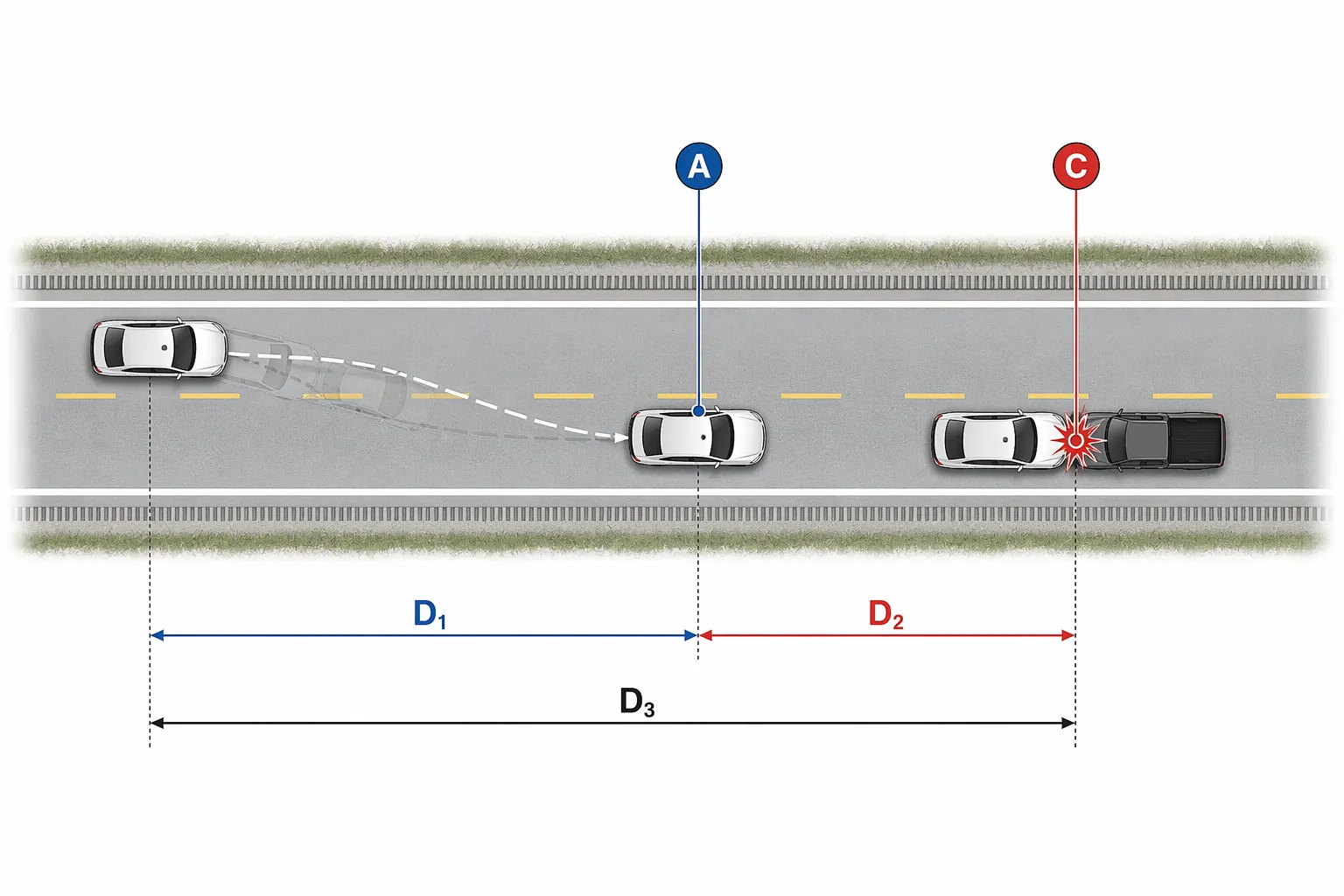
The narrow answer is this: according to news reports describing the Lafourche Parish District Attorney’s independent review, Lacy had returned to his lane 92.3 yards before the crash and was 72.6 yards behind the collision at the moment of impact. The same review, as reported, found that the evidence did not support the premise that Lacy “should have known his actions were the cause” of the crash, which mattered because that premise helped support the Louisiana State Police arrest theory.[1][2]
Those measurements do not decide every moral or factual question about the driving sequence. They do something more specific and more legally important: they attack the link between the report’s account and probable cause for the charged theory. A police report can survive ordinary ambiguity. It has a harder time surviving distance, lane position, and video evidence that place the accused vehicle away from the collision in the way the charging narrative required.
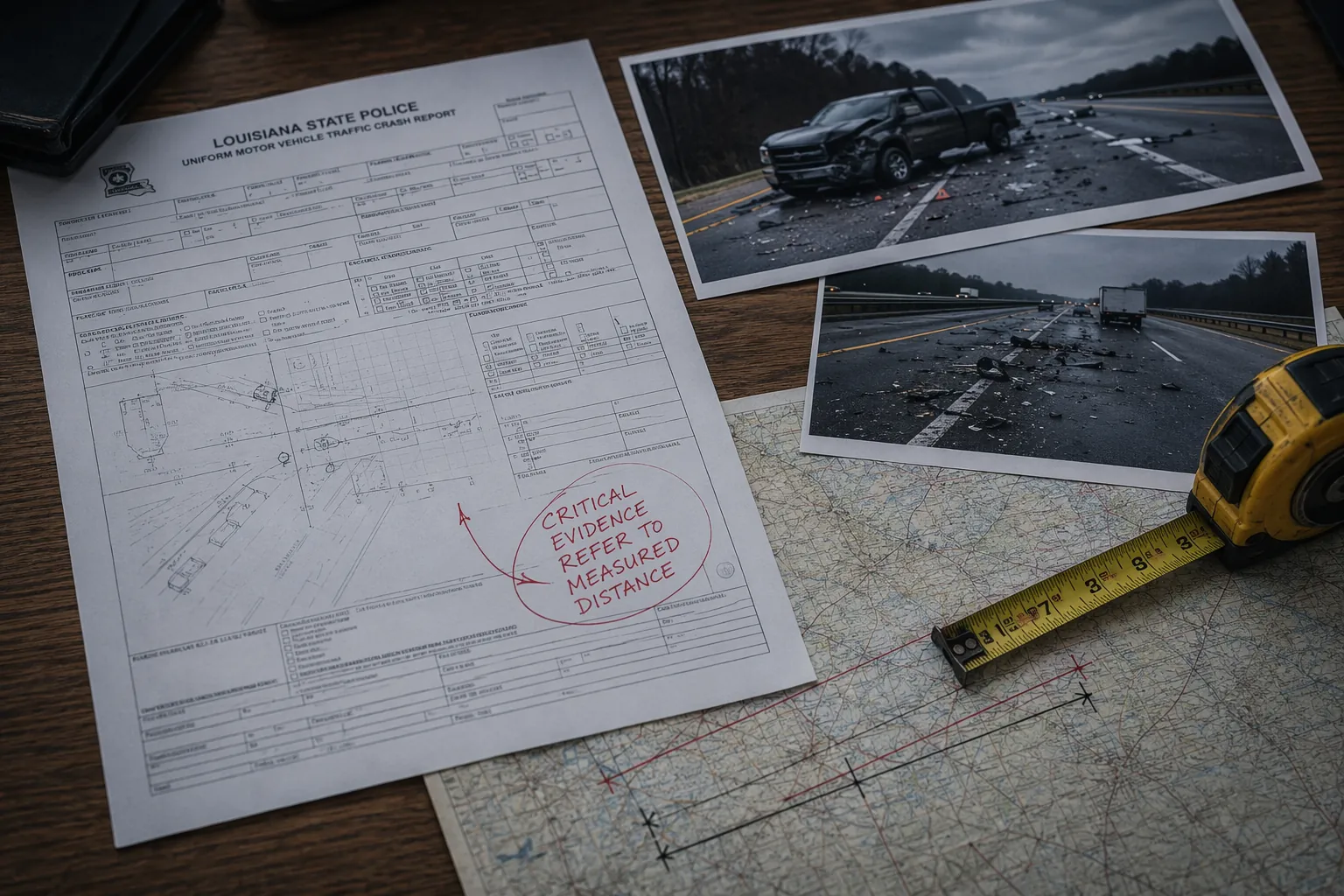
What the DA review reportedly found
The DA review is the load-bearing document in this record, but the publicly available discussion of its most specific findings comes through news excerpts rather than a directly published full report. That matters. The figures below should be read as findings reported by outlets that reviewed or quoted the DA material, not as independent measurements recalculated here.
| Issue | What the crash-report theory needed | What the DA review was reported to find | Legal significance |
|---|---|---|---|
| Lane position | Lacy’s passing maneuver remained causally connected to the fatal collision. | Lacy had returned to his lane 92.3 yards before the crash. | A completed return to the lane weakens the premise that his vehicle was still creating the immediate collision hazard. |
| Distance from impact | Lacy was close enough to the impact to support the charged causal theory. | Lacy was 72.6 yards behind the collision at impact. | The farther the vehicle is from the impact, the harder it is to treat the report’s causal statement as self-proving. |
| Knowledge of causation | Lacy should have known his actions caused the crash. | The DA review reportedly found the evidence did not support that he should have known his actions were the cause. | That finding goes directly to probable cause for the reported criminal theory. |
A distance number in a crash file is not decoration. It fixes the report to physical space. If the accused vehicle is back in its lane before the collision and behind the impact when it happens, the prosecution cannot simply lean on a broad phrase like “caused the crash” without explaining the mechanics that make that phrase true. The DA review, as reported by ABC News and FOX8, found the mechanics did not support the probable-cause theory that had been built into the case.[1][2]
The witness record did not just contain conflict; it may have been shaped
The more troubling part of the file is not that witnesses gave messy accounts. Crash witnesses often do. The problem reported by WBRZ is that body-camera video showed Trooper Tyler Werner speaking with the driver of a gold truck after the driver initially attributed the wreck to “that lady behind me,” then telling the witness to “make sure you add in there that you had to slam on your brakes” to avoid Lacy.[3]
That is not a small drafting preference. In a vehicular-homicide investigation, the difference between “the driver behind me caused it” and “I had to slam on my brakes because of Lacy” changes the direction of causation. It changes who is centered in the narrative and who becomes the apparent reason other drivers reacted.
WBRZ also reported that the witness refused to sign and that Werner turned off his body camera. A refusal to sign does not, by itself, prove misconduct. A camera turning off does not, by itself, prove fabrication. But in a file already dependent on a contested causal theory, those are not clerical footnotes. They are the moments a later prosecutor or civil-rights lawyer will isolate because they show where the official record may have moved away from the witness’s first account.[3]
The citation history points in the same direction
The citation issued to the Kia Cadenza driver also became part of the inconsistency record. WBRZ and ABC News reported that the Cadenza driver was initially cited for following too closely, and that the citation was later changed to crossing left of center.[1][3]
That alteration matters because citations are not merely traffic paperwork after a fatal crash. They can signal the investigating agency’s view of which driver’s conduct created the legally relevant danger. A following-too-close citation points toward one kind of crash mechanics. A crossing-left-of-center citation points toward another. When the report’s larger theory depends on assigning causation to Lacy, a changed citation becomes part of the chain a defense lawyer would test: who changed it, when, on what evidence, and whether the change aligned with the video and witness record.
Why these inconsistencies mattered to probable cause
Probable cause does not require proof beyond a reasonable doubt. It does require a fair factual basis for believing the charged offense occurred and that the accused committed it. In a crash case, that basis often comes from the first investigative narrative: lane movements, driver statements, citations, diagrams, video, and a conclusion about causal responsibility.
Here, the reported DA findings attacked several of those supports at once. The lane-position evidence weakened the idea that Lacy’s vehicle was still in the movement that caused the collision. The impact-distance evidence weakened the immediacy of the causal claim. The witness-record issue raised a separate integrity question: whether a witness statement had been nudged toward language that fit the report’s theory. The citation change raised a documentation question: whether the agency’s assignment of fault shifted after the initial account.
This is where a police report stops being only a narrative. Once signed, filed, and repeated, it routes the case. It supports an arrest warrant. It shapes public accusation. It tells prosecutors what they have inherited. If the report’s premise no longer matches video, measurements, witness handling, and citation history, the legal issue is not simply that the report was imperfect. The issue is whether the state had enough reliable facts to keep moving the case forward.
The case stopped before a grand jury heard it
Lacy died by suicide on April 12, 2025. CNN reported that this was the day after the DA report was completed and two days before a grand jury hearing at which the DA was expected to present findings undercutting the charges.[4]
The sequence is important, but it should not be made to carry more than the record supports. The public materials establish timing: report completed, death by suicide, grand jury presentation not reached. They do not establish a medical or psychological causation finding. What they do establish is that the criminal case failed before the grand jury could consider the reported exculpatory evidence because Lacy was no longer alive.
The civil-rights lawsuit
On April 10, 2026, Lacy’s parents filed a lawsuit alleging a fabricated investigation, false arrest, malicious prosecution, civil-rights violations, and wrongful death, according to WDSU, WAFB, and WBRZ reporting on the complaint.[5][6][7]
The complaint allegation reported by those outlets is direct: “But for Defendants’ fabricated investigation, false arrest, and malicious prosecution, Mr. Lacy would be alive today.” That is an allegation in a pending civil case, not a court finding.[5][6][7]
For civil-rights purposes, the lawsuit’s significance is not limited to whether every pleaded claim survives. Its factual center is familiar in §1983 litigation: an official file allegedly presented a version of events that video, witness statements, measurements, and later prosecutorial review did not support. If proved, that kind of defect can become more than a defense argument in the criminal case. It can become the basis for civil litigation over fabrication, arrest, prosecution, and damages.
The official dispute does not erase the documented problems
Louisiana State Police later released video and case materials connected to the fatal Lafourche Parish crash involving Lacy.[8] The agency has publicly disputed the DA’s conclusions, and Louisiana Attorney General Liz Murrill has said the DA’s finding “does not absolve Kyren Lacy of responsibility,” according to the reporting summarized in the public record.
Those responses matter, but they do not turn the record into a simple “two sides disagree” problem. The DA review’s reported findings were not character assessments. They were concrete measurements and evidentiary comparisons. The witness issue was not a vague complaint about tone. It concerned specific body-camera conduct, including a request to add braking language, a refusal to sign, and the camera being turned off.[3]
Separate Department of Justice pattern-or-practice material concerning Louisiana State Police should be treated cautiously in this context because the finding was retracted in May 2025. It may explain why readers already track LSP oversight questions, but it should not be used as proof of what happened in this crash investigation.
What remains unresolved
The available record supports a narrower conclusion than some commentary around the case may want. It supports that the DA review, as reported, found material inconsistencies that undermined probable cause. It supports that body-camera reporting raised serious questions about witness handling. It supports that a citation was reportedly altered in a way relevant to fault allocation. It supports that the criminal case did not reach grand jury presentation because Lacy died by suicide after the DA review was completed.
It does not establish final civil liability. It does not establish that every officer defendant committed every act alleged in the lawsuit. It does not establish that the DA’s review resolves all crash responsibility. Those questions remain for litigation and any future public record that develops from it.
The durable risk signal is still plain enough: when a police report’s account of causation no longer fits the measurements, video, witness record, and citation history, report reliability itself becomes a legal issue. By then, the damage is not confined to a bad paragraph in a file. It may already have routed an arrest, a prosecution decision, public accusation, and years of civil litigation.
References
- Prosecutor's report disputed police claims in fatal crash that led to former LSU player's arrest, ABC News
- Lafourche Parish District Attorney report finds inconsistencies in State Police investigation that resulted in Kyren Lacy's arrest, FOX8
- Recently obtained evidence in crash involving Kyren Lacy shows new look at deadly wreck, WBRZ
- Kyren Lacy: What we know, CNN
- Kyren Lacy lawsuit against State Police, WDSU
- Kyren Lacy's family alleges State Police botched investigation leading to his death, WAFB
- Kyren Lacy's parents blame Louisiana State Police for his death in newly filed lawsuit, WBRZ
- LSP Releases Evidence in Fatal Lafourche Parish Crash Involving Kyren Lacy, Louisiana State Police
Related records
Tool profile
Browse tool evaluations →Governing regulation
Browse the obligations tracker →Preventive workflow
Browse verification workflows →
Report a correction or tip
Spotted an outdated figure, a misstated fact, or a ruling this case record should reflect? Public comments are disabled for this content given the professional cost of a misreported case outcome, penalty amount, or rule text — use the structured correction channel instead.
Report a correction or tip for this record →