
What Legal Risks Remain After Refusing to Sign an NDA?
Using the Camryn LaVine–TBvnks dispute as a case study, this article explains that refusing to sign a non-disclosure agreement eliminates contract-based liability but leaves the speaker exposed to defamation, privacy torts, and related claims if they disclose information publicly.
- Jurisdiction
- United States
- Court
- General
- AI tool named
- None
- Ruling date
- Feb 1, 2026
- Source document
- View primary court order ↗
- Last verified
- Jul 27, 2026
Lex Machina Review is an independent risk-tracking and reference resource. Nothing on this site is legal advice, and using it does not create an attorney-client relationship. Every record is reviewed against primary sources but may not reflect the most current status of a matter — always verify directly against the cited court order, rule text, or a licensed attorney before relying on it.
Companion explanation — secondary to the source document above
The short answer after an unsigned NDA
For anyone searching “camryn lavine refused to sign nda legal implications,” the clean answer is narrower than the internet version: if a person never agreed to the NDA, the other side loses the clean breach-of-contract claim. That does not make every later post, accusation, screenshot, or disclosure safe.
This is practitioner-risk analysis, not legal advice and not a court-confirmed record of the LaVine–TBvnks dispute. The public facts available as of July 27, 2026 come from press and entertainment reporting, not pleadings, discovery, forensic reports, law-enforcement statements, or a judicial ruling. That matters because the legal distinction is solid, while many of the underlying facts remain untested.
The useful hinge is the February 2026 report that Camryn LaVine said on TikTok that she “never signed the NDA.” The same report described her public cheating-related allegations involving TBvnks, including a claim about finding “large panties” in his car and a statement that she had text-message receipts. Those facts, if accurately reported, move the analysis away from NDA enforcement and toward the law governing public statements and private information. [1]
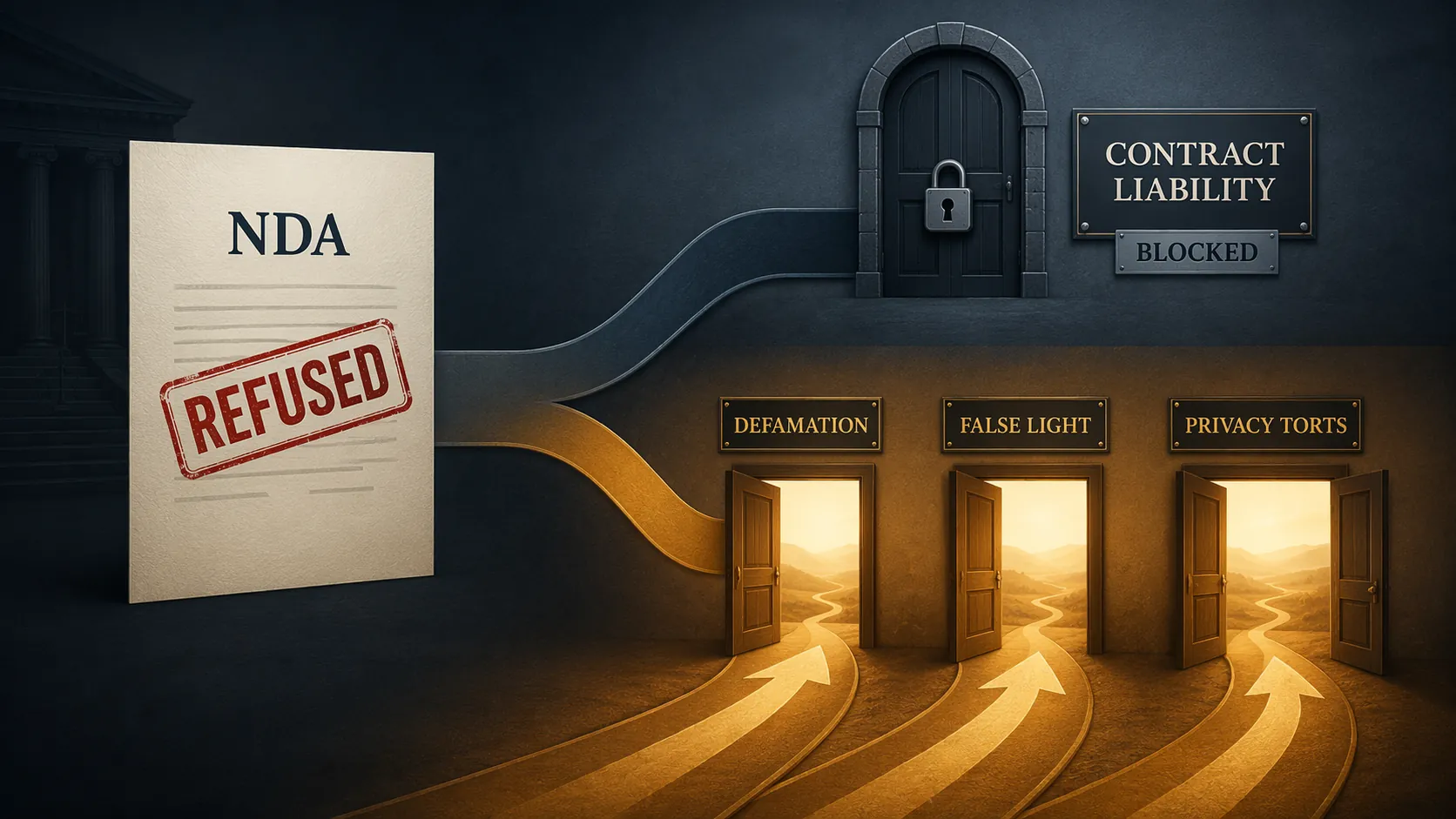
What refusal actually blocks
An NDA is a contract. If the person being accused never accepted it, the other side does not get to sue that person for breaching that NDA merely because the proposed document existed, was sent, was discussed, or was demanded. General NDA guidance treats enforceability as a contract question: there must be an agreement, defined obligations, and a basis to enforce those obligations against the person being sued. [2][3][4]
That is why “I never signed” can be legally powerful. It takes away the most administrable claim: identify the NDA, identify the covered information, show disclosure, and seek the contractual remedy. Without assent to the NDA, that route should not be available.
But it only blocks the contract route. It does not convert the subject matter into consequence-free public property. The same disclosure can be legally different depending on whether an NDA exists:
| Conduct | If a valid NDA exists | If no NDA was accepted |
|---|---|---|
| Posting covered private messages | Potential breach of the NDA, plus any independent tort issues | No NDA breach claim, but possible privacy, defamation, false light, or related claims depending on content and context |
| Making a factual accusation about cheating or misconduct | Potential breach if the NDA covered the topic, plus possible defamation exposure | No contract claim, but the statement still has to survive defamation and false-light scrutiny |
| Publishing intimate or highly private material | Potential breach if covered, plus serious privacy exposure | No NDA breach claim, but privacy tort, statutory, and source-of-information issues remain |
| Using information obtained through unauthorized account access | Potential breach if the speaker also had NDA duties, plus computer-crime and privacy issues | No NDA breach claim against a non-signer, but the method of acquisition and republication can create separate exposure |
The practical mistake is treating refusal as either immunity or misconduct. It is neither. It is a stop sign for one theory of liability, followed by a fact-specific inquiry into other theories.
The claims left on the table
Once the contract theory disappears, the next questions are about the statement, the information, the audience, and the source. Public accusations may invite defamation analysis. Suggestive framing may invite false-light analysis. Disclosure of intimate or highly private material may invite privacy claims. Unauthorized access raises a different set of concerns from voluntary disclosure.
Defamation and false light
A non-signer can still be sued over a public factual accusation. The legal problem is no longer “you promised not to say this.” It becomes “what you said was false, harmful, and legally actionable.” General guidance on NDAs and public disclosures recognizes that breaking or avoiding an NDA does not erase defamation exposure; truth matters, but the speaker should expect to substantiate factual claims rather than rely on the absence of a confidentiality contract. [5][6][7]
That is where “receipts” become legally unromantic. A screenshot may help prove truth, context, or state of mind. It may also create authentication fights, selective-quotation problems, privacy problems, or a new publication of someone else’s private communication. The litigation file does not care that the post felt responsive in the moment; it cares what the words conveyed to the audience and whether the speaker can defend that meaning later.
Private facts, intrusion, and emotional-distress theories
Privacy claims ask a different question. Even true information can create risk if it is highly private, not newsworthy in the legally relevant sense, and disclosed in a way that would be highly offensive. Intrusion theories focus less on the final post and more on how the information was obtained. Intentional infliction of emotional distress is harder to plead successfully in many disputes, but it is predictable demand-letter territory when the publication is humiliating, intimate, or calculated to escalate a private breakup into a public spectacle.
For counsel, the order of operations matters. Do not begin with whether the client was morally entitled to respond. Start with the nouns and verbs: what exactly will be said, what proof exists, who appears in the material, how the material was obtained, and what private facts will become public.
A signed NDA would not necessarily have solved everything either
There is also a floor beneath NDA enforcement. Courts and legislatures have become more skeptical of confidentiality provisions that suppress reports of harassment, discrimination, or illegal conduct. California’s Silenced No More Act, SB 331, and similar laws in at least 20 states restrict NDAs in harassment or discrimination contexts; general enforceability guidance also recognizes public-policy limits, including problems with provisions that attempt to conceal illegal activity. [5][7]
That point should not be overread in the LaVine dispute. The text of the alleged NDA has not been publicly released. No court has assessed its scope, consideration, public-policy implications, or enforceability. If a proposed agreement broadly demanded silence about cheating allegations, that would raise questions worth asking. It would not allow a responsible lawyer to declare the document enforceable or unenforceable without seeing it.
How the LaVine sequence maps onto the risk
The LaVine reporting is useful because the sequence is legally clean even if the facts are not court-tested. First came the reported refusal: she said she never signed the NDA. Then came public allegations and claimed receipts. Only later did the alleged hack-and-leak story emerge. Those are not one legal event.
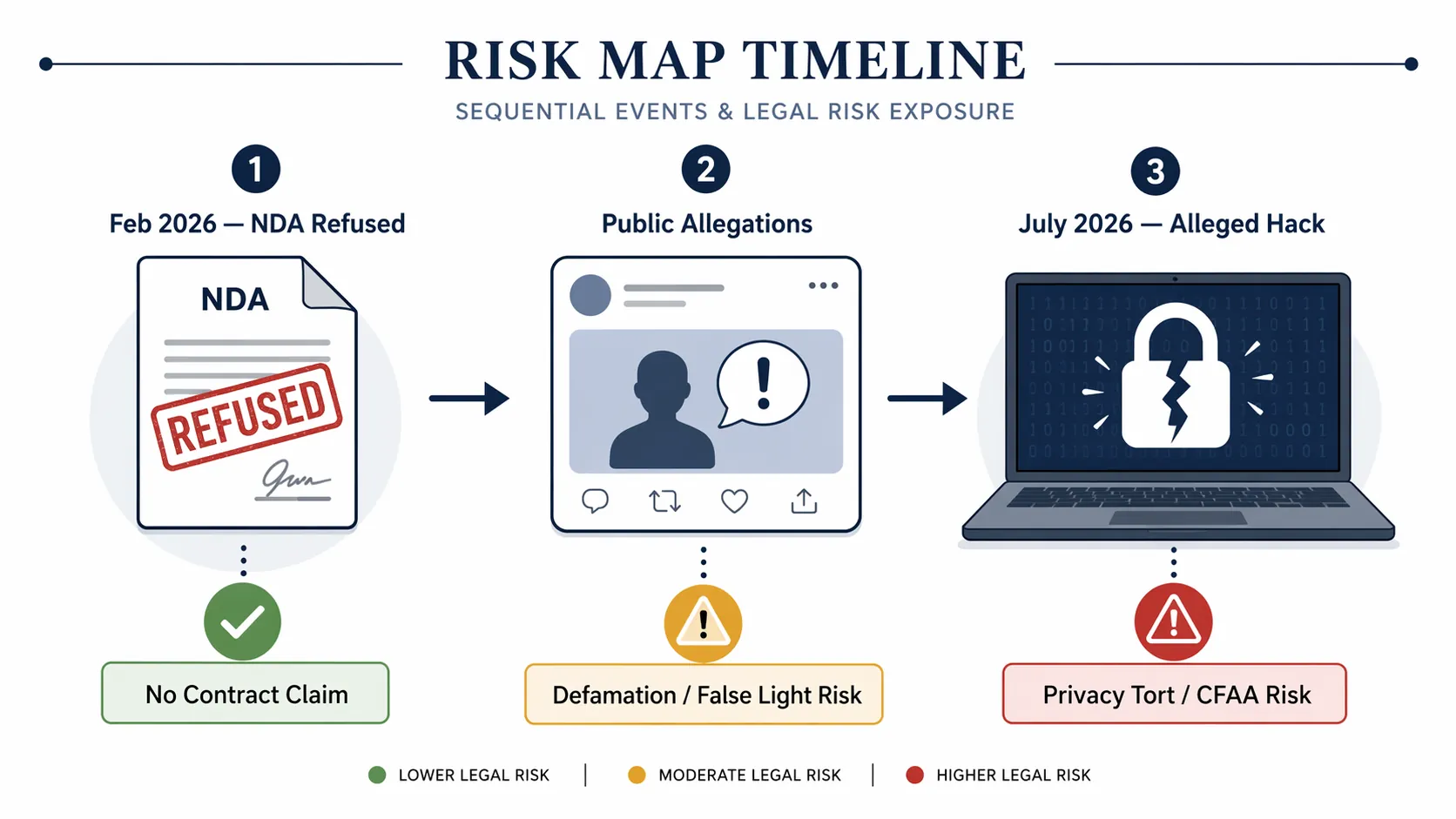
| Reported event | Most relevant legal category | What can and cannot be concluded |
|---|---|---|
| February 2026: LaVine reportedly said she “never signed the NDA.” | Contract formation and NDA enforcement | If she never accepted the NDA, TBvnks would not have a breach-of-NDA claim against her based on that document. [1] |
| February 2026: LaVine reportedly made cheating-related allegations and referenced text-message receipts. | Defamation, false light, privacy depending on the exact statements and materials | The absence of a signed NDA does not answer whether the statements were true, misleading, private, or actionable. [1] |
| July 24, 2026: intimate photos and videos were reportedly posted online after an alleged hack of LaVine’s accounts. | Privacy torts, potential computer-crime issues, source-of-information analysis | The alleged hack has been reported by entertainment and lifestyle outlets, but it has not been verified here through law enforcement, forensic reporting, court filings, or primary records. [8][9][10] |
That last row deserves caution. Reports described intimate photos and videos of LaVine and TBvnks appearing online on July 24, 2026, allegedly after LaVine’s accounts were hacked. The available reporting traces the allegation through social-media circulation and entertainment or lifestyle coverage, not an official investigative record. [8][9][10]
If the hack allegation were true, the legal center of gravity would shift again. The key questions would include who accessed the accounts, who first posted the material, who republished it, whether anyone knew or should have known it was obtained without authorization, and what privacy rights attached to the people depicted. None of that turns an unsigned NDA into a signed one.
The alleged leak is not a shortcut back to contract liability
In a messy public dispute, parties often try to make every later event prove the righteousness of their original position. That is not how the claims sort. If intimate content was posted by an unknown third party after unauthorized access, the alleged wrong may be hacking, publication of private facts, nonconsensual disclosure, or republication. The identity and conduct of the actor matter.
For LaVine specifically, the reported refusal of the NDA remains important. It means a later leak, without more, does not create a contractual duty she never accepted. But if any person—LaVine, TBvnks, a third-party account, or someone downstream—knowingly published private intimate material, amplified hacked content, or used stolen account access, the legal analysis would not need an NDA to become serious.
What to test before the client posts
For a client who refused to sign an NDA and now wants to speak, the safer review does not begin with a victory lap. It begins with claim triage:
- Confirm the contract record: Was the NDA actually refused, or was there some other written, oral, platform, employment, settlement, or confidentiality obligation in play?
- Separate opinion from factual assertion: “I felt betrayed” is a different risk profile from “he did X on Y date with Z person.”
- Demand proof before publication: If the statement depends on texts, images, DMs, or recordings, review authenticity, completeness, consent, and context.
- Identify private facts: Even true material can be dangerous if it exposes intimate, medical, sexual, financial, or family information unrelated to a legally relevant public issue.
- Trace the source: Material obtained through a hack, account sharing, password access, device access, or a third-party leak should be treated differently from information the client personally witnessed.
- Review republication risk: Sharing, quoting, stitching, reposting, or summarizing someone else’s leaked material can create a new publication event.
- Preserve rather than perform: If litigation is plausible, preserve the evidence and reduce public commentary. The audience for the proof may eventually be opposing counsel, a platform investigator, an insurer, or a court.
The LaVine–TBvnks dispute does not supply a court outcome, and it should not be used as if it does. It supplies a useful risk map. Refusing to sign can remove the cleanest claim the other side might have had. It does not create a license to publish false accusations, private facts, intimate material, or hacked content.
The better client-facing formulation is not “don’t sign and say anything.” It is: if no NDA was signed, analyze the next statement under tort, privacy, and source-of-information rules before it goes public.
References
- Zach LaVine’s Sister Goes Viral Over Video Explaining Why She Refused to Sign TBvnks’ ‘Scary’ NDA, Sportscasting
- 4 things to know about non-disclosure agreements, Thomson Reuters
- Should I Sign an NDA?, LegalTemplates.net
- What Is an NDA?, Best Lawyers
- Is a Nondisclosure Agreement Silencing You from Sharing Your #MeToo Story?, ACLU
- What Happens If Someone Breaks a Non-Disclosure Agreement?, PBS FRONTLINE
- What Makes a Non-Disclosure Agreement Legally Enforceable?, Hanley Law
- TBvnks Leaks Intimate Photos Of Ex Camryn LaVine, HotNewHipHop
- Camryn LaVine Allegedly Hacked Exposing Intimate Content with Ex-Boyfriend TBvnks, whereisthebuzz.com
- Who Is Twitch Streamer TBvnks? Creator Tamari Simms and Ex Camryn LaVine's Private Content Leaked After Reported Hacking Incident Amid Break-Up Drama, India Times
Related records
Tool profile
Browse tool evaluations →Governing regulation
Browse the obligations tracker →Preventive workflow
Browse verification workflows →
Report a correction or tip
Spotted an outdated figure, a misstated fact, or a ruling this case record should reflect? Public comments are disabled for this content given the professional cost of a misreported case outcome, penalty amount, or rule text — use the structured correction channel instead.
Report a correction or tip for this record →