
What Legal Rights Do Patients Have After Levothyroxine Recalls?
The Class II levothyroxine recalls of 2025–2026 exposed a critical gap: neither federal law nor the FDA requires pharmacies to notify patients. This article maps the legal rights patients retain and the liability risks for providers who know of a recall but stay silent.
- Jurisdiction
- United States
- Court
- FDA
- AI tool named
- None
- Ruling date
- Jul 23, 2025
- Source document
- View primary court order ↗
- Last verified
- Jul 28, 2026
Lex Machina Review is an independent risk-tracking and reference resource. Nothing on this site is legal advice, and using it does not create an attorney-client relationship. Every record is reviewed against primary sources but may not reflect the most current status of a matter — always verify directly against the cited court order, rule text, or a licensed attorney before relying on it.
Companion explanation — secondary to the source document above
Last verified July 28, 2026. This article is a legal-risk analysis, not medical or legal advice. Patients should not stop or change levothyroxine without speaking with a clinician, and any claim assessment depends on state law, prescription records, lot verification, symptoms, testing history, and when the patient learned enough to connect the product to a possible injury.
The uncomfortable fact in the levothyroxine recalls is not just that bottles were pulled from the market. It is that a medication used by millions can move through a Class II recall while many affected patients may never receive a direct notice from the pharmacy that dispensed it. That is where patient legal rights after recalled levothyroxine become harder to evaluate: the right to sue, if one exists, may survive the recall, but the patient may not learn about the recall early enough to preserve evidence, test causation, or avoid a limitations fight.
The 2025 Accord Healthcare/Intas event put that gap in unusually sharp form. Accord recalled 160,630 bottles across nine lots of levothyroxine sodium tablets after assay testing found the product below approved specification; the recall began June 20, 2025, and the FDA later classified it as Class II on July 23, 2025.[1] The American Thyroid Association separately alerted patients and clinicians that the affected tablets were being recalled because they might contain less active ingredient than labeled.[2] A separate 2026 recall involving Major Pharmaceuticals covered levothyroxine sodium strengths from 25 mcg through 150 mcg with expiration dates extending through January 2027.[3]

Those recalls sit inside a much larger exposure pool. In March 2026, the FDA described levothyroxine as a drug taken by about 22 million U.S. patients annually, based on outpatient retail and mail-order data.[4] The figure does not mean 22 million patients received recalled tablets. It does explain why a recall affecting a fraction of the market can still create a serious notice problem: the patients most in need of accurate information may be dispersed across pharmacy systems, mail-order channels, prescriber offices, and refill histories.
What Class II status does—and does not—do
Under the FDA recall framework, a Class II recall is one in which use of or exposure to a violative product may cause temporary or medically reversible adverse health consequences, or where the probability of serious adverse health consequences is remote.[5] That classification matters. It is not a finding that the product is harmless. It is also not the same thing as a Class I recall, which involves a reasonable probability of serious adverse health consequences or death.
The FDA’s role in a recall is supervisory and classificatory. The agency describes recalls as actions taken to remove or correct products that violate FDA-administered law, and it explains that public notification is generally used where a recalled product has been widely distributed or poses a serious hazard.[5][6] That is different from a rule requiring each dispensing pharmacy to identify and contact every patient who received a recalled Class II drug.
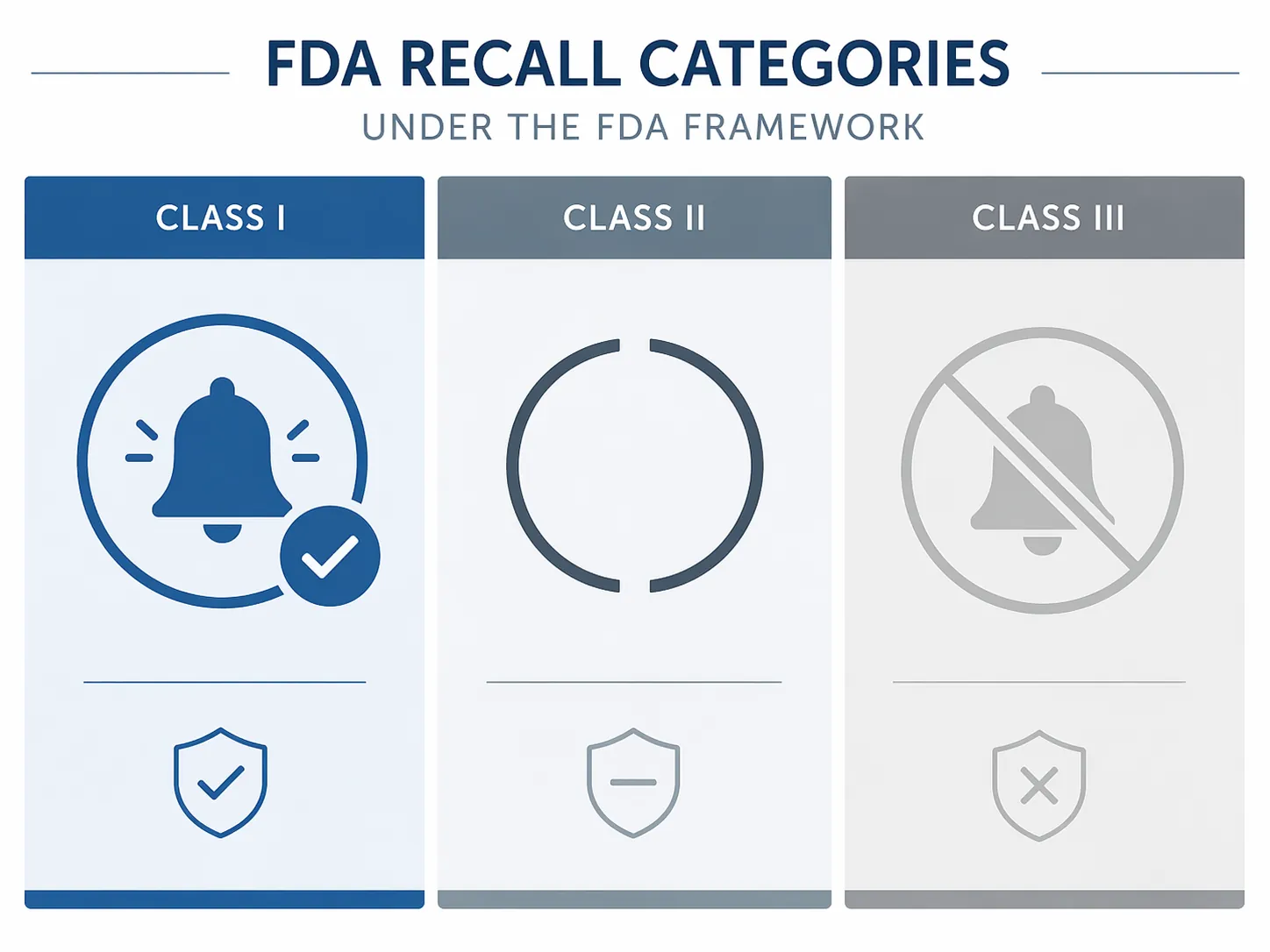
That distinction is the legal hinge. A public FDA recall notice may make information available to the market, lawyers, clinicians, and motivated patients. It does not, by itself, prove that the patient who received the medication was personally told. Nor does it establish that the pharmacy had a federal patient-notification obligation for a Class II recall. The patient’s practical assumption—“my pharmacy would tell me if my thyroid medication was recalled”—is understandable. It is not the same as a federal statutory duty.
The pharmacy notice gap
The available legal sources identify no general federal or FDA rule requiring pharmacies to notify individual patients of Class II prescription-drug recalls. State law can add duties, but the most relevant example remains limited: New York’s pharmacy notification law requires pharmacies to quickly notify patients of Class I drug recalls, not Class II recalls.[7] The levothyroxine recalls discussed here were Class II events, so a Class I-only statute does not close the gap.
That does not mean pharmacies have no operational role. Pharmacies may receive manufacturer, wholesaler, board-of-pharmacy, or system-level recall information. They may quarantine stock, return inventory, or post notices. Large chains may have internal recall workflows that go beyond bare legal requirements. But a voluntary practice, a contract obligation, or an internal policy is not the same thing as a universal federal duty owed to every patient in every Class II recall.
The distinction matters because a recall case often turns less on the headline than on the notice chain. Who received the manufacturer communication? Was the lot traceable to a particular dispensing event? Could the pharmacy management system identify the patient? Did a prescriber receive an alert? Did anyone document a decision not to notify? A plaintiff’s lawyer who cannot answer those questions may have a morally compelling story and still face a proof problem.
| Question | Why it matters in a levothyroxine recall claim |
|---|---|
| Was the patient’s bottle from a recalled lot? | Without product exposure, the recall is background noise rather than case proof. |
| When did the patient receive and use the medication? | Timing affects causation, damages, and limitations defenses. |
| When did the patient first learn of the recall? | This may shape discovery-rule arguments and equitable tolling theories, depending on state law. |
| Did a pharmacy, prescriber, or healthcare system have actual notice? | Actual knowledge can become the hinge for secondary negligence or failure-to-warn theories. |
| Was the patient medically affected or economically harmed? | A recall alone does not establish injury, but injury is not limited to a reported adverse event. |
Why subpotent levothyroxine is legally consequential
Levothyroxine is not an incidental medication for the patients who depend on it. The FDA describes hypothyroidism as affecting about 2% of U.S. adults, and the American Thyroid Association’s patient-facing materials identify potential consequences of undertreatment such as fatigue, weight gain, cognitive impairment, bradycardia, elevated cholesterol, infertility, and cardiac strain.[2][4] For a patient whose thyroid levels are already closely managed, subpotency is not a technical defect tucked inside a manufacturing file.
Still, the medical point has to be kept within its evidentiary lane. Public recall accounts for the 2025 and 2026 levothyroxine events did not identify reported adverse events to the manufacturers at the time of the recall announcements.[1][3] That fact affects damages framing. It does not automatically defeat every possible claim. A patient may investigate out-of-pocket replacement costs, additional testing, physician visits, monitoring, symptom aggravation, or a more specific injury theory. Each category requires its own proof.
Lot verification is also not clerical decoration. For the Accord recall, public reporting identified nine lots and 160,630 bottles.[1] Some lot details appeared in secondary sources and pharmacy-board materials, but any claim file should verify the exact lot, strength, dispensing date, and National Drug Code against original records rather than relying on copied recall lists. A plaintiff who took levothyroxine during the recall period but cannot connect the bottle to the recalled product has a different case from one with a pharmacy profile, bottle label, refill record, and matching lot evidence.
Rights patients may retain even without direct notice
The absence of a federal pharmacy-to-patient notice mandate does not erase patient rights. It narrows the path. Depending on state law and facts, a patient may still investigate product-liability claims against a manufacturer or distributor, warranty or economic-loss theories, negligence claims tied to defective manufacture or distribution, and, in more fact-specific circumstances, claims against a dispenser or provider whose own conduct worsened the harm or delayed discovery.
The first screen is exposure. Did the patient receive recalled levothyroxine, and can that be shown from pharmacy, insurer, bottle, or prescriber records? The second is injury or loss. Did the patient experience medically documented undertreatment, require additional testing, change therapy, incur costs, or suffer a cognizable injury? The third is causation. Were symptoms, lab changes, or medical consequences plausibly tied to the subpotent product rather than disease fluctuation, adherence issues, unrelated medication changes, or other clinical factors?
A recall can help establish notice of a defect in the market, but it does not fill every gap. It does not prove that the plaintiff ingested the affected lot. It does not prove that the dosage deviation caused the particular medical course. It does not prove that a pharmacy knew the plaintiff had the recalled bottle. And it does not automatically extend a statute of limitations. That is why recall intake should be built around records, not outrage.
The statute-of-limitations problem created by late discovery
Limitations deadlines are where the notification gap becomes procedural leverage. Product-liability limitation periods vary sharply by state. FindLaw’s October 2025 state-by-state compilation lists product-liability filing periods ranging from one year in Kentucky, Tennessee, and Louisiana to six years in Maine, North Dakota, and Missouri.[8] Most states apply some form of discovery rule, meaning the clock may begin when the patient discovers, or reasonably should discover, the injury and its cause; law-firm guidance on recall-related rights likewise treats timing and discovery as central to whether a claim can still be filed.[8][9]
For the Accord recall, the June 20, 2025 recall date creates immediate pressure in one-year states for patients who learned of the recall in summer 2025.[1][8] By July 28, 2026, a defendant in those jurisdictions would likely scrutinize whether the claim is already time-barred. A plaintiff would want to know the exact date of actual discovery, the date a reasonable patient should have discovered the connection, whether the patient received any direct or indirect notice, and whether any defendant’s conduct delayed the patient’s ability to connect the medication to the alleged harm.
The harder case is the patient who did not receive direct notice and only later learned that a prior bottle had been recalled. That patient may argue that the limitations clock should not have started with an FDA posting or a public article the patient never saw. A defendant may respond that public recall information, symptoms, lab results, refill changes, or medical visits should have triggered inquiry earlier. The result is jurisdiction-specific and fact-heavy. The lack of a direct notice mandate does not automatically toll the claim, but it can become an important fact in a discovery-rule dispute.
Provider and dispenser risk when someone actually knew
Pharmacies and prescribers should not be treated as if they all occupied the same legal position. A retail pharmacy that never received patient-specific recall information presents a different risk profile from one whose system matched recalled lots to dispensing records and generated an internal alert. A prescriber who never saw a recall notice is in a different posture from a clinic that received an alert, recognized that several patients were on the affected product, and did nothing.
This is the point at which the claim may move from primary product liability to secondary negligence exposure. The plaintiff is no longer arguing only that the tablets were defective. The plaintiff is asking whether a healthcare actor had actual knowledge, had the practical ability to identify or warn the patient, and stayed silent in a way that increased injury or delayed discovery. That theory does not require a universal federal notice mandate, but it does require evidence: recall logs, wholesaler communications, pharmacy-system alerts, prescriber portal messages, board notices, call-center scripts, and patient-account notes.
Healthcare counsel should be particularly careful about internal policies. If a pharmacy chain or healthcare system has a written recall escalation protocol, a plaintiff may try to use that protocol to define the standard of care or to show that the defendant understood the risk. The defense answer may be that the policy exceeds legal requirements, that it did not apply to Class II recalls, that the lot could not be matched to the plaintiff, or that the patient was not harmed by any delay. None of those arguments is available in the abstract. They depend on documents and timestamps.
Litigation status as of July 28, 2026
No active class-action complaints or multidistrict-litigation petitions were identified in the public search record reviewed for this analysis as of July 28, 2026. That is a litigation-status caveat, not a merits prediction. Recall litigation can develop after patients obtain records, after adverse-event reporting changes, or after plaintiffs’ firms identify a repeatable exposure-and-injury pattern.
The absence of a public MDL also does not make individual claims disappear. It may simply mean that the present record is fragmented: different strengths, different manufacturers, different recall dates, different states, and different medical histories. For a daily medication with narrow dose sensitivity, the claims that survive early screening are likely to be the ones with the cleanest chain of proof.
How to evaluate a recalled levothyroxine file
A useful intake does not begin with “Were you injured by a recall?” It begins with records. The patient should preserve the bottle if available, photograph the label, request pharmacy dispensing records, obtain prescriber notes and thyroid-function testing history, and record when and how they first learned of the recall. Counsel should then map those facts against the state limitations period, the applicable discovery rule, and the defendant-specific notice chain.
- Product exposure: manufacturer, strength, lot, NDC, fill date, refill date, and whether the recalled product can be tied to the patient.
- Medical timeline: symptoms, lab values, dose changes, clinician visits, and alternative explanations.
- Economic loss: replacement medication, testing, appointments, monitoring, missed work, or other documented costs.
- Discovery timeline: when the patient learned of the recall, what they were told, and what information was publicly or directly available before that date.
- Provider knowledge: whether a pharmacy, prescriber, distributor, or health system had actual notice and whether patient-specific identification was feasible.
For healthcare systems and pharmacy chains, the parallel exercise is defensive and operational. Preserve recall communications, identify who received them, document inventory actions, determine whether patient-level matching was attempted or possible, and avoid casual statements suggesting that “patients were notified” unless the system can prove who was notified, when, and by what method.
The central issue is not whether a levothyroxine recall automatically creates liability. It does not. The issue is whether the patient can connect injury, timing, product exposure, and delayed discovery—and whether any provider’s knowledge or silence changed that timeline.
References
- FDA Upgrades Recall on 160,000 Bottles of Thyroid Medication, U.S. News & World Report, July 24, 2025.
- FDA Alert — Levothyroxine 2025, American Thyroid Association.
- Thyroid Levothyroxine Sodium Recall FDA, Prevention, July 2026.
- FDA's Actions to Address Unapproved Thyroid Medications, FDA, March 2026.
- Recalls Background and Definitions, FDA.
- Understanding Drug Recalls: What to Know and What to Do, FDA.
- New Law in New York Requires Pharmacies to Quickly Notify Patients of Drug Recalls, The Well News.
- Time Limits for Filing Product Liability Cases: State by State, FindLaw, updated October 2025.
- Rights After a Product Recall, The Cochran Firm.
Related records
Tool profile
Browse tool evaluations →Governing regulation
Browse the obligations tracker →Preventive workflow
Browse verification workflows →
Report a correction or tip
Spotted an outdated figure, a misstated fact, or a ruling this case record should reflect? Public comments are disabled for this content given the professional cost of a misreported case outcome, penalty amount, or rule text — use the structured correction channel instead.
Report a correction or tip for this record →