
Did Lindell's pillow giveaway break Minnesota campaign law?
An administrative law judge has already found a prima facie violation in the Minnesota campaign finance complaint over Mike Lindell's July 4 parade pillow giveaways. Learn what Minn. Stat. § 211B.13 prohibits, how the expedited OAH process works, and where the case stands before the Aug 11 primary.
- Jurisdiction
- Minnesota
- Court
- Minnesota Office of Administrative Hearings
- AI tool named
- No AI tool named
- Ruling date
- Aug 3, 2026
- Source document
- View primary court order ↗
- Last verified
- Aug 4, 2026
Lex Machina Review is an independent risk-tracking and reference resource. Nothing on this site is legal advice, and using it does not create an attorney-client relationship. Every record is reviewed against primary sources but may not reflect the most current status of a matter — always verify directly against the cited court order, rule text, or a licensed attorney before relying on it.
Companion explanation — secondary to the source document above
Last verified Aug. 4, 2026: Fiskum v. Lindell, OAH case 50-0320-41898, remains a pending Minnesota Office of Administrative Hearings matter. An administrative law judge has issued a prima facie order on the campaign-law complaint over Mike Lindell’s July 4 Delano parade pillow giveaways, and a probable-cause hearing was set for Aug. 3. As of this verification, no published OAH disposition from that hearing has been found. The important point is narrower than the political noise: the official record has already passed the first screening stage, but it has not yet produced a final violation finding. [1][2]
This is a status and process explainer, not legal advice. The legal issue is not simply whether a campaign reported an expense correctly. The complaint invokes Minnesota’s bribery and treating statute, Minn. Stat. § 211B.13, which treats giving “something of value” to influence voting as a serious election-law problem and contains only a narrow value-based carve-out for refreshments. [3]
What has actually been filed
The case is a Chapter 211B administrative complaint brought by Dan Fiskum against Mike Lindell. The complaint concerns Lindell-branded pillows allegedly handed out during the July 4, 2026 Delano parade while Lindell was campaigning for Minnesota governor. The OAH prima facie order is the load-bearing document: at that stage, the judge found enough alleged facts to let the complaint proceed into the expedited election-complaint track. [1]
That threshold should not be inflated. A prima facie determination is not a final finding that Lindell violated Minnesota law. It means the complaint, if its allegations are accepted for initial screening purposes, states a claim sufficient to require the next procedural step. The disputed facts still matter, and the statute’s intent element still matters.
The giveaway’s value is disputed in three different ways in the public reporting. The complaint reportedly used a $34.95 figure. Lindell told WCCO that the pillows cost $4.90. Reporting on the campaign invoice placed the amount at about $4.50 per pillow, with roughly $13,275.94 for 2,500 pillows including tax. Those numbers should be read as attributed positions and reported invoice context, not as a resolved valuation finding by OAH. [2][4]
Fiskum is not just a bystander in the 2026 cycle. Ballotpedia and local reporting identify him as a DFL candidate in the Minnesota Senate District 29 primary. That fact belongs in the file because it identifies the complainant and the election context, but it does not prove motive and does not change the statutory question OAH must answer. [5][6]
A Checks & Balances parade account supplies some contemporaneous color about the Delano Fourth of July setting and uses the “Twinkie Law” nickname, but it should be handled as a partisan political account rather than neutral legal authority. The nickname is useful only as a pointer to how Minnesota political insiders sometimes talk about low-value campaign giveaways; it does not define the statute. [7]
Why § 211B.13 is doing the work here
Minnesota’s anti-bribery and treating statute is unusually direct. Section 211B.13 prohibits a person from willfully giving, promising, offering, or providing money, food, liquor, clothing, entertainment, or another thing of monetary value to induce a voter to vote, refrain from voting, or vote in a particular way. The statute labels a violation a felony. [3]
That is why the pillow dispute is more than a merch story. A branded pillow can be ordinary campaign promotion in one jurisdiction and still create a Minnesota treating question if the factfinder concludes it was a thing of monetary value given with the prohibited electoral purpose. The statute does not turn on whether the item was amusing, common at parades, or inexpensive by campaign standards.
The $5 language also needs careful handling. Section 211B.13 contains a narrow exception for refreshments of up to $5, but that is not a general safe harbor for all campaign merchandise under $5. A pillow is not a refreshment, and the public record does not support treating the statutory carve-out as a blanket low-value exemption. [3]
The felony label should be read with the same discipline. The statute says a violation is a felony; the pending OAH case has not adjudicated a felony conviction. In the administrative process, the panel may impose civil consequences and may refer a matter to a county attorney. Charging decisions and criminal adjudication belong to a different stage and a different forum.
The Campaign Finance Board issue is a caveat, not the forum
Lindell has reportedly said his campaign received guidance from the Minnesota Campaign Finance and Public Disclosure Board before the giveaways. CBS Minnesota reported that the board declined to confirm or deny whether such guidance was given. That leaves the claim unconfirmed in the public record. [4]
The jurisdictional distinction matters. The Campaign Finance Board maintains campaign-finance records and administers Minnesota campaign-finance requirements; Lindell’s candidate records are available through the board’s public candidate viewer. But this complaint is proceeding at OAH under Chapter 211B, not as a board enforcement order under the campaign-finance reporting regime. [8]
The campaign-finance reports are still useful source material. They may show how the campaign characterized or paid for the pillows, and Minnesota Reformer/St. Cloud Times coverage used the reports to situate Lindell’s campaign finances heading into the primary. They do not, by themselves, answer whether § 211B.13 was violated. [9]
For broader Lindell 2026 context, see the site’s prior records on Lindell’s Texas registration and Minnesota run and Lindell voter-registration coverage. Those links explain candidate-context issues; they do not decide the Chapter 211B complaint.
The expedited OAH path
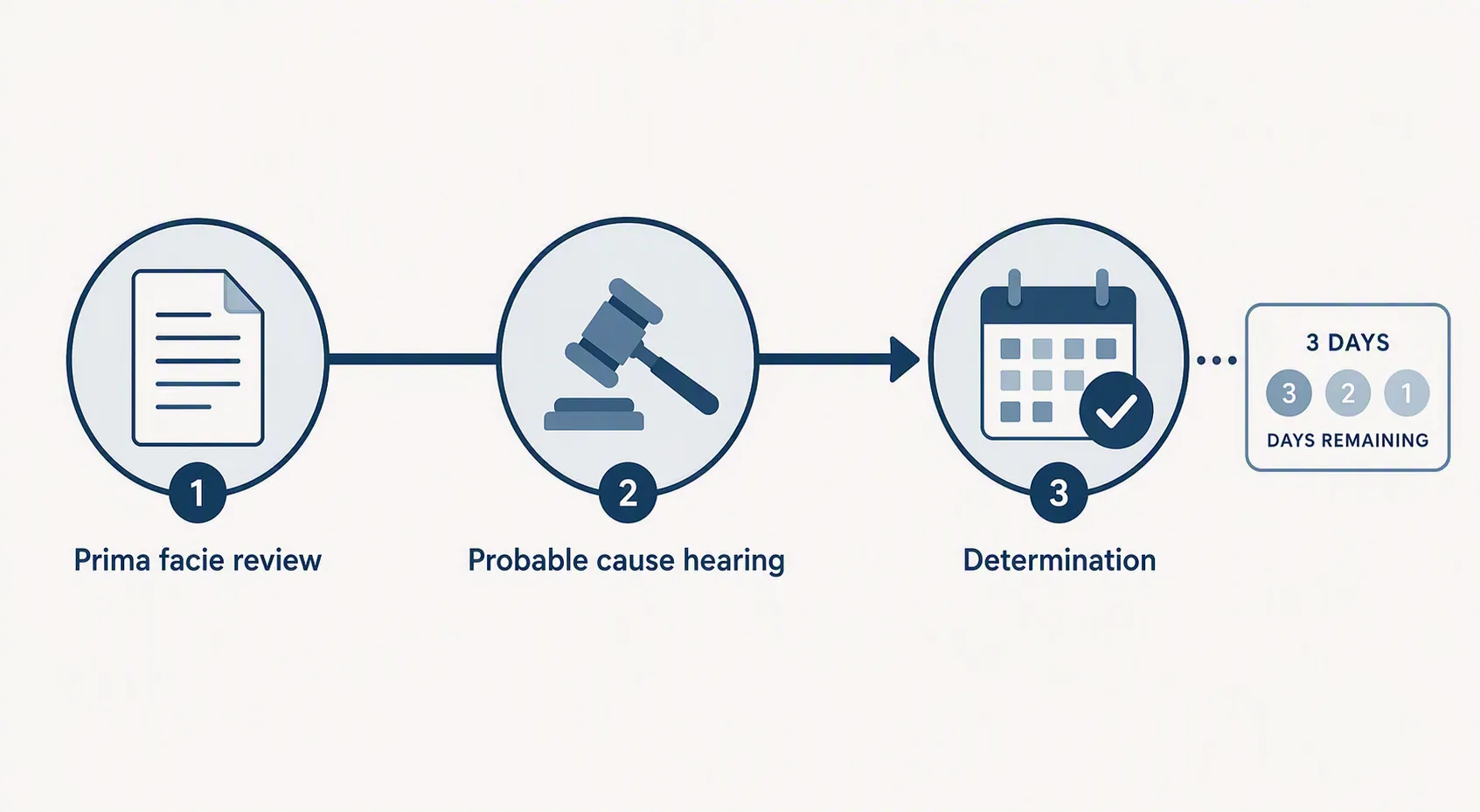
Chapter 211B complaints move quickly because election disputes can become stale while voters are already casting ballots or preparing to vote. The statute creates a screening and hearing sequence rather than a conventional, slow civil docket.
| Stage | What it means in this matter |
|---|---|
| Complaint filed | Fiskum filed a Chapter 211B complaint against Lindell over the July 4 pillow giveaways. [1] |
| Prima facie review | An ALJ found the complaint sufficient to proceed beyond initial screening, without making a final violation finding. [1][10] |
| Probable-cause hearing | A hearing was set for Aug. 3, 2026. As of Aug. 4 verification, no published outcome had been found. [2][11] |
| Possible panel stage | If probable cause is found, the matter may proceed before a three-ALJ panel. [12] |
| Disposition deadline | After the record closes, the statutory scheme requires a prompt disposition; the three-business-day timing is why an official ruling could plausibly arrive before the Aug. 11 primary if the record closed promptly. [11] |
The first statutory checkpoint is the prima facie review. Under § 211B.33, the chief administrative law judge or designee reviews the complaint to determine whether it alleges a prima facie violation. If it does not, the complaint can be dismissed at the threshold. If it does, the matter moves to the next step. [10]
The next checkpoint is probable cause under § 211B.34. That is the stage KSTP reported was scheduled for Aug. 3 in the Lindell matter. The statute’s three-business-day disposition language after the record closes is central to the timing analysis; it explains why the case is live in a meaningful way before the Aug. 11 primary without requiring anyone to predict the result. [2][11]
If the matter proceeds beyond probable cause, Chapter 211B allows referral to a panel of three administrative law judges. The available administrative outcomes include dismissal, a reprimand, and a civil penalty. The statute also provides for referral to the appropriate county attorney in circumstances specified by the election-complaint provisions. [12][13]
The civil-penalty ceiling matters because it is one of the concrete risks in the administrative forum: up to $5,000 per violation. That figure should not be confused with the pillow valuation dispute. One is a statutory penalty cap; the other is a contested factual issue relevant to whether the giveaway falls within the treating statute at all. [13]
What remains unresolved
Several facts remain open on the public record. OAH has not yet published a final disposition found in the Aug. 4 verification. The value of the pillows is disputed. The record does not publicly confirm the claimed Campaign Finance Board guidance. And a prima facie order does not establish Lindell’s intent under § 211B.13.
The disciplined reading is therefore limited but significant. The complaint has cleared the prima facie threshold, the controlling legal issue is Minnesota’s strict anti-bribery and treating statute, and the next verified update should be the OAH probable-cause determination, panel action, dismissal, settlement, or other official disposition.
References
- 0320-41898 Fiskum-Lindell Campaign Violation Prima Facie Order, Minnesota Office of Administrative Hearings
- Judge calls probable cause hearing on campaign finance complaint against Lindell, KSTP
- Minnesota Statutes 211B.13, Minnesota Revisor of Statutes
- Mike Lindell pillow handouts campaign law complaint, CBS News Minnesota
- Dan Fiskum, Ballotpedia
- Dan Fiskum seeks DFL nomination in Minnesota State Senate District 29, Delano Herald Journal
- Interesting Insights from the Delano Fourth of July Parade, Checks & Balances
- Mike Lindell — Campaign Finance Candidate Viewer, Minnesota Campaign Finance and Public Disclosure Board
- Lindell campaign finance report reveals little; Demuth has cash; Qualls, Klobuchar, Minnesota primary, St. Cloud Times
- Minnesota Statutes 211B.33, Minnesota Revisor of Statutes
- Minnesota Statutes 211B.34, Minnesota Revisor of Statutes
- Minnesota Statutes 211B.35, Minnesota Revisor of Statutes
- Minnesota Statutes 211B.36, Minnesota Revisor of Statutes
Related records
Tool profile
How Meta's AI Spending Reshapes Law Firm ProfitabilityGoverning regulation
Browse the obligations tracker →Preventive workflow
Browse verification workflows →
Report a correction or tip
Spotted an outdated figure, a misstated fact, or a ruling this case record should reflect? Public comments are disabled for this content given the professional cost of a misreported case outcome, penalty amount, or rule text — use the structured correction channel instead.
Report a correction or tip for this record →