
Clancy Trial Judge Admits Autopsy Photos Over Stipulation Objection
Judge Sullivan's June 18, 2026 order admitting graphic autopsy photographs in Commonwealth v. Lindsay Clancy applied Massachusetts Rule 403 balancing, holding the photos' probative value on intent and premeditation outweighed unfair prejudice, and rejecting the defense's stipulation offer as grounds to exclude.
- Jurisdiction
- Massachusetts
- Ruling date
- Jun 18, 2026
- Source document
- View primary court order ↗
Lex Machina Review is an independent risk-tracking and reference resource. Nothing on this site is legal advice, and using it does not create an attorney-client relationship. Every record is reviewed against primary sources but may not reflect the most current status of a matter — always verify directly against the cited court order, rule text, or a licensed attorney before relying on it.
Companion explanation — secondary to the source document above
The June 18 order answered several evidence questions at once
The June 18 evidence ruling in Lindsay Clancy’s trial was not a single yes-or-no answer about disturbing exhibits. On June 18, 2026, Judge William Sullivan allowed the Commonwealth to use autopsy photographs and pre-death photographs of the three child victims; allowed a 3D model of the home; allowed a jury view; initially held the 911 call before later allowing it on June 29 with a limiting instruction; deferred a blood-spatter demonstration to a July 13 Frye/reliability hearing; and allowed witness sequestration with a family exception. [1][2]
| Evidence or procedure | Disposition reported from the June 18 order and later related ruling |
|---|---|
| Autopsy photographs and pre-death photographs | Allowed on June 18, 2026, over the defense objection and stipulation offer. [1][2] |
| 3D model of the home | Allowed. [1][2] |
| Jury view of the home | Allowed. [1][2] |
| 911 call | Initially held; later allowed on June 29, 2026, with a limiting instruction and under the excited utterance exception. [1] |
| Blood-spatter demonstration | Deferred to a July 13, 2026 Frye/reliability hearing after the defense challenged the proposed evidence as “voodoo forensics” and “junk science”; the result of that hearing is not established by the available sources. [1][2] |
| Witness sequestration | Allowed, with a family exception. [1][2] |
That compact procedural map matters because the ruling is easy to misread if it is treated only as a ruling about shock value. The photographs were admitted in a first-degree murder prosecution in which the defense had offered to stipulate to the children’s deaths but continued to contest mens rea through an insanity defense. The live disputes therefore included deliberate premeditation, extreme atrocity or cruelty, and the defendant’s state of mind. [1][2]
Nothing in the ruling required the court to narrate the case in graphic terms, and neither does a useful account of the ruling. The legal question was not whether the photographs were painful to look at. They plainly were. The question was whether the Commonwealth had shown a reason to place them before jurors despite the predictable risk that the images could stir emotion faster than they could assist proof.
Rule 403 made relevance only the first step
Massachusetts Guide to Evidence § 403 permits a judge to exclude relevant evidence if its probative value is substantially outweighed by a danger of unfair prejudice, confusion, misleading the jury, undue delay, wasting time, or needless cumulative presentation. [3] The phrasing is important. The rule does not exclude evidence because it hurts a party’s case. Criminal evidence often does. The rule asks whether the danger is unfair and whether that danger substantially outweighs the proof value.
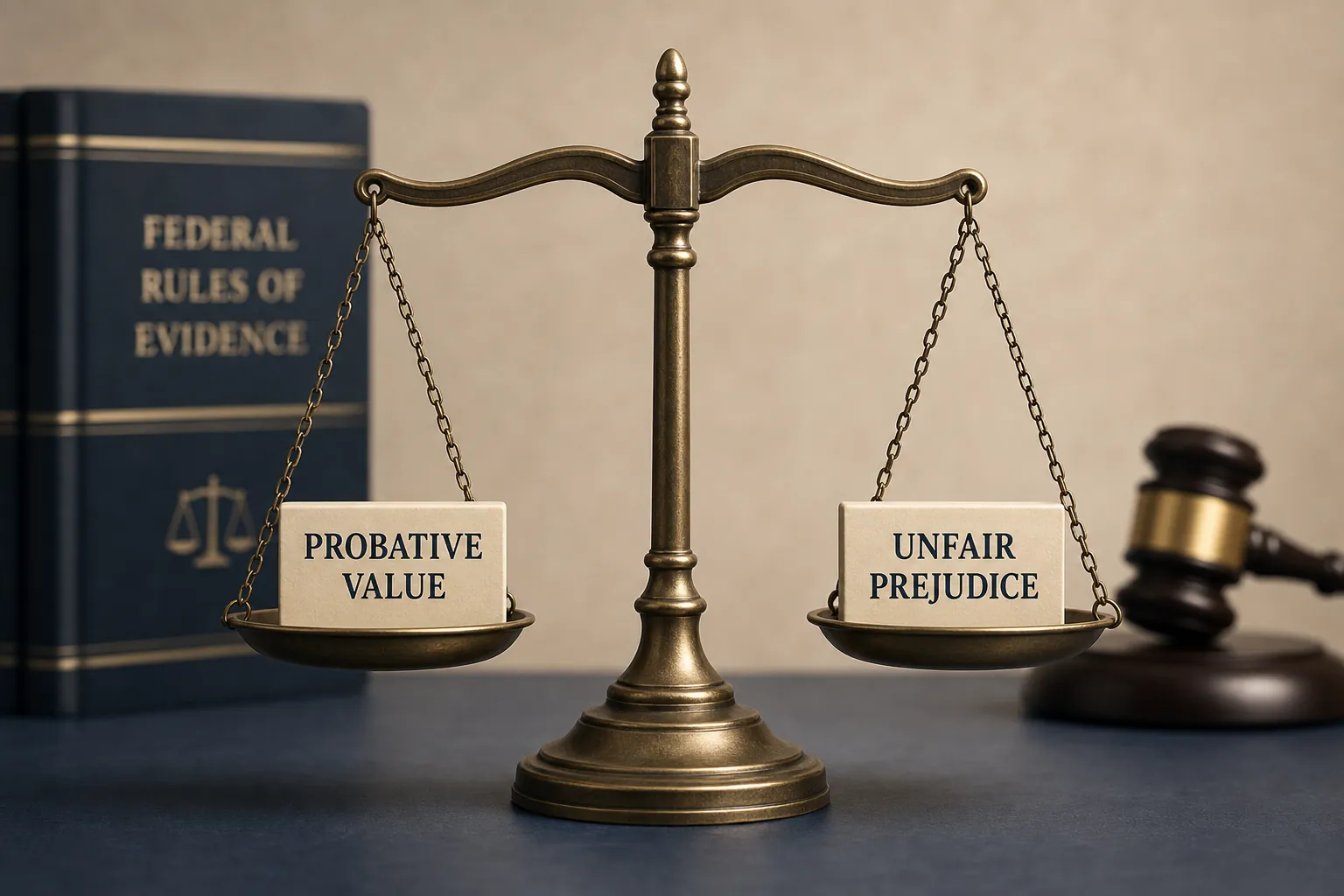
Graphic photographs sit at the point where that distinction matters most. Their evidentiary value may be real: they can show injuries, sequence, force, position, condition, or other circumstances bearing on intent and state of mind. Their prejudice risk is also real: jurors may react to what they see before they finish asking what the exhibit proves. Judicial education materials addressing gruesome evidence and Rule 403 emphasize that emotionally powerful images can affect juror reasoning, which is exactly why the balancing inquiry has to be more disciplined than a bare declaration that the exhibits are relevant. [4]
Judge Sullivan’s order, as reported, treated the photographs as going to central disputed elements rather than to an uncontested death fact alone. That is the pivot. If the photographs merely repeated a point no one contested, the stipulation argument would have had more practical force. But where the Commonwealth still had to prove deliberate premeditation, extreme atrocity or cruelty, and a mental state inconsistent with the defense theory, the photographs were not assessed as decorative proof of tragedy. They were assessed as evidence tied to what the jury would still have to decide. [1][2]
The stipulation offer did not give the defense control over the Commonwealth’s proof
The defense offered to stipulate to the children’s deaths. The Commonwealth declined. Judge Sullivan’s ruling accepted the familiar Massachusetts premise that a defendant cannot preclude the prosecution from proving an element by offering to concede it. [1][2]
That premise should not be confused with indifference to prejudice. A stipulation does not automatically strip the state’s evidence of probative value, but it can change the balancing problem. Once a fact is conceded, the judge should ask more sharply what the challenged exhibit proves beyond the conceded point. In this case, the answer was not simply “death.” The order tied the photographs to intent, premeditation, extreme atrocity or cruelty, and the defendant’s state of mind. [1][2]
The Massachusetts comparators help explain why that reasoning is not an outlier. Commonwealth v. Da Lin Huang is useful for the proposition that photographs may remain relevant where they bear on intent and malice. Commonwealth v. Jaime matters because evidence bearing on a central issue carries greater weight in the Rule 403 balance. Commonwealth v. Taghizadeh supplies the stipulation point: the Commonwealth is not required to accept a defendant’s evidentiary substitute when proving its case. [2]
Those cases do not create a free pass for every autopsy photograph in every homicide trial. They identify the questions the trial judge must ask. What element is genuinely disputed? What does the photograph prove about that element? Is the same point already established by less inflammatory proof? How many images are necessary? Does the exhibit risk moving jurors from reasoned inference to revulsion? Rule 403 exists because relevance alone is not enough to answer those questions.
Why the photographs carried more than cumulative force
The defense stipulation narrowed one fact, not the whole field of proof. A concession that the children died would not resolve whether the killings were deliberately premeditated, whether the circumstances met the Commonwealth’s theory of extreme atrocity or cruelty, or whether the defendant’s mental condition defeated criminal responsibility. Those are not peripheral questions in a first-degree murder trial. They are the trial.
For that reason, the ruling’s force lies in its treatment of the photographs as circumstantial evidence of state of mind. The Commonwealth was permitted to argue from the condition and circumstances shown in the photographs to the mental elements it had to prove. The defense remained free to argue that the images were emotionally overwhelming, that the inference the Commonwealth sought was unsound, or that the insanity defense changed the meaning of the physical evidence. But the court did not require the prosecution to present a bloodless version of the case once the defense conceded the fact of death. [1][2]
This is the most consequential part of the ruling for trial lawyers. The admission of graphic photographs became defensible because the judge identified live elements and connected the photographs to them. A ruling that merely said the photographs were “relevant” would have done less work. A ruling that accepted the stipulation as dispositive would have treated the death fact as if it exhausted the photographs’ evidentiary function. Judge Sullivan’s order took the middle path Massachusetts law usually requires: relevance identified, prejudice acknowledged by implication, and the centrality of the disputed elements used to carry the probative side of the scale.
The 911 call, model, jury view, and sequestration rulings stayed closer to procedure
The June 18 order also allowed the Commonwealth to use a 3D model of the home and permitted a jury view. Those rulings served a different function from the autopsy-photo ruling. Models and views usually help orient jurors: rooms, sight lines, distances, and spatial relationships. The available reporting does not support treating either ruling as the doctrinal center of the order. They matter because they show the court allowing the Commonwealth to present the setting in concrete terms, not because they resolved the hard Rule 403 question posed by the photographs. [1][2]
The 911 call followed a slightly different path. Judge Sullivan initially held the call on June 18, then allowed it on June 29 with a limiting instruction and under the excited utterance exception. [1] That sequence is worth noting because it shows the court did not simply admit every emotionally charged item at the first opportunity. The call was treated as requiring its own evidentiary fit and limiting instruction.
Witness sequestration was allowed with a family exception. [1][2] That ruling is procedurally important but analytically separate from the graphic-evidence dispute. It controls who may remain in the courtroom and under what conditions; it does not answer whether a particular exhibit has enough probative value to justify the risk of unfair prejudice.
The blood-spatter issue remains unverified beyond the deferred hearing
The blood-spatter demonstration should be kept out of the photographs analysis unless and until the Frye record is confirmed. The defense reportedly attacked that proposed evidence as “voodoo forensics” and “junk science,” and Judge Sullivan deferred the issue to a July 13, 2026 hearing on reliability and expert qualifications. [1][2] The available sources do not establish the outcome of that hearing.
That caution is not just housekeeping. A Rule 403 ruling on photographs and a Frye/reliability ruling on a forensic demonstration answer different questions. The first asks whether otherwise admissible evidence should be excluded because its unfair-prejudice risk substantially outweighs its probative value. The second asks whether the proffered expert method or demonstration is reliable enough to be presented at all. Conflating the two makes the order look broader than the verified record supports.
What this ruling is useful for
For prosecutors, the order is useful because it shows how to defend graphic photographic evidence without relying on the vague claim that the jury is entitled to “the whole story.” The stronger argument is narrower: identify the disputed elements, explain what the photographs tend to prove about those elements, and address why a stipulation does not supply the same evidentiary force.
For defense lawyers, the order is useful for the opposite reason. It shows that an objection to graphic photographs cannot rest only on the fact that the images are upsetting or that death is conceded. The objection has to separate the conceded fact from the remaining issues and then press the court on necessity, cumulative presentation, sequencing, limiting instructions, and the danger that emotional impact will outrun permissible inference.
The ruling is notable because the admitted photographs were tied to live elements the Commonwealth still had to prove. A stipulation to death did not require the prosecution to abandon its own proof on intent, premeditation, extreme atrocity or cruelty, and state of mind. At the same time, the ruling should not be cited as though Massachusetts courts treat graphic photographs as automatically admissible in homicide cases. The work remains in the balance.
Verification notes
- The docket number should be checked against Massachusetts Trial Court eAccess before publication or citation. Source materials identify the case as Plymouth Superior Court Docket No. 2383CR00199, while related references have used a different formatting of the number. [1][2]
- The July 13, 2026 blood-spatter Frye/reliability hearing outcome is not established by the available sources and should not be reported as decided without independent verification. [1][2]
- Descriptions of the child victims and the autopsy evidence should remain minimal. The evidentiary issue can be analyzed without reproducing graphic detail.
- Because the case involves mental-health content, readers in the United States who are in crisis or worried about someone else can call or text the 988 Suicide and Crisis Lifeline.
References
- Autopsy images of Lindsay Clancy's children, 911 call can be used in murder trial — WHDH
- Jurors will hear, see grisly evidence at Lindsay Clancy trial — MassLive, June 2026
- Massachusetts Guide to Evidence Section 403 — Mass.gov
- Gruesome Evidence, Science, and Rule 403 — National Judicial College
Related records
Tool profile
Browse tool evaluations →Governing regulation
Browse the obligations tracker →Preventive workflow
Browse verification workflows →
Report a correction or tip
Spotted an outdated figure, a misstated fact, or a ruling this case record should reflect? Public comments are disabled for this content given the professional cost of a misreported case outcome, penalty amount, or rule text — use the structured correction channel instead.
Report a correction or tip for this record →