
Where Lindsay Clancy Falls on the Postpartum Psychosis Precedent Map
The peer-reviewed JAAPL precedent reveals that command auditory hallucinations predict NGRI, but planning and concealment do not. This article applies that framework to Lindsay Clancy's case and explains why the overmedication variable makes her defense a test of uncharted precedent.
- Jurisdiction
- Massachusetts
- Court
- Massachusetts Superior Court
- AI tool named
- None
- Ruling date
- Jul 28, 2026
- Source document
- View primary court order ↗
- Last verified
- Jul 28, 2026
Lex Machina Review is an independent risk-tracking and reference resource. Nothing on this site is legal advice, and using it does not create an attorney-client relationship. Every record is reviewed against primary sources but may not reflect the most current status of a matter — always verify directly against the cited court order, rule text, or a licensed attorney before relying on it.
Companion explanation — secondary to the source document above
A useful legal analysis of Lindsay Clancy’s postpartum psychosis defense has to begin with the precedent map rather than the biography. The strongest map currently available is not a famous case; it is a 34-case peer-reviewed review of published appellate decisions involving maternal filicide and postpartum mental illness from 1969 through 2010. Its most practical finding is blunt: the formal insanity test mattered less than the psychiatric fact pattern. In that dataset, defendants in M’Naghten jurisdictions were found not guilty by reason of insanity at about the same rate as defendants in MPC-style jurisdictions — approximately 46% compared with 43% — while acute psychosis with documented hallucinations or delusions was the recurring feature in successful NGRI outcomes.[1]
The same study is equally important for what it did not reward. Depression-only cases, PTSD-only cases, and personality-disorder cases did not produce NGRI results in the reviewed appellate record. That does not mean those conditions were unreal or legally irrelevant. It means that when appellate courts described the cases that crossed the insanity line, they were usually describing a defendant whose mental state had moved into documented psychosis — hallucinations, delusions, or both — rather than severe distress alone.[1]
That distinction matters now because, as of July 28, 2026, Clancy’s criminal trial has begun, Day 1 reporting supplies only an early public record, and no verdict has resolved the defense theory. The case is therefore not a lesson yet. It is a live test of how Massachusetts jurors will translate reported postpartum psychosis, reported command hallucinations, and alleged planning conduct into the binary grammar of criminal responsibility.

McHoul supplies the legal route, not the factual answer
Massachusetts uses the McHoul formulation: a defendant is not criminally responsible if, because of mental disease or defect, she lacked substantial capacity either to appreciate the criminality or wrongfulness of her conduct or to conform her conduct to the requirements of law.[2] That is both a cognitive and volitional test. It gives the defense two routes, but it does not answer the factual question that decides most postpartum psychosis cases: what psychiatric state was the defendant actually in when the children died?
For the Massachusetts procedural frame, see the earlier McHoul Standard and the Lindsay Clancy Insanity Defense. The narrower task here is comparative: to ask where Clancy falls among the postpartum psychosis cases that actually produced NGRI findings, convictions, or reversals.
The JAAPL dataset keeps that inquiry disciplined. It warns against assuming that Massachusetts’ more flexible volitional language makes NGRI probable by itself. It also warns against the opposite mistake: treating ordinary-looking conduct before or after a psychotic act as if it conclusively disproves psychosis. The decisive legal work is done in the evidence connecting psychiatric symptoms to the charged conduct.
Why the reported command hallucination puts Clancy on the NGRI-associated side of the map
The defense fact that matters most is not simply that Clancy is alleged to have had postpartum depression or postpartum distress. It is the reported testimony that she heard a voice telling her: “This is your last chance. Kill the children so you can kill yourself.” Day 1 coverage by AP and The Guardian reported that command-auditory-hallucination account as part of the emerging trial record.[3][4]
On the JAAPL map, that is not a small detail. Command hallucinations and delusions are the kind of acute psychosis evidence that appeared in the successful NGRI cluster. A defendant who says she was overwhelmed, depressed, sleep-deprived, ashamed, suicidal, or unable to cope may describe a grave psychiatric condition, but the study’s appellate cases did not treat those descriptions the same way they treated documented psychosis. Clancy’s reported voice-hearing account therefore gives the defense a precedent-relevant feature that many unsuccessful postpartum cases lacked.[1]
That still leaves the hard part. A reported command hallucination is not a verdict. McHoul asks whether mental disease or defect deprived the defendant of substantial capacity in one of the legally specified ways. Jurors may accept that a hallucination occurred and still dispute timing, intensity, credibility, causal force, or whether the defendant retained enough capacity to understand or control her conduct. Psychosis is not a magic word that dissolves the conduct evidence around it.
The prosecution’s ordinary-behavior evidence is not just atmosphere
The prosecution’s strongest route is familiar from conviction-producing postpartum psychosis cases: take behavior that looks ordinary, purposeful, or concealed, and argue that it shows retained capacity. In Clancy’s case, reported prosecution evidence includes a Google search about restaurant distance, a normal pediatrician visit, and snowman-building with the children earlier that day.[3][4]
Those facts can be overread. A parent can attend a pediatric appointment and still be psychiatrically unstable. A person in intermittent psychosis can have organized stretches. A morning family activity is not a clinical exam. Courts and jurors sometimes put too much weight on the word “normal,” as if severe mental illness announces itself without interruption.
But those facts cannot be waved away either. They are the prosecution’s bridge to cases like Adams and Comitz, where evidence of planning, concealment, or the absence of documented delusions helped defeat postpartum psychosis insanity defenses. NewsNation’s comparative discussion identifies Adams as a Louisiana case resulting in a life sentence despite postpartum psychosis expert testimony, with planning, concealment, and no documented delusions serving as key distinctions; it places Comitz in the same conviction-side precedent landscape.[5]
| Evidence cluster | How it helps the defense | How it helps the prosecution |
|---|---|---|
| Reported command voice | Places the case near the JAAPL pattern most associated with NGRI: acute psychosis with hallucinations or delusions. | Still requires proof that the symptom affected McHoul capacity at the relevant time. |
| Restaurant-distance search | Could be characterized as conduct occurring during an unstable or intermittently psychotic period. | Can be argued as purposeful planning to create opportunity or separation. |
| Pediatrician visit and snowman-building | May show a lucid interval rather than sanity throughout the day. | Can be presented as ordinary functioning inconsistent with claimed incapacity. |
| Medication chronology | Could supply a mechanism for induced or worsened psychosis if proven. | At this stage, rests on allegations and defense theory rather than adjudicated causation. |
The practical question is sequencing. If jurors treat the restaurant search and daytime normalcy as proof that Clancy could plan and conceal, the case moves toward Adams and Comitz. If they treat those same facts as compatible with intermittent psychosis, the case moves toward Yates. The facts do not sort themselves. Lawyers do that, and then jurors decide whether the sorting is credible.

Yates matters because it changed the meaning of lucid intervals
Andrea Yates remains the most important comparison because her retrial strategy did not require pretending that every observed moment looked psychotic. The defense instead reframed outwardly lucid conduct as compatible with intermittent postpartum psychosis. NewsNation describes that reframing as central to the successful retrial theory and identifies it as the same kind of argument now central to Clancy’s defense.[5]
That is the terrain Clancy wants to occupy. If psychosis fluctuates, then a pediatrician visit or snowman-building does not necessarily end the inquiry. Jurors would have to ask whether apparently organized moments were merely intervals inside a broader psychotic episode, and whether the command voice allegedly present near the deaths overwhelmed appreciation or control under McHoul.
Sheryl Massip belongs in the broader postpartum psychosis precedent landscape, but she should not be turned into a shortcut. The better use of Yates, Massip, Adams, and Comitz is not to announce that postpartum psychosis defenses win or lose. It is to identify which evidentiary combinations persuaded courts and juries that psychosis had crossed the legal threshold.
The medication chronology is the part prior precedent does not map
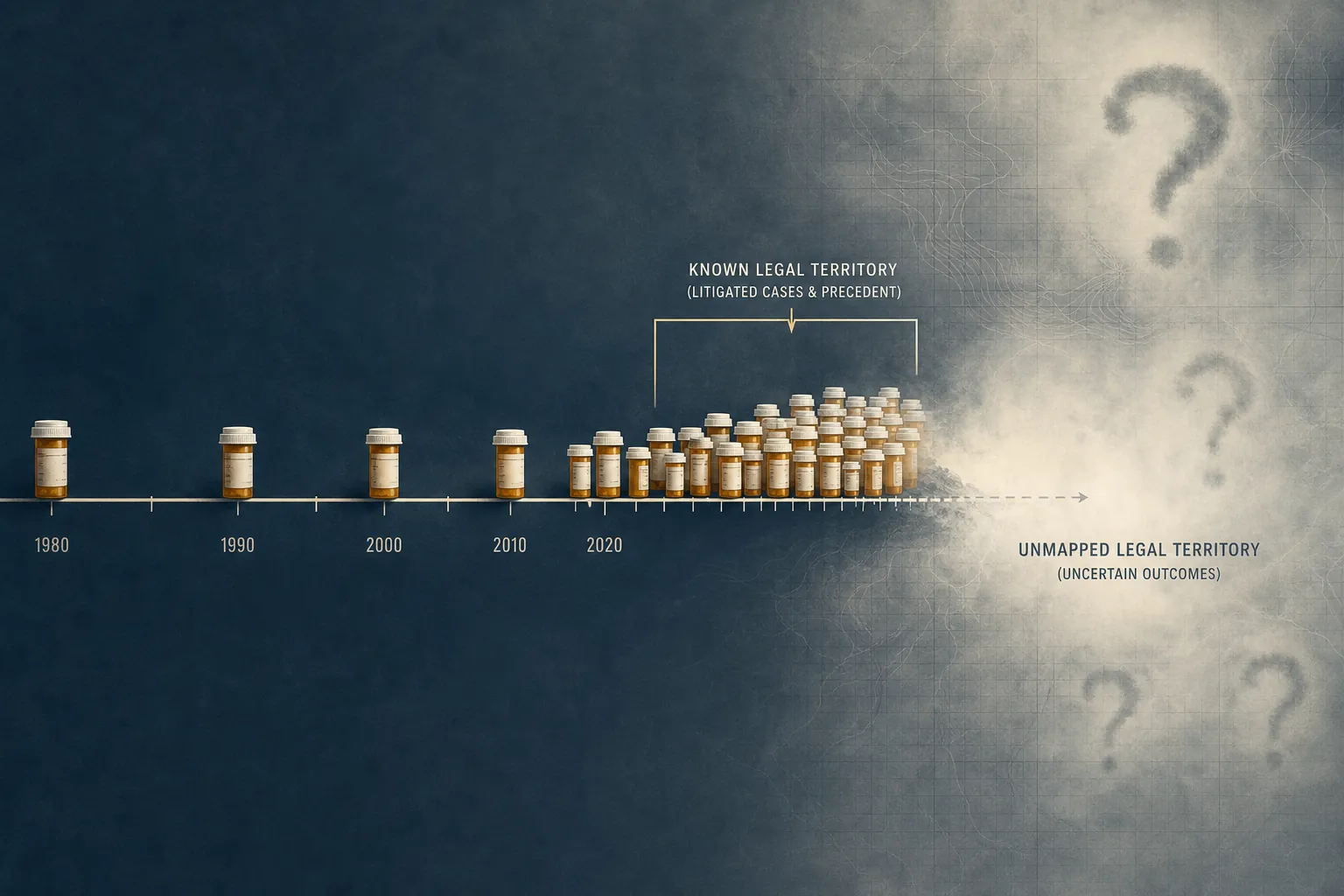
The most legally consequential unknown is the medication theory. The reported chronology is striking: the civil complaint and defense statements describe 13 drugs over four months, eight added in 21 days, and short virtual appointments described as 17 minutes.[6] Those numbers matter because they offer the defense a possible mechanism different from the classic postpartum psychosis cases: not only that Clancy was postpartum and psychotic, but that a medication course allegedly induced, worsened, or destabilized her psychiatric state.
That theory must be kept in its lane. The 13-drug chronology comes from a civil complaint and defense statements, not from a completed civil verdict or a criminal jury’s factual finding. It is not established causation. It is not proof that any prescriber caused psychosis. It is, at this stage, a defense factual theory that may become important if supported by records, expert testimony, timing evidence, and a persuasive explanation of how medication effects relate to McHoul capacity.
It also sits outside the JAAPL dataset. The 34-case appellate review can tell us that acute psychosis with hallucinations or delusions is the most NGRI-associated pattern in reported postpartum cases. It can tell us that depression-only, PTSD-only, and personality-disorder cases did not carry the same force. It cannot tell us how a Massachusetts jury in 2026 will treat an alleged medication-induced or medication-amplified psychosis theory layered over postpartum illness, command hallucinations, and planning evidence.[1]
What can be said without pretending to predict the verdict
For practitioners, Clancy’s case falls between the two most useful precedent markers. The reported command hallucination places her close to the JAAPL study’s NGRI-associated pattern. The restaurant-distance search, pediatrician visit, and morning activity give prosecutors the same kind of planning-and-normalcy material that pushed other postpartum psychosis cases toward conviction.
The defense’s best path is not simply to prove diagnosis. It is to connect the reported command hallucination, the timing of symptoms, postpartum condition, and any medication effects to the specific McHoul question of substantial capacity. The prosecution’s best path is not simply to say she looked normal. It is to make ordinary behavior legally meaningful by tying it to planning, opportunity, concealment, and retained appreciation or control.
Prior postpartum psychosis precedent therefore gives a framework, not a forecast. Clancy has one of the fact patterns most associated with NGRI in the peer-reviewed appellate literature. She also faces prosecution evidence resembling cases that did not result in NGRI. The medication chronology makes the map less complete than it first appears.
References
- Postpartum Psychosis and the Courts, Journal of the American Academy of Psychiatry and the Law, 2012.
- Commonwealth v. McHoul, 352 Mass. 544 (1967), Justia, 1967.
- Lindsay Clancy murder trial postpartum psychosis, AP News.
- Lindsay Clancy murder trial postpartum psychosis, The Guardian, July 25, 2026.
- Lindsay Clancy, Andrea Yates, Sheryl Massip, NewsNation.
- Lawyer Kevin Reddington to defend Duxbury mother accused of killing children, The Patriot Ledger, July 27, 2026.
Related records
Tool profile
Browse tool evaluations →Governing regulation
Browse the obligations tracker →Preventive workflow
Browse verification workflows →
Report a correction or tip
Spotted an outdated figure, a misstated fact, or a ruling this case record should reflect? Public comments are disabled for this content given the professional cost of a misreported case outcome, penalty amount, or rule text — use the structured correction channel instead.
Report a correction or tip for this record →