
How the Lindsay Clancy trial tests insanity defense standards
The Lindsay Clancy trial tests the boundaries of Massachusetts's insanity defense standard in a national landscape where four states have abolished the defense post-Kahler v. Kansas. This article compares those jurisdictional differences and examines the viability of postpartum-psychosis defenses under the McHoul standard.
- Jurisdiction
- Massachusetts
- Court
- Massachusetts Superior Court
- AI tool named
- None
- Ruling date
- Jul 27, 2026
- Source document
- View primary court order ↗
- Last verified
- Jul 29, 2026
Lex Machina Review is an independent risk-tracking and reference resource. Nothing on this site is legal advice, and using it does not create an attorney-client relationship. Every record is reviewed against primary sources but may not reflect the most current status of a matter — always verify directly against the cited court order, rule text, or a licensed attorney before relying on it.
Companion explanation — secondary to the source document above
For anyone looking for lindsay clancy trial updates, the legally important update is not a prediction about the verdict. It is the posture. Opening statements began on July 27, 2026, and as of July 29 the public record still reflects an early trial: Patrick Clancy’s direct testimony has been heard, but the expert reports, full digital-forensic materials, and final jury instructions remain unavailable to the public.[1]
That matters because Massachusetts does not ask the jury to decide whether postpartum psychosis is frightening, sympathetic, rare, or culturally intelligible. Once lack of criminal responsibility is properly raised, Massachusetts asks whether the Commonwealth has proved sanity beyond a reasonable doubt under the McHoul rule. The legal question is whether, because of a “mental disease or defect,” the defendant lacked substantial capacity either to appreciate the wrongfulness of her conduct or to conform her conduct to the requirements of law.[2]

That is a comparatively favorable legal architecture for the defense, but it is not a shortcut. The phrase “mental disease or defect” is doing legal work, not clinical work. A diagnosis, a medication history, and a tragic sequence of events do not automatically satisfy McHoul. They have to be translated into the specific capacity deficits Massachusetts law recognizes.
The McHoul Question Under the “Toxic Soup” Theory
The defense theory reported from opening statements is that Clancy was affected by a combination of postpartum psychiatric illness and an alleged “toxic soup” of medications: 13 drugs over four months, prescribed by multiple providers.[1] That framing is pointed. It does not simply say she had postpartum psychosis. It asks jurors to accept a more complex causal account in which psychiatric vulnerability, prescribing patterns, medication effects, and postpartum timing together produced a qualifying impairment.
The prosecution’s burden makes the Commonwealth’s task heavier than it would be in jurisdictions where the defendant must prove insanity. But the burden does not resolve the classification problem. A jury can believe that a defendant was mentally ill, overmedicated, distressed, or poorly treated and still find that the Commonwealth proved she retained substantial capacity to appreciate wrongfulness or conform her conduct to law.
The clinical background supplies plausibility, not a verdict. PBS, citing Cleveland Clinic information, describes postpartum psychosis as occurring in about 1 to 2 per 1,000 women who give birth, a figure that should be verified against primary clinical sources before it is treated as settled.[3] PBS also cites a 2023 Medical University of Lublin study for the point that roughly half of affected women have a prior psychiatric history, another figure that warrants primary-source confirmation.[3]
Those numbers matter because they keep two errors apart. One error is treating postpartum psychosis as too rare or too strange to be legally legible. The other is treating its clinical existence as enough to answer the McHoul inquiry. Massachusetts law leaves room for the defense theory, but the room is not the same thing as acceptance.
| Issue | Why it matters at trial |
|---|---|
| Postpartum psychiatric illness | May support the existence of a qualifying impairment, but does not itself decide capacity under McHoul. |
| Medication history | May support the defense’s causal theory, especially if experts connect the prescriptions to cognitive or volitional impairment. |
| Multiple providers | May help explain how the alleged medication pattern developed, but does not by itself establish legal insanity. |
| Sealed expert reports | Limit public assessment of how strong either side’s psychiatric evidence actually is. |
| Final jury instructions not yet public | Limit any confident claim about how the jurors will be directed to operationalize McHoul. |
Why Massachusetts Is Not the National Default
The same postpartum-psychosis evidence would not travel the same way everywhere. MassLive’s legal-expert analysis describes a national landscape in which four states have abolished the traditional insanity defense, while 10 states have some form of a guilty-but-mentally-ill alternative.[4] After the U.S. Supreme Court’s 2020 decision in Kahler v. Kansas, states have substantial room to define or restrict the insanity defense, including by declining to recognize the traditional moral-incapacity formulation.[4]
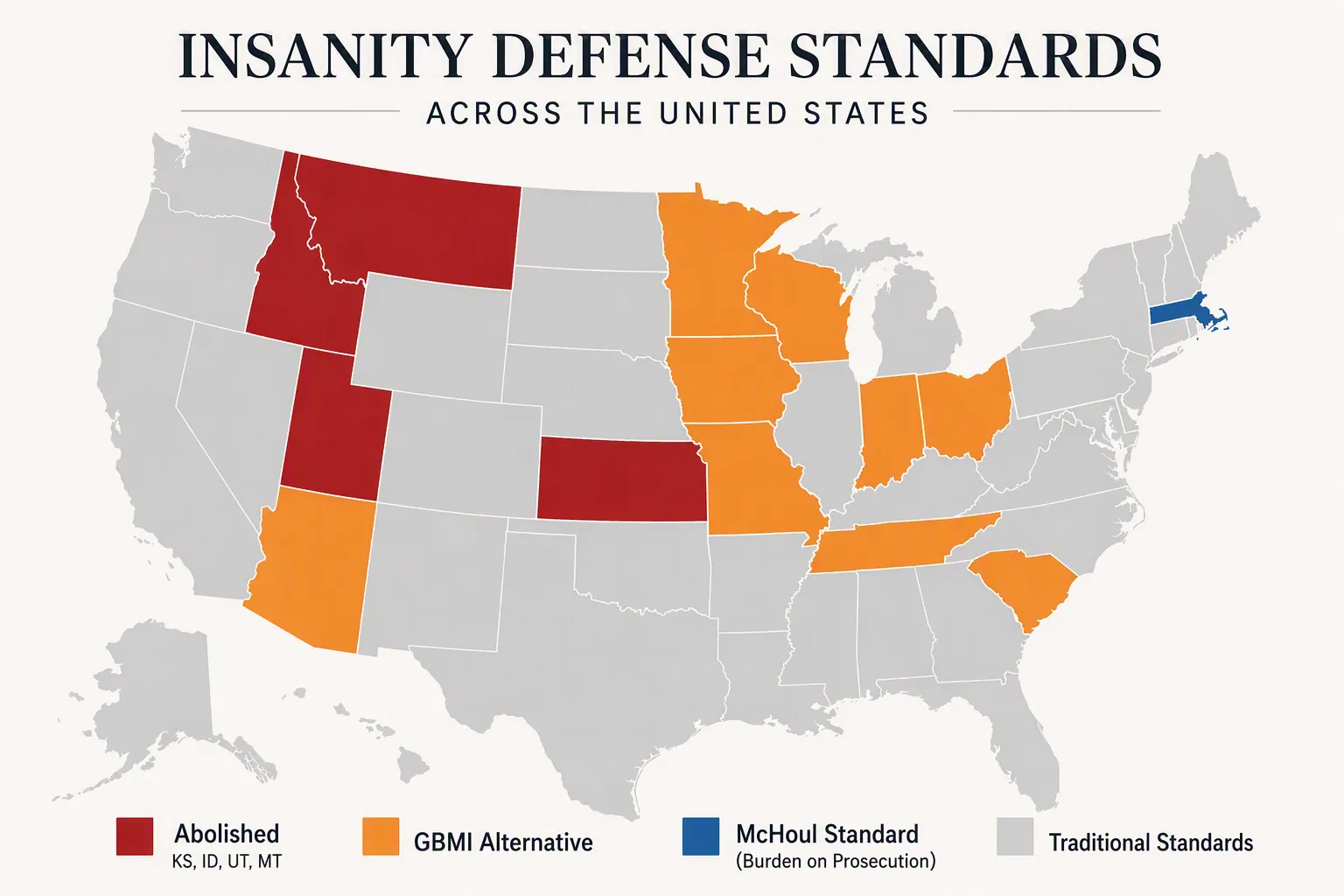
That divergence is not academic housekeeping. In Massachusetts, once the defense is in play, the prosecution must prove sanity beyond a reasonable doubt.[2] In a state that has abolished the traditional insanity defense, the same evidence might instead be routed toward mens rea, sentencing, mitigation, competency, or treatment placement. In a guilty-but-mentally-ill jurisdiction, the jury may have an intermediate label available that acknowledges mental illness without producing an insanity acquittal.
For counsel, that means the threshold question is not simply whether the psychiatric evidence is strong. It is whether the jurisdiction gives that evidence a doctrinal destination. Massachusetts does. The harder question is whether Clancy’s particular theory—postpartum illness plus medication exposure across multiple prescribers—fits that destination cleanly enough for jurors to use it.
The Comparator Cases Cut in Different Directions
The Andrea Yates case is the obvious caution against assuming that postpartum-psychosis insanity claims are legally impossible. Yates was convicted in her first trial after the 2001 deaths of her children; that conviction was later reversed, and a second jury found her not guilty by reason of insanity.[5] The point is not that Clancy’s case is Yates. It is that appellate correction, expert framing, and jury instructions can materially change the legal outcome of a postpartum-psychosis defense.
Carol Coronado points the other way. In that 2014 case, one forensic psychiatrist reportedly found insanity, but Coronado nevertheless received three consecutive life sentences.[5] Expert support may be necessary in these cases, but it is not sufficient. Jurors still decide credibility, factual fit, and whether the legal standard has been met.
That is where the reported jury composition has some relevance without becoming destiny. Reports identify the seated jury as 12 women and 6 men.[6] No responsible analysis can infer a verdict from gender composition. But in an insanity case involving children, postpartum illness, and competing narratives of agency, juror perception is not a side issue. It is the mechanism through which expert testimony becomes, or fails to become, reasonable doubt.
The Rare-Acquittal Statistic Should Be Used Carefully
A frequently repeated figure in coverage of insanity defenses is that such defenses succeed in only about 0.1% of criminal cases, with AAPL data cited in secondary reporting and commentary.[2][4] The figure is useful only if handled with discipline. It should be verified against the underlying AAPL material before being treated as a primary-source number, and it should not be made to carry more than it can bear.
A national success rate does not tell a Massachusetts jury how to apply McHoul. It also does not isolate postpartum-psychosis cases, medication-based theories, homicide prosecutions, or burden-of-proof differences. At most, it is a reminder that insanity acquittals are uncommon in the aggregate. It is not a jurisdiction-specific forecast.
The Policy Horizon Is Separate From the Jury’s Job
Massachusetts Bill H.1924 belongs in the background, not in the jury box. The bill has been described as a treatment-over-punishment pathway for mothers with postpartum psychiatric illness, and its current status should be checked against the Massachusetts Legislature’s official tracking page.[5] Its existence signals that lawmakers may be looking for a more tailored response to postpartum psychiatric crises.
But a pending or proposed policy pathway does not answer whether the Commonwealth has proved sanity beyond a reasonable doubt in this prosecution. The Clancy jury is working under existing criminal-law doctrine. If H.1924 advances, it may alter future charging, diversion, treatment, or sentencing conversations. It does not rewrite McHoul for this trial.
What the Trial Is Actually Testing
The Clancy trial is not a universal referendum on postpartum psychosis, maternal culpability, or psychiatric medicine. It is a Massachusetts criminal-responsibility case moving through a comparatively defense-favorable doctrinal structure while much of the public evidentiary record remains incomplete.
That structure matters. Requiring the prosecution to prove sanity beyond a reasonable doubt gives the defense a real procedural advantage once the issue is properly raised. But the advantage only matters if jurors accept that the defense’s medication-plus-postpartum theory describes a legally cognizable mental disease or defect that impaired one of the capacities McHoul identifies.
The narrowest sound conclusion, as of July 29, 2026, is also the most useful one: this case is a jurisdiction-specific stress test. It will show how far McHoul can stretch under sealed expert reports, incomplete public evidence, and a novel polypharmacy narrative tied to postpartum psychiatric illness. It should not be treated as if it has already answered that question.
References
- Opening-statement coverage of the Lindsay Clancy trial — CNN, WCVB, and MassLive
- McHoul standard explanation — BostonCriminalLawyer.com
- PBS reporting on postpartum psychosis, citing Cleveland Clinic data and a 2023 Medical University of Lublin study — PBS
- Legal-expert analysis of insanity-defense abolition, restriction, guilty-but-mentally-ill alternatives, and AAPL data — MassLive
- Guardian reporting on Andrea Yates, Carol Coronado, and Massachusetts Bill H.1924 — The Guardian
- Jury-composition reporting in the Lindsay Clancy trial — Patriot Ledger and WBUR
Related records
Tool profile
Browse tool evaluations →Governing regulation
Browse the obligations tracker →Preventive workflow
Browse verification workflows →
Report a correction or tip
Spotted an outdated figure, a misstated fact, or a ruling this case record should reflect? Public comments are disabled for this content given the professional cost of a misreported case outcome, penalty amount, or rule text — use the structured correction channel instead.
Report a correction or tip for this record →