
Lottery winner arrest highlights AI evidence threat in DV cases
The arrest of a lottery winner on domestic violence charges has drawn attention to a deeper problem: AI-generated text messages and deepfake videos are entering courtrooms with little verification. This article traces documented wrongful arrests caused by fabricated AI evidence and examines why current authentication rules cannot catch them.
- Jurisdiction
- United States
- Court
- Florida state court
- AI tool named
- ChatGPT
- Ruling date
- Jul 29, 2026
- Source document
- View primary court order ↗
- Last verified
- Jul 30, 2026
Lex Machina Review is an independent risk-tracking and reference resource. Nothing on this site is legal advice, and using it does not create an attorney-client relationship. Every record is reviewed against primary sources but may not reflect the most current status of a matter — always verify directly against the cited court order, rule text, or a licensed attorney before relying on it.
Companion explanation — secondary to the source document above
Last verified: July 30, 2026. This Risk Digest entry is for legal-risk analysis only and is not legal advice. The public trigger is the James Farthing lottery-winner domestic-violence arrest, but the available materials reviewed for this article do not show a documented AI-evidence issue in that case. The connection is narrower: the arrest has pushed attention toward a problem that already has a stronger record elsewhere — fabricated digital evidence moving fast enough to put someone in jail before authentication catches up.
That distinction matters. A lottery winner arrested in a domestic violence legal case is a news hook, not proof that AI-generated evidence was used against Farthing. The documented AI-evidence harm in the current record comes from a different protective-order case: Melissa Sims in Florida, who told 6abc Philadelphia/WPVI that AI-generated text messages led to her arrest for an alleged violation, two days in jail, and eight months of pending charges before the case was dropped after a forensic expert intervened.[1]
| Item | Current Source Status |
|---|---|
| James Farthing arrest | Reported public trigger; no AI-evidence issue documented in the materials reviewed for this article |
| Melissa Sims protective-order arrest | Reported local-news investigation; not independently confirmed here through court orders or police reports |
| Mendones v. Cushman & Wakefield | Courtroom deepfake incident described in legal analysis; sanctions reported after judicial detection |
| Detector reliability concerns | Benchmark-style expert warning cited in practitioner commentary |
| Proposed FRE 901(c) | Rule-reform proposal, not current uniform courtroom practice |
The documented harm is not the lottery arrest
Protective-order cases are built for speed. That is often necessary. A complainant may be asking for protection after a frightening incident; a respondent may be facing arrest, exclusion from a home, or a criminal violation allegation before the record is complete. The problem with fabricated digital evidence is that it can enter that urgent channel wearing the costume of something courts already see every day: a screenshot, a message thread, a call log, a short video.
In the Sims matter, the alleged evidence was not a cinematic deepfake. It was text-message evidence, the kind of material that often arrives in domestic-violence practice with little ceremony. Sims said AI-generated text messages made it appear that she violated a protective order. She was arrested, spent two days in jail, and waited eight months before charges were dropped; according to the 6abc/WPVI investigation, the turn came only after a forensic expert got involved.[1]
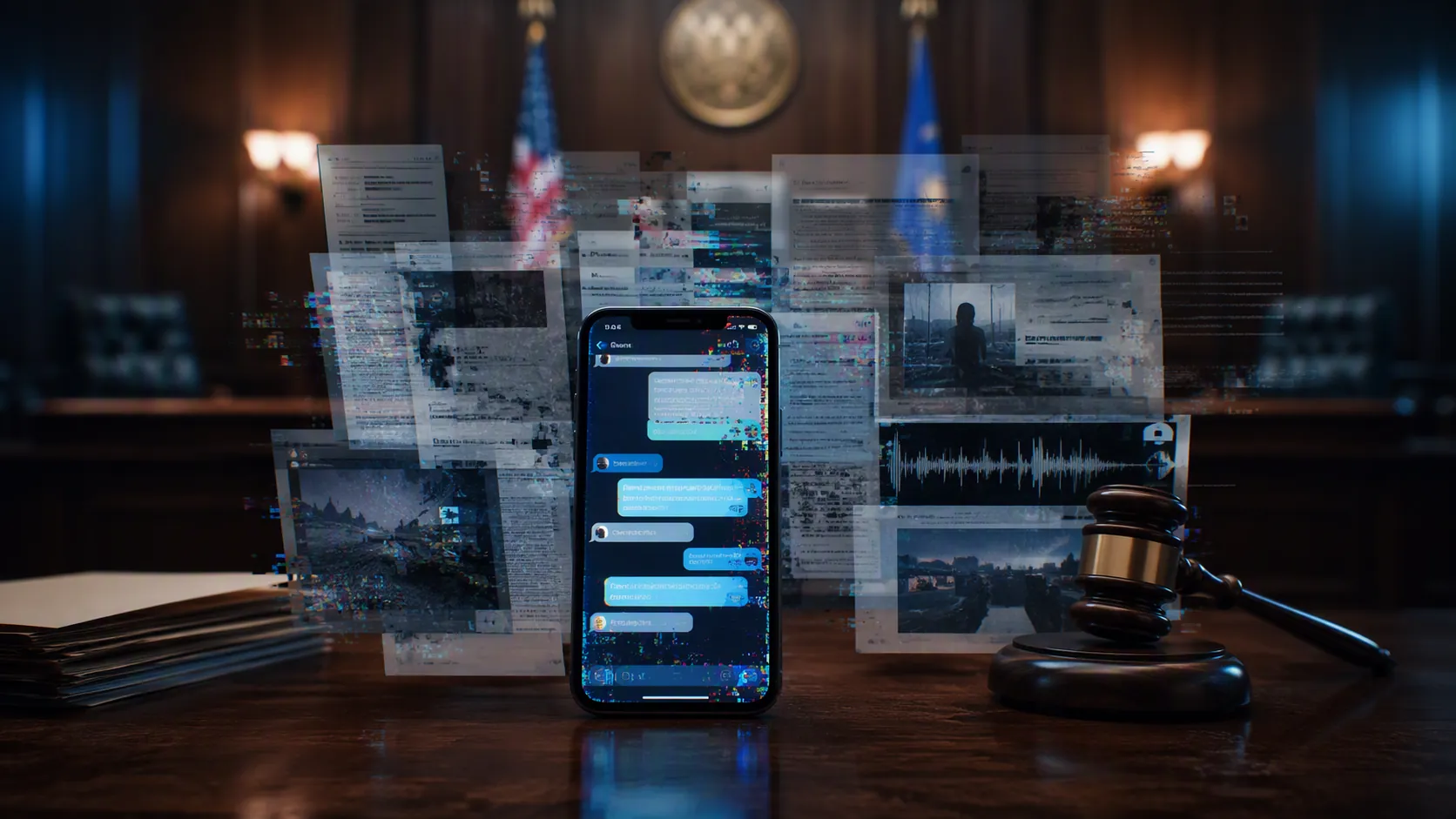
The narrowness of that source base should be kept in view. This is not a published appellate opinion establishing a doctrine of AI-fabricated domestic-violence evidence. It is a local-news investigation describing a criminal process that reached jail before forensic review changed the direction of the case. For risk analysis, that is still consequential. The relevant injury is not merely that a fake could fool a judge at trial. It is that a fake can be operationally useful much earlier: during a report, an arrest decision, a bond setting, a protective-order violation allegation, or a prosecutor’s initial review.
That is why the Sims case carries more risk weight than the Farthing hook. The Farthing arrest explains why readers are searching for the issue. Sims shows the procedural failure mode: the person contesting the digital record may have to do so after arrest, after jail intake, and after the case has already acquired the momentum of an alleged protective-order violation.
A fake does not have to be sophisticated to be damaging
Authentication rules were never supposed to treat every screenshot as self-proving. In practice, however, digital exhibits often travel through a familiar shorthand: a witness recognizes the screen, counsel offers the exhibit, the court asks enough foundation questions to move the hearing along. In emergency or quasi-emergency settings, that shorthand becomes tempting because the court is balancing speed against safety.
AI-generated messages complicate that routine because they attack the premise behind ordinary recognition testimony. A person can recognize a name, profile photo, phone number, or conversation style and still be looking at fabricated content. A respondent can deny authorship and still sound evasive if the exhibit visually resembles a normal message thread. A complainant can also be harmed by the same weakness if a fabricated image is used to impeach a real account of abuse. The evidentiary problem does not belong to one side of domestic-violence practice.
The absence of a consistent verification protocol is the recurring weakness. A useful authentication record may need device-level extraction, metadata review where available, platform records, carrier records, account-access evidence, hash values for preserved files, and a clear chain of custody. Those steps are familiar to forensic practitioners, but they are not automatically built into the first moments of a protective-order violation case. The gap resembles the authentication concerns discussed in What Clancy trial openings reveal about AI evidence authentication, where the practical issue is not whether lawyers know the word “deepfake,” but whether the record shows who verified what before the evidence was used.
Mendones shows the courtroom version of the same weakness
Mendones v. Cushman & Wakefield is not a domestic-violence case, and it should not be made to do domestic-violence work. Its value is different. It shows that deepfake evidence is not confined to hypotheticals or social media rumors. According to Berkeley Technology Law Journal’s analysis, pro se litigants submitted deepfake witness videos in the California litigation; the judge noticed anomalies and imposed terminating sanctions.[2]
That outcome may look reassuring until the sequence is examined closely. The videos were caught because something about them drew judicial attention. That is not the same as a repeatable screen. A fake that contains visible artifacts, strange timing, or implausible presentation may be easier to challenge. A cleaner fake, a rushed docket, a lower-stakes evidentiary hearing, or a judge with less technical exposure may produce a different path.
Mendones therefore cuts against detector complacency as much as party misconduct. Courts cannot safely build a system around lucky noticing. Nor can counsel assume that the only dangerous fabricated evidence will look dramatic. The broader pattern of fabricated materials entering legal records is already visible in high-profile settings, a point also raised in AI Evidence Risks After Epstein Model Scout Found Dead. The practical question is whether a case file contains enough verification work to survive contact with a fabricated exhibit.
The scale indicators are messy, but not comforting
The strongest current evidence is still case-specific, not statistical. Sims is a reported wrongful-arrest account. Mendones is a litigation incident. The broader numbers are useful only if read with care.
Damien Charlotin’s AI hallucination database listed 1,811 total cases as of July 29, 2026.[3] The National Center for State Courts has separately described more than 350 self-represented litigant cases and more than 200 lawyer cases involving AI-hallucinated citations or fabricated evidence in U.S. courts, while warning that legal professionals are “far from a perfect bulwark.”[4]
Those figures should not be inflated into a clean measure of deepfake evidence in domestic-violence proceedings. The Charlotin database is voluntary-submission based, and the category includes AI hallucinations as well as fabricated legal materials. It does, however, support a narrower and important conclusion: courts are already receiving AI-contaminated materials often enough that one-off treatment is no longer adequate. The undercount risk runs in the obvious direction because undiscovered fakes and unreported incidents do not enter a public database.
Running a detector is not an authentication plan
Detector tools are attractive because they promise a courtroom-friendly answer: upload the image, read the probability, move on. That promise is too thin for protective-order work, where the consequence of a wrong early call may be jail.
A Drexel University professor’s finding, cited in practitioner commentary, illustrates the problem sharply: the same AI-generated image produced detection probabilities ranging from 1% to 62% across three leading detectors.[5] That spread is not a small calibration disagreement. In a real hearing, it could be the difference between “no concern,” “possible concern,” and “major concern,” depending on which tool a party happened to use.
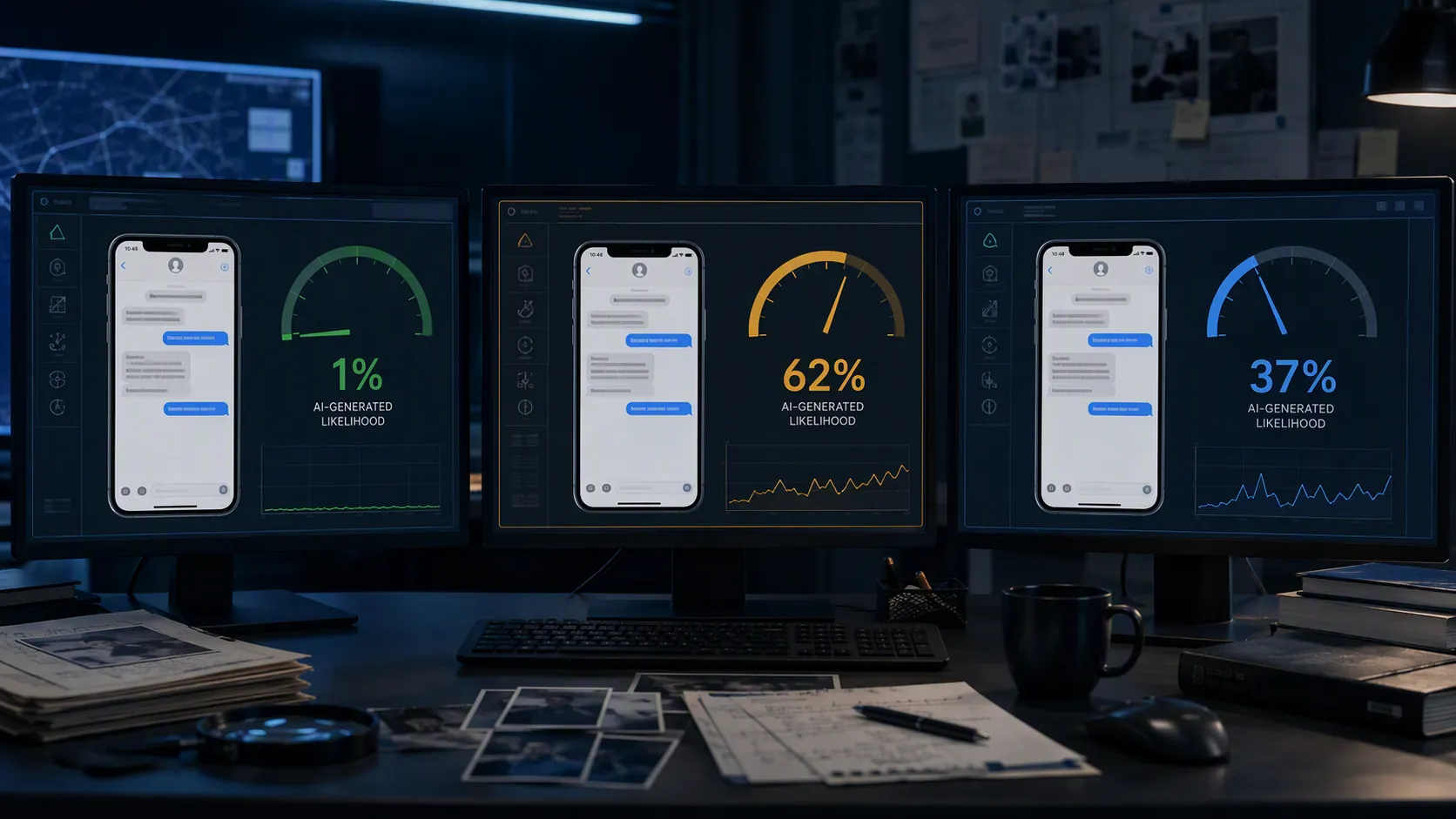
The better use of a detector result is as one documented input, not as a substitute for foundation. Counsel still needs to know where the file came from, who handled it, whether the original device or account is available, whether platform or carrier records can corroborate the exchange, and whether the opposing party has been given a meaningful chance to inspect the material. A detector score without that surrounding record can create a false sense of procedural cleanliness.
Consumer tools widen the gap between fabrication and verification
The risk is widening because fabrication no longer requires a specialist. CU Boulder’s Visual Evidence Lab has warned that consumer-grade tools such as ChatGPT, Midjourney, and Sora 2 can help produce convincing fakes without technical skill.[6] That point should be read practically, not theatrically. A party does not need to understand model architecture to create a piece of evidence that looks familiar enough to survive a hurried first look.
Domestic-violence proceedings are especially exposed to that asymmetry because the records are often personal, fragmented, and emotionally charged. A fabricated message can be dropped into an existing conflict. A manipulated call log can appear to corroborate unwanted contact. A synthetic voice clip can sound like the sort of thing a court already expects to hear in a volatile relationship. The more ordinary the format, the less likely it is to trigger the visual skepticism that caught the videos in Mendones.
That does not mean every disputed screenshot deserves a full forensic hearing. It does mean the proponent’s burden should not collapse into “it looks like the other person’s phone number.” In practice, counsel should separate emergency protective facts from contested digital authorship and make the verification status explicit. If the court must act quickly, the order can still preserve the dispute: what evidence was relied on, what was not authenticated, what inspection remains open, and what follow-up records are being requested.
Rule reform is coming too slowly to be the first safeguard
The proposed Federal Rule of Evidence 901(c) amendment would apply a preponderance authenticity standard when deepfake concerns are raised, but the rulemaking cycle takes about three years.[4] That proposal is useful because it recognizes that synthetic evidence can require a more deliberate authenticity determination. It is not useful as a near-term operating plan for lawyers handling active matters this quarter.
Nor would a federal amendment, by itself, solve state protective-order practice. Many domestic-violence matters move in state courts, under local procedures, with litigants who may be self-represented and records that may not arrive through formal discovery. A rule can set a standard; it cannot automatically create device access, forensic funding, platform-response speed, or judicial time on a crowded docket.
For litigators and in-house counsel, the more immediate duty is documentation before reliance. ABA Formal Opinion 512 addresses lawyers’ duty to verify AI outputs, and that verification obligation matters beyond brief-writing.[7] If counsel uses, receives, summarizes, or challenges AI-suspect material, the file should show what was checked and what remains unverified. The sanctions and verification issues discussed in How Microsoft’s July 2025 Earnings Masked AI Stock Risk are part of the same professional-risk family: courts are becoming less patient with AI-related reliance that lacks a checkable human process.
What the file should show before digital evidence carries weight
The practical response is not to accuse every party of fabrication. It is to make authenticity visible. A lawyer trying to rely on a message, image, audio clip, or video should be able to identify the source, the preservation method, the person who collected it, and the corroborating records requested or obtained. A lawyer challenging the material should be equally specific: what feature is disputed, what alternative source is plausible, what inspection is needed, and what consequence should be delayed until the court has a better record.
- Preserve originals where possible, not just forwarded screenshots or compressed exports.
- Record the chain of custody for phones, accounts, files, and any forensic images.
- Seek platform, carrier, device, or account-access records when authorship is material.
- Treat detector results as leads or impeachment material, not as standalone proof.
- State on the record whether disputed digital evidence is authenticated, provisionally considered, or excluded from the immediate decision.
The Farthing arrest explains why the public is looking at the issue now. Sims shows the harm can land before the system corrects itself. Mendones shows deepfakes are entering litigation and may be caught only when someone notices enough to stop the proceeding. The detector and rule materials show why there is no uniform screen waiting in the courthouse hallway. Until verification practice becomes more consistent, AI-generated evidence challenges belong in the authentication record early, before a screenshot becomes the basis for detention, sanctions, settlement pressure, or corporate reliance.
References
- No verified evidence? Woman says AI-generated deepfake text sent her to jail - 6abc Philadelphia / WPVI - https://6abc.com/post/no-verified-evidence-woman-says-ai-generated-deepfake-text-sent-jail-action-news-investigation/18373467/
- Deepfaked Evidence: What Case Law Tells Us About How the Rules of Authenticity Needs to Change - Berkeley Technology Law Journal - June 2025 - https://btlj.org/2025/06/deepfaked-evidence-what-case-law-tells-us-about-how-the-rules-of-authenticity-needs-to-change/
- AI Hallucination Cases - Damien Charlotin - https://www.damiencharlotin.com/hallucinations/
- AI-Generated Evidence: A Threat to Public Trust in Courts - National Center for State Courts - https://www.ncsc.org/resources-courts/ai-generated-evidence-threat-public-trust-courts
- How AI and Deepfakes Can Impact Domestic Violence Cases - Saiber LLC - December 16, 2024 - https://www.saiber.com/insights/publications/2024-12-16-how-ai-and-deepfakes-can-impact-domestic-violence-cases
- Deepfakes and AI in the courtroom: Report calls for legal reforms to address troubling trend - CU Boulder Today - November 17, 2025 - https://www.colorado.edu/today/2025/11/17/deepfakes-and-ai-courtroom-report-calls-legal-reforms-address-troubling-trend
- Formal Opinion 512 - American Bar Association - https://www.americanbar.org/content/dam/aba/administrative/professional_responsibility/ethics-opinions/aba-formal-opinion-512.pdf
Related records
Tool profile
How to Read Legal AI Benchmarks Ahead of the OpenAI IPOGoverning regulation
Browse the obligations tracker →Preventive workflow
Browse verification workflows →
Report a correction or tip
Spotted an outdated figure, a misstated fact, or a ruling this case record should reflect? Public comments are disabled for this content given the professional cost of a misreported case outcome, penalty amount, or rule text — use the structured correction channel instead.
Report a correction or tip for this record →