
2027 Medicare Part D Changes After the Premium Subsidy Ends
The end of the $9.8B Premium Stabilization Demonstration and the CY 2027 Final Rule together reset Medicare Part D structurally for 2027. This article outlines the premium changes, regulatory codifications, and deregulatory shifts that plans, sponsors, and benefits counsel need to track.
- Jurisdiction
- United States
- Court
- Centers for Medicare & Medicaid Services
- AI tool named
- None
- Ruling date
- Apr 2, 2026
- Source document
- View primary court order ↗
- Last verified
- Jul 30, 2026
Lex Machina Review is an independent risk-tracking and reference resource. Nothing on this site is legal advice, and using it does not create an attorney-client relationship. Every record is reviewed against primary sources but may not reflect the most current status of a matter — always verify directly against the cited court order, rule text, or a licensed attorney before relying on it.
Companion explanation — secondary to the source document above
Medicare Part D after the subsidy ends in 2027 is not just a premium story. CMS’s July 28, 2026 decision to let the Premium Stabilization Demonstration expire after calendar year 2026 lands on top of the Contract Year 2027 Medicare Advantage and Part D Final Rule, which CMS finalized in April 2026 and made effective for the 2027 contract year.[1][2] For plans, sponsors, PBMs, employer disclosure teams, and benefits counsel, the operative date is the same: January 1, 2027.
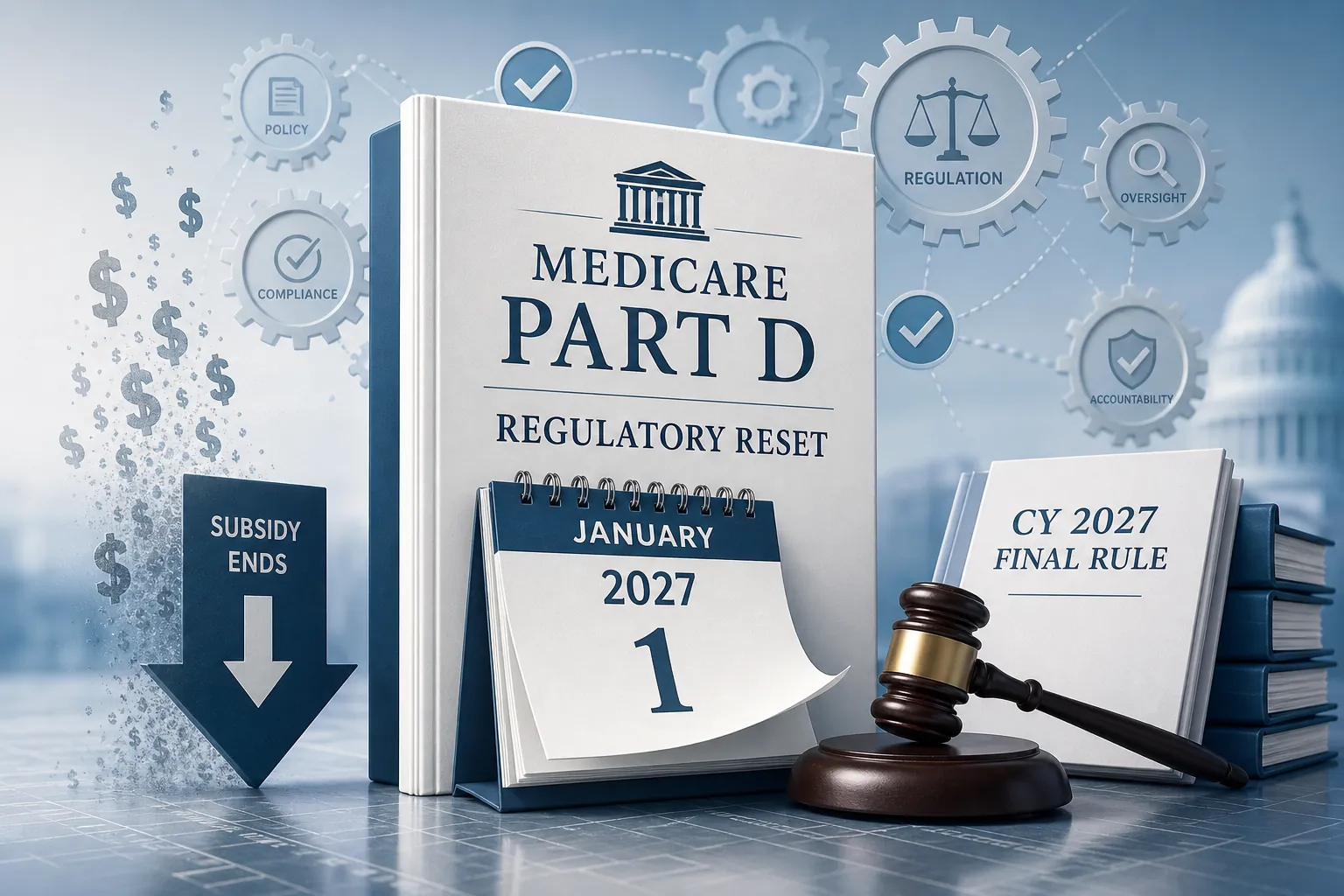
The first visible change is premium pressure. The more durable legal change is that CMS is moving the redesigned Part D benefit into regulation while also removing or loosening several plan-operations requirements. That combination is what makes the 2027 reset easy to misread if it is reduced to “subsidy ends, premiums rise.”
| 2027 item | Confirmed change | Why compliance teams should care |
|---|---|---|
| Premium stabilization | The temporary demonstration ends after CY 2026. | Bid assumptions, member communications, and call-center explanations need to stop relying on a demonstration that no longer applies. |
| Base beneficiary premium | The 2027 base beneficiary premium is $41.33, up from $38.99 in 2026. | This is the statutory base figure, not the premium every enrollee will pay. |
| NAMBA | The 2027 national average monthly bid amount is $296.05. | This figure feeds the Part D premium calculation architecture. |
| Part D redesign | CMS codifies elimination of the coverage gap, an indexed out-of-pocket cap, and the Manufacturer Discount Program. | Plan documents, formularies, pharmacy claims administration, and manufacturer-discount controls need legal and operational alignment. |
| Deregulatory changes | CMS removes selected Star Ratings, health-equity, marketing, and related operational requirements. | Compliance calendars should subtract requirements as carefully as they add new ones. |
| Creditable coverage | Account-based plan treatment and simplified methodology rules change for 2027. | Employer disclosure templates and actuarial/legal review processes may need revision. |
The Premium Demonstration Was Temporary, but Its Effects Were Not Small
The Premium Stabilization Demonstration was built to soften stand-alone Part D premium increases during the first years of the Inflation Reduction Act redesign. GAO reported that the demonstration cost $9.8 billion in total, with $6.2 billion in 2025 and $3.6 billion in 2026.[3] That is not a rounding error in a bid cycle.
GAO found that the demonstration reduced average monthly stand-alone prescription drug plan premiums by $26 in 2025 and $16 in 2026.[3] It also found that, without the demonstration, premiums for beneficiaries who remained in their 2024 plans would have nearly doubled in 2025, and 37% would have faced increases exceeding $40 per month.[3] Those numbers explain why the demonstration’s removal creates practical pressure even though the policy was always temporary.
The 2027 increase is still not a settled dollar figure for every enrollee. CMS Administrator Mehmet Oz said most beneficiaries should see increases under $10 per month, while KFF warned that some stand-alone Part D enrollees could see increases of up to $20 per month after the temporary subsidies end.[4] Those are estimates about likely premium effects, not final plan-specific notices.
The exposure is not evenly distributed across Part D products. KFF reported that in 2026, the average monthly premium for stand-alone prescription drug plans was $36, compared with $8 for Medicare Advantage drug plans.[4] That gap matters because the demonstration was aimed at stand-alone drug plans; it also matters because beneficiaries, agents, plan call centers, and employer retiree-benefit teams often experience “Part D” as one category even when the premium mechanics differ.
The 2027 Premium Mechanics Start With Two CMS Figures
CMS announced a 2027 Part D base beneficiary premium of $41.33, up from $38.99 in 2026.[1] CMS also announced a 2027 national average monthly bid amount, or NAMBA, of $296.05.[1] Those two figures will show up in different places: the base beneficiary premium is the statutory benchmark that benefits professionals tend to see in notices and explanatory materials, while NAMBA is part of the bid and subsidy calculation framework.
The base beneficiary premium increase is constrained by the Inflation Reduction Act’s 6% annual cap through 2029.[1] That cap is important, but it should not be mistaken for a cap on every enrollee’s actual premium. Plan-specific premiums can still vary based on bids, benefit design, geography, low-income subsidy status, and whether the coverage is stand-alone PDP or MA-PD.
That distinction is where legal and communications review often becomes more important than the headline number. A member-facing sentence that says “Part D premiums are capped at 6%” is not the same as a sentence that says the base beneficiary premium is subject to a statutory 6% annual increase limit through 2029. The former invites a complaint; the latter reflects the rule.
The Final Rule Codifies the IRA Redesign Into the Part D Rulebook
The April 2026 final rule does not merely acknowledge that the Inflation Reduction Act changed the Part D benefit. CMS codifies key parts of the redesign for contract year 2027, including elimination of the coverage gap, an annual out-of-pocket cap that is indexed after its initial implementation years, and the Manufacturer Discount Program.[2]

For 2027, the confirmed CMS materials support the benefit-design point without requiring a beneficiary shopping guide: the coverage gap is eliminated, the annual out-of-pocket cap is indexed, and the redesigned liability structure replaces the old coverage phases.[2] Available source materials also identify $2,000 for 2025 and $2,100 for 2026 as confirmed statutory out-of-pocket cap figures, with indexing thereafter; any specific 2027 out-of-pocket threshold beyond the confirmed indexed framework should be treated as a projection unless CMS confirms it in final plan materials.
That caveat is not academic. Employer notices, evidence-of-coverage summaries, broker scripts, and legal updates often get revised before the final beneficiary-facing plan details are fully absorbed. If a document uses an estimated 2027 out-of-pocket amount, it should say so. If it uses only the confirmed indexed-cap framework, it should avoid implying that a final 2027 dollar threshold has already been officially set.
The Coverage Gap Is Gone, but the Work Moves Elsewhere
Eliminating the coverage gap simplifies the old member explanation, but it does not eliminate administration. Plans still need to price, adjudicate, and explain the redesigned benefit phases. Counsel still need to review whether plan materials describe the out-of-pocket cap, covered Part D drugs, enhanced alternative benefits, and cost-sharing obligations with enough precision for 2027.
The practical shift is from explaining a confusing gap to proving that the redesigned structure has been implemented consistently. That touches formulary files, claims logic, pharmacy help desk scripts, member appeals materials, and the handoff between plan sponsor, PBM, and downstream entities.
Manufacturer Liability Becomes a Compliance Track of Its Own
The Manufacturer Discount Program is one of the places where “benefit redesign” becomes a legal operations issue rather than a member-education issue. CMS codified manufacturer discount obligations that include 10% discounts in the initial coverage phase and 20% discounts in the catastrophic phase.[2] Law-firm analyses of the final rule also identify civil money penalty exposure of 25% for manufacturer noncompliance.[5][6]
That structure gives manufacturers, plans, and PBMs different but connected control problems. Manufacturers need participation and discount-compliance processes. Plans and PBMs need systems that can apply the redesigned liability structure and preserve records when amounts are disputed. Counsel need to know which obligations are imposed directly on manufacturers and which obligations flow through plan operations, contracts, data exchanges, and audit rights.
The manufacturer discount rules also change the drafting posture for service agreements. It is not enough for a PBM contract to say that the vendor will administer Part D consistent with applicable law. The documents that matter in 2027 are the ones that identify data responsibilities, timing, reconciliation duties, error correction, audit support, and cooperation if CMS or another party challenges discount handling.
CMS Is Also Removing Requirements
The same final rule that codifies the Part D redesign also removes or relaxes several Medicare Advantage and Part D requirements. That simultaneity is easy to miss because premium and out-of-pocket changes dominate public coverage. For compliance teams, subtracting requirements can be as operationally sensitive as adding them, especially when templates, vendor scripts, committee charters, and quality dashboards have already been built around the prior rule.
CMS finalized removal of 11 Star Ratings measures, eliminated the Health Equity Index reward, and removed related health-equity requirements for Medicare Advantage utilization management committees.[2][6] The rule also eliminated the 48-hour Scope of Appointment waiting period, a change that affects marketing and sales processes rather than core drug-benefit liability.[2][6]
| Operational area | 2027 final-rule change | Immediate review point |
|---|---|---|
| Star Ratings | Removal of 11 measures. | Quality dashboards and internal performance calendars should distinguish retired measures from measures that still affect ratings. |
| Health equity | Elimination of the Health Equity Index reward and related utilization-management committee requirements. | Committee charters, delegated-entity requirements, and board materials may need targeted revisions. |
| Marketing | Removal of the 48-hour Scope of Appointment waiting period. | Agent training, scripts, CRM timing rules, and oversight procedures should be updated without loosening unrelated marketing controls. |
| Supplemental benefits | Clarification affecting cannabis policy for Special Supplemental Benefits for the Chronically Ill. | Benefit-design review should separate federal Medicare rules from state cannabis-law assumptions. |
The Scope of Appointment change is a good example of why “deregulatory” does not mean “no compliance work.” If a plan has hard-coded a 48-hour waiting period into agent workflow tools, call-center scheduling logic, or delegated marketing oversight, someone has to decide whether to remove it, when to remove it, and how to document that other consent, recording, and marketing rules remain intact.
The Star Ratings removals create a different risk. Plans may stop tracking a retired measure too early for internal trend purposes, or keep treating it as if it still carries rating consequences. Either mistake can distort management reporting. A clean 2027 ratings matrix should identify the measures CMS removed, the measures that remain, and any internal quality measures the plan chooses to keep for business reasons rather than regulatory scoring.
CMS’s cannabis clarification for Special Supplemental Benefits for the Chronically Ill belongs in the same operational bucket. It is not a broad invitation to treat cannabis benefits as routine Medicare supplemental benefits. The safer reading is narrower: plan benefit teams and counsel should review the federal clarification alongside state law, benefit-design limits, medical-necessity standards, vendor capability, and marketing language before changing SSBCI materials.[2][8]
Creditable Coverage Rules Change for Employers and Account-Based Plans
The 2027 reset also reaches employer-facing Part D disclosure work. Compliance-firm analyses of the final rule report that account-based plans, including FSAs, HRAs, ICHRAs, and HSAs, are exempt from Medicare Part D creditable coverage disclosure requirements starting in 2027.[7] The same analyses describe a revised simplified determination methodology using a 73% threshold.[7]
For benefits counsel, the account-based-plan exemption is a template issue before it becomes a strategy issue. Employers that have been sending or reviewing creditable coverage notices for arrangements now treated differently should not simply delete language across the board. They need to identify which arrangements are account-based, which prescription drug coverages remain subject to disclosure, and whether any vendor or broker notice packages still assume the old approach.
The simplified methodology change is similarly practical. If an employer, consultant, or third-party administrator has a standing annual process for creditable coverage determinations, the process should be updated for the 73% threshold rather than carried forward by habit. The people most likely to be blamed for a late or inaccurate notice are often not the people who followed the final rule closely in April.
The Compliance Work Is Coordinated, Not Sequential
A clean 2027 implementation plan should not treat the subsidy end, the redesigned benefit, manufacturer discounts, marketing procedures, Star Ratings changes, and creditable coverage notices as separate annual chores. They collide in the same member materials, bid assumptions, contracts, oversight files, and call-center answers.
- Plans need bid and premium communications that distinguish the base beneficiary premium, plan-specific premiums, NAMBA, and the end of the demonstration.
- PBMs and plan sponsors need claims, formulary, discount, reconciliation, and audit processes aligned with the codified Part D redesign.
- Manufacturer agreements and operational controls need to reflect initial coverage and catastrophic discount obligations, plus noncompliance exposure.
- Marketing teams need updated Scope of Appointment procedures without relaxing unrelated CMS marketing requirements.
- Quality and compliance teams need Star Ratings and health-equity tracking tools that separate removed CMS requirements from voluntary internal monitoring.
- Employer disclosure teams need revised creditable coverage workflows for account-based plans and the simplified methodology threshold.
The member-facing version of the 2027 change will probably sound simpler than the compliance version: premiums may rise, the coverage gap is gone, and out-of-pocket costs are capped under the redesigned benefit. The legal version has more moving parts. Some figures are confirmed by CMS now, including the $41.33 base beneficiary premium and $296.05 NAMBA for 2027.[1] Some effects remain estimates, including the range of actual premium increases after the demonstration ends.[4] Some details depend on final plan-specific materials expected later in 2026.
That is the line to hold in 2027 communications and legal review: confirmed CMS figures should be stated as confirmed, external projections should be labeled as projections, and operational changes should be mapped to the January 1, 2027 effective date before annual notices and member questions turn the reset into a scramble.
References
- Medicare Part D 2027 National Average Monthly Bid Amount Information, CMS, July 28, 2026.
- Contract Year 2027 Medicare Advantage and Part D Final Rule, CMS, April 2, 2026.
- Medicare Part D: Implementation of Beneficiary Premium Stabilization Demonstration, GAO.
- CMS’s Decision to End Temporary Subsidies to Medicare’s Stand-Alone Drug Plans Could Mean Larger Premium Increases for Some Beneficiaries Next Year, KFF, July 29, 2026.
- CMS Finalizes CY 2027 Medicare Advantage and Part D Rule, Holland & Knight, April 7, 2026.
- CMS Finalizes CY 2027 Medicare Advantage and Part D Rule: Key Implications for Plan Sponsors, Crowell & Moring, April 17, 2026.
- Medicare Part D Creditable Coverage: FSA, HRA and ICHRA Disclosures & 2027 Simplified Determination Method, M3 Insurance.
- Regs & Eggs, McDermott+.
Related records
Tool profile
Browse tool evaluations →Governing regulation
Browse the obligations tracker →Preventive workflow
Browse verification workflows →
Report a correction or tip
Spotted an outdated figure, a misstated fact, or a ruling this case record should reflect? Public comments are disabled for this content given the professional cost of a misreported case outcome, penalty amount, or rule text — use the structured correction channel instead.
Report a correction or tip for this record →