
Mega Backdoor Roth for Startup Founders in 2026
Startup founders can contribute up to ~$47,500 annually in after-tax Roth space through a Solo 401(k) mega backdoor Roth—but only if they adopt a custom plan document, as standard Fidelity/Schwab/Vanguard plans lack the required provisions. This article explains the 2026 limits, the three non-negotiable plan provisions, and common execution errors to avoid.
- Jurisdiction
- United States
- Court
- Internal Revenue Service
- AI tool named
- None
- Ruling date
- Jul 25, 2026
- Source document
- View primary court order ↗
- Last verified
- Jul 25, 2026
Lex Machina Review is an independent risk-tracking and reference resource. Nothing on this site is legal advice, and using it does not create an attorney-client relationship. Every record is reviewed against primary sources but may not reflect the most current status of a matter — always verify directly against the cited court order, rule text, or a licensed attorney before relying on it.
Companion explanation — secondary to the source document above
If you are a startup founder who makes too much for a direct Roth IRA, controls the company retirement plan, and gets most of your upside from equity rather than salary, the mega backdoor Roth can work differently for you than it does for a normal W-2 employee. The reason is simple: a zero-employee founder may control the plan document and may not be blocked by the nondiscrimination testing that often kills after-tax contributions inside larger employer plans. That control is useful only if the plan is actually written to permit the transaction.
For 2026, the headline number is large enough to deserve attention. The total 401(k) annual additions limit is $72,000, and the employee elective deferral limit is $24,500; depending on eligible compensation and employer contribution math, the remaining space can allow roughly $47,500 of after-tax money to move through the plan and into Roth treatment through the mega backdoor Roth process.[1] That is the part of the founder strategy that gets quoted most often. It is not the part that usually breaks.
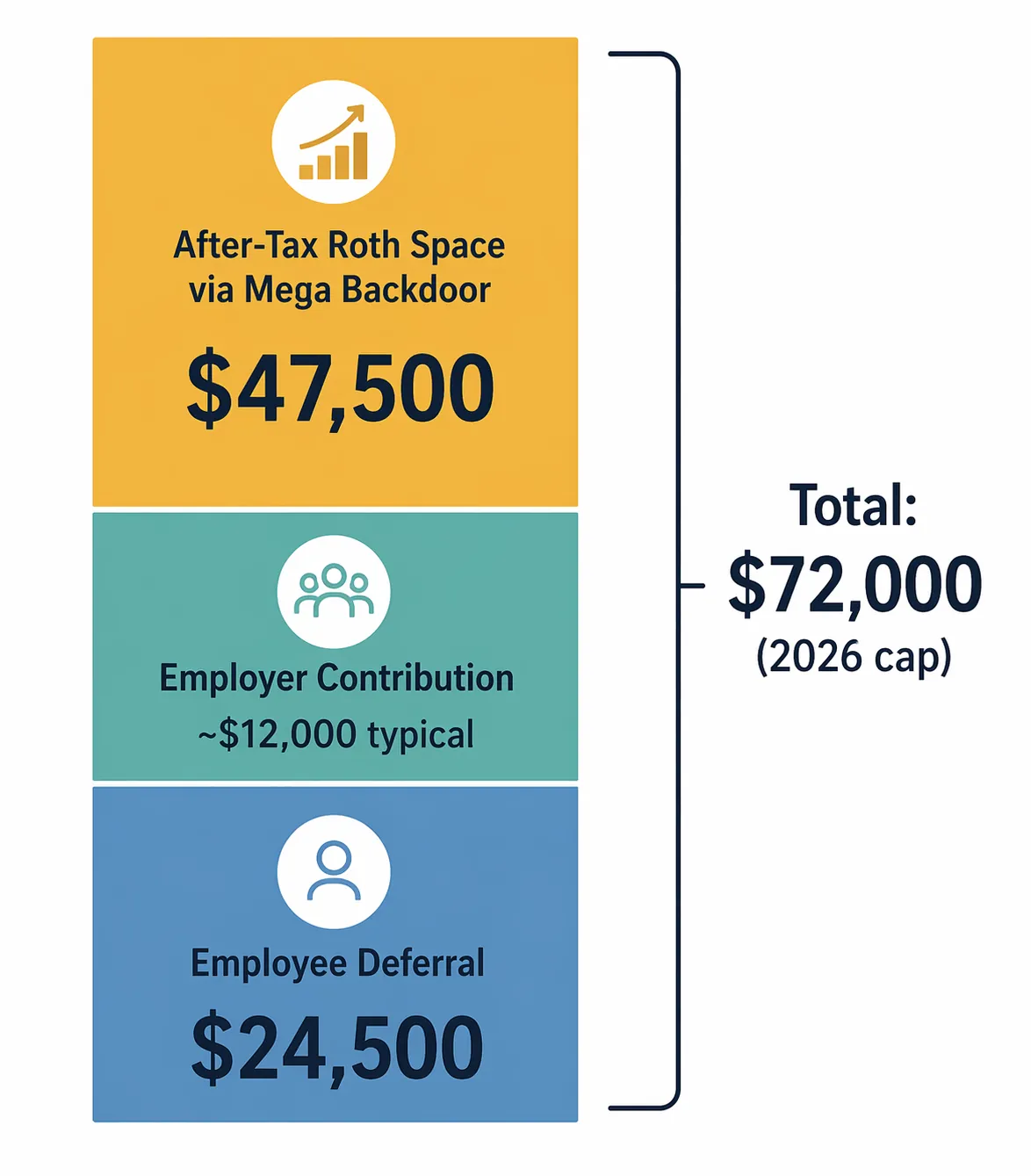
The failure point is the Solo 401(k) document. A standard free Solo 401(k) from a familiar brokerage name may be perfectly fine for basic salary deferrals and employer contributions, while still being useless for a mega backdoor Roth. The required provisions are usually missing from standard provider documents, including those commonly associated with Fidelity, Schwab, and Vanguard, according to practitioner guides focused on owner-only 401(k) plan design.[2][3]
The 2026 Math, Without Pretending the Math Is the Strategy
A founder usually thinks about the mega backdoor Roth after the obvious retirement buckets are already full. The direct Roth IRA is unavailable because of income. The regular 401(k) deferral is already maxed or planned. The question becomes whether the founder can use the unused space under the total 401(k) cap.
| 2026 layer | What it means for a founder | Why it matters |
|---|---|---|
| Employee elective deferral: $24,500 | This can be traditional pre-tax or Roth 401(k), depending on the plan and founder choice. | This is not the mega backdoor Roth contribution; it uses the regular employee deferral bucket.[1] |
| Employer contribution | This depends on eligible compensation and entity structure. | It uses part of the same $72,000 annual additions cap.[1] |
| After-tax non-Roth contribution | This is the contribution type used for the mega backdoor Roth path. | It can fill remaining annual additions space only if the plan document authorizes it.[2][3] |
| Total annual additions cap: $72,000 | Employee deferrals, employer contributions, and after-tax non-Roth contributions are coordinated against this cap. | The rough $47,500 opportunity exists only after the other layers are counted.[1] |
The phrase "up to roughly $47,500" does a lot of work. It assumes the founder has enough eligible compensation, that employer contributions do not consume more of the $72,000 cap, and that the plan allows after-tax non-Roth contributions. A founder paying themselves a modest W-2 wage from an S corporation cannot ignore the compensation side just because the company has a high valuation or a promising pipeline. Equity value is not automatically compensation for 401(k) contribution purposes.
This is where startup planning gets messier than the clean limit chart. A sole proprietor, single-member LLC owner, and S corporation founder may all use an owner-only plan in the right circumstances, but their contribution math is not identical. The CPA has to reconcile entity type, earned income or W-2 wages, employer contribution limits, and payroll timing before anyone can say how much after-tax room is actually available.
Why Founders Have an Advantage Over W-2 Employees
A W-2 employee at a large company can want a mega backdoor Roth and still have no practical way to do it. The employer plan must allow after-tax contributions and a Roth conversion or in-service distribution path. Even then, the plan can run into nondiscrimination testing constraints if highly compensated employees are using the feature more heavily than the rest of the workforce.
A Solo 401(k) with no non-owner employees is different. Owner-only plans generally avoid the ACP nondiscrimination testing barrier that applies to broader multi-participant plans, which is one reason the mega backdoor Roth is more feasible for a true zero-employee business owner than for a highly compensated employee inside a corporate plan.[4][3]
That advantage disappears as soon as the company has eligible non-owner employees. A founder who hires employees, even before the next financing round, needs to treat plan eligibility as a live compliance question rather than a one-time setup item. The mega backdoor Roth may still be possible in some employer plans, but it is no longer the clean owner-only case.
The Three Plan Provisions That Decide Whether the Strategy Exists
A founder does not have a mega backdoor Roth because an account dashboard says "Solo 401(k)." The plan document has to authorize the steps. The brokerage account is plumbing. The adopted plan document is the operating manual.
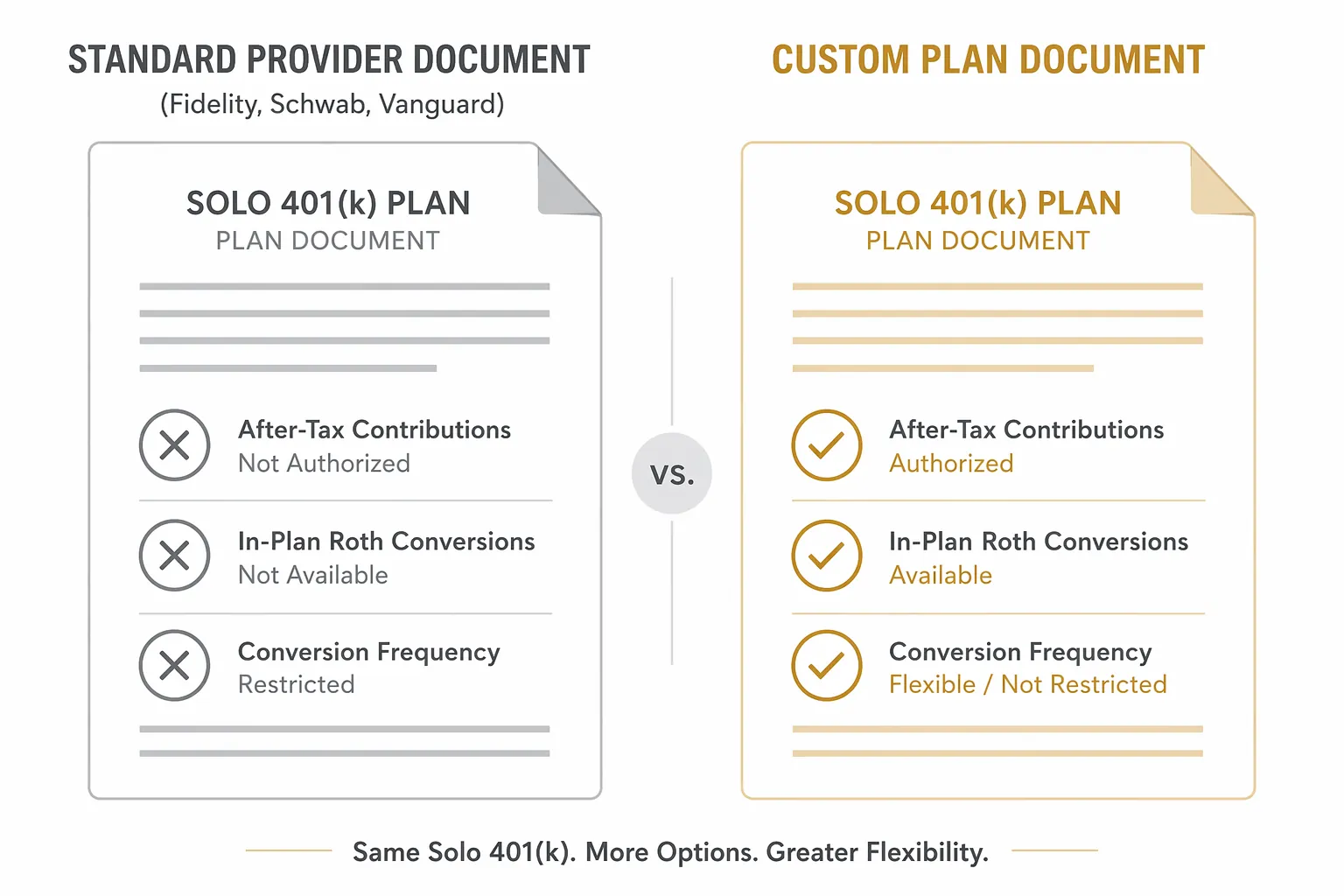
- After-tax non-Roth contributions must be authorized. Roth employee deferrals are not the same thing. If the document only allows regular pre-tax or Roth salary deferrals, the mega backdoor path is not open.
- The plan must allow in-plan Roth conversions or in-service distributions to a Roth IRA. Without one of those exits, after-tax money can enter the plan but cannot efficiently move into Roth treatment.
- The plan should permit frequent conversions. If the document or administrator restricts timing, earnings can build up before conversion, creating taxable income.
These provisions are the custom-document trap. Standard Solo 401(k) documents are often designed to keep administration simple. That simplicity is exactly why they may omit after-tax contribution authorization, in-plan Roth conversion language, and flexible conversion timing.[2][3][4] A founder can have the right business profile, the right income level, and the right tax motivation, then still have no usable strategy because the plan they adopted cannot perform the transaction.
This is also why provider-name comfort is dangerous. Fidelity, Schwab, Vanguard, or any other custodian can be a place where assets sit. The relevant question is narrower: what does the adopted prototype or custom plan document permit? If the document excludes after-tax contributions, customer service cannot fix that with a form in December.
A Founder-Specific Setup Flow
The clean setup is not complicated, but it has to happen in the right order. Startup founders tend to notice retirement planning after tax projections arrive late in the year. That timing can still work, but only if the plan is adopted by the deadline and the payroll and contribution records are clean.
- Confirm Solo 401(k) eligibility, including the absence of eligible non-owner employees.
- Confirm eligible compensation for the entity type: self-employment income, W-2 wages, or the applicable owner compensation measure.
- Adopt a custom Solo 401(k) plan document by December 31 if the goal is to use it for that tax year.
- Make or schedule employee deferrals and employer contributions within the 2026 annual limits.
- Make after-tax non-Roth contributions only if the plan document explicitly allows them.
- Convert after-tax contributions promptly through an in-plan Roth conversion or an in-service Roth IRA distribution.
The December 31 adoption point deserves more respect than it usually gets. A plan adopted after year-end cannot simply reach back and accept contributions for the prior year. Practitioner guidance on custom Solo 401(k) setup treats the year-end adoption deadline as a hard boundary for using the plan for that year.[3][2] This is one of those tax planning rules that sounds administrative until it costs a founder an entire contribution year.
The payroll records matter too. For an S corporation founder, the W-2 wage base is not a footnote; it constrains what can go into the plan. For a sole proprietor, the earned income calculation has its own mechanics. A founder who has deliberately kept salary low to preserve runway may have less contribution room than the $72,000 headline implies. That is not a failure of the mega backdoor Roth. It is the retirement plan following compensation reality.
The Error That Creates Taxable Earnings
The mega backdoor Roth is usually described as moving after-tax money into Roth. The timing detail is where the tax result changes. If after-tax contributions sit in the plan before conversion and generate earnings, those earnings are taxable at ordinary income rates when converted or distributed.[5][3]
That does not mean a small delay ruins the whole strategy. It does mean the founder and administrator need a repeatable process. If contributions are made through payroll, conversion instructions should not wait until the founder remembers during year-end bookkeeping. A plan that allows frequent conversions lets the after-tax contribution move into Roth treatment before much taxable earnings can accumulate.
A hypothetical founder who contributes after-tax dollars each month but converts only once at year-end may still complete the mega backdoor process, but any pre-conversion earnings are not magically tax-free. A cleaner process converts shortly after each contribution batch, keeps records of contribution source, and gives the CPA something reconcilable instead of a December mystery ledger.
Do Not Confuse Roth Deferrals With After-Tax Contributions
The most common conceptual mistake is mixing up two Roth-adjacent buckets. A Roth 401(k) employee deferral is part of the regular $24,500 employee deferral limit for 2026.[1] An after-tax non-Roth contribution is a different contribution type that can use remaining space under the total annual additions limit, if the plan authorizes it.[2][3]
| Contribution type | Counts against | Mega backdoor role |
|---|---|---|
| Traditional employee deferral | $24,500 employee deferral limit | Optional regular 401(k) layer, not the mega backdoor contribution |
| Roth employee deferral | $24,500 employee deferral limit | Already Roth, but still uses the regular deferral bucket |
| Employer contribution | $72,000 total annual additions cap | Reduces remaining room available for after-tax contributions |
| After-tax non-Roth contribution | $72,000 total annual additions cap | The contribution type that can be converted through the mega backdoor Roth path |
This distinction matters when a founder says, "My Solo 401(k) has Roth." That may only mean Roth employee deferrals are available. It does not prove the document allows after-tax non-Roth contributions, in-plan Roth conversions, or frequent conversion rights. The word "Roth" on the platform is not enough.
Catch-Up Contributions Add Another Coordination Point
Founders old enough to make catch-up contributions need to coordinate those amounts with the rest of the plan design. SECURE 2.0 requires catch-up contributions to be made as Roth contributions for participants with wages above $150,000, based on guidance summarized by major retirement providers and 2026 planning coverage.[1][6] For a founder above that threshold, the catch-up rule is not a reason to abandon the mega backdoor Roth, but it does affect how payroll elections and Roth buckets are coordinated.
The practical point is that catch-up contributions, regular deferrals, employer contributions, and after-tax contributions should not be handled as separate improvisations. The administrator needs to know which dollars are elective deferrals, which are employer contributions, and which are after-tax non-Roth dollars intended for conversion.
The Five-Year Clock Is Not a Startup Liquidity Plan
The Roth conversion treatment is attractive, especially for a founder expecting higher future tax exposure. But converted amounts bring their own timing rules. Guidance on mega backdoor Roth conversions notes that the five-year Roth conversion clock can apply separately to conversions, affecting when converted funds may be withdrawn without triggering tax or penalty consequences.[1][6]
That matters because founders sometimes treat every balance sheet as potential liquidity. Retirement assets are not the same as operating cash, an emergency reserve, or dry powder for a bridge round. The mega backdoor Roth is best understood as a long-term tax location strategy, not a short-term liquidity tool.
Where Standard Solo 401(k) Plans Usually Fall Short
The free Solo 401(k) offer is appealing for exactly the same reason it is limited: it is standardized. A founder can often open the account quickly, make normal employee deferrals, and make employer contributions without paying for a custom document. For many owners, that is enough.
For a mega backdoor Roth, standardization becomes the problem. Practitioner sources consistently flag that standard Solo 401(k) documents from large providers generally do not include the after-tax contribution and Roth conversion features needed for the strategy.[2][3][4] The founder may have a brokerage relationship with a strong custodian, but the plan document is still too narrow.

A custom third-party plan document adds cost and administration. It also creates the legal permission the strategy needs. The extra paperwork is not decoration; it is the difference between making a permitted after-tax contribution and making a contribution the plan never allowed.
Execution Checks Before Money Moves
Before a founder funds the after-tax bucket, someone should be able to answer a short set of questions from the actual plan documents and payroll records. If the answer is "I think the platform supports Roth," the setup is not ready.
- Does the business have any eligible non-owner employees, or is it still a true owner-only plan?
- Was the custom Solo 401(k) document adopted by December 31 for the intended tax year?
- Does the document explicitly authorize after-tax non-Roth contributions?
- Does the document allow in-plan Roth conversions or in-service distributions to a Roth IRA?
- Can conversions happen frequently enough to limit taxable pre-conversion earnings?
- Have employee deferrals, employer contributions, catch-up contributions, and after-tax contributions been coordinated against the 2026 limits?
Those checks sound procedural because they are procedural. That is the point. The mega backdoor Roth does not usually fail because the founder misunderstood the appeal of tax-free Roth growth. It fails because the wrong document was adopted, the deadline passed, the contribution type was mislabeled, the compensation base was too small, or the conversion step was treated as an afterthought.
Boundary Conditions for 2026
The 2026 figures used here come from retirement limit guidance available in the first half of 2026. If the IRS publishes mid-year updates or transition guidance affecting contribution limits, catch-up implementation, or plan administration, those updates would control over any static planning analysis.
There is also legislative risk around large Roth accumulations and mega backdoor strategies. As of Q3 2026, no enacted federal law has eliminated the strategy. That is different from saying Congress will never change the rules. For a founder using the strategy now, the job is to comply with current plan and tax rules rather than assume permanence.
The Practical Threshold
A mega backdoor Roth can be a powerful 2026 planning layer for the right startup founder: no eligible non-owner employees, sufficient eligible compensation, a properly adopted custom Solo 401(k), clear after-tax contribution authority, and a fast Roth conversion process. The rough $47,500 of potential after-tax Roth space is real enough to matter, but it is not self-executing.
If the founder is using a standard Solo 401(k) document that does not authorize after-tax non-Roth contributions and Roth conversion mechanics, they do not yet have the strategy they think they have. They have a basic Solo 401(k), and that is a different thing.
References
- What is a mega backdoor Roth? - Fidelity
- Mega Backdoor Roth 401(k) for Business Owners: How It Works and Who Qualifies - Defiant Capital
- Mega Backdoor Roth 401(k) Guide: Plan Setup & Requirements - SDO CPA
- The Mega Backdoor Roth Solo 401k Explained - carry.com
- 2026 Mega Backdoor Roth IRA Step-by-Step Guide - WealthKeel
- How To Use A Mega Backdoor Roth For Maximum Tax Free Retirement Income - Forbes/David Rae, Apr 2026
Related records
Tool profile
Browse tool evaluations →Governing regulation
Browse the obligations tracker →Preventive workflow
Browse verification workflows →
Report a correction or tip
Spotted an outdated figure, a misstated fact, or a ruling this case record should reflect? Public comments are disabled for this content given the professional cost of a misreported case outcome, penalty amount, or rule text — use the structured correction channel instead.
Report a correction or tip for this record →