
Melania Trump's Ukraine Child Diplomacy Tests International Criminal Law
An analysis of how Melania Trump's backchannel diplomacy returning 26 Ukrainian children from Russia operates in tension with ICC arrest warrants for Putin and the UN Commission's crimes against humanity finding, and the unresolved legal questions this precedent raises for practitioners assessing humanitarian-accountability trade-offs.
- Jurisdiction
- International
- Court
- International Criminal Court
- AI tool named
- None
- Ruling date
- Apr 30, 2026
- Source document
- View primary court order ↗
- Last verified
- Jul 31, 2026
Lex Machina Review is an independent risk-tracking and reference resource. Nothing on this site is legal advice, and using it does not create an attorney-client relationship. Every record is reviewed against primary sources but may not reflect the most current status of a matter — always verify directly against the cited court order, rule text, or a licensed attorney before relying on it.
Companion explanation — secondary to the source document above
The hard part of Melania Trump's Ukraine child-separation diplomacy is that the channel produced a result before the law produced a remedy. By April 30, 2026, Ukraine's human rights ombudsman, Dmytro Lubinets, had confirmed that 26 Ukrainian children had returned through a route opened by the U.S. first lady's contacts with Russia.[1] That is not a theory of accountability. It is also not nothing.
The public sequence is narrow enough to describe, and still opaque enough to make lawyers uneasy. A personal letter from Melania Trump was hand-delivered by President Donald Trump to Vladimir Putin during the Alaska summit in August 2025. Putin sent a written response. An unnamed representative of the first lady then held backchannel meetings with Putin's team, and the channel remained open.[2] Across four documented rounds, Ukrainian children were returned: eight in the first announced round on October 10, 2025; further rounds followed in February 2026 and April 2026; by April 30, Lubinets put the total at 26.[1][3][4]
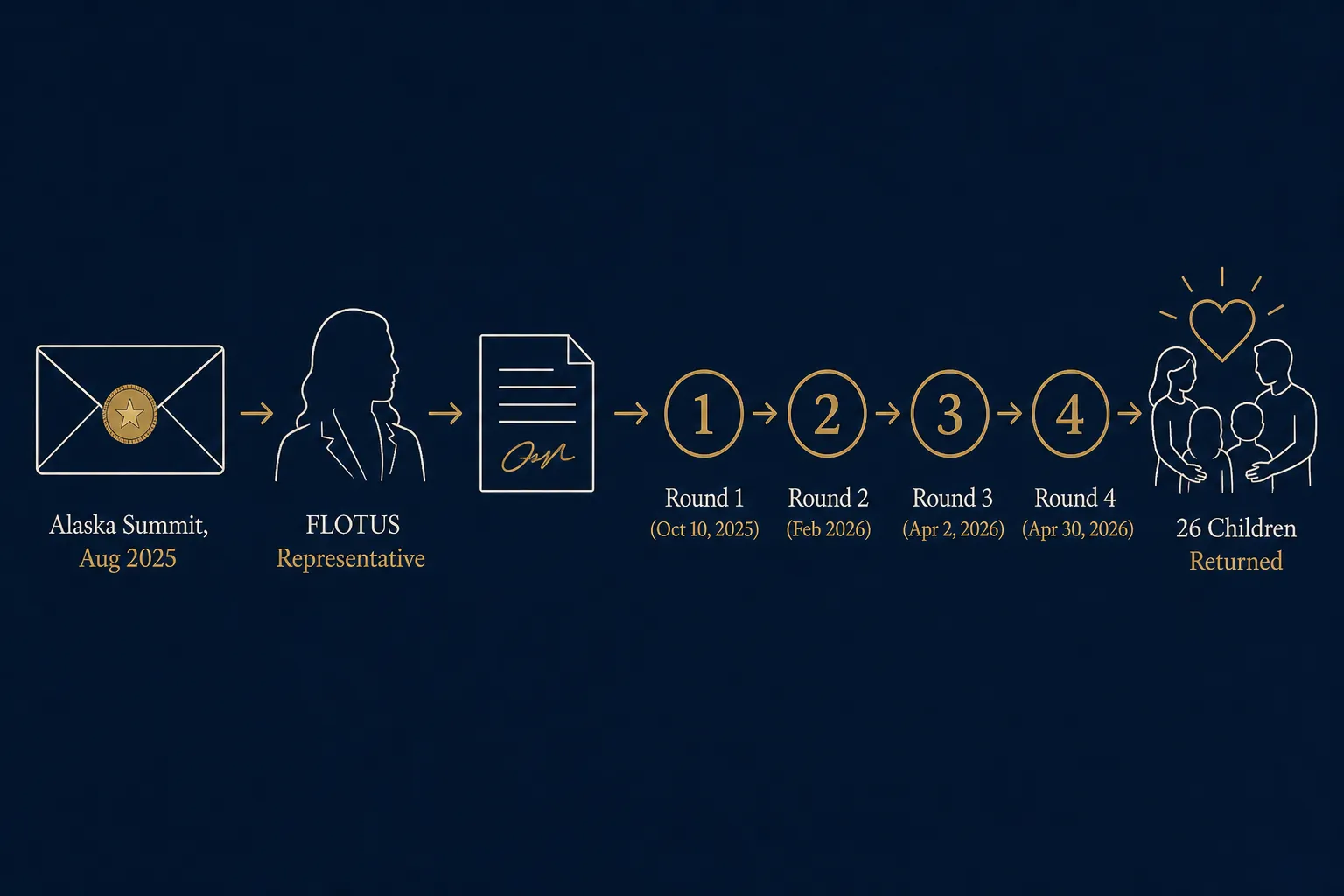
Lubinets's explanation is the most legally useful fact in the record because it describes why the route mattered. He said the first lady "helps us a lot" and that negotiations became easier because, when requests came through her, Russia "can't avoid" responding.[1] That does not prove a diplomatic breakthrough in the larger sense. It does show an operational effect: a request channel that made nonresponse more difficult for Moscow, at least in a limited set of child-return files.
The public record does not identify the first lady's representative, the full meeting locations, the conditions discussed, or whether accountability language was raised. It does not disclose concessions. It also does not show that the channel displaced Ukraine's own Bring Kids Back UA coordination structure or the work of Ukrainian officials and families. The safer reading is narrower: a politically unusual U.S. channel was used to secure Russian engagement on specific children, and Ukraine's ombudsman publicly credited it with helping.
The Denominator Is the Discomfort
Twenty-six returns are easy to minimize from a distance and impossible to dismiss if one of those children is in the file. The scale problem begins when the number is placed beside the verified universe of children Ukraine says were taken: more than 19,500. Against that baseline, 26 returns amount to about 0.13% of verified abducted children. Against roughly 2,100 total returns through all channels reported by April 30, 2026, the first lady's route accounts for about 1.2%.[1][7]

Those percentages do not make the 26 less human. They prevent the channel from being described as structurally adequate. A humanitarian file can be successful and still leave the system that created the file largely intact.
| Measure | Publicly Supported Figure | What It Measures |
|---|---|---|
| Children returned through the first lady channel | 26 by April 30, 2026 | Confirmed returns attributed by Ukraine's ombudsman to this route |
| Total returns through all channels | About 2,100 by April 30, 2026 | Aggregate returned children, not proof that one channel caused the total |
| Verified abducted children | More than 19,500 | Defensible verified baseline, not the highest estimate |
| FLOTUS share of verified abducted children | About 0.13% | A scale comparison, not a measure of legal significance |
| FLOTUS share of total known returns | About 1.2% | A contribution within the return ecosystem |
The reason the denominator matters is not only statistical. The mechanics of return are burdened by the alleged methods used to absorb children into Russian-controlled systems. Reported obstacles include Russian citizenship grants, placement on adoption databases, name changes, and re-education in at least 43 camps identified by Yale School of Public Health's Humanitarian Research Lab and summarized in the child-abduction record.[7] Each of those steps can convert a tracing problem into a status problem, then into a custody problem, then into a political problem.
That is why the return of a single child can require the sort of pressure and verification that looks disproportionate until the file is opened. Someone must identify the child, confirm family ties, secure Russian acknowledgment, negotiate movement, manage documentation, and keep the family from being made responsible for a geopolitical dispute. The smaller the public number, the more visible the administrative weight behind each successful return becomes.
The Conduct Being Negotiated Is the Conduct in the Warrants
The legal backdrop is not a vague allegation that Russia has mistreated Ukrainian children. On March 17, 2023, the International Criminal Court issued arrest warrants for Vladimir Putin and Maria Lvova-Belova for the war crimes of unlawful deportation and unlawful transfer of children from occupied areas of Ukraine to the Russian Federation, citing Rome Statute Articles 8(2)(a)(vii) and 8(2)(b)(viii).[5]
That distinction matters. The ICC warrants publicly announced in 2023 charge war crimes. They are not, in that notice, charges of crimes against humanity or genocide. The Genocide Convention contains a separate provision on forcibly transferring children of a group to another group, but that is not the classification in the ICC warrant notice at issue here. Treating all of these labels as interchangeable weakens the record rather than strengthening it.
A broader classification followed in another forum in March 2026. The UN Independent International Commission of Inquiry on Ukraine concluded that Russian authorities' deportation and forcible transfer of Ukrainian children amounted to crimes against humanity, specifically deportation or forcible transfer and persecution under Rome Statute Articles 7(1)(d) and 7(1)(h). The Commission said it had verified more than 1,200 cases across five regions, found that 80% of the children in those verified cases had not been returned, and concluded that the policy was carried out under the authority of Russia's highest leadership.[6]
The sequence is important for practitioners. The ICC action creates individual criminal process against named suspects for war crimes. The UN Commission's finding supplies a broader institutional assessment that the pattern also reaches crimes against humanity. Neither fact legally bars humanitarian contact for child returns. Neither fact makes the contact legally neutral.

What the Backchannel Did Not Publicly Say
The first lady's public language reportedly referred to children "displaced" by the Russia-Ukraine war and to reunification after talks with Putin.[3] That wording is not a legal classification. It is also not the terminology used by the ICC or the UN Commission. For legal-risk work, this gap is not cosmetic. Language can preserve claims, blur them, or create future exhibits for parties arguing that a situation was treated as humanitarian displacement rather than alleged unlawful deportation and transfer.
At the same time, the existence of softer public language does not establish capitulation. Humanitarian negotiators often avoid public phrasing that blocks the next transfer. A child's return may depend on a document being signed by someone who denies the premise of the accusation. The relevant question is not whether the public statement used every legal term available. It is whether the arrangement preserved the ability to document the underlying violation, identify responsible actors, and avoid laundering the alleged conduct as consensual family assistance.
On the public record, that preservation cannot be fully assessed. The channel's conditions, if any, remain undisclosed. There is no public indication that accountability commitments were attached to the returns. There is also no public proof that accountability was traded away. The evidence supports discomfort, not accusation.
Humanitarian Access and Accountability Are Not the Same Instrument
The temptation is to force the channel into one of two moral boxes: either a courageous workaround that proves formal justice is too slow, or an unacceptable engagement with an ICC indictee. Neither box is precise enough for international-law analysis.
A humanitarian channel can complement accountability by recovering victims, preserving testimony, and keeping individual files alive. It can also create risk if the accused state uses selective returns to dilute pressure, reframe the conduct as benevolent reunification, or establish a diplomatic habit in which access is exchanged for public restraint. The present record shows the first possibility in concrete human terms and leaves the second unresolved.
The Geneva Convention IV framework, as discussed by legal analysts at the Lieber Institute, treats forcible transfer and deportation of protected persons from occupied territory as core international humanitarian law concerns.[8] That framework helps explain why child-return negotiations cannot be evaluated as ordinary consular problem-solving. The alleged wrong is not only that children are away from home. It is that the removal and absorption process may itself be the prohibited act.
For a legal-risk analyst, the first-lady channel therefore raises a traceability problem. Who confirmed the child's identity and family link? Which authority acknowledged the child's location? Was the return documented as correction of an unlawful transfer, humanitarian family reunification, or something else? Were records preserved for later proceedings? Did any public statement imply recognition of Russian custody decisions? These questions are not meant to slow returns. They are meant to keep the return from erasing the legal record that made the return necessary.
The Precedent Is Small in Numbers and Large in Form
If the only metric is lives immediately affected, the channel is limited: 26 children. If the metric is diplomatic form, it is more consequential. A U.S. first lady's private route created a direct line to a head of state wanted by the ICC for the same child-transfer conduct being discussed. Russia responded. Ukraine's ombudsman welcomed the effect. The public accountability terms, if any, are invisible.
That combination is precisely why easy outrage misses something and easy congratulation misses more. Sneering at the channel ignores the practical fact that families and ombuds offices cannot wait for the perfect enforcement environment. Celebrating it as a breakthrough ignores the denominator, the legal classification, and the possibility that selective humanitarian cooperation can coexist with the continuation or denial of the underlying wrong.
Current international law does not provide a clean rule for this fact pattern. There is no public determination that humanitarian engagement with an ICC indictee over charged conduct is unlawful. There is also no settled assurance that such engagement is harmless when it proceeds without visible accountability conditions. The practice sits in the space between victim recovery and normalization risk.
The working judgment should stay that narrow. The channel appears to have helped return 26 Ukrainian children. It did not resolve the fate of more than 19,500 verified abducted children. It operated beside, not through, the ICC warrant framework and the UN Commission's crimes-against-humanity finding. For practitioners, the precedent to track is not whether humanitarian diplomacy is good or bad. It is whether future child-return channels can recover victims while keeping visible the legal claim that the transfers were not unfortunate displacement, but alleged international crimes.
References
- 'She helps us a lot.' Melania Trump aided in bringing back 26 Ukrainian children since last year, Ukraine's ombudsman says, Kyiv Independent, Apr. 30, 2026
- Melania Trump says eight Ukrainian children reunited with families after talks with Putin, BBC, Oct. 11, 2025
- Melania Trump says 8 kids displaced by Russia-Ukraine war reunite with families after Putin talks, Courthouse News / AP, Oct. 10, 2025
- First Lady Melania Trump Advances Efforts in Fourth Ukraine-Russia Child Reunification, White House, Apr. 2, 2026
- Situation in Ukraine: ICC judges issue arrest warrants against Vladimir Vladimirovich Putin and Maria Alekseyevna Lvova-Belova, International Criminal Court, Mar. 17, 2023
- UN Commission concludes deportation and forcible transfer of Ukrainian children constitute crimes against humanity, OHCHR, Mar. 20, 2026
- Child abductions in the Russo-Ukrainian war, Wikipedia
- Russia's Forcible Transfer of Children, Lieber Institute / West Point
Related records
Tool profile
Browse tool evaluations →Governing regulation
Browse the obligations tracker →Preventive workflow
Browse verification workflows →
Report a correction or tip
Spotted an outdated figure, a misstated fact, or a ruling this case record should reflect? Public comments are disabled for this content given the professional cost of a misreported case outcome, penalty amount, or rule text — use the structured correction channel instead.
Report a correction or tip for this record →