
DA's Legal Analysis of Memphis Burger King Shooting Video
Analysis of DA Mulroy's declination letter in the Memphis Burger King shooting reveals how the absence of verifiable primary evidence allowed deference to unverified accounts to determine the legal outcome, a pattern that mirrors AI citation verification risks.
- Jurisdiction
- US-TN
- Court
- Shelby County Criminal Court
- AI tool named
- None
- Ruling date
- Jul 20, 2026
- Source document
- View primary court order ↗
- Last verified
- Jul 25, 2026
Lex Machina Review is an independent risk-tracking and reference resource. Nothing on this site is legal advice, and using it does not create an attorney-client relationship. Every record is reviewed against primary sources but may not reflect the most current status of a matter — always verify directly against the cited court order, rule text, or a licensed attorney before relying on it.
Companion explanation — secondary to the source document above
The problem in Shelby County District Attorney Steve Mulroy’s declination letter is not that it reaches an impossible legal conclusion. It is that the conclusion rests on a factual account the available video apparently does not verify. Reported descriptions of the July 20, 2026 letter say its main analysis credits DEA Agent Alex Blandon’s account that Charles Pigram aggressively surged through a Burger King door before Blandon fired; the same reported footnotes say the restaurant surveillance footage appears to show Blandon moving through the door first and Pigram backing away.[1][2]
That is the narrow but important tension in the DA’s legal analysis of the Memphis Burger King shooting video. A prosecutor can decline charges under the governing use-of-force standards without proving that every factual premise in an agent’s account is objectively true. But when the only independent video is narrow, grainy, and silent, deference begins to carry more weight than corroboration. The letter can be legally defensible and still leave a record that feels thinner than the consequence it supports.
The Footnote Problem
The declination letter itself was not available for direct review as a PDF, so the exact footnote language should be treated carefully. The key phrasing here is reconstructed from media reports that quoted or described the letter, not from an independently inspected primary copy. That distinction matters because this is an article about verification gaps; it would be careless to smooth over one while criticizing another.
According to those reports, the letter’s body recites the agents’ account: Pigram moved aggressively toward Blandon as officers attempted to arrest him. But the reported footnotes acknowledge that surveillance footage appears inconsistent with that account, including that Blandon appears to be the one surging through the door and that Pigram appears to back away.[1][2]
A footnote can do a great deal of work in a legal document. Here, it appears to preserve an evidentiary caveat while the main analysis proceeds through the officer-perception framework. That is not the same as ignoring the video. It is more precise, and more troubling: the video is acknowledged, but it does not dislodge the account that supplies the reasonable-threat premise.
The Shelby County District Attorney’s Office announced on July 20, 2026 that no criminal charges would be filed against Blandon in Pigram’s death.[3] The office’s conclusion belongs to a familiar legal category: a prosecutor explaining why the available evidence does not establish criminal liability beyond a reasonable doubt. But the hard part is not the charging threshold in the abstract. It is how that threshold functions when the decisive moment depends on an agent’s perception and the available recording cannot independently resolve what the agent actually faced.
Why the Legal Standard Can Tolerate an Unverified Account
Tennessee’s deadly-force statute does not ask whether a later viewer, studying a restaurant camera angle, can certify the officer’s account as factually complete. Tennessee Code § 39-11-620 permits deadly force by a law enforcement officer in defined circumstances, including when the officer reasonably believes the force is immediately necessary and when other reasonable means of apprehension are exhausted or unavailable.[4]
The federal constitutional frame points in the same direction. In Graham v. Connor, the U.S. Supreme Court held that claims of excessive force during an arrest or investigatory stop are evaluated under the Fourth Amendment’s objective-reasonableness standard, judged from the perspective of a reasonable officer on the scene rather than with “20/20 vision of hindsight.”[5]
Those standards are often described as deferential, but the important point is what they defer to. They do not require perfect after-the-fact certainty. They ask whether, under the circumstances confronting the officer, the use of force could be understood as reasonable. That makes sense in a fast-moving arrest. It also creates a serious evidentiary problem when the circumstances confronting the officer are known mainly through the officer’s own account.
The legal distinction is easy to flatten. If the video appears to contradict the agents’ description, one might assume prosecution must follow. If the statute and Graham permit deference, one might assume the contradiction no longer matters. Neither inference is clean. The contradiction matters because it weakens confidence in the factual narrative. It may still be insufficient to establish that Blandon committed a crime.
Legally Permissible Is Not the Same as Tactically Prudent
Former Shelby County Assistant District Attorney Kevin Rardin’s critique helps locate the middle ground. In media coverage of the declination decision, Rardin distinguished between a use of force that may be legally permissible and tactics that may have been poor or unnecessary.[6] That distinction is not a compromise slogan; it is the hinge of the case.
A prosecutor deciding whether to charge an agent must evaluate criminal liability. The public watching the video may also be evaluating planning, restraint, positioning, communication, and whether officers created the very compression that later became the threat. Those are related questions, but they are not identical legal tests.
This is why the declination letter can be both unsurprising and unsatisfying. If Blandon could reasonably have perceived an immediate threat in a confined doorway during an attempted arrest, the criminal-law analysis may have no charge to bring. If the footage appears to show Blandon entering first and Pigram retreating, the record still fails at a different task: persuading a careful reader that the credited account has been independently verified.
What the Surveillance Footage Can and Cannot Do
The Burger King cameras are not meaningless. They are the reason the discrepancy is visible at all. Action News 5’s follow-up reporting identified specific ways the available footage appeared to diverge from the agents’ narrative and included the family attorney’s response to the declination decision.[6]
But restaurant surveillance is not the same as a body-worn camera record. The available reports describe three operational restaurant cameras, with footage that was grainy, limited in angle, and without audio. Those limitations matter because the legally decisive question is not merely body direction in a doorway. It is what a reasonable officer could have perceived in the moment: distance, hands, verbal warnings, timing, obstruction, and whether less-lethal or non-deadly options were meaningfully available.
The surveillance footage apparently undercuts the clean version of the agents’ account. It does not necessarily supply a complete replacement account. That is the evidentiary trap. The record contains enough video to make the official narrative look unstable, but not enough video to answer all the questions that the legal standard permits the prosecutor to ask.
| Question | What the available surveillance can show | What remains hard to verify |
|---|---|---|
| Who moved through the doorway first | Reportedly, Blandon appears to move through first | Whether that movement followed an unseen or unheard threat cue |
| Whether Pigram was moving toward or away | Reportedly, Pigram appears to back away | Whether Blandon reasonably perceived danger from hands, distance, or timing |
| Whether commands were given | The cameras lacked audio | What was said, heard, or misunderstood before the shot |
| Whether less force was available | The footage may show positions and movement | Whether other reasonable means were exhausted or unavailable under the statute |
The Missing Body-Camera Layer
The evidentiary gap did not simply happen at the Burger King door. ProPublica reported that the DEA ended its body-camera program after a Trump executive order, with an internal email announcing that the 2022 Biden mandate would terminate effective April 1, 2025.[7] The available materials do not independently verify the precise day-to-day effect of that policy on the Memphis Safe Task Force. But the policy context is central to understanding why the public record in Pigram’s case was so dependent on restaurant cameras.
Body-camera footage would not automatically decide the case. It can be obstructed, ambiguous, activated late, or interpreted differently by different viewers. Still, it is the recording layer designed for exactly this kind of encounter. It is closer to the officer’s perspective, more likely to capture commands and timing, and less dependent on a private business’s camera placement.
Once that layer is absent, a declination letter has to do something awkward. It must apply a perception-based legal standard without the best available evidence of perception. The result is not a simple cover-up theory. It is an institutional design problem: the law asks what could reasonably have been perceived, while the recording policy removes the tool most likely to show what was perceived.
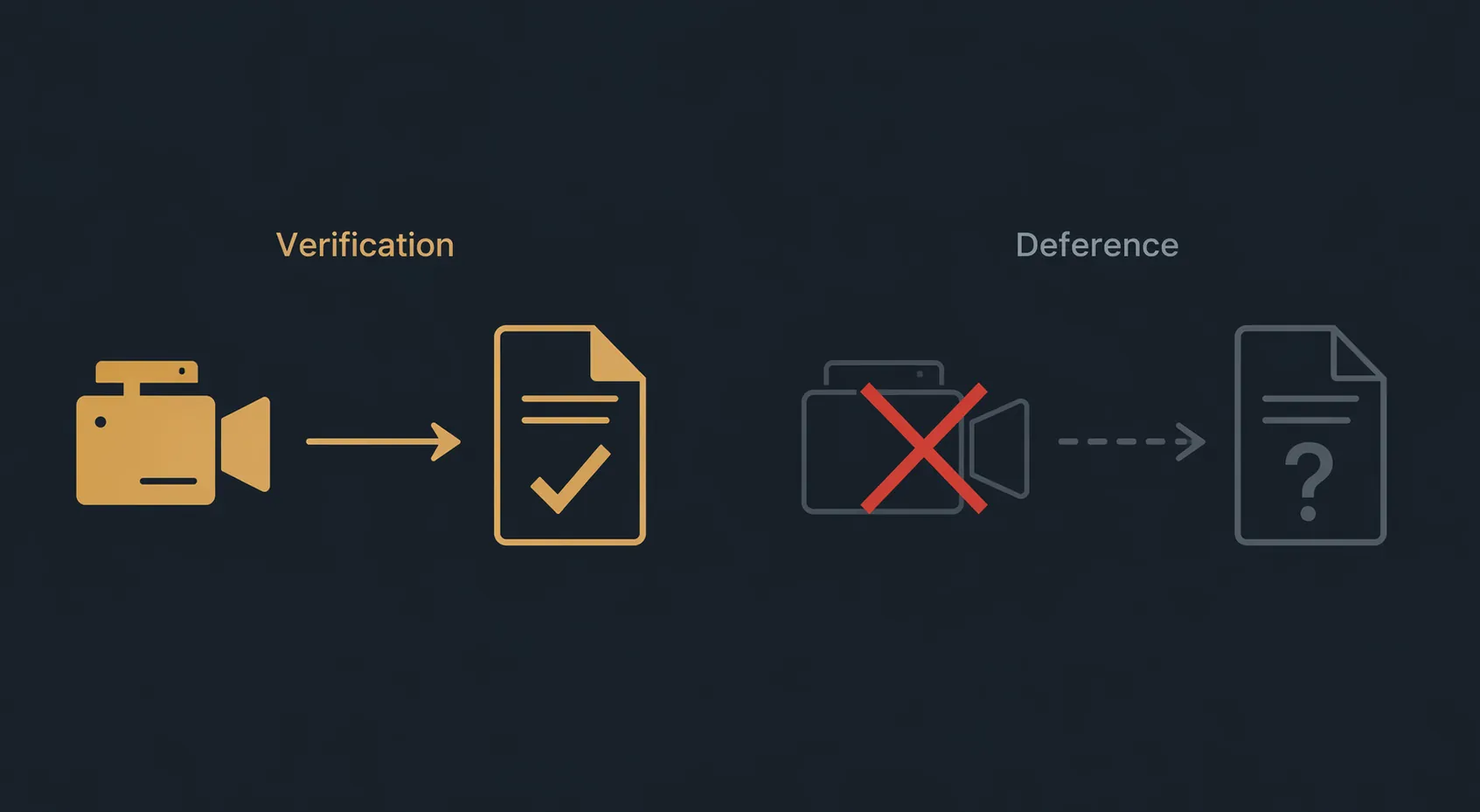
Deference Becomes a Substitute for Verification
Legal professionals have seen this pattern outside criminal procedure. In legal AI review, the immediate danger of a hallucinated citation is not only that a model invents something false. It is that a downstream reviewer, partner, or court treats an unverifiable reference as if it has already passed through a primary-source check. The failure occurs when institutional trust moves faster than verification.
The Pigram declination letter presents a different domain and far higher stakes, but the structure is recognizable. When the primary verification layer is missing, the system leans harder on the account that remains. A prosecutor does not need to claim certainty; the charging standard and the reasonableness framework can do the work. The account becomes outcome-determining because the available record cannot reliably defeat it.
That is why the footnotes matter. They appear to concede that the record is not clean. Yet the legal analysis still arrives at no charges because the governing standards leave room for reasonable perceived danger even where the footage does not corroborate the narrative in full. Deference has not been abused in any way the available materials prove. It has been asked to stand where corroboration should have been.
The Limits of the Public Record
The broader task-force context should be handled with restraint. The available materials note that the Tennessee Bureau of Investigation has declined to release investigative files in four task-force shootings, citing Tennessee law that shields records during ongoing investigations. That limits what can responsibly be inferred about patterns, training, supervision, or whether the Pigram record is representative.
It also limits the family’s ability, and the public’s ability, to reconstruct what happened from primary materials. A declination letter is not an evidentiary file. It is a prosecutor’s explanation of a charging decision. It selects, characterizes, and applies law to facts; it does not give the reader the full investigative substrate needed to test every premise.
That distinction should make lawyers uneasy even when they agree with the legal result. A no-charge decision can be correct under Tennessee law and Graham. It can also depend on a record too thin to satisfy anyone trained to ask whether the best evidence was preserved, produced, and matched against the claim it is supposed to support.
What the Letter Cannot Repair
The most defensible reading of the Pigram declination letter is also the most uncomfortable one. The district attorney could acknowledge apparent inconsistencies in the surveillance footage and still conclude that criminal charges were not supported. The legal standards permit that outcome because they focus on reasonable perception in a fast-moving encounter, not on later factual certainty from a perfect record.
But the record was not perfect, and the missing evidence was not incidental. If the body-camera layer had existed, the analysis might still have ended in declination. It would at least have had a more direct source for the perception question that Tennessee law and Graham make decisive.
A declination letter can explain why charges will not be filed. It cannot repair the missing primary record. In this case, that absence is not a rhetorical flourish or a generalized complaint about policing. It is the gap through which lawful deference became enough.
References
- Declination letter coverage of the Memphis Burger King shooting, ABC News
- Coverage of the Pigram declination letter, The Commercial Appeal
- Shelby County District Attorney General official release on the Pigram shooting declination, Shelby County District Attorney General, July 20, 2026
- Tennessee Code § 39-11-620. Use of deadly force by law enforcement officer, Justia
- Graham v. Connor, 490 U.S. 386 (1989), Legal Information Institute, May 15, 1989
- Action News 5 follow-up on family attorney response and video discrepancies, Action News 5, July 23, 2026
- DEA Ends Body Camera Program After Trump Executive Order, ProPublica
Related records
Tool profile
Browse tool evaluations →Governing regulation
Browse the obligations tracker →Preventive workflow
Browse verification workflows →
Report a correction or tip
Spotted an outdated figure, a misstated fact, or a ruling this case record should reflect? Public comments are disabled for this content given the professional cost of a misreported case outcome, penalty amount, or rule text — use the structured correction channel instead.
Report a correction or tip for this record →