
Could Meta's $14B BlackRock deal create bondholder risk?
This article examines whether the off-balance-sheet SPV structure used in the Meta-BlackRock $14 billion El Paso data center venture creates securities disclosure exposure for Meta and its financing partners, drawing on the pending Oracle bondholder class action and recent regulatory warnings.
- Jurisdiction
- us-new-york
- Court
- New York Supreme Court
- AI tool named
- Unspecified
- Ruling date
- Jan 14, 2026
- Source document
- View primary court order ↗
- Last verified
- Jul 29, 2026
Lex Machina Review is an independent risk-tracking and reference resource. Nothing on this site is legal advice, and using it does not create an attorney-client relationship. Every record is reviewed against primary sources but may not reflect the most current status of a matter — always verify directly against the cited court order, rule text, or a licensed attorney before relying on it.
Companion explanation — secondary to the source document above
The July 28, 2026 Meta-BlackRock El Paso transaction is not hard to describe, which is why its disclosure posture matters. Meta and BlackRock formed a data center venture valued at about $14 billion; BlackRock holds 80% of the special-purpose vehicle, the SPV carries $12.5 billion of debt, and Meta disclosed an approximately $13 billion residual value guarantee in footnotes rather than as a headline obligation.[1][2] The legal issue is not whether Meta needs capacity or whether BlackRock may properly finance infrastructure. The issue is whether a formally separated, non-recourse structure still creates an economically material exposure that bond investors would want surfaced before they buy, hold, or price debt.
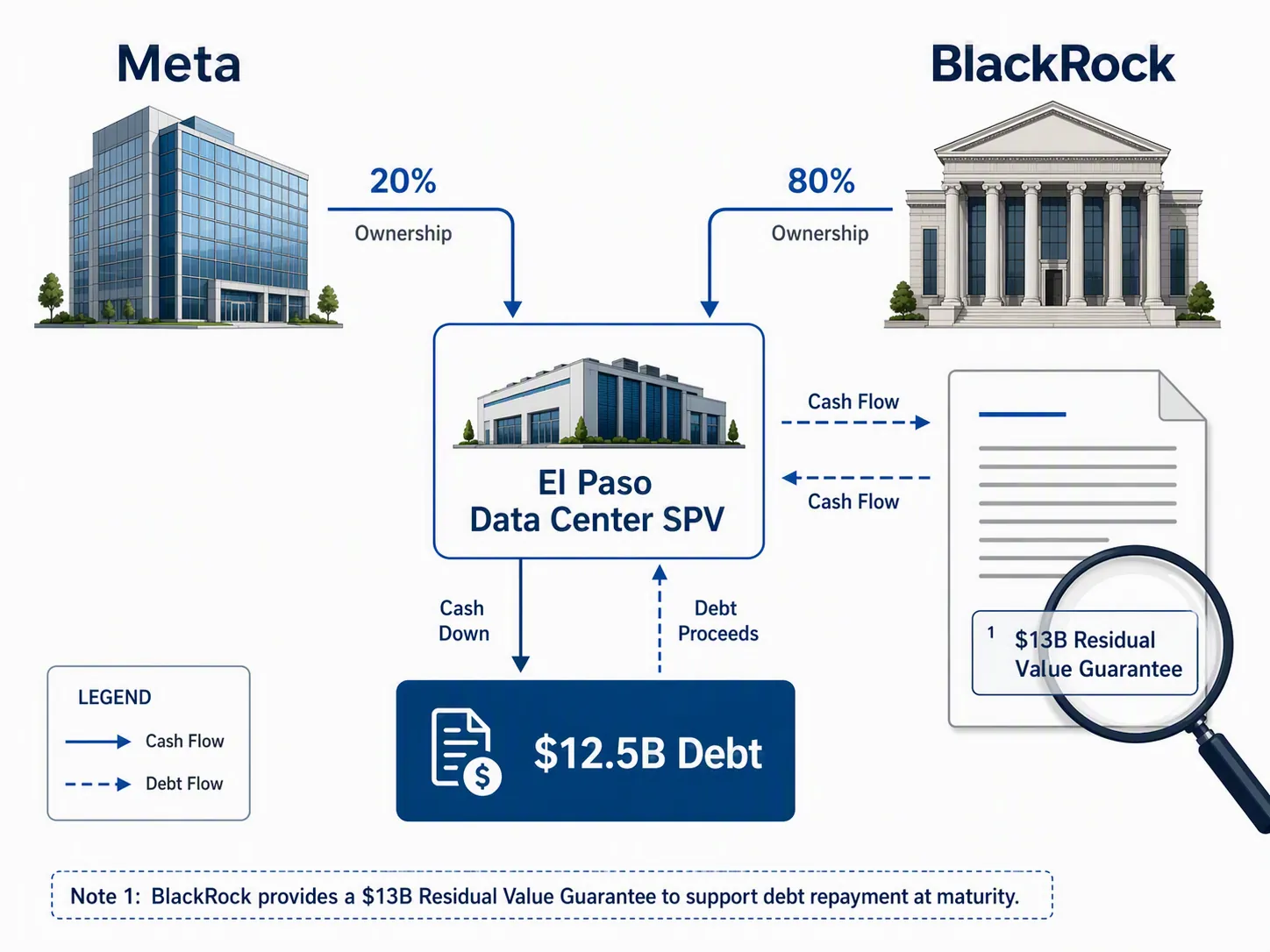
That distinction is easy to blur. An SPV can be outside the sponsor’s consolidated debt presentation and still matter to credit. A residual value guarantee can be contingent and still shape expected cash exposure. A footnote can satisfy a technical accounting presentation and still be too quiet for a market-facing risk discussion. The El Paso structure sits directly on that fault line: BlackRock-majority ownership and SPV debt on one side; a Meta-linked guarantee of roughly the same order of magnitude as the debt stack on the other.[1][2]
What The El Paso Structure Puts In Front Of Bondholders
A credit reader will see four moving pieces before reaching any broader AI story: Meta’s need for data center capacity, BlackRock’s majority equity position, the SPV’s $12.5 billion debt load, and Meta’s approximately $13 billion residual value guarantee.[1][2] The guarantee is the part that changes the disclosure analysis. It does not make the SPV debt identical to ordinary Meta senior debt, but it can make the economics less remote than the phrase “off balance sheet” suggests.
For a bondholder, the useful question is not whether the obligation is consolidated in the same line item. It is whether the arrangement can require cash, support asset values, alter refinancing risk, or change the company’s future capacity to service other debt. If the answer may be yes at a scale near $13 billion, the placement of the disclosure becomes more than formatting.
The reported timing sharpens that question. CNBC reported analyst estimates projecting Meta’s free cash flow to decline by about 90% in 2026 while capital expenditures rise to a $125 billion to $145 billion range.[1] Those figures do not prove that the El Paso guarantee will be called, and they do not establish that any filing was misleading. They do make contingent and off-balance-sheet exposures more relevant to a credit committee assessing how much cash flexibility remains after the AI buildout is funded.
Why Moody’s Warning Matters Here
The most important outside signal is not political criticism of data centers. It is Moody’s February 2026 credit warning that AI-sector lease obligations can understate true cash-flow exposure.[3] That is a market-risk frame. It asks whether the reported liability presentation captures the economics that matter to creditors.
Moody’s warning does not decide Meta’s accounting, and it does not accuse the El Paso parties of wrongdoing. Its relevance is narrower and stronger: it identifies the same category of risk that appears in the El Paso structure. Where AI infrastructure is funded through lease-like, SPV, or partnership arrangements, the contractual allocation of ownership can differ from the sponsor’s practical dependence on the asset and its associated cash commitments.[3]

That is why the roughly $13 billion residual value guarantee should not be treated as a stray annotation. In structured finance documents, residual value support is often where formal asset ownership and practical credit exposure start to diverge. A guarantee may be contingent, but it can also transfer enough downside risk to make the sponsor’s economic position look closer to financing than ordinary procurement.
The Hyperion/Beignet Precedent Makes El Paso Look Less Isolated
El Paso also reads differently against Meta’s earlier Hyperion facility, associated with Beignet Investor. A March 2026 Quinn Emanuel client alert described Meta’s approximately $30 billion Hyperion facility as precedent for the SPV model.[4] A law-firm alert is not a judicial finding, and it should not be treated as one. But it is useful evidence that practitioners already viewed the model as repeatable before the El Paso announcement.
Repeatability matters to disclosure analysis. A one-off structure may be explained as bespoke financing for a particular project. A pattern can become part of how a company funds a strategic buildout. If a company repeatedly uses majority-partner SPVs and residual support to obtain data center capacity, investors may reasonably ask for a clearer map of the sponsor’s aggregate cash exposure, not merely the legal perimeter of each vehicle.
That does not collapse all SPV debt into corporate debt. It does mean the analytical focus moves from accounting labels to practical materiality. How much of the asset risk remains with Meta? How large is the guarantee relative to expected free cash flow? Are similar guarantees present across multiple facilities? Would the answer affect pricing of Meta debt or the risk appetite of financing partners? Those are credit questions before they become litigation questions.
The Oracle Bondholder Case Shows The Litigation Path, Not The Outcome
The pending Oracle bondholder action is the reason this is no longer just an analyst concern. In Ohio Carpenters’ Pension Plan v. Oracle Corp., filed January 14, 2026 in New York Supreme Court, bondholders assert Securities Act Sections 11 and 12 claims tied to alleged AI infrastructure financing opacity.[5] The complaint is important because it shows plaintiffs testing whether off-balance-sheet AI infrastructure exposure can support a bond-offering disclosure theory.
It is equally important that the case remains pending and, based on the record provided, has no merits ruling. A filed complaint is not a holding. It does not prove that similar disclosures are false, misleading, or actionable. It does, however, identify the route a plaintiff may try to take: start with offering documents, isolate the treatment of AI infrastructure obligations, compare reported liabilities with alleged economic exposure, and argue that bond purchasers lacked material information when they bought securities.
Sections 11 and 12 make that route especially attractive in a bond context because they focus on alleged misstatements or omissions in registration statements and prospectus materials. A plaintiff does not need to turn every accounting choice into fraud. The more direct question is whether the offering materials omitted or softened information that a reasonable investor would view as important to the investment decision.
That is where El Paso’s footnote-only residual value guarantee becomes legally interesting. A defense can argue that the guarantee was disclosed. A plaintiff can respond that burying a guarantee of roughly $13 billion in footnotes, in the context of a capital-intensive AI buildout and projected free-cash-flow compression, failed to give the exposure the prominence a fixed-income investor would expect.[1][2][5] The merits of that argument remain untested for Meta’s structure.
Regulatory Signals Add Pressure Without Proving A Violation
The January 2026 Senate warning from Senators Elizabeth Warren, Richard Blumenthal, Chris Van Hollen, and Tina Smith gives the issue a systemic-risk vocabulary. The senators warned that opaque AI debt markets “could cause destabilizing losses for an interconnected set of financial institutions.”[6] That warning does not establish that Meta, BlackRock, or any financing partner violated securities law. It does show that opacity in AI infrastructure finance had become a live oversight concern before the El Paso announcement.
The Federal Reserve Bank of Chicago’s concern points in a related direction: banks may have indirect exposure through lending to private credit funds.[7] That matters because the visible borrower in an SPV structure may not capture where losses, refinancing stress, or liquidity pressure ultimately travel. For disclosure counsel, the lesson is not that every indirect exposure must be described as issuer debt. It is that off-balance-sheet financing can create risk channels that conventional balance-sheet snapshots do not show cleanly.
The AI Data Center Moratorium Act, introduced by Senator Bernie Sanders and Representative Alexandria Ocasio-Cortez on June 24, 2026, belongs in a different category.[8] It is a legislative signal, not enacted law. It may affect the atmosphere around AI data center expansion, but it does not supply a disclosure standard for the El Paso SPV and does not show liability.
Nor is there a Department of Justice view to import into this analysis. On the record provided, DOJ has not opined on the Meta-BlackRock El Paso structure. That absence matters. The present risk is a securities-disclosure and credit-market risk, informed by analyst warnings, pending private litigation, and regulatory attention. It is not a DOJ-backed theory.
What A Careful Disclosure Record Would Need To Confront
The practical materiality question is straightforward: would a serious fixed-income investor want a plain description of the guarantee and related cash-flow exposure before buying or holding debt? With El Paso, the answer is difficult to dismiss. The SPV has $12.5 billion in debt, while Meta’s residual value guarantee is reported at approximately $13 billion.[1][2] A guarantee of that scale is not background color.
The strongest defense-facing point is that disclosure placement alone is not automatically actionable. Footnotes are part of filed disclosure. Investors, underwriters, and analysts are expected to read them. A residual value guarantee may also be contingent, project-specific, and subject to conditions that reduce the probability or timing of cash outflow.
The strongest plaintiff-facing point is that prominence can be part of materiality. If a company uses a structure that reduces reported debt while preserving meaningful downside exposure, a court may be asked to decide whether the total mix of information gave bondholders enough to understand the issuer’s actual financing risk. The pending Oracle action shows that plaintiffs are already framing that question under federal securities statutes.[5]
| Record Item | Why It Matters |
|---|---|
| BlackRock-majority El Paso SPV | Supports formal separation from Meta but does not eliminate the need to assess Meta-linked economic exposure. |
| $12.5 billion SPV debt | Gives the financing structure credit scale, even if the debt is not presented as ordinary Meta corporate borrowing. |
| Approximately $13 billion residual value guarantee | Creates the disclosure pressure point because the support is close in size to the SPV debt stack. |
| Moody’s February 2026 warning | Frames AI infrastructure obligations as potentially understating true cash-flow exposure. |
| Oracle bondholder complaint | Shows a live Sections 11 and 12 theory, while leaving the merits unresolved. |
For in-house counsel, the risk is not limited to whether a particular accounting conclusion can be defended. The more durable issue is whether offering documents, risk factors, MD&A-style discussion, and debt-investor communications describe the economic substance of the financing with enough clarity. If the key exposure appears only where a reader must hunt for it, the record gives future plaintiffs an avoidable narrative.
The Narrow Bottom Line
The Meta-BlackRock El Paso SPV creates real, documentable disclosure exposure because its mechanics resemble AI infrastructure structures already criticized by credit analysts, noticed by regulators, and targeted by bondholder plaintiffs. The exposure is not the same as proven liability. No court has ruled on the merits of the Oracle theory, no DOJ opinion is part of the record, and the legislative signals remain signals rather than binding rules.
Still, the practical marker has changed. A footnote-only treatment of a multibillion-dollar AI infrastructure residual value guarantee is no longer just an accounting presentation choice. In 2026, it is a litigation and regulatory risk marker that securities lawyers, underwriters, private credit funds, and corporate debt investors will have reason to read as carefully as the debt table itself.
References
- CNBC report on Meta-BlackRock El Paso data center venture, CNBC, July 28, 2026.
- Reuters report on Meta-BlackRock El Paso data center venture, Reuters, July 28, 2026.
- Moody’s February 2026 warning on AI-sector lease obligations and cash-flow exposure, Moody’s, February 2026.
- Quinn Emanuel client alert on Meta’s Hyperion facility and the Beignet Investor SPV model, Quinn Emanuel, March 2026.
- Ohio Carpenters’ Pension Plan v. Oracle Corp., Index No. 150612/2026, N.Y. Sup. Ct., filed January 14, 2026.
- January 2026 Senate warning on opaque AI debt markets, Senators Warren, Blumenthal, Van Hollen, and Smith, January 2026.
- Federal Reserve Bank of Chicago analysis on bank exposure through private credit fund lending, Federal Reserve Bank of Chicago.
- AI Data Center Moratorium Act, introduced June 24, 2026.
Related records
Tool profile
Browse tool evaluations →Governing regulation
Browse the obligations tracker →Preventive workflow
Browse verification workflows →
Report a correction or tip
Spotted an outdated figure, a misstated fact, or a ruling this case record should reflect? Public comments are disabled for this content given the professional cost of a misreported case outcome, penalty amount, or rule text — use the structured correction channel instead.
Report a correction or tip for this record →