
Two consecutive life terms for Minnesota lawmaker assassination
The federal sentencing of Vance Boelter in the Minnesota lawmaker assassination case resulted in two consecutive life sentences without parole plus 40 years, the maximum non-capital penalty under federal law. A separate state prosecution on first-degree murder charges remains pending with a scheduled first appearance on August 3, 2026.
- Jurisdiction
- District of Minnesota
- Ruling date
- Jul 23, 2026
- Source document
- View primary court order ↗
Lex Machina Review is an independent risk-tracking and reference resource. Nothing on this site is legal advice, and using it does not create an attorney-client relationship. Every record is reviewed against primary sources but may not reflect the most current status of a matter — always verify directly against the cited court order, rule text, or a licensed attorney before relying on it.
Companion explanation — secondary to the source document above
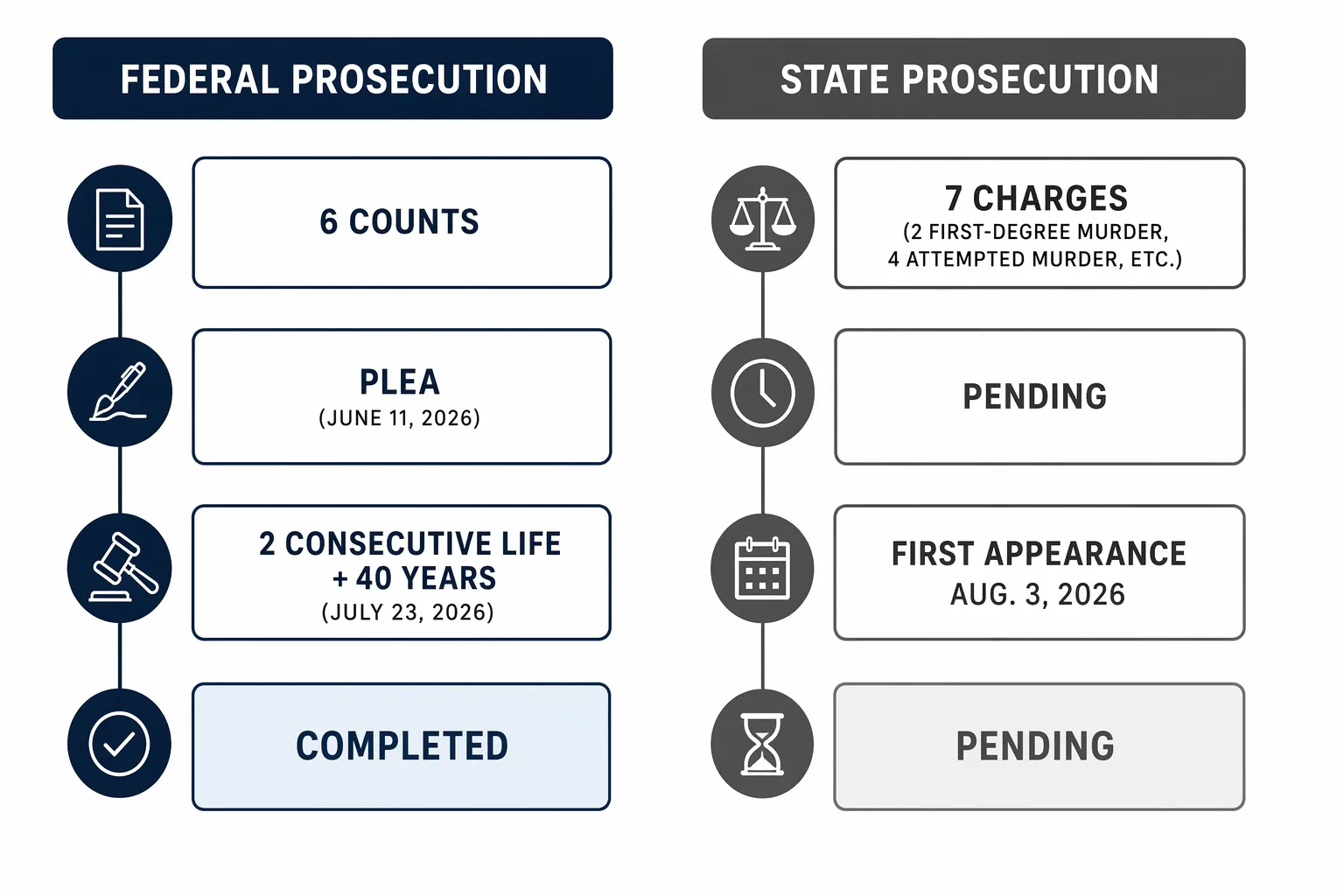
Vance Boelter’s federal sentencing in the Minnesota lawmaker assassination case now has a concrete penalty attached to it: two consecutive life sentences without parole, followed by 40 additional consecutive years. U.S. District Judge John R. Tunheim imposed the sentence in the District of Minnesota on July 23, 2026, after Boelter pleaded guilty to federal murder, stalking, and firearms counts in a plea agreement that avoided the death penalty.[1]
That is the federal outcome, not the entire legal outcome. Hennepin County’s prosecution remains pending on state charges that include first-degree premeditated murder, and Boelter’s first appearance in that case is scheduled for August 3, 2026.[3][4] For anyone tracking the Minnesota lawmaker assassination trial outcome and sentencing, that distinction matters: the federal sentence has been imposed as a courtroom result, while the state case is still a live proceeding.
The Federal Sentence Imposed
The federal sentence was structured to run in layers, not as a single life term. The two life sentences run consecutively, and the 40-year term runs consecutively after them. AP reported Judge Tunheim’s statement from the bench that it was “the longest sentence I have imposed after hearing thousands of cases over the years.”[1]
The plea was entered on June 11, 2026. Boelter pleaded guilty to six federal counts: two murder counts, two stalking counts, and two firearms offenses.[1] The federal charging history began after the shootings of former Minnesota House Speaker Melissa Hortman and her husband, Mark Hortman, and the shootings of State Sen. John Hoffman and his wife, Yvette Hoffman.[2]
| Track | Status as of July 24, 2026 | Penalty consequence |
|---|---|---|
| Federal case, District of Minnesota | Guilty plea entered; sentence imposed July 23, 2026 | Two consecutive life terms without parole plus 40 consecutive years |
| State case, Hennepin County | Pending; first appearance scheduled for August 3, 2026 | First-degree murder charges carry a separate mandatory life consequence if proved |
The phrase “maximum non-capital penalty” is doing necessary work here. It is narrower than “maximum penalty.” The plea agreement avoided a federal death-penalty trial, so the remaining federal sentencing frame was the harshest non-capital punishment available: life without parole, stacked consecutively, with the firearms term added after it.[1] Calling that simply “the maximum penalty” would blur the fact that capital exposure was resolved by plea rather than imposed or litigated to a verdict.
Why the Case Was Treated as an Extreme Targeted-Violence Prosecution
The federal record and related reporting describe a case built around planning and impersonation, not a sudden encounter. Prosecutors alleged that Boelter targeted public officials, appeared at residences while disguised as a police officer, and used a vehicle resembling law enforcement equipment during the attacks.[2] Reporting also describes a silicone mask and a list of roughly 70 targets.[1]
The police-disguise allegation is not decorative detail. It changes the risk analysis for every later official, staff member, spouse, or county clerk who has to decide whether a knock at the door is routine, threatening, or a trap. In a courthouse file, impersonation is a charge or an aggravating fact. In the real world, it corrodes the ordinary signals people rely on to stay safe.
The address-gathering evidence points in the same direction. Lawfare, discussing FBI affidavit details, reported that Boelter used 11 data broker sites to find addresses.[5] That fact should not be overstated into a general claim that data brokers cause political violence. It does, however, identify a concrete threat vector in this case: locating public officials and their families did not require an insider leak or physical surveillance alone.
The Victims and the Counts
The completed federal sentence arose from the deaths of Melissa Hortman and Mark Hortman and the attempted killings of John Hoffman and Yvette Hoffman. DOJ’s initial federal announcement identified the victims as two Minnesota lawmakers and their spouses and described the shootings that followed.[2] The state charging announcement likewise identified the state-law charges tied to the deaths and attempted killings.[4]
On the state side, Hennepin County announced charges including two counts of second-degree murder with intent, two counts of attempted second-degree murder, impersonating a peace officer, and animal cruelty, while stating that prosecutors would seek first-degree murder charges.[4] Later reporting on the continuing state case identified the pending charges as including two counts of first-degree premeditated murder and four counts of attempted first-degree murder, along with animal cruelty and impersonating an officer.[3]
That sequence is one reason a status-conscious record should avoid treating the federal sentencing as a procedural full stop. The federal plea resolved federal exposure. It did not dismiss Hennepin County’s case, did not convert the state charges into sentencing surplusage, and did not remove the independent state-law consequences that may follow if the prosecution proves its case or obtains a plea.
Federal and State Tracks Do Different Work
The federal case punished federal crimes: murder-related counts, stalking counts, and firearms offenses resolved by a federal guilty plea. The state case is not an appeal from that sentence and is not a backup sentencing memo. It is a separate prosecution by Hennepin County under Minnesota law, with its own charges, appearances, plea decisions, trial rights, and sentencing consequences.
The practical distinction is sharper than it may look from the outside. A federal life sentence without parole is already the end of any ordinary federal release analysis. But a Minnesota first-degree murder conviction carries a mandatory life consequence under state law, and that consequence is not made unnecessary as a legal matter merely because a federal judge has already imposed consecutive life terms.
The separation also matters for executive power. A federal sentence is subject to federal clemency authority. A state life sentence is not erased by a federal pardon. That is why the pending Hennepin County case remains material even after a federal sentence that, as a practical prison term, already reaches beyond a human lifespan.
What Still Needs Docket Verification
The sentencing occurred one day before this record date. As of July 24, 2026, the AP account supplies courtroom reporting for the sentence and Judge Tunheim’s statement, but the written federal judgment may still need verification on the District of Minnesota docket before the file is treated as fully primary-source complete.[1] That is not a reason to ignore the sentence. It is a reason to label the source posture correctly.
The same caution applies to the state calendar. The August 3, 2026 first appearance is a scheduled date, not a completed event.[3] Calendars move, appearances are continued, and state-court dockets should be checked before relying on that date for anything more precise than current procedural status.
For a risk record, the defensible formulation is therefore narrow: Boelter has been sentenced federally to two consecutive life terms without parole plus 40 consecutive years after a six-count federal guilty plea; the plea avoided the death penalty; the sentence represents the maximum non-capital federal punishment structure reported from the sentencing; and Hennepin County’s separate prosecution remains pending.
Current Procedural Status
As of July 24, 2026, the federal court has imposed the completed federal outcome: consecutive life terms without parole, plus 40 years, after a plea that removed the death penalty from the case.[1] Hennepin County’s case remains pending, with a first appearance scheduled for August 3, 2026, and state first-degree murder charges still capable of producing an additional mandatory life term if resolved against Boelter.[3][4] The federal sentence is not the end of the legal record.
References
- Vance Boelter is sentenced to life for killing Minnesota Democratic leader Melissa Hortman, AP News
- After Two-Day Manhunt, Suspect Charged with Shooting Two Minnesota Lawmakers and Their Spouses, U.S. Department of Justice
- State case against Vance Boelter will continue despite federal guilty plea, CBS News Minnesota
- Hennepin County Attorney's Office confirms multiple charges against Vance Luther Boelter, will seek first-degree murder charges, Hennepin County Attorney
- Data Brokers Are a Killer's Best Friend, Lawfare
Related records
Tool profile
Browse tool evaluations →Governing regulation
Browse the obligations tracker →Preventive workflow
Browse verification workflows →
Report a correction or tip
Spotted an outdated figure, a misstated fact, or a ruling this case record should reflect? Public comments are disabled for this content given the professional cost of a misreported case outcome, penalty amount, or rule text — use the structured correction channel instead.
Report a correction or tip for this record →