
Mother-Daughter Arrest at SFO Exposes ICE Facial Recognition Risks
The March 2026 arrest of a mother and daughter at SFO highlights the due-process risks of ICE's Mobile Fortify facial recognition app, which has a documented track record of misidentification and is treated by ICE as definitive evidence over physical documents. This article explains the tool's accuracy failures and how practitioners can challenge evidence derived from it in immigration proceedings.
- Jurisdiction
- US Federal
- Court
- U.S. District Court for the District of Minnesota
- AI tool named
- Mobile Fortify
- Ruling date
- Jan 1, 2026
- Source document
- View primary court order ↗
- Last verified
- Jul 30, 2026
Lex Machina Review is an independent risk-tracking and reference resource. Nothing on this site is legal advice, and using it does not create an attorney-client relationship. Every record is reviewed against primary sources but may not reflect the most current status of a matter — always verify directly against the cited court order, rule text, or a licensed attorney before relying on it.
Companion explanation — secondary to the source document above
The SFO arrest is the right warning, but not the Mobile Fortify case
The March 2026 mother-daughter arrest by ICE at SFO is the kind of incident that quickly gets flattened into a single phrase: facial recognition, airport surveillance, mistaken identity, immigration arrest. The procedural detail matters. The arrest was triggered by TSA Secure Flight data sharing, not by ICE’s Mobile Fortify app. Mobile Fortify belongs in the same enforcement environment, but the available materials do not show that it caused the SFO arrest. Treating the two as the same event would weaken the very argument that lawyers need to make: identity evidence has to be traced, not assumed. [1]
SFO still matters because it shows the posture of the modern immigration encounter. A person arrives with a travel record, a document history, and an identity she can explain. The government arrives with information moving through systems the person may not know exist. By the time counsel sees the file, the arrest may appear to rest on a clean administrative sequence rather than on a choice by one agency to transmit data and another agency to act on it.
That is the useful entry point for Mobile Fortify. The immediate question is not whether the SFO arrest was a Mobile Fortify incident. On the present record, it was not. The question is what happens in a removal, detention, bond, or collateral civil-rights record when an ICE identity tool is treated as more reliable than the person standing in front of the officer.
DHS classifies Mobile Fortify as high-impact
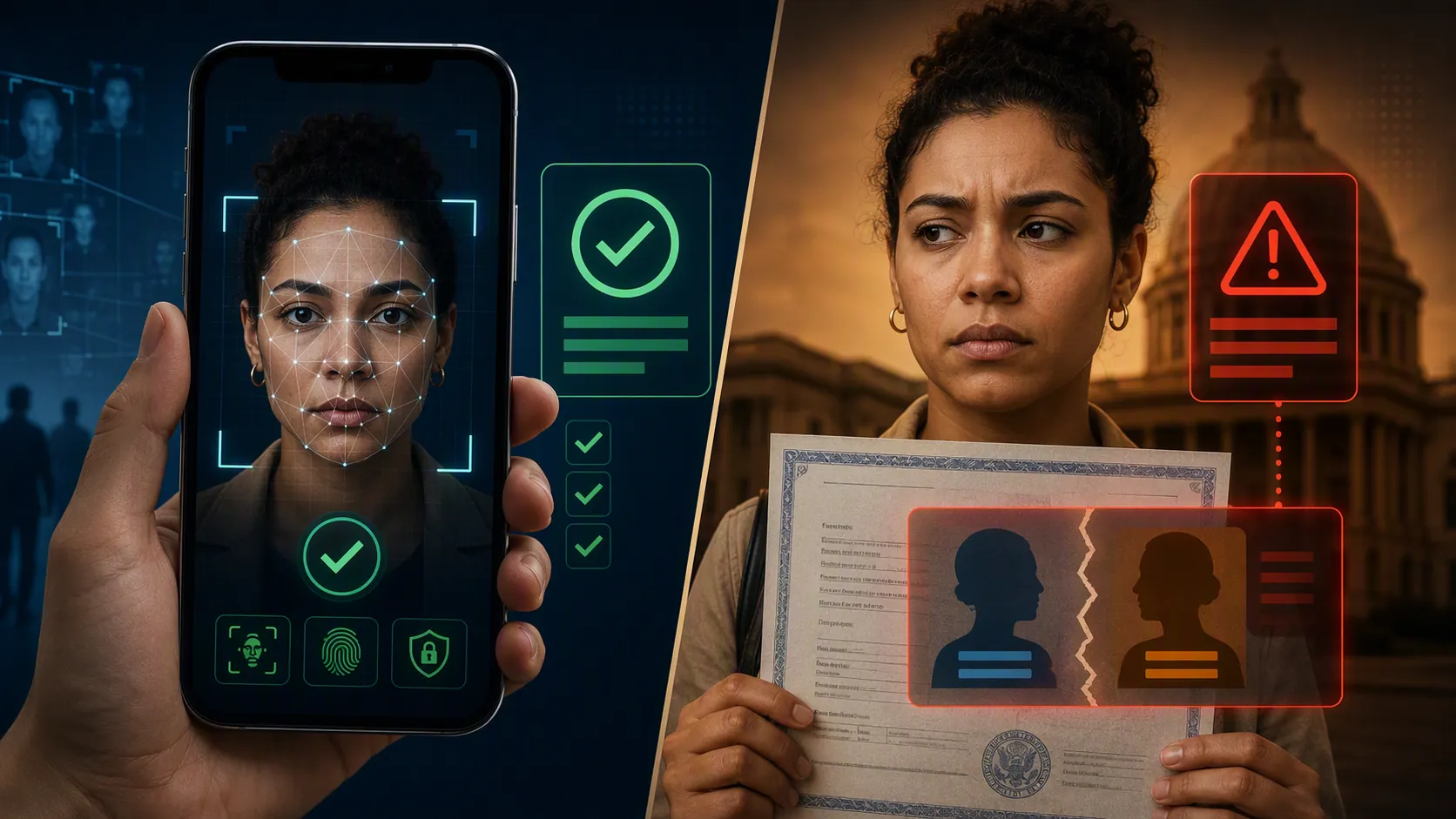
Mobile Fortify is not just an officer’s convenience app if it is being used to identify people in enforcement settings. DHS’s AI Use Case Inventory lists Mobile Fortify as DHS AI Use Case ID DHS-2577 and classifies it as a high-impact AI system. The inventory should be checked at the time of filing because DHS use-case entries can change; as of July 30, 2026 UTC, the high-impact classification is the important starting point. [2]
That label is not decorative. A high-impact classification signals that the system is being used in a context where an output can affect rights, liberty, legal status, or access to government processes. For a litigator, it changes the first move. The match should not be treated as a neutral database lookup unless the government can explain what was captured, where it was searched, what result was returned, who reviewed it, and how it entered the case file.
The Oregon misidentification is the record practitioners should study
The strongest available reliability warning is not a generalized objection to facial recognition. It is a January 2026 Oregon enforcement operation described by 404 Media in which Mobile Fortify returned two different wrong names for a single individual. The report is especially significant because it rests on sworn CBP testimony, not only on outside criticism of the technology. [3]
That fact pattern is narrow, but it is hard to dismiss. One person, one encounter, two different wrong names. A tool that produces that sequence has not merely made a typographical error in a file. It has generated identity assertions that could point officers, databases, and later adjudicators toward the wrong legal history.
The Oregon account does not prove that every Mobile Fortify result is unreliable. It does prove that a Mobile Fortify output is not self-validating. In an immigration record, that distinction matters. If the government offers a biometric match as the bridge between a body and an immigration history, the respondent should be able to test the bridge rather than cross it on faith.
The reported “definitive determination” posture is where the due-process problem sharpens
ACLU reporting adds a second, more troubling layer. The ACLU reported that Rep. Bennie Thompson said ICE officials told Congress that a Mobile Fortify biometric match is a “definitive” determination of immigration status and should be trusted over a physical birth certificate. The same reporting states that ICE does not allow people to refuse biometric collection and that photos of U.S. citizens are retained in DHS’s Automated Targeting System. [4]
That sentence has to be handled carefully. The available materials do not include an independently verified internal ICE policy document saying exactly that. The claim comes through ACLU reporting, citing a member of Congress’s account of what ICE officials told Congress. That is still important. It is not the same as a confirmed operating manual, but it is enough to justify targeted discovery, cross-examination, and preservation demands whenever a Mobile Fortify result appears to have displaced documentary evidence.
The dangerous move is evidentiary, not technological. A birth certificate, passport, state record, or immigration document has provenance that can be inspected. It has an issuing authority, a date, a custodian, and often a statutory framework for authentication. A facial-recognition result can look cleaner precisely because its intermediate steps are hidden. If an officer treats the app as conclusive while the respondent is left to rebut an output she cannot see, the hearing record is already tilted.
A Mobile Fortify match is evidence with a chain, not a fact without one
The first litigation mistake is to argue about “AI” in the abstract. The better question is how the asserted identity traveled into the record. A Mobile Fortify-derived allegation should be broken into parts: the image capture, the biometric comparison, the source databases, the returned candidate or candidates, the officer’s interpretation, any corroborating document review, and the later agency summary.
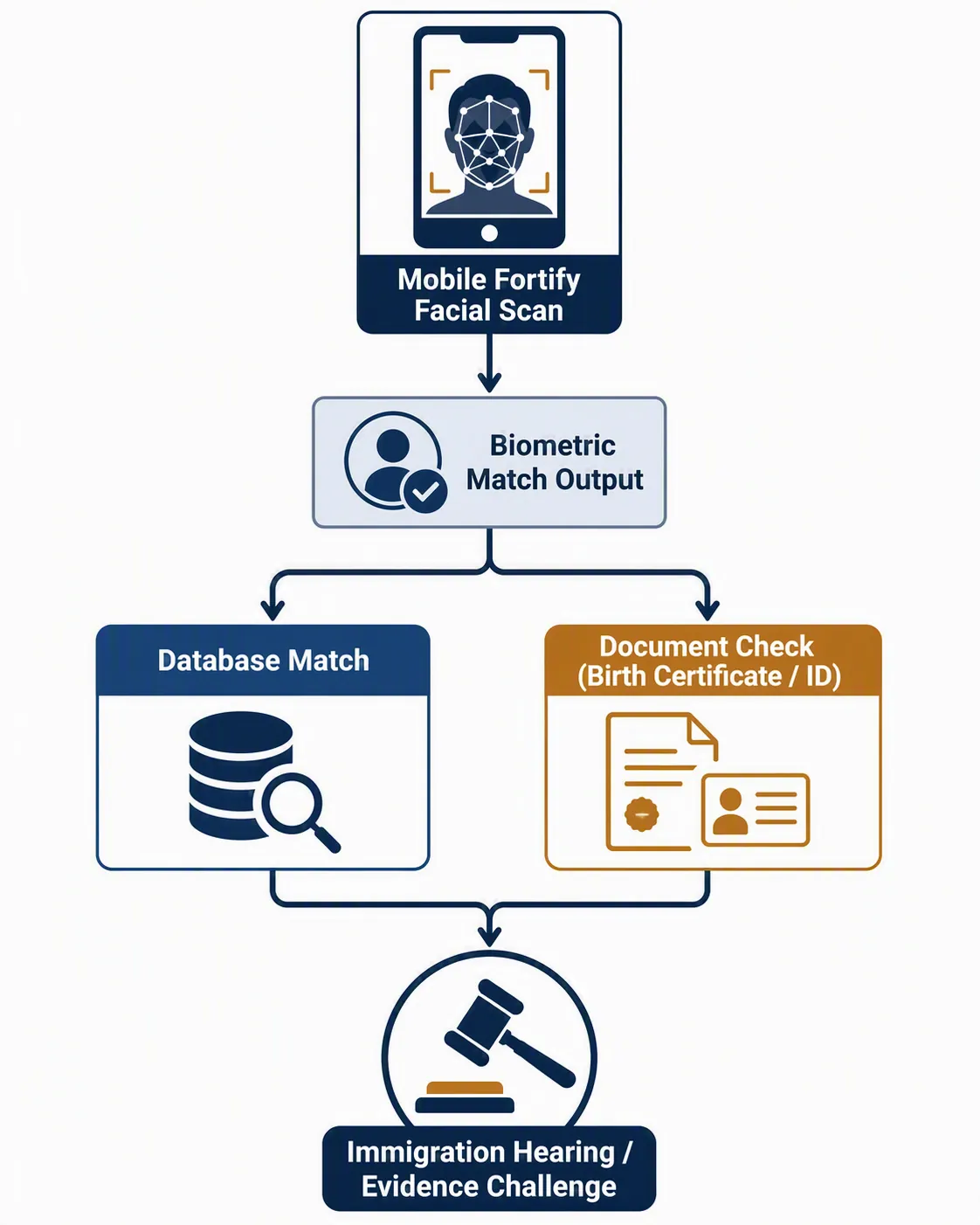
| Point in the chain | Questions counsel should press | Why it matters |
|---|---|---|
| Image capture | Who took the photo, under what authority, and were multiple images captured? | A later match cannot be evaluated without knowing what input the system actually processed. |
| Biometric comparison | What system produced the candidate result, and did it return one name, multiple names, or a confidence-ranked list? | The Oregon account shows why the difference between a single asserted match and multiple conflicting outputs is not cosmetic. |
| Source databases | Which repositories were searched, and what records populated them? | A facial-recognition output inherits the weaknesses of the databases it depends on. |
| Officer interpretation | Did an officer independently compare documents, ask follow-up questions, or simply accept the app output? | The due-process risk is greatest when the human review is only a rubber stamp. |
| Case-file entry | How did the match appear in the immigration record: raw output, officer note, sworn declaration, database printout, or summary? | A summary may conceal uncertainty, conflicting candidates, or missing provenance. |
This is where the 2019 federal ruling on ICE database reliability becomes useful. That ruling, as identified in the available materials, held that ICE’s own databases were too unreliable to serve as probable cause for warrants. It is not a Mobile Fortify case, and it should not be stretched into one. Its value is more disciplined: it supports the proposition that immigration databases and derivative outputs should not be accepted as probable-cause machinery without scrutiny of the underlying records.
A Mobile Fortify challenge can use the same instinct. The point is not that a biometric match is categorically inadmissible. The point is that the government should not be allowed to convert a database-dependent output into identity certainty while withholding the database path, confidence information, conflicting returns, and officer review steps that would let the respondent test it.
What the broader enforcement ecosystem adds, and what it does not
NPR’s March 2026 reporting places Mobile Fortify within a wider surveillance and enforcement ecosystem through interviews with people caught in DHS and ICE encounters. That reporting is useful because it shows how identity tools are experienced downstream: not as procurement categories, but as confrontations where the person being scanned may not control the setting, the data trail, or the later explanation of what happened. [1]
The surrounding litigation and civil-liberties record points in the same direction without proving every contested fact. Tincher v. Noem, filed in the District of Minnesota in December 2025, challenges ICE-related biometric and enforcement practices in a class-action posture. [5] Rights organizations also demanded in November 2025 that ICE halt Mobile Fortify, and EFF later reported in January 2026 on a Palantir tool connection involving Medicaid data feeds. [6][7]
Those materials should not be treated as substitutes for case-specific proof. A class action does not establish that the respondent in a separate proceeding was misidentified. A public demand to halt a tool does not prove that a particular match was wrong. Reporting about data connections does not, by itself, show which repositories Mobile Fortify searched in a given encounter. The value is different: the ecosystem evidence helps justify why counsel should ask for the technical and administrative record instead of accepting a short officer statement as the whole story.
How to frame the reliability challenge
A useful challenge starts by identifying whether Mobile Fortify was used at all. That question should be asked even when the record uses ordinary language such as “biometric verification,” “field identification,” “database confirmation,” “facial match,” or “mobile encounter.” Agency summaries can describe the conclusion while omitting the tool that generated it.
Once use is identified or reasonably suspected, the request should move from general discovery to provenance. Counsel should seek the raw match record, the timestamp, the image or images submitted, any candidate list, confidence or ranking information if generated, the databases queried, audit logs, officer notes, and any later edits or summaries. If the government claims the match was definitive, that claim should be pinned to a witness, document, policy, or training material rather than left as an atmospheric assertion.
The Oregon double-misidentification should be used carefully. It is not proof of universal failure. It is a concrete impeachment point against unexamined certainty: sworn testimony has already described a Mobile Fortify encounter in which the same individual was assigned two different wrong names. [3] That is enough to ask whether the respondent’s alleged match was independently corroborated, whether conflicting candidates were suppressed from the file, and whether the officer knew the tool could return erroneous identity information.
The reported birth-certificate posture should also be framed with precision. If the government’s witness says documents were disregarded because the app was considered definitive, the ACLU reporting supplies a reason to explore whether that deference reflects training or practice. [4] If the government denies such a policy, counsel still has a narrower argument: in this case, the officer chose the biometric output over documentary evidence, and the government must explain why that choice was reliable.
Probable cause and suppression arguments need a factual foundation
The strongest probable-cause argument will usually be record-specific. If officers acted first and documented later, if the only basis for identity was a Mobile Fortify return, or if the source databases have known reliability problems, the 2019 database ruling gives counsel a way to argue that a government database output cannot carry the probable-cause burden by itself. The argument becomes stronger where the government cannot produce the underlying match materials or where documentary evidence pointed the other way.
Suppression will not follow automatically. Immigration proceedings have their own evidentiary rules and remedial limits, and many judges will want a concrete showing of unreliability, coercion, regulatory violation, or egregious government conduct. That makes preservation important. Counsel should build the record early rather than waiting for a final hearing to object to a match that has already shaped detention, charging decisions, or credibility findings.
The risk posture for Mobile Fortify evidence
A Mobile Fortify match should not be treated as a neutral administrative lookup. The available materials show a DHS-classified high-impact AI system, a documented individual-level misidentification in sworn testimony, opaque dependency on underlying data systems, and reported agency deference to biometric output over physical documentation. That combination is enough to change how the record should be litigated.
The practical sequence is narrow but important: verify whether Mobile Fortify was used; demand the chain of evidence and underlying match records; test the reliability of the source databases; separate reported policy from verified primary-source material; and connect any probable-cause or reliability challenge to existing precedent on ICE database unreliability. The issue is not whether every Mobile Fortify match is wrong. The issue is whether the government can make a person bear the legal consequences of a biometric assertion it has not had to prove.
References
- NPR March 2026 reporting on ICE, DHS, immigrants, surveillance, confrontation, deportation, and Mobile Fortify, NPR, March 2026
- DHS AI Use Case Inventory, Department of Homeland Security
- ICE’s Facial Recognition App Misidentified a Woman Twice, 404 Media, January 2026
- ICE Face Recognition, ACLU
- Tincher v. Noem et al, ACLU, December 2025
- Rights Organizations Demand Halt to Mobile Fortify, ICE’s Handheld Face Recognition, Electronic Frontier Foundation, November 2025
- Report: ICE Using Palantir Tool That Feeds on Medicaid Data, Electronic Frontier Foundation, January 2026
Related records
Tool profile
Browse tool evaluations →Governing regulation
Browse the obligations tracker →Preventive workflow
Browse verification workflows →
Report a correction or tip
Spotted an outdated figure, a misstated fact, or a ruling this case record should reflect? Public comments are disabled for this content given the professional cost of a misreported case outcome, penalty amount, or rule text — use the structured correction channel instead.
Report a correction or tip for this record →