
Why the Liz Murrill Dismissal Leaves the Law Unsettled
The dismissal of charges against Louisiana AG Liz Murrill answers almost nothing on the merits. This entry explains why the case collapsed on procedural grounds, what the unresolved statutory ambiguity means for attorneys issuing official-duty warnings, and why no binding precedent was set.
- Jurisdiction
- Louisiana
- Ruling date
- Jul 22, 2026
- Source document
- View primary court order ↗
Lex Machina Review is an independent risk-tracking and reference resource. Nothing on this site is legal advice, and using it does not create an attorney-client relationship. Every record is reviewed against primary sources but may not reflect the most current status of a matter — always verify directly against the cited court order, rule text, or a licensed attorney before relying on it.
Companion explanation — secondary to the source document above
The dismissal of the Liz Murrill intimidation charges does not answer the question that matters most to lawyers and risk managers: whether an attorney general’s official-duty warning letter, invoking removal-from-office consequences, falls outside Louisiana’s public intimidation statute. The statute itself still supplies the unresolved phrase. Louisiana RS 14:122 reaches public intimidation or retaliation by use of “violence, force, extortionate threats, or true threats.”[1]
That wording leaves room for a hard case. A letter warning a public official that recognition of an allegedly unauthorized officeholder could expose the official to loss of office is not violence or force. It is also not automatically an extortionate threat merely because the recipient found it coercive. But it is not automatically immune from the statute merely because it came from a lawyer acting in public office. The dismissal did not choose between those positions.
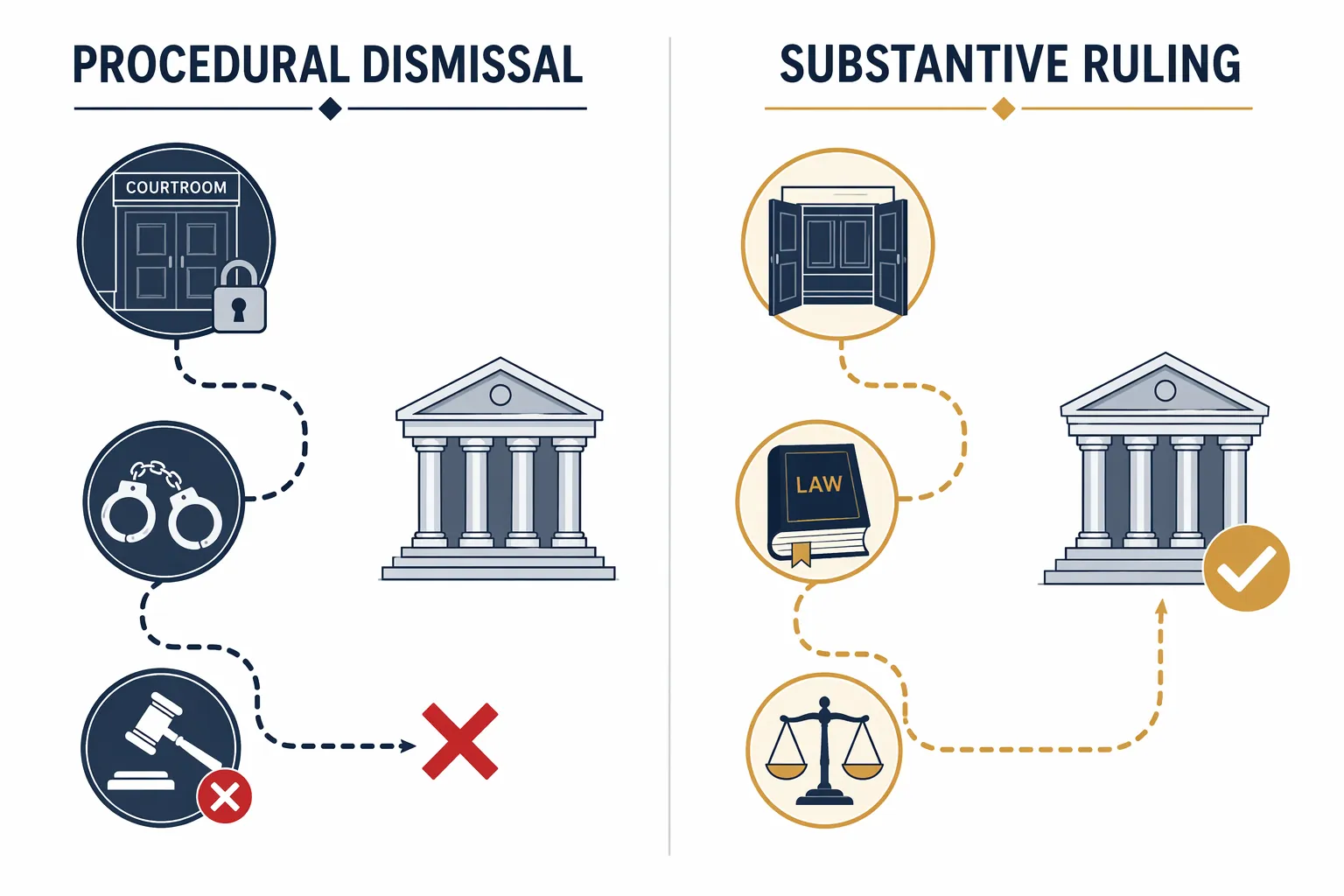
That distinction is the legal implication worth preserving. The criminal case ended before any merits ruling on whether Murrill’s letters were lawful warnings, unlawful threats, protected advocacy, or something else. A procedural collapse can end a prosecution. It cannot quietly become a construction of RS 14:122.
The Case Ended Before the Statutory Question Was Reached
The indictment came on July 2, 2026, and the dismissal followed on July 22, 2026. As of July 24, 2026, there is no appellate merits opinion resolving whether Murrill’s warning letters met the “extortionate threats” element of RS 14:122. The available record is therefore unusually thin for anyone trying to turn the outcome into guidance.
The most consequential legal event was not an interpretation of the intimidation statute. It was the Louisiana Supreme Court’s intervention after reports that the Orleans Parish Criminal District Court closed the courtroom and that a journalist and his attorney were detained in handcuffs. News reports quoted the court as saying that, “by all public accounts, the Orleans Parish Criminal District Court violated express provisions of state law.”[2]
That language matters because it points away from the merits. The stay responded to courtroom-access and process defects, not to the substance of Murrill’s statutory defense. If a court halts proceedings because the process has gone off the rails, the halt does not tell later lawyers what RS 14:122 means.
The full stay order was not available in the reviewed sources, so the analysis must rest on reported quotations and descriptions rather than a complete order. That limitation is not cosmetic. Without the full order, there is even less reason to treat the Supreme Court’s action as any kind of implied endorsement of Murrill’s position on the intimidation statute.
The Dismissal Was Driven by Process and Pressure
Special prosecutor Laurie White’s dismissal followed a chain of events that made the prosecution difficult to continue: the open-court controversy, the Supreme Court stay within 24 hours of indictment, public political intervention, and letters from all eight alleged victims asking that the case be dropped. Those alleged victims said they were “not intimidated.”[3]
Those letters were plainly important to the case’s end. They are less useful as legal proof of what the statute requires. Public intimidation, like many threat-based offenses, raises timing questions. If an offense is complete when a communication is sent, received, and has the legally required character, a later statement by the recipient that he or she did not feel intimidated may be relevant evidence, but it does not necessarily erase the earlier legal question.
White herself did not describe the result as a clean merits vindication. She warned that “extraordinary interference” should “not set a precedent,” citing reported factors that included the governor’s pardon promise, the rapid Supreme Court stay, and the coordinated victim letters.[3]
That warning is easy to miss if the only retained fact is that the charges were dismissed. The dismissal closed the file against Murrill. It did not create a rule that official legal warnings invoking removal statutes are categorically lawful, nor did it create a rule that such warnings are categorically criminal.
The Letter Theory Remains Unresolved
The underlying dispute began with Act 15, also identified in reporting as SB 256, which abolished the Orleans Parish criminal court clerk position shortly before Calvin Duncan was to take office. Duncan, a wrongful-conviction exoneree, had won the election with 68% of the vote. Murrill’s letters reportedly invoked Louisiana’s usurper statutes and warned city officials that they could lose office if they recognized an unauthorized officeholder.[4][5]
That context explains why the letters were not ordinary legal correspondence. They were communications from the state attorney general to local officials, tied to a disputed office, and backed by a warning about personal loss of office. A recipient in that position is not simply receiving a law-review footnote. The recipient is being told that one course of action may carry severe legal consequences.
For an attorney, that is also familiar terrain. Government lawyers often must warn officials that a planned act may be unlawful. A legal warning does not become criminal intimidation merely because it is firm, unwelcome, or politically explosive. If the law authorizes the sender to state the consequence and the recipient is being asked only to comply with a lawful obligation, the communication looks much more like official legal advice or enforcement notice than an extortionate threat.
The difficult version is the one the dismissed case never resolved: what if the warned official could not lawfully do what the sender demanded, or what if the legal consequence invoked was used to pressure conduct the sender had no lawful basis to demand? At that point, the phrase “extortionate threats” begins to do real work. The answer would likely turn on the statutory text, the authority behind the warning, the exact wording of the letter, the recipient’s lawful options, and the relationship between the threatened consequence and the demanded act.
The exact text of Murrill’s May 2026 warning letters was not available in full from the reviewed sources. That means any broader conclusion about their legality should be framed as conditional. News summaries can identify the controversy; they cannot replace the document-by-document analysis that a court would need before deciding whether a communication crossed from legal warning into criminal threat.
Political Vindication Is Not Binding Law
The political force around the case was real. The dispute aligned Republican state officials against Democratic New Orleans officials; Governor Jeff Landry publicly promised a pardon; and the fallout continued after dismissal, including Landry’s veto of more than $33 million in state funding for New Orleans and Councilmember Helena Moreno’s withdrawal of a $110 million bond request.[6]
Those facts help explain why the prosecution became combustible and why continuation became difficult. They do not answer the statutory question. Political pressure can make a case untenable without making the charged theory wrong. It can also expose a weak prosecution without producing a usable precedent for the next lawyer who sends a forceful warning letter.
| What Happened | What It Does Not Establish |
|---|---|
| The charges were dismissed. | That Murrill’s letters were substantively outside RS 14:122. |
| The Louisiana Supreme Court stayed proceedings after reported open-court and detention problems. | That the court interpreted “extortionate threats.” |
| All eight alleged victims asked the special prosecutor to drop the case. | That recipient recantation legally defeats a completed threat offense in every case. |
| The case became politically costly to pursue. | That similarly worded official-duty letters carry no criminal-liability risk. |
What Attorneys Should Take From the Dismissal
For attorneys issuing official-duty warnings, the safe lesson is narrow. Do not cite the Murrill dismissal as binding protection for aggressive letters that invoke removal, office forfeiture, prosecution, or other personal consequences. The case does not supply that shield.
A risk review should instead start with the communication itself. What statute authorizes the warning? Is the threatened consequence one the sender may lawfully invoke? Is the recipient being asked to do something the law permits, or something the recipient may be forbidden to do? Does the letter explain the legal basis, or does it rely mainly on pressure? Is the demand tied to public legal compliance, or to an advantage outside the sender’s lawful authority?
Those questions matter more than the caption of the Murrill case. A dismissal without a merits ruling separates Murrill from criminal exposure in that proceeding. It does not separate future official warnings from RS 14:122.
The case leaves three categories that should not be merged. Political vindication means the prosecution lost its practical foundation. Procedural invalidity means the court process was compromised before merits review. Substantive statutory legality would mean a court decided that the warning letters did or did not satisfy the public-intimidation statute. Only the first two appeared in the dismissal story. The third remains open.
References
- RS 14:122 - Public intimidation and retaliation, Louisiana Legislature.
- Reports on the Louisiana Supreme Court stay and open-court violations, NBC News, PBS, NOLA.com, Fox 8.
- Reports on Laurie White’s dismissal statement and victim letters, NOLA.com, Washington Examiner.
- Reports on Act 15/SB 256 and Murrill’s warning letters, NBC News, PBS, NOLA.com.
- Calvin Duncan profile, National Registry of Exonerations.
- Reports on New Orleans funding vetoes and withdrawn bond request, NOLA.com.
Related records
Tool profile
Browse tool evaluations →Governing regulation
Browse the obligations tracker →Preventive workflow
Browse verification workflows →
Report a correction or tip
Spotted an outdated figure, a misstated fact, or a ruling this case record should reflect? Public comments are disabled for this content given the professional cost of a misreported case outcome, penalty amount, or rule text — use the structured correction channel instead.
Report a correction or tip for this record →