
Nancy Guthrie Evidence Delay Exposes Chain-of-Custody Risks
The Nancy Guthrie murder investigation reveals multiple chain-of-custody failures stemming from a four-day delay before FBI involvement, including lost video evidence and DNA sent to a private lab. This article maps those failures to FRE admissibility risks and identifies verification steps legal professionals should demand in multi-agency investigations.
- Jurisdiction
- Arizona
- Ruling date
- Jul 23, 2026
- Source document
- View primary court order ↗
Lex Machina Review is an independent risk-tracking and reference resource. Nothing on this site is legal advice, and using it does not create an attorney-client relationship. Every record is reviewed against primary sources but may not reflect the most current status of a matter — always verify directly against the cited court order, rule text, or a licensed attorney before relying on it.
Companion explanation — secondary to the source document above
The search phrase “nancy guthrie case FBI evidence delay 2025” misdates the controversy. The relevant Guthrie investigation events described in the available reporting occurred in 2026, and as of late July 2026 there was no charged suspect and no criminal docket to test the evidence in court. That distinction matters: there is no existing admissibility ruling. The issue is which evidence-preservation problems would matter if charges were ever filed.
The starting point is the four-day delay before FBI involvement. FBI Director Kash Patel said in May 2026 that the bureau was “kept out of the investigation” for four days and added that “the first 48 hours of anyone’s disappearance are the most critical.”[1] The courtroom-facing question is not whether that quote makes one agency sound better than another. It is what happened to time-sensitive evidence during the period when the FBI was not yet inside the investigation.
That question has a legal backdrop. The FBI does not simply take over a local murder investigation because federal officials want access; the bureau’s role depends on a formal request from the local jurisdiction with primary authority.[2] Local control is not itself misconduct. But local control also does not answer the later evidentiary questions: who had the item, who preserved it, what was documented, and what cannot now be reconstructed.
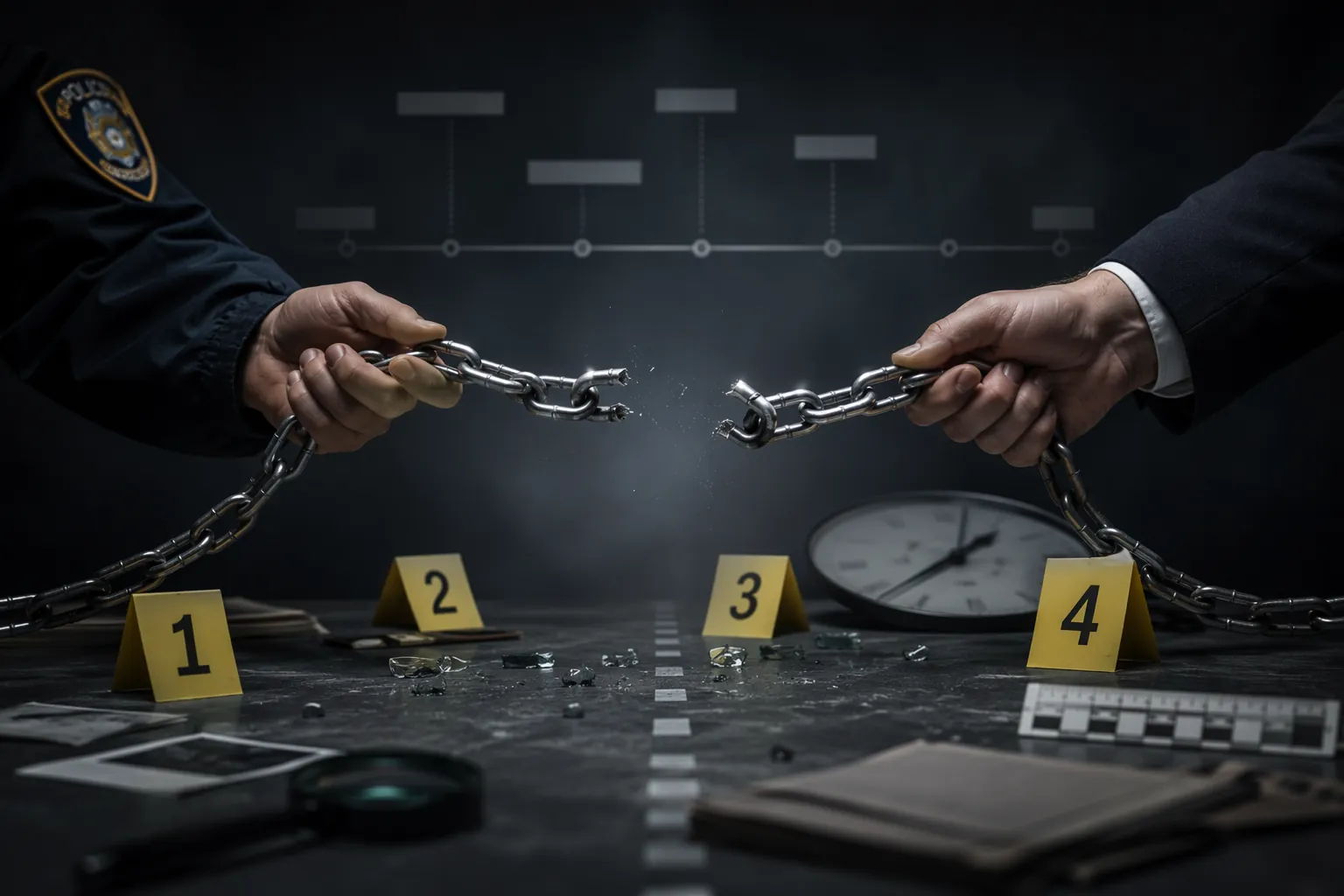
The Timeline Starts With Evidence That Could Disappear
Video is often treated casually until it is gone. In the Guthrie investigation, reporting in July 2026 said doorbell camera footage was recovered from Google’s cache and was “close to being deleted.” The same reporting said additional video “was lost before the FBI became involved,” while the evidentiary value of that lost material remained unknown.[3]
That last phrase should slow the analysis down. Unknown evidentiary value is not the same as exculpatory value, inculpatory value, or proven prejudice. It means counsel cannot evaluate what the footage would have shown because the footage is not available. In a later case, that uncertainty would not automatically produce exclusion or dismissal, but it would give the defense a clean line of inquiry: when did investigators learn the footage existed, who sent preservation demands, what platform or device held it, and why any copy was not secured before deletion.
The recovered Google-cache footage creates its own set of questions. A cached copy may be useful, but it is not the same evidentiary posture as a timely preserved original or a complete platform production with metadata. A prosecutor trying to use it would want records showing how the copy was located, who downloaded it, whether it was altered by the caching process, what metadata remained, and how the exhibit was stored after recovery.
The danger is not merely that a clip went missing. The danger is that the missing clip becomes the hinge for every later dispute about investigative selectivity. If the state later offers a surviving video fragment, the defense can ask why the jury is seeing that piece but not the material lost before federal involvement. If the prosecution argues the missing video was probably unimportant, the natural response is that the government no longer has the evidence needed to prove that point.
Scene Release Before Federal Arrival
The physical scene adds a different kind of vulnerability. July 2026 reporting said the crime scene had already been released before the FBI arrived, and that people had been allowed to approach Guthrie’s front door, where her blood was found on the porch.[4]
A released scene is not automatically a compromised scene. Investigators routinely make judgment calls about when a location can be returned, especially while a search or disappearance response is still developing. But once blood is associated with a threshold area that people later approached, the record has to carry more weight. It needs scene-security logs, perimeter decisions, photographs, body-camera or incident documentation, and a clear account of who entered or approached the relevant area after the first responding officers arrived.
For a jury, “people approached the front door” sounds simple. For litigation, it becomes a set of transfer questions. Did any person step near the blood? Did anyone touch the door, porch surface, railing, mat, or adjacent area? Were items moved before collection? Were later samples taken from a surface exposed to untracked contact? A prosecutor may have perfectly ordinary answers. The point is that those answers have to be documented, not supplied later as institutional reassurance.
The DNA Routing Dispute Is the Hardest Custody Problem
The DNA issue is where agency friction becomes an evidentiary record problem. Reuters reported in February 2026 that Pima County Sheriff Chris Nanos sent DNA evidence from a glove and other items to a private Florida lab, and quoted a U.S. official saying Nanos blocked FBI access to evidence.[5] Other reporting said the FBI had requested that the material go to the FBI laboratory in Quantico, while Nanos gave a conflicting account to KVOA, saying the FBI “agreed” to the Florida lab decision.[6]
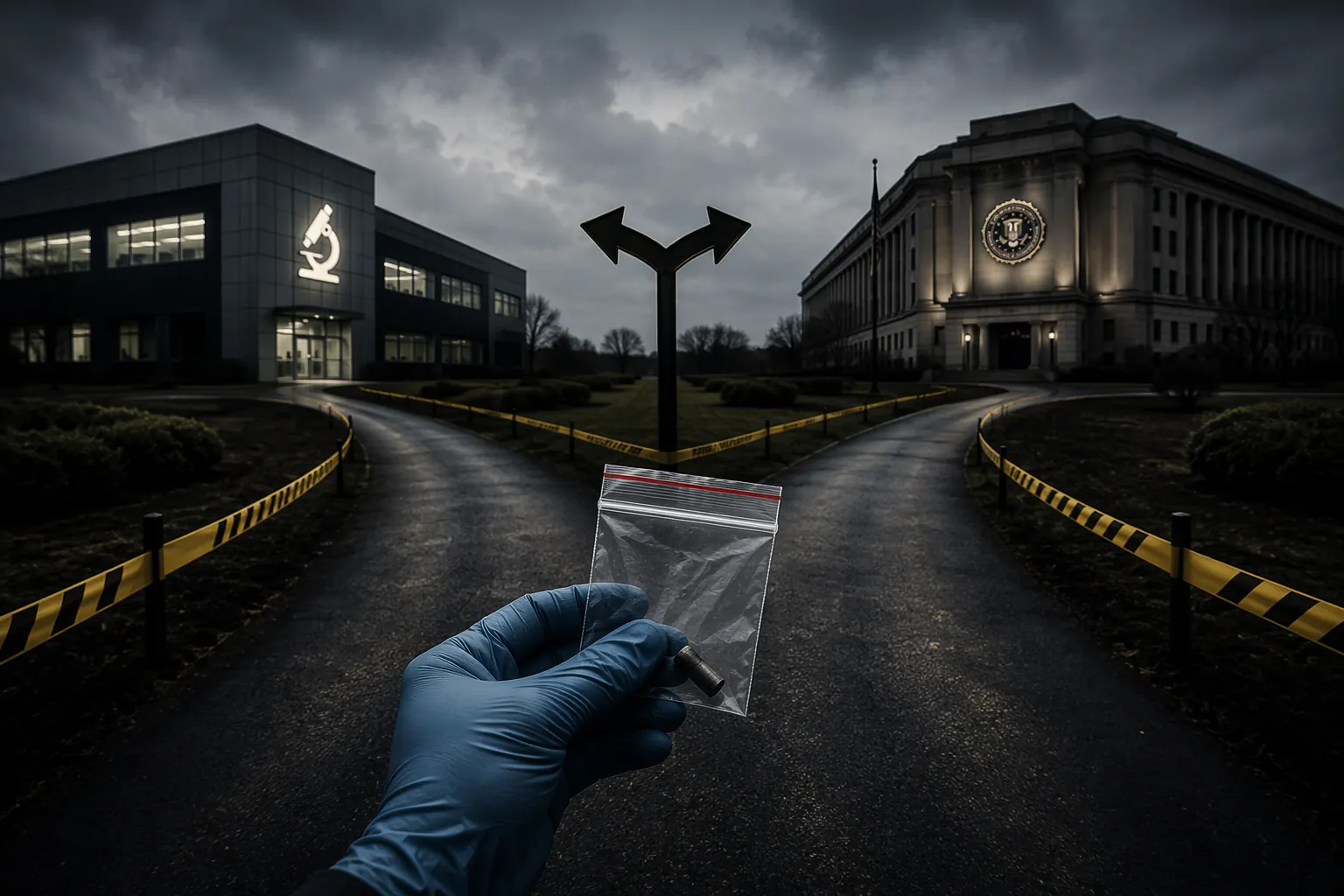
Those accounts cannot both do the same work in court. If the FBI requested Quantico and the sheriff chose a private lab over that request, that is one litigation posture. If the FBI agreed to the Florida lab, that is another. If there was partial agreement, conditional agreement, or disagreement among different officials, the documents matter more than the press comments.
The unresolved money issue belongs in the same file, but not as a stand-alone accusation. The source material includes an FBI official’s statement that the county spent approximately $200,000 sending evidence to the Florida lab, and also includes Nanos’s later characterization of the work as pro bono.[6] Without reconciliation, the number proves less than it appears to prove. What it does create is a discovery target: contracts, invoices, memoranda of understanding, lab communications, procurement records, and any explanation of whether the lab was paid, discounted, or working without charge.
For admissibility purposes, the lab-selection dispute is not about whether private laboratories are inherently unreliable. They are not. The issue is why this evidence went to that lab, who approved the route, what protocols governed collection and shipment, whether the same items were available for federal testing, and whether any consumption, degradation, repackaging, or retesting limits were created by the choice.
DNA evidence also carries a particular cross-examination risk because jurors often treat it as more objective than other proof. That advantage can disappear quickly when the custody path is disputed. A defense lawyer does not need to prove contamination at the outset to make the state explain the route. The first questions are procedural: where was the glove collected, how was it packaged, who sealed it, when was the seal broken, who transported it, what lab received it, what condition was noted, and what happened to any remaining extract or item after testing.
Hair Samples Waited Eleven Weeks
The hair-sample timeline is narrower but still important. Fox News reported in June 2026, citing Nanos’s own interview, that hair samples were not forwarded to Quantico for more advanced testing until 11 weeks later.[7]
Delay alone does not make biological evidence inadmissible. Properly packaged hair can remain testable, and the legal question would turn on the condition of the samples, the reason for the delay, and the completeness of the custody record. But an 11-week gap before advanced testing gives the defense an obvious place to look for avoidable loss: storage conditions, interim handling, degradation concerns, consumption by earlier testing, and whether a faster submission would have produced more complete or more reliable results.
It also matters because the delay occurred in the same investigation already marked by disputed lab routing and late federal involvement. Each issue can be explained separately. Together, they change the tone of the evidentiary hearing. The prosecutor is no longer rehabilitating one odd handling decision; the prosecutor is asking the court to accept a sequence of timing and custody decisions across video, scene access, DNA routing, and specialized testing.
What the Federal Rules Would Actually Put in Play
Because no suspect has been charged, any Federal Rules of Evidence analysis has to stay conditional. There is no trial judge, no motion record, no exhibit list, and no ruling. The useful exercise is risk mapping: what a defense could attack, what the prosecution would need to show, and where missing documents would matter.
| Evidence issue | Likely courtroom pressure point | Records counsel should demand |
|---|---|---|
| Doorbell footage nearly deleted; additional video lost | Authentication, completeness, potential prejudice, and investigative selectivity | Preservation notices, platform requests, cache-recovery logs, download records, metadata reports |
| Scene released before FBI arrival; people allowed near the front door | Contamination, secondary transfer, and reliability of later collection | Scene logs, perimeter records, body-camera footage, photographs, release authorization |
| DNA routed to private Florida lab despite disputed accounts | Chain of custody, lab protocol, testing reliability, and bias or selection questions | Transfer forms, lab-selection communications, contracts, invoices, seals, accession records |
| Hair samples sent for advanced Quantico testing after 11 weeks | Delay, sample condition, degradation, and lost opportunity for earlier testing | Storage logs, submission records, interim testing notes, condition reports |
Rule 901 authentication would be the first stop for video. The proponent would need evidence sufficient to support a finding that the item is what the proponent claims it is. For the recovered cache footage, that means more than a witness saying the clip looks familiar. The state would want platform records, extraction documentation, timestamps, device or account information where available, and a witness who can explain the recovery path without hand-waving the cache process.
Rule 403 would frame a different dispute. If the prosecution offered partial video after other video was lost, the defense could argue unfair prejudice or misleading presentation, especially if the surviving footage appeared incriminating but the missing footage might have supplied timing, context, or an alternate explanation. The court would not be deciding whether investigators behaved perfectly. It would be deciding whether the exhibit’s probative value is substantially outweighed by the danger of unfair prejudice, confusion, or misleading the jury.
Rules 401 and 402 would keep the focus on relevance, but relevance is rarely the hard part for blood, DNA, hair, or surveillance in a homicide investigation. The harder litigation usually concerns the weight the jury should give the evidence after hearing how it was handled. That is where chain-of-custody testimony becomes impeachment material even when the exhibit survives an admissibility challenge.
Rule 702 may become central if expert testimony is offered from the private lab, Quantico, or both. The question would not be whether DNA science in general is accepted. It would be whether the expert’s opinions reliably fit the evidence actually tested, using methods reliably applied to that evidence. Lab accreditation, validation, mixture interpretation, contamination controls, consumption of samples, and the handoff between agencies could all become part of the reliability record.
Rule 1002, the best-evidence rule, is not a universal cure for missing video arguments, and it should not be overstated. It applies when a party seeks to prove the content of a recording. If a cached or copied video is offered, the fight may turn on whether the proponent has an admissible duplicate, whether the original was lost without bad faith, and whether the opponent can fairly challenge accuracy. The lost additional video may not fit neatly into a best-evidence objection if it is not the recording being offered, but it remains powerful cross-examination material.
The Defense Theory Writes Itself, Even Before It Wins
Retired FBI agent Jason Pack warned in February 2026 that “any competent defense attorney would immediately scrutinize the chain of custody, potential contamination and the possibility of secondary transfer.”[8] That is the practical center of the dispute. A defense lawyer does not have to win every objection to make the handling history matter. Sometimes the damage is done through cross-examination, expert rebuttal, or a closing argument that asks why the jury is being asked to trust an incomplete record.
The most direct defense path would be chronological. First, the FBI was not involved for four days. During that window, at least some video was not preserved, and the recovered footage was close to deletion. The scene was released before federal arrival. DNA evidence was routed to a private Florida lab amid conflicting accounts about whether the FBI agreed. Hair samples waited 11 weeks before advanced Quantico testing. None of those facts alone proves contamination, fabrication, or suppression. Together, they provide a disciplined impeachment structure.
The prosecutor’s response would also be chronological. Local jurisdiction controlled the early investigation. FBI participation required a request. Emergency decisions had to be made before the investigation’s final shape was known. Some video was recovered. A private lab can be competent. Later advanced testing can still produce reliable results. Those are real answers, but each depends on records that can be shown to the court rather than reconstructed in interviews months later.
The victim’s family is left with the worst version of an investigative controversy: the public can see the process fight, but not the full evidentiary file. Reporting has described more than 30,000 tips and no suspect publicly identified as of late July 2026.[9] A large tip volume may show public engagement or investigative activity. It does not repair a custody gap, identify a defendant, or establish what missing evidence would have shown.
What to Verify in a Multi-Agency Evidence Dispute
The Guthrie investigation should not be flattened into a simple federal-good, local-bad story. Local agencies have primary authority in many homicide investigations, and federal agents cannot always enter on the timeline outside observers would prefer. The more useful lesson is narrower and more demanding: when agency friction coincides with perishable digital evidence, released scenes, disputed lab routing, and delayed specialized testing, counsel should stop relying on public explanations and ask for the underlying records.
- Formal request timestamps showing when federal assistance was requested, accepted, limited, or refused.
- Custody logs for each physical item, including collection, packaging, sealing, transfer, receipt, testing, storage, and retesting.
- Preservation notices and platform communications for doorbell, cloud, cache, phone, neighborhood, and account-based video.
- Scene-security and release records identifying who controlled the perimeter, who approached the front door, and when the location was released.
- Lab-selection communications explaining why evidence went to a private Florida lab rather than Quantico, and who agreed or objected.
- Contracts, invoices, pro bono agreements, procurement records, and accession documents for the private laboratory.
- Submission and storage records explaining the 11-week interval before hair samples were forwarded for advanced testing.
Jurisdictional friction does not automatically destroy evidence, and imperfect early decisions do not automatically make later proof inadmissible. In the Guthrie investigation, the risk is more concrete: the record described to date contains undocumented, disputed, and time-sensitive gaps at exactly the points a competent defense would know how to exploit.
References
- Kash Patel says FBI was kept out of Nancy Guthrie investigation for four days — AZFamily / Fox News, May 2026.
- What authority does the FBI have to investigate state and local crimes? — FBI FAQs.
- Doorbell camera footage in Nancy Guthrie case was close to being deleted — USA Today / Fox News, July 23, 2026.
- Nancy Guthrie crime scene released before FBI arrived — Fox News, July 2026.
- U.S. official says Pima County sheriff blocked FBI access to Nancy Guthrie evidence — Reuters, February 12, 2026.
- Pima County sheriff sent Nancy Guthrie DNA evidence to private Florida lab — Washington Examiner, February 13, 2026.
- Nancy Guthrie hair samples not sent to Quantico for advanced testing for 11 weeks — Fox News, June 2026.
- Retired FBI agent warns defense attorneys would scrutinize Nancy Guthrie evidence chain of custody — Fox News via WFMD, February 16, 2026.
- Nancy Guthrie investigation timeline — CNN, July 2026.
Related records
Tool profile
Browse tool evaluations →Governing regulation
Browse the obligations tracker →Preventive workflow
Browse verification workflows →
Report a correction or tip
Spotted an outdated figure, a misstated fact, or a ruling this case record should reflect? Public comments are disabled for this content given the professional cost of a misreported case outcome, penalty amount, or rule text — use the structured correction channel instead.
Report a correction or tip for this record →