
Peter Navarro's appeal denied: the privilege trap for attorneys
The D.C. Circuit's July 2026 opinion affirms Peter Navarro's contempt conviction and clarifies that only the President, not a witness, can invoke executive privilege. This ruling creates a binding procedural trap for attorneys advising clients on congressional subpoenas.
- Jurisdiction
- D.C. Circuit
- Ruling date
- Jul 21, 2026
- Source document
- View primary court order ↗
Lex Machina Review is an independent risk-tracking and reference resource. Nothing on this site is legal advice, and using it does not create an attorney-client relationship. Every record is reviewed against primary sources but may not reflect the most current status of a matter — always verify directly against the cited court order, rule text, or a licensed attorney before relying on it.
Companion explanation — secondary to the source document above
A client who receives a congressional subpoena and says, "I am covered by executive privilege, so I do not have to show up," needs the answer before anyone starts drafting position papers: no, not on the witness's unilateral say-so. The D.C. Circuit's merits ruling in Peter Navarro's case was not a 2025 legal ruling, despite the search phrase now attached to it. The court affirmed his contempt conviction on July 21, 2026. The 2025 events were procedural milestones: an en banc denial in February and a Justice Department withdrawal in August.
That date correction matters because the operative rule is the 2026 merits holding: only the President, or a formally designated official, can invoke executive privilege; a witness cannot create the privilege defense by asserting it personally; even a valid privilege claim does not excuse total nonappearance; and a court will not accept an uncorroborated account that the privilege was invoked. Reporting on the 37-page opinion describes those holdings consistently, but the primary D.C. Circuit opinion in United States v. Navarro, No. 24-3006, should be linked and checked before publication if the court docket or CourtListener document becomes accessible.[1][2][3][4]
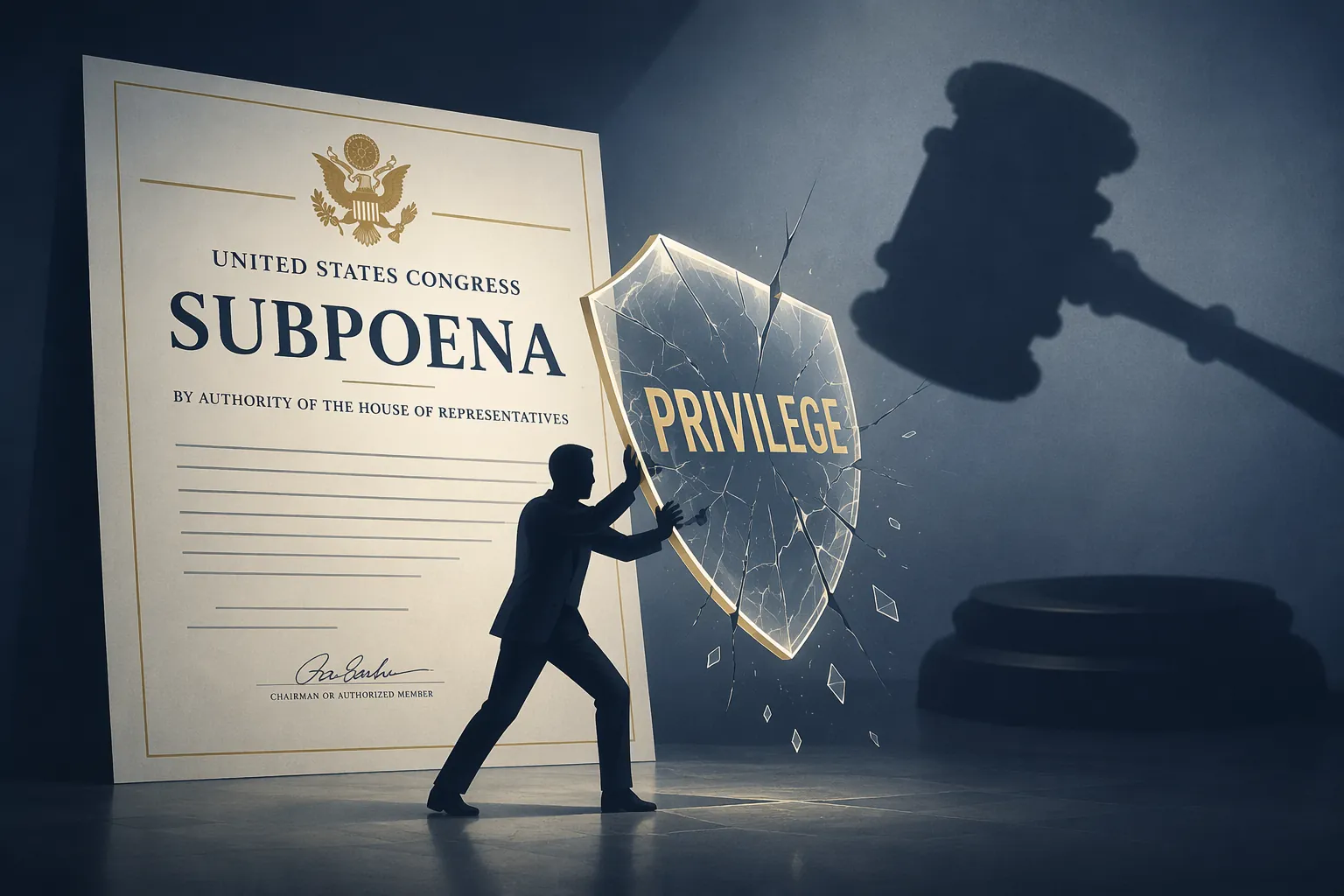
The failed shortcut was the first response
The most useful fact in the Navarro appeal is not the sentence, the politics, or the familiar January 6 backdrop. It is the first move. According to reports describing the opinion, Navarro responded to the House January 6 committee within roughly three minutes of receiving its email, before he reviewed the subpoena, before he consulted counsel, and before he had any formal direction from former President Donald Trump invoking executive privilege on his behalf.[1][2][3]
That is the move lawyers inherit later. The client has already taken a position. The record already has a timestamp. The claimed privilege is already being used not as a carefully preserved objection, but as a reason not to engage with the subpoena process at all.
The D.C. Circuit treated the defect as more than bad optics. Navarro had no formal presidential invocation comparable to what Trump's office reportedly issued for Dan Scavino and Mark Meadows: written privilege directives that gave those witnesses a documented chain from the President's office to the subpoena response. Navarro, by contrast, relied on his own account of what Trump had said and what he believed the privilege covered.[4]
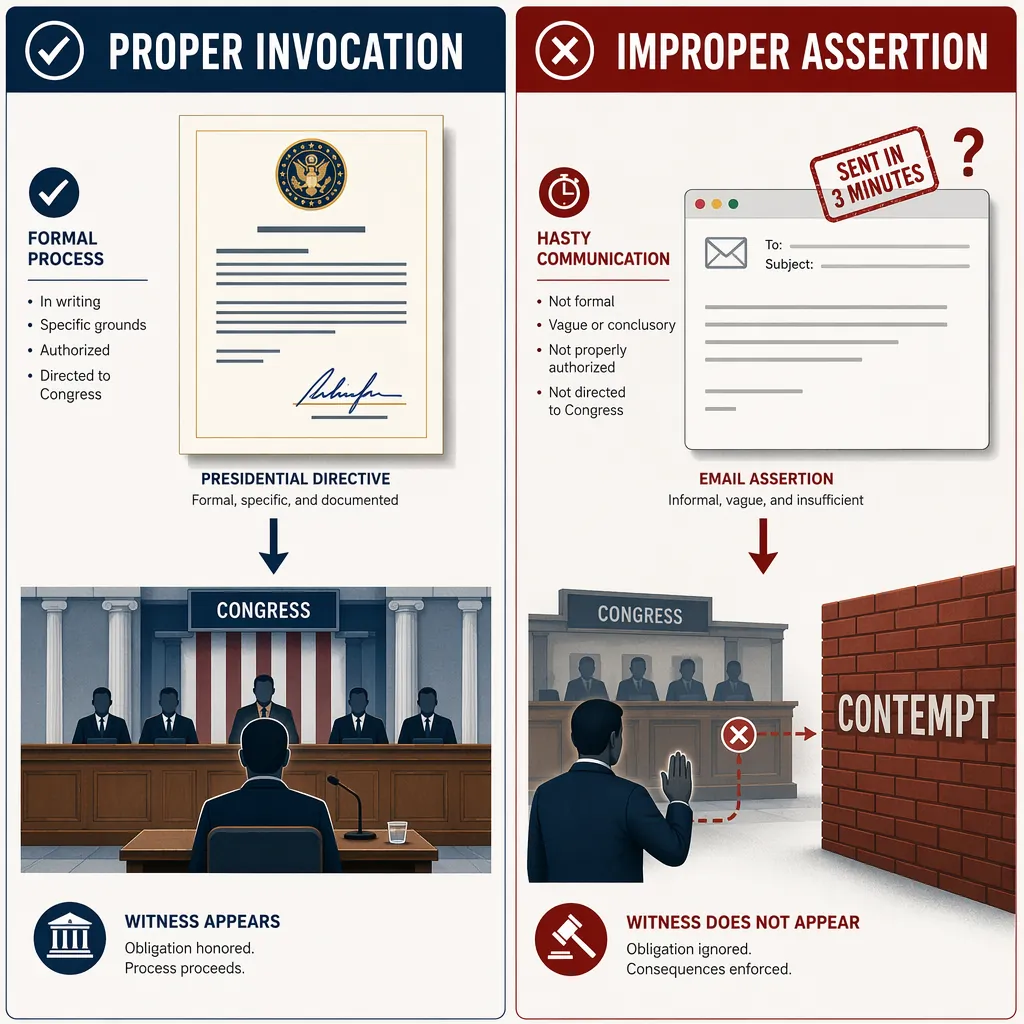
Invocation is an act of authority, not a witness label
Executive privilege is not self-executing in the hands of the subpoena recipient. The privilege belongs to the executive, and the D.C. Circuit's reported holding turns on that chain of authority. A witness may believe communications are privileged. A witness may expect the President to protect them. A witness may even have a colorable reason to ask for instructions. None of that is the same as an invocation by the President or by someone formally designated to speak for him.[1][2][3]
Judge Patricia Millett's reported language goes directly to the proof problem: courts "cannot simply take a defendant at his word" that executive privilege was invoked.[2] That sentence is not a throwaway credibility jab. If the defense depends on a presidential act, the record has to contain more than the witness's later description of that act.
For lawyers advising a subpoena recipient, that means the privilege question has to be separated into two questions before the client responds:
- Who has authority to invoke the privilege for this testimony or document request?
- Has that person invoked it in a form that can be shown to a court?
- Does the invocation identify the subpoena, topics, documents, or categories at issue?
- Does the invocation instruct the witness not to answer specific questions, not to produce specified material, or not to appear at all?
The last question is where many rushed responses collapse. A privilege instruction may protect particular testimony or documents. It does not automatically convert a subpoena into an optional calendar entry.
Appearance is a separate obligation
The D.C. Circuit's second practical warning is independent of the invocation defect. Reporting on the opinion states that even if executive privilege had been validly invoked, Navarro still could not categorically fail to appear before the committee. He had to show up and assert any privilege question by question, unless he had a legally sufficient instruction that excused the appearance itself.[3]
That distinction is easy to lose in client conversations because clients tend to hear "privileged" as "off limits." Subpoena practice does not work that cleanly. A subpoena commands an appearance, production, or both. A privilege objection may narrow what the witness must disclose, but the obligation to attend and make a record remains unless a court, the issuing body, or a valid controlling instruction changes that obligation.
| Client position | Counsel's risk question |
|---|---|
| The President told me privilege applies. | Where is the formal invocation, and who was authorized to issue it? |
| The subpoena asks about privileged matters. | Which questions or document categories are covered, and how will the objection be preserved? |
| I should not attend at all. | What authority excuses the appearance, not merely the answer? |
| The committee already knows my position. | Has the position been communicated in a way that a court can verify? |
This is the procedural trap the case leaves for counsel. If the client refuses to appear and the privilege theory later fails, counsel is no longer arguing only about protected communications. Counsel is defending an absence.
The timeline is context, not the rule
Navarro was convicted by a jury in 2023 on two counts of contempt of Congress. He served a four-month sentence. On February 14, 2025, the D.C. Circuit denied rehearing en banc. On August 29, 2025, the Justice Department withdrew from the appeal. Oral argument followed in December 2025, and the D.C. Circuit affirmed the conviction on July 21, 2026.[1][2][3][4]
Those dates should not be mashed into a single "2025 appeal denied" label. The 2025 activity did not supply the merits holding now relevant to subpoena advice. The July 2026 panel opinion did. As of the July 21 reporting, the mandate was withheld, so any publication should check for a rehearing petition, certiorari petition, or other post-opinion development before treating the appellate process as fully closed.[2]
One more boundary is worth keeping clean: Supreme Court coverage about release pending appeal involved a separate procedural posture. It should not be blended into the D.C. Circuit merits ruling. A custody or release question is not the same as an appellate decision on whether the conviction stands.
What subpoena advice should look like after Navarro
The safest first instruction after a congressional subpoena is usually the least glamorous one: do not answer substantively until counsel has reviewed the subpoena, identified deadlines, preserved objections, and determined who has authority to invoke any privilege. A three-minute response may feel decisive to the client. It gives future prosecutors and judges a clean exhibit.
Where executive privilege is genuinely in play, the workflow should force documentation before defiance:
- Review the subpoena before responding, including the appearance date, production demands, topics, and issuing authority.
- Identify the privilege holder and any official formally designated to communicate an invocation.
- Obtain the invocation in a form that can be filed, proffered, or otherwise verified if the dispute reaches court.
- Separate objections to specific testimony or documents from any claimed basis for not appearing.
- Create a record of compliance steps, negotiations, objections, and instructions before any refusal.
That is not a checklist pretending to resolve every constitutional question. There will be serious disputes over the scope of executive privilege, the rights of former officials, congressional need, separation of powers, and judicial review. Navarro does not erase those questions. It does, however, make one failure mode much harder to defend: a witness deciding alone that privilege lets him stay away.
A bounded ruling with a real workflow consequence
The Navarro affirmance is a binding D.C. Circuit procedural warning for congressional-subpoena counseling. It is not a general lesson about political loyalty, and it is not an AI-reliability case. If this article is placed in a risk publication built around AI hallucination sanctions, it needs a visible routing note: the risk here is obligations and workflow failure, not AI-tool use.
For attorneys, the takeaway is narrower and more useful. Privilege has to be invoked by the right authority, preserved in a verifiable record, and handled without ignoring the separate duty to appear. The client may want a sentence that ends the matter. The subpoena process requires a file that can survive the next judge.
References
- CNN report on the D.C. Circuit's July 21, 2026 Navarro decision, CNN, July 21, 2026
- Courthouse News report quoting the 37-page United States v. Navarro opinion, Courthouse News, July 21, 2026
- The Hill report on the D.C. Circuit's July 21, 2026 Navarro ruling, The Hill, July 21, 2026
- Roll Call report comparing Navarro with Scavino and Meadows privilege directives, Roll Call, July 21, 2026
Related records
Tool profile
Browse tool evaluations →Governing regulation
Browse the obligations tracker →Preventive workflow
Browse verification workflows →
Report a correction or tip
Spotted an outdated figure, a misstated fact, or a ruling this case record should reflect? Public comments are disabled for this content given the professional cost of a misreported case outcome, penalty amount, or rule text — use the structured correction channel instead.
Report a correction or tip for this record →