
NBA YoungBoy's bodycam arrest forces a hard look at AI-generated evidence
Using the July 2025 arrest of rapper NBA YoungBoy as a case study, this Risk Digest entry examines whether bodycam footage—long treated as objective evidence—can survive authentication challenges in an era when AI tools can generate convincing bodycam-style video. The entry covers the current Baez authentication standard, the Mendones deepfake sanctions, and what proposed FRE Rule 707 would change.
- Jurisdiction
- US-UT
- Court
- Utah state court
- AI tool named
- Deepfake software
- Ruling date
- Jul 1, 2025
- Source document
- View primary court order ↗
- Last verified
- Jul 31, 2026
Lex Machina Review is an independent risk-tracking and reference resource. Nothing on this site is legal advice, and using it does not create an attorney-client relationship. Every record is reviewed against primary sources but may not reflect the most current status of a matter — always verify directly against the cited court order, rule text, or a licensed attorney before relying on it.
Companion explanation — secondary to the source document above
The NBA YoungBoy reckless driving arrest bodycam evidence is useful precisely because it looks so familiar: a traffic stop, a luxury car, an officer’s camera angle, a speed allegation, and a clip that moved through social feeds before most viewers had any reason to ask what record they were actually watching. Entertainment reporting describes a July 2025 Utah stop in which officers said a Bentley was traveling 109 MPH, four miles per hour over Utah’s per-se reckless-driving threshold of 105 MPH, and says the officers did not know the driver’s identity during the stop.[1] Utah Code section 41-6a-528 makes reckless driving at 105 MPH or faster a class B misdemeanor, effective May 4, 2022.[2]
That is the exhibit sticker version of the story. The record version is thinner. The arrest details now circulating in public come from music-news reporting and social media publication of bodycam footage, not from a verified Utah docket, an official police release, or a certified evidentiary export made available for inspection. That does not make the video fake. It means a lawyer should not treat a viral clip as if it arrived in court already authenticated.
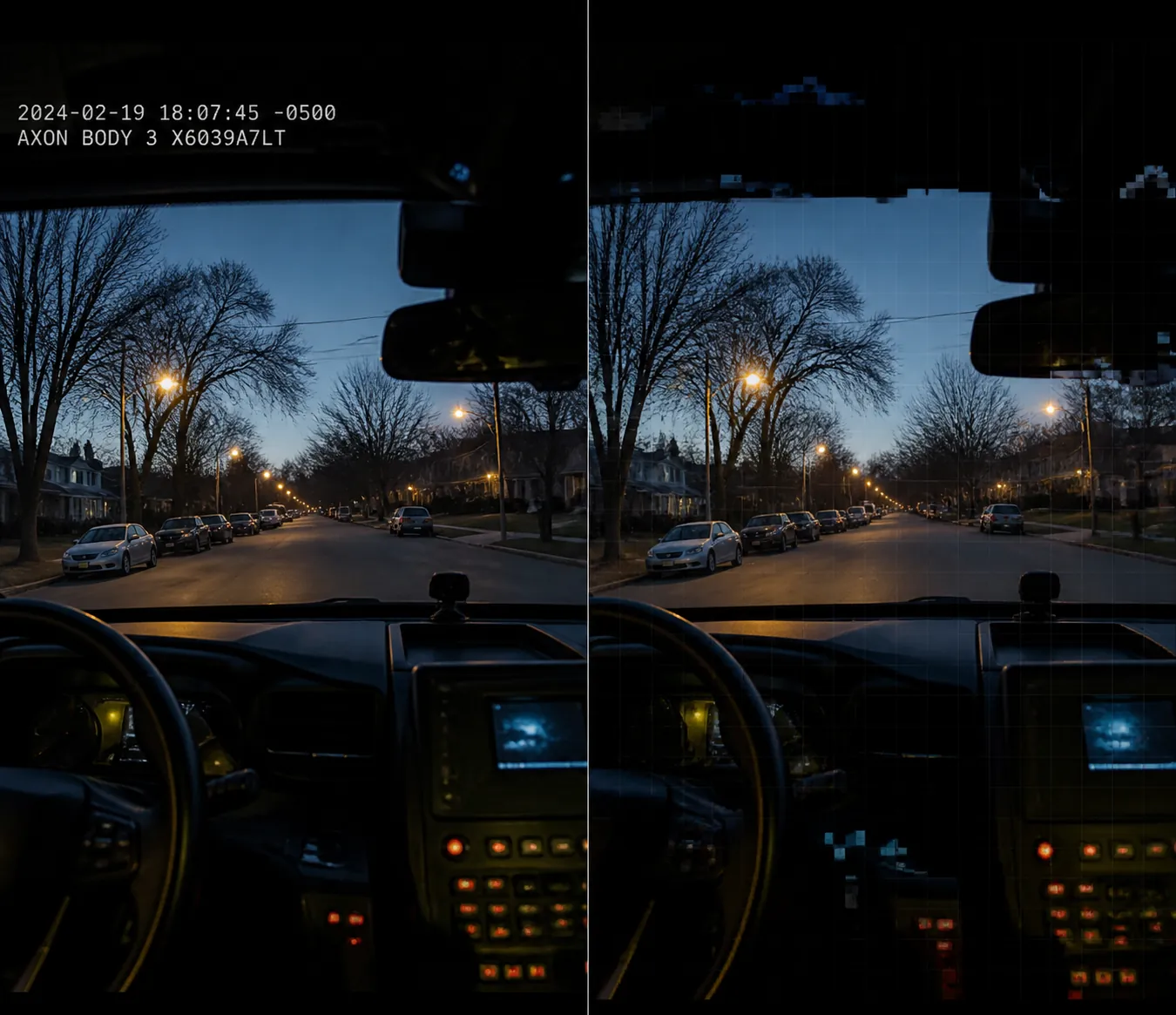
The better question is not whether this particular clip is an AI fake. The available record does not support that accusation. The harder 2026 question is what a court should require before it keeps treating body-worn camera footage as reliable when plausible bodycam-style video can be generated, altered, compressed, reposted, and argued over by people who never touched the original file.
What a Court Would Ask Before Watching the Clip
A judge does not admit bodycam footage because it feels official. The present working path is still authentication: someone with knowledge, or a reliable process, must show that the item is what its proponent says it is. In bodycam cases, that usually means testimony about the device, activation, recording continuity, export, storage, and absence of editing.
Baez v. Commonwealth is the cleanest current frame among the cited authorities. The Virginia Supreme Court affirmed admission of body-worn camera footage where officers testified about the recording process, proper activation, continuous recording, lack of editing, and chain of custody. The court recognized both the “silent witness” theory and the “pictorial evidence” theory as possible routes for admissibility.[3]
Those two theories matter because they answer slightly different foundation problems. Under pictorial evidence, a witness says, in substance, “I was there, and this fairly and accurately depicts what I saw.” Under silent witness, the recording process itself does more of the work: the system captured the event, the process was reliable, and the file was preserved without material alteration. Bodycam evidence often uses both. The officer can identify the stop, while the custodian or system evidence can explain how the file moved from camera to storage to export.
On the reported NBA YoungBoy facts, a Baez-style foundation would probably be enough if the proponent could produce the right witnesses and records. An officer could testify that the camera was issued to the officer, activated during the stop, recorded continuously, and captured the interaction with the Bentley. A records custodian could testify that the file was uploaded to the agency’s evidence system, preserved in the ordinary course, exported without alteration, and matched the version offered in court. If the radar, lidar, patrol-car system, citation, or arrest paperwork exists, those records would do separate work on the speed allegation; the bodycam clip itself may show the encounter but not necessarily prove the vehicle’s speed.
That last distinction is not fussy. A video of a roadside stop is not the same exhibit as proof that a vehicle traveled 109 MPH. The clip may authenticate the officer’s words, the driver’s statements, the location, the timing, or the fact of arrest. The speed measurement may still require its own foundation. If the public clip is a social-media copy rather than the original export, it is even further from being the courtroom exhibit.
Baez Solves the Old Problem Better Than the New One
Baez is useful because it refuses the lazy version of video evidence. It makes a proponent account for the recording process. It asks whether the camera was activated, whether the recording was continuous, whether anyone edited it, and whether the chain of custody holds. For ordinary disputes over missing context, officer memory, or sloppy reporting, that is real discipline.
The AI-era vulnerability appears at the seam between “no one edited this file after upload” and “this file originated from the bodycam system in the first place.” A traditional foundation can be strong on custody after ingestion and still weak on cryptographic proof of origin. It can also be strong for the agency’s internal export while saying little about a reposted copy that circulated online before counsel ever requested discovery.
| Foundation question | Baez-style answer | AI-era pressure point |
|---|---|---|
| Who recorded it? | Officer identifies the bodycam and the event. | A generated clip may imitate an officer-view perspective without coming from the device. |
| Was it continuous? | Officer testifies the camera recorded continuously. | Continuity inside a file is different from proof that the file is the original device output. |
| Was it edited? | Witness or custodian testifies no edits were made. | The testimony may only cover agency handling after upload, not pre-ingestion generation or later public copies. |
| Where was it stored? | Evidence system and chain-of-custody logs show preservation. | Logs are stronger when paired with hashes, metadata retention, and audit trails. |
None of this means bodycam evidence is suddenly unreliable. It means the foundation that once felt complete may become underdescribed. The officer who says “that is my video” may be entirely truthful and still unable to answer whether the file in court is byte-for-byte identical to the first agency export, whether embedded metadata was stripped during conversion, or whether a defense copy differs from the prosecution copy because of platform compression rather than tampering.
For the NBA YoungBoy clip, the practical split is straightforward. If prosecutors had the original agency file and supporting custodian testimony, the video likely survives a standard authentication objection under Baez. If a lawyer tried to use only a music-site embed, a social-media repost, or a downloaded clip with no export history, the exhibit should draw a much colder look.
The Warning in Mendones Is Not That Every Fake Wins
Mendones v. Cushman & Wakefield is the wrong case to cite for panic and the right case to cite for cost. In September 2025, a federal court in the Central District of California imposed terminating sanctions after finding that plaintiffs submitted deepfake witness videos and altered images.[4] Reporting on the decision emphasized that the videos were crude: lighting did not match, shadows were inconsistent, and the materials were eventually exposed.[4][5]
The sanctions still matter. The court found prejudice even though the fakes were detected, because the opposing party had to spend resources on forensic analysis and litigation work to prove that the evidence was not genuine.[4][5] That is the piece lawyers tend to underestimate. A bad fake can still distort a case. It can force continuances, expert retention, supplemental briefing, deposition cleanup, and judicial time that should have been spent on the merits.
Mendones does not prove that sophisticated generated police video will evade detection. It does prove that courts have already had to confront fabricated visual evidence as litigation conduct, not as a law-review hypothetical. It also shows why “we will spot the fake later” is not an adequate evidence-management policy. Later is expensive. Later may be after a plea discussion, after a suppression hearing, after a witness has adjusted testimony around the clip, or after public pressure has hardened around a visual narrative.
Authenticity Arguments Are Already Being Used From Both Directions
The developing case law is uneven, jurisdictionally mixed, and not always precedential. It is still useful as a map of tactics. In Huang v. Tesla, a court rejected a deepfake defense and warned against a “slippery slope” in which prominent people could avoid accountability by suggesting that inconvenient recordings were synthetic. In Wisconsin v. Rittenhouse, the court barred the prosecution from using pinch-to-zoom on video without an expert witness, treating even a familiar enhancement as something that could require foundation. In United States v. Reffitt, a D.D.C. trial court allowed the defense to suggest AI manipulation without requiring a factual foundation.[6]
Those examples do not create one national rule. They show the range of moves now available. A party can say the video is fake. A party can say the enhancement changed the video. A party can say the other side’s AI accusation is speculative gamesmanship. A court can demand an expert, reject the challenge, or let counsel argue doubt to the jury. The same visual exhibit can be attacked as too technologically mediated and defended as routine documentation.
Bodycam footage sits in the middle of that fight because it has institutional credibility without being self-proving. Jurors understand the camera angle. Judges have seen these files for years. Agencies have evidence-management systems. But familiarity is not a rule of evidence. Once a plausible AI-authenticity challenge is made, the proponent needs more than confidence in the genre.
What Metadata and Hash Verification Add
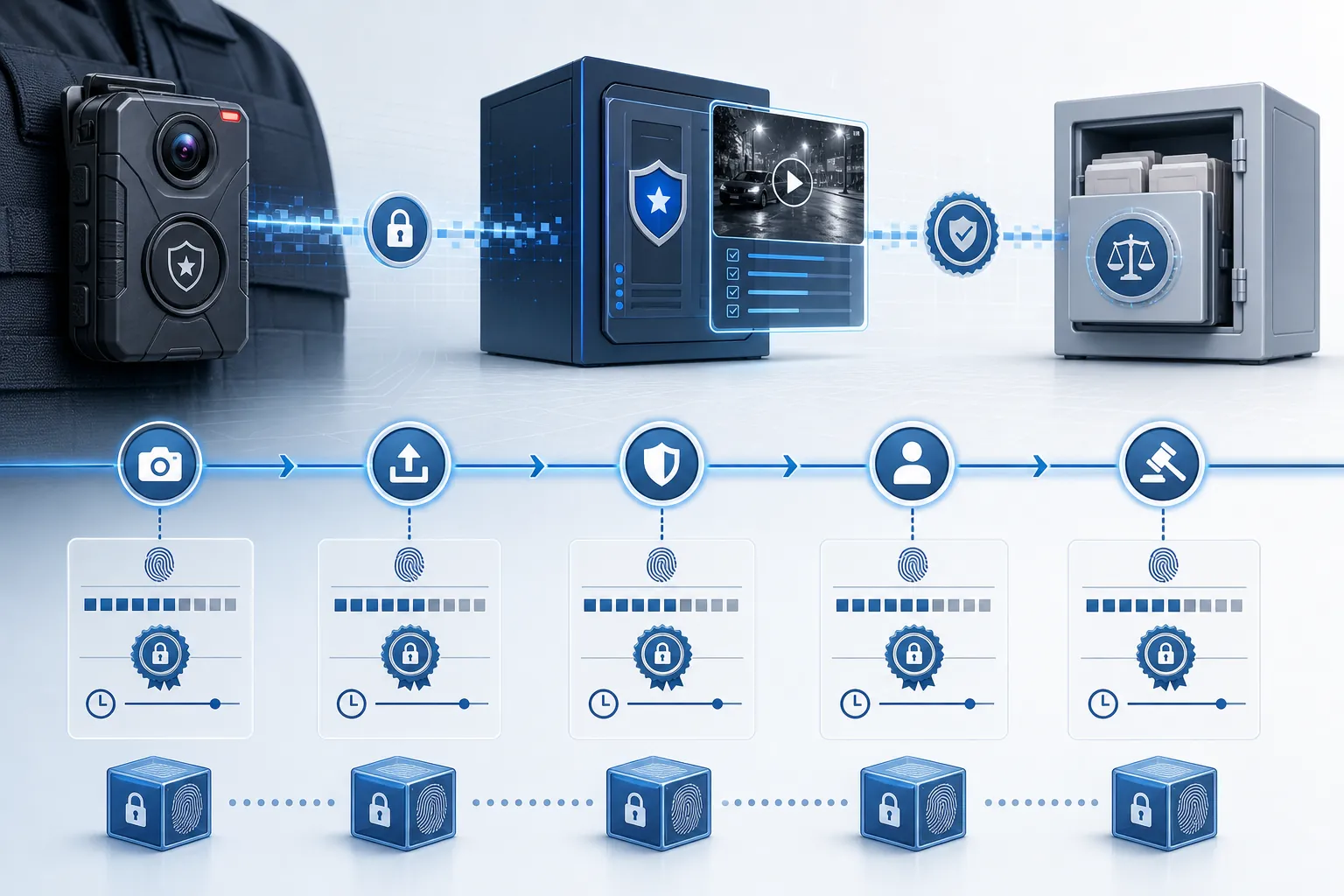
A better foundation does not require treating every traffic stop like a national-security file. It requires preserving the parts of the record that answer the next objection before it is made. The basic question is whether counsel can connect the courtroom exhibit to the device output through a documented, testable path.
- Preserve the original agency file, not only a clipped export prepared for public release.
- Retain device and system metadata where the platform captures it, including timestamps, device identifiers, upload records, and audit logs.
- Generate and preserve hash values at ingestion, export, and production so later copies can be compared.
- Document every conversion, redaction, compression, or clipping step separately from the original evidentiary file.
- Produce enough chain-of-custody material for the other side to test origin and integrity without turning every hearing into a forensic excavation.
Hash verification is not magic. It will not prove that an officer acted lawfully or that a speed measurement was accurate. It does something narrower and important: it shows whether the file being offered is the same file that was hashed at a known point in the chain. Metadata is similar. It can be incomplete, platform-dependent, or stripped during export, but when preserved properly it gives counsel and the court more than a witness’s memory of a file-management process.
In the NBA YoungBoy scenario, that would change the courtroom conversation. Instead of arguing from the visual familiarity of a bodycam angle, the proponent could walk the judge from camera assignment to activation to upload to hash value to export log to courtroom file. The defense could still contest interpretation, speed, officer conduct, or missing context. But a generic “AI could have made this” challenge would have to confront a preserved technical chain.
Where Rule 707 Fits
Proposed Federal Rule of Evidence 707 was scheduled for an Evidence Rules Committee vote on May 7, 2026, according to the cited Steptoe source.[7] Because that date has passed, anyone publishing or litigating from this point should verify the current rule status, committee materials, and any amended text rather than describe the proposal as frozen in its pre-vote form.
The proposal matters because it targets machine-generated evidence with a reliability inquiry closer to Rule 702 expert testimony. That would be a meaningful shift from treating many system outputs mainly as authentication problems under Rule 901(b)(9).[7] If a party offers evidence generated by a machine process, the court would ask more directly whether the process is reliable, not merely whether a witness can identify the output.
Bodycam footage is not usually offered as machine-generated evidence in the same way as an algorithmic reconstruction or synthetic exhibit. A camera records. An evidence system stores. A human witness authenticates. But AI-era disputes blur that comfort. If the challenge is that the file was generated or materially altered by AI, a court may need a reliability showing about the systems and processes used to prove origin and integrity. Proposed Rule 707 is best understood as a pressure signal: the rules are being pulled toward process reliability because visual recognition no longer carries the same weight by itself.
The Liar’s Dividend Reaches Police Video Too
The National Center for State Courts has warned that video evidence now plays a central role in court cases and has published judicial guidance on AI-generated evidence.[8] CU Boulder’s Visual Evidence Lab has called for national standards on visual evidence authentication and flagged the “Liar’s Dividend”: the risk that genuine evidence loses force because AI makes denial easier.[9]
That risk is not limited to celebrities, although celebrity cases make it easier to see. A famous defendant can claim a clip was generated because the public already knows their face and voice are valuable synthetic targets. A police agency can overclaim reliability because the file came from an official system. A prosecutor can mistake a clean video for a complete foundation. A defense lawyer can float “deepfake” as atmosphere rather than evidence. Each move taxes the court in a different way.
The right answer is not to demote bodycam footage into suspicion by default. Body-worn cameras still correct bad memory, selective reports, and confident testimony that does not survive replay. They also capture things no witness thought to write down. The answer is to stop pretending the camera is a moral witness. It is a technical record, and technical records need foundations that fit the attack they are likely to face.
On the present materials, the NBA YoungBoy bodycam would likely be admissible under current Baez-style standards if supported by officer and custodian testimony, original-file preservation, and a clean chain of custody. The public version of the story still needs independent verification against Utah court or police records before anyone treats the reported arrest facts as court-confirmed facts. The next contested bodycam exhibit may not fail because the video looks suspicious. It may fail because the proponent waited too long to preserve the metadata, hashes, and audit trail needed to prove that the familiar-looking footage is the actual record.
References
- NBA YoungBoy Bodycam Footage Arrest, HotNewHipHop.
- Utah Code 41-6a-528, Utah Legislature.
- The Supreme Court Determines the Admissibility of an Officer’s Body-Worn Camera Footage, Blankingship & Keith.
- Court Throws Out Case After Finding Plaintiffs Submitted Deepfake Videos and Altered Images, Reason, September 25, 2025.
- Deepfake Videos and Images Lead to Terminating Sanctions: eDiscovery Case Law, eDiscovery Today, September 25, 2025.
- Deepfaked Evidence: What Case Law Tells Us About How the Rules of Authenticity Needs to Change, BT Law Journal, June 2025.
- AI in the Courtroom: How Proposed Rule 707 Could Shape Evidence Standards, Steptoe & Johnson.
- AI-Generated Evidence: Threat to Public Trust in Courts, National Center for State Courts.
- Deepfakes and AI in the Courtroom: Report Calls for Legal Reforms to Address Troubling Trend, CU Boulder Today, November 17, 2025.
Related records
Tool profile
Browse tool evaluations →Governing regulation
Browse the obligations tracker →Preventive workflow
Browse verification workflows →
Report a correction or tip
Spotted an outdated figure, a misstated fact, or a ruling this case record should reflect? Public comments are disabled for this content given the professional cost of a misreported case outcome, penalty amount, or rule text — use the structured correction channel instead.
Report a correction or tip for this record →