
Are NeeDoh toy injury claims real or media hype?
A source-linked breakdown of the NeeDoh injury record, separating documented burn cases from unverified consumer reports, contested lab findings, and the unproven Mendoza class action — including why the absence of a CPSC recall as of August 2026 is a regulatory gap, not a safety clearance.
- Jurisdiction
- US - N.D. California
- Court
- U.S. District Court, Northern District of California
- AI tool named
- NeeDoh
- Ruling date
- Jul 21, 2026
- Source document
- View primary court order ↗
- Last verified
- Aug 3, 2026
Lex Machina Review is an independent risk-tracking and reference resource. Nothing on this site is legal advice, and using it does not create an attorney-client relationship. Every record is reviewed against primary sources but may not reflect the most current status of a matter — always verify directly against the cited court order, rule text, or a licensed attorney before relying on it.
Companion explanation — secondary to the source document above
Verification ledger: what is on the record as of Aug. 3, 2026
The short answer on NeeDoh toy injury claims is tiered. Heat-related burn injuries are the strongest part of the record. Chemical-irritation reports exist, but the mechanism is less settled. Consumer Reports’ acidic pH finding matters, but Schylling disputes it. The Mendoza class action is a legal signal, not a finding of liability. And no CPSC recall was identified through Aug. 3, 2026, which means only that no recall was found — not that the product has been cleared.
| Issue | Current status | What the record supports |
|---|---|---|
| Heat-burn injuries | Reported and comparatively strongest | Multiple media-reported hospital or physician-linked cases describe heated or heat-exposed gel toys rupturing and causing serious burns, including cases tied to microwaving/freezing, hot cars, and heated toys. The sources are still mostly media reports rather than primary medical records. [1][2][3][4][5] |
| SaferProducts.gov reports | Useful but unverified | Consumer reports describe NeeDoh or related gel toys bursting or leaking and causing alleged burns or skin injuries. These are self-reported accounts, not independently adjudicated findings. [6][7][8][9] |
| Consumer Reports testing | Important but contested | Consumer Reports reported a pH 2 result for one Groovy Glob gel sample, no lead/phthalates/BPA, and microwave-heated samples exploding after about 15 seconds at more than 200°F. Schylling disputed the pH result. [10] |
| Mendoza v. Schylling | Pending allegations only | The class action alleges that NeeDoh sensory toys can rupture or explode when exposed to heat and that warnings were inadequate. No class certification, settlement, or liability finding is identified in the provided record. [11][12] |
| Manufacturer position | Company response, not independent clearance | Schylling’s public position is that NeeDoh products meet ASTM F963, that heat/freezing/microwaving are dangerous misuse, and that warnings were updated in March 2025. [13] |
| CPSC track | Regulatory gap | Consumer Reports petitioned CPSC in March 2025 and later reported that the agency was monitoring the matter. No CPSC recall was identified through Aug. 3, 2026. [10][14] |
That spread matters. A hospital physician’s warning, a poison-center comment, a consumer database entry, a lab test, and a class-action complaint do not carry the same weight. They can, however, point toward the same physical mechanism. Here, the repeated mechanism that deserves the closest attention is not a general fear of “squishy toys.” It is a gel-filled toy exposed to heat, rupturing or bursting, and transferring hot gel onto skin.
Incident chronology, sorted by mechanism and source weight
The chronology below separates documented source type from claimed severity. “Reported” means the injury was described through media, physicians, poison centers, Consumer Reports, or a legal filing. “Self-reported” means the entry came from SaferProducts.gov and should be treated as an allegation unless independently confirmed. “Contested” means a material factual point is disputed by Schylling. “Absence finding” means no recall was identified in the reviewed record by the verification date.
| Date or incident window | Source | Mechanism classification | Severity described | Status flag |
|---|---|---|---|---|
| Oct. 2024 | SaferProducts.gov ReportId 4970013 | Alleged chemical/skin burn after a NeeDoh Nice Cube burst during squeezing | 8-year-old; calf/ankle burn alleged | Self-reported consumer allegation; not independently verified in the record. [6] |
| Jan. 11, 2025 | SaferProducts.gov ReportId 5108893 | Alleged chemical/skin burn after toy contents contacted skin | 10-year-old; forearm burn; emergency department treatment alleged | Self-reported consumer allegation; ED treatment is alleged by reporter, not confirmed by hospital records in the provided source. [7] |
| March 2025 incident, later reported in July 2026 | NY Post/Yahoo account cited in the record | Thermal: microwave/freeze challenge involving a gel toy | 7-year-old Missouri girl reportedly placed in a medically induced coma | Media-reported hospital case; stronger on injury reality than a database complaint, but not a primary medical record. [1] |
| March 19, 2025 | Consumer Reports petition to CPSC | Regulatory/chemical-risk track | No individual injury severity assigned to the petition itself | Petition filed; not a CPSC finding. [14] |
| Aug. 3, 2025 | SaferProducts.gov ReportId 5464670 | Thermal or heat-exposure: Groovy Fruit allegedly burst in a car | 10-year-old; hand burns alleged | Self-reported consumer allegation; mechanism overlaps with later hot-car reports. [8] |
| Dec. 16, 2025 | Consumer Reports investigation | Lab testing: disputed chemical finding and thermal testing | Groovy Glob gel sample measured at pH 2; microwave-heated samples reportedly exploded after about 15 seconds at more than 200°F; no lead, phthalates, or BPA found | Independent consumer-testing report, with Schylling contesting the pH result. [10] |
| Feb. 2026 | NY Post report citing Loyola Medicine case | Thermal: heated or heat-exposed gel toy | 9-year-old Illinois boy; second-degree burns reported | Media-reported hospital-linked case; not a primary hospital record in the provided material. [1] |
| Feb. 22, 2026 | SaferProducts.gov ReportId 5917865 | Alleged burn after toy contents contacted skin; Poison Control allegedly identified polyvinyl alcohol | 12-year-old; stomach/leg burn alleged | Self-reported consumer allegation; poison-center identification is reported by the consumer entry, not independently confirmed here. [9] |
| May–July 2026 | Schylling safety and retail guidance | Manufacturer response to heat/freezing/microwaving concern | No injury count stated in the company guidance | Company position: products meet ASTM F963; heat, freezing, and microwaving are unsafe; warnings updated in March 2025. [13] |
| July 10, 2026 | WSAZ report with West Virginia and Kentucky poison-center responses | Mixed: skin contact/ingestion calls, plus thermal-burst caution | Mingo County, West Virginia case described as a heat burn, not chemical, healing as first-degree | Poison-center/media report; useful for mechanism distinction and call pattern, not a national incidence rate. [5] |
| July 21, 2026 | Mendoza v. Schylling class-action notices | Legal allegations: normal squeeze rupture and heat-related explosion theory | Complaint alleges an 11-year-old suffered third-degree burns after a microwaved toy burst and required about four months of treatment; named plaintiff alleges a Nice Cube ruptured during normal indoor squeezing | Unproven civil allegations; no class certification or liability finding in the provided record. [11][12] |
| July 2026, reported by NY Post from KRQE account | NY Post account of New Mexico teen case | Thermal: toy allegedly left in hot car for about four hours and exploded | Teen reportedly suffered third-degree burns | Secondhand media report of another outlet’s reporting; treat as reported, not independently confirmed here. [1] |
| July 31, 2026 | FOX5 Vegas | Thermal: gel toy left in hot car melted or ruptured onto lap | Las Vegas girl reportedly required operating-room surgery | Media-reported hospital-linked case; no primary medical record in provided material. [2] |
| July 31, 2026 | NBC Connecticut | Thermal: heated toys | Dr. Alisa Savetamal, medical director of the Connecticut Burn Center, described treating children after heated toys | Physician-reported through media; supports real burn-treatment concern, without a published case series. [3] |
| July 31, 2026 | TribLive | Thermal: NeeDoh burn cases seen by burn center | Dr. Emily Werthman, Johns Hopkins Burn Center manager, estimated about a dozen NeeDoh burn cases as of July 2026 | Physician estimate reported by media; approximate, not a published statistic. [4] |
| Aug. 3, 2026 | Risk Digest recall search status | Regulatory status | No CPSC recall identified for NeeDoh in the reviewed record | Absence finding only; not a CPSC safety clearance. |
The heat rows are the most coherent part of the file because they repeat across different types of material. A child heats or indirectly heats a gel-filled toy; the toy’s exterior does not necessarily reveal how hot the interior has become; the shell fails or the toy bursts; hot gel contacts skin. That pattern appears in viral-challenge reporting, hot-car cases, physician warnings, poison-center cautions, Consumer Reports’ microwave testing, and the Mendoza complaint’s thermal-insulator theory. The sources are not identical in reliability, but the mechanism is not invented by one lawsuit paragraph.
The chemical rows are different. They exist, and they should not be erased, but several are self-reported SaferProducts entries or depend on a contested pH finding. A parent’s report of a “chemical burn” may be clinically accurate, loosely descriptive, or later reclassified. The WSAZ report is a useful reminder: the Mingo County case was described as a heat burn rather than a chemical burn, and poison-center comments focused heavily on leaking or punctured contents and ingestion calls, while still warning that heat can make the contents extremely hot. [5]
The thermal-burn mechanism is the center of the current record
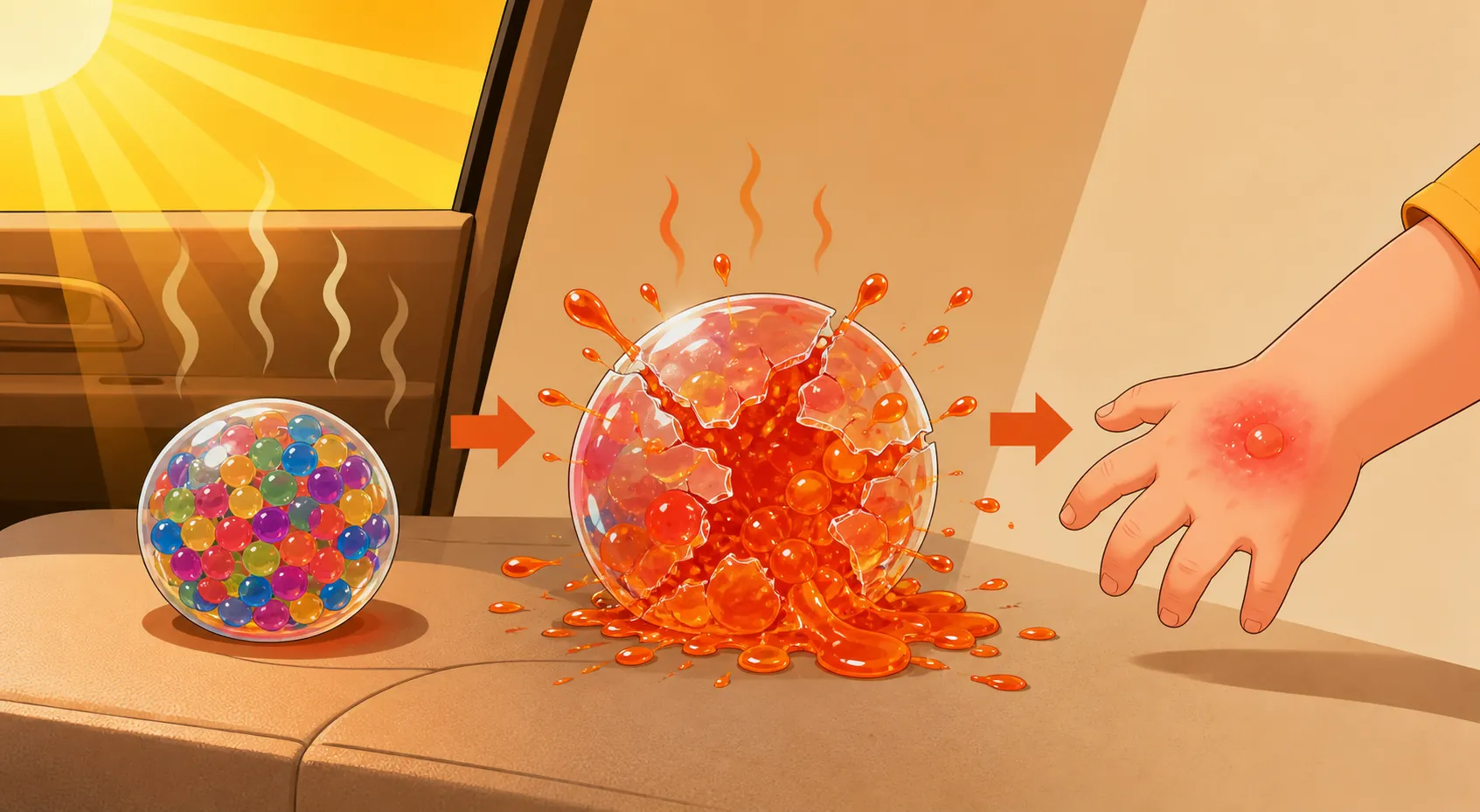
The heat cases do not all come from the same exposure. Some involve microwaving or a microwave/freezer challenge. Others involve a toy left in a hot car. Physician warnings refer more generally to heated toys. That variation weakens any simple claim that there is only one behavior or one platform-driven trend to blame. It also matters for risk classification, because a hot-car case is not the same thing as a child intentionally microwaving a toy.
Consumer Reports’ thermal testing is the most concrete non-injury evidence in the file. Its testers reported that microwave-heated samples exploded after about 15 seconds and reached more than 200°F. That does not prove the facts of any individual hospital case. It does, however, give a physical pathway for the reported injuries: gel can become dangerously hot before or during rupture. [10]
The physician-sourced reports add a different kind of weight. Dr. Emily Werthman of Johns Hopkins was reported as estimating about a dozen NeeDoh burn cases as of July 2026, and Dr. Alisa Savetamal in Connecticut was reported as warning after treating children injured by heated toys. Those comments are not a peer-reviewed incidence study. They are still harder to dismiss than a viral post because they come from burn-treatment settings where the injury consequences arrive after the online trend, the playroom decision, or the car exposure has already happened. [3][4]
The poison-center material also narrows the story. West Virginia and Kentucky poison-center comments described a rise in squishy-related calls, mostly involving leaking or burst toys with skin contact or ingestion. Heat-burst cases were described as rare, but the Kentucky Poison Center cautioned that heat can make contents extremely hot and cause severe burns if a toy bursts. That is a more disciplined warning than a generalized claim that every NeeDoh product is chemically dangerous. [5]
Chemical-irritation reports exist, but the pH evidence is not settled
Several SaferProducts reports describe alleged chemical burns after a NeeDoh or similar gel toy burst or leaked. Those entries are part of the record, especially because they predate the July 2026 litigation spike. But SaferProducts.gov reports are consumer-submitted. They are designed to surface possible product hazards, not to decide causation, diagnosis, or defect. [6][7][8][9]
Consumer Reports’ December 2025 investigation is the main reason the chemical track cannot be ignored. CR reported that one Groovy Glob gel sample tested at pH 2, which it compared to lemon juice, while seven other toys tested between pH 6 and 6.5. It also reported finding no lead, phthalates, or BPA. Schylling CEO Paul Weingard disputed the pH finding as unsupported by Schylling’s specifications, and Consumer Reports stood by its work. [10]
That leaves a narrower conclusion than some headlines suggest. There is a documented contested lab finding and there are self-reported chemical-burn allegations. There is not, in the provided record, a settled regulatory finding that NeeDoh gel is chemically defective or that chemical burns are the dominant injury mechanism.
What the Mendoza class action adds — and what it does not
Mendoza v. Schylling was filed on July 21, 2026, in the Northern District of California, docketed as 5:26-cv-07534 according to ClassAction.org. The notices describe a 47-page complaint asserting claims under California’s Unfair Competition Law, Consumers Legal Remedies Act, and False Advertising Law. The named plaintiff is described as a California behavioral technician who bought a NeeDoh Nice Cube at a San Jose Walmart in April 2026 and alleges the toy ruptured during normal indoor squeezing. [11][12]
The complaint also reportedly alleges that an 11-year-old boy suffered third-degree burns, infection, scarring, and about four months of treatment after a microwaved toy burst. Its theory includes a thermal-insulator allegation: the polymer shell can feel cool while gel inside has overheated. That theory tracks the thermal mechanism seen elsewhere in the record, but it remains a pleading allegation. [11][12]
A complaint is not a verdict, and proposed class allegations are not a certified class. As of the record provided for Aug. 3, 2026, there is no identified class certification, settlement, or liability ruling. The lawsuit matters because it consolidates theories already visible in consumer reports, testing, and physician warnings. It does not prove those theories.
The CPSC track: no recall found is not the same as no hazard
Consumer Reports urged CPSC to investigate chemical-burn risks from gel in sensory squeeze toys, including the NeeDoh Nice Cube, in a March 19, 2025 press release and petition. CR later reported that CPSC did not respond at the time and that Acting Chair Peter Feldman said the agency was monitoring the matter. CR also reported a Toy Association statement that CPSC was investigating squishy toys and that no hazard had been confirmed. [10][14]
Schylling’s position belongs in the same regulatory file, but it should be labeled as the manufacturer’s position. The company has said its products meet ASTM F963, has characterized microwaving, freezing, and heat exposure as misuse, and has said warnings were updated in March 2025. Those statements may matter to a future warning-defect dispute. They are not a substitute for an independent recall decision. [13]
Through Aug. 3, 2026, no CPSC recall for NeeDoh was identified in the reviewed record. That sentence should not be inflated. It does not mean CPSC has found the product safe. It means there is no recall found by this verification date, despite a public petition track, media-reported burn cases, consumer reports, and company responses.
The contrast with the 2026 Orb Funkee squeeze-toy recall is useful only in a limited way. CPSC announced a recall of about 121,340 Orb Funkee squeeze toys due to asbestos exposure from fibrous tremolite. That is a different product, importer, and hazard theory. It shows that squeeze-toy recalls can occur when a hazard record reaches the agency’s threshold; it does not establish what CPSC should or will do with NeeDoh. [15]
Final classification
- Best-documented concern: thermal burn injuries after heated or heat-exposed gel-filled toys rupture, burst, or melt. The record includes media-reported hospital cases, physician warnings, poison-center cautions, Consumer Reports thermal testing, and legal allegations that overlap on mechanism.
- Present but less settled concern: chemical irritation or chemical-burn allegations from gel contact. The strongest lab item is Consumer Reports’ pH 2 result for one Groovy Glob sample, but that finding is disputed by Schylling.
- Unverified allegation tier: SaferProducts.gov entries. They are valuable early warnings and should be preserved in the chronology, but they do not independently prove causation or defect.
- Legal signal: Mendoza v. Schylling. The complaint collects thermal-burn and warning theories, including an alleged normal-squeeze rupture and an alleged severe microwave-related injury. It remains unproven.
- Regulatory status: no CPSC recall identified through Aug. 3, 2026. That is an absence finding, not a safety clearance.
The injury claims are not mere media hype. They are also not all equally proven. This Risk Digest record is source-linked, non-advice, and last verified Aug. 3, 2026. It should be updated if CPSC action, docket movement, new lab testing, or additional hospital-confirmed cases change the evidentiary picture.
References
- Doctor warns viral NeeDoh toy trend is hospitalizing children with severe burns — New York Post, July 7, 2026.
- Gel toys linked to some burn injuries across Las Vegas, nationally — FOX5 Vegas, July 31, 2026.
- Connecticut doctor warns heated NeeDoh toys can cause serious burns — NBC Connecticut, July 31, 2026.
- As burn cases mount, doctor warns of dangers of popular squishy toys — TribLive, July 31, 2026.
- WSAZ Investigates: Mom says child burned by squishy toy — WSAZ, July 10, 2026.
- SaferProducts Report 4970013 — SaferProducts.gov.
- SaferProducts Report 5108893 — SaferProducts.gov.
- SaferProducts Report 5464670 — SaferProducts.gov.
- SaferProducts Report 5917865 — SaferProducts.gov.
- Squishy Fidget Toys Can Be a Sticky Mess, or Worse — Consumer Reports, Dec. 16, 2025.
- Class Action Lawsuit Alleges NeeDoh Sensory Toys Can Explode When Exposed to Heat, Posing Risk of Severe Burns — ClassAction.org.
- Needoh Sensory Toy Burn Hazard Lawsuit — Class Action Pulse.
- Schylling Shares NeeDoh Safety and Retail Guidance Amid High Demand — National Law Review, May 18, 2026.
- Consumer Reports Urges CPSC to Investigate Chemical Burn Risks from Gel in Sensory Squeeze Toys, Including the NeeDoh Nice Cube — Consumer Reports Advocacy, March 19, 2025.
- Orb Funkee Squeeze Toys Recalled Due to Risk of Serious Injury or Death from Asbestos Exposure; Imported by The Orb Factory — U.S. Consumer Product Safety Commission, 2026.
Related records
Tool profile
Browse tool evaluations →Governing regulation
Browse the obligations tracker →Preventive workflow
Browse verification workflows →
Report a correction or tip
Spotted an outdated figure, a misstated fact, or a ruling this case record should reflect? Public comments are disabled for this content given the professional cost of a misreported case outcome, penalty amount, or rule text — use the structured correction channel instead.
Report a correction or tip for this record →