
New York Times Awarded $171,616 in Anti-SLAPP Costs
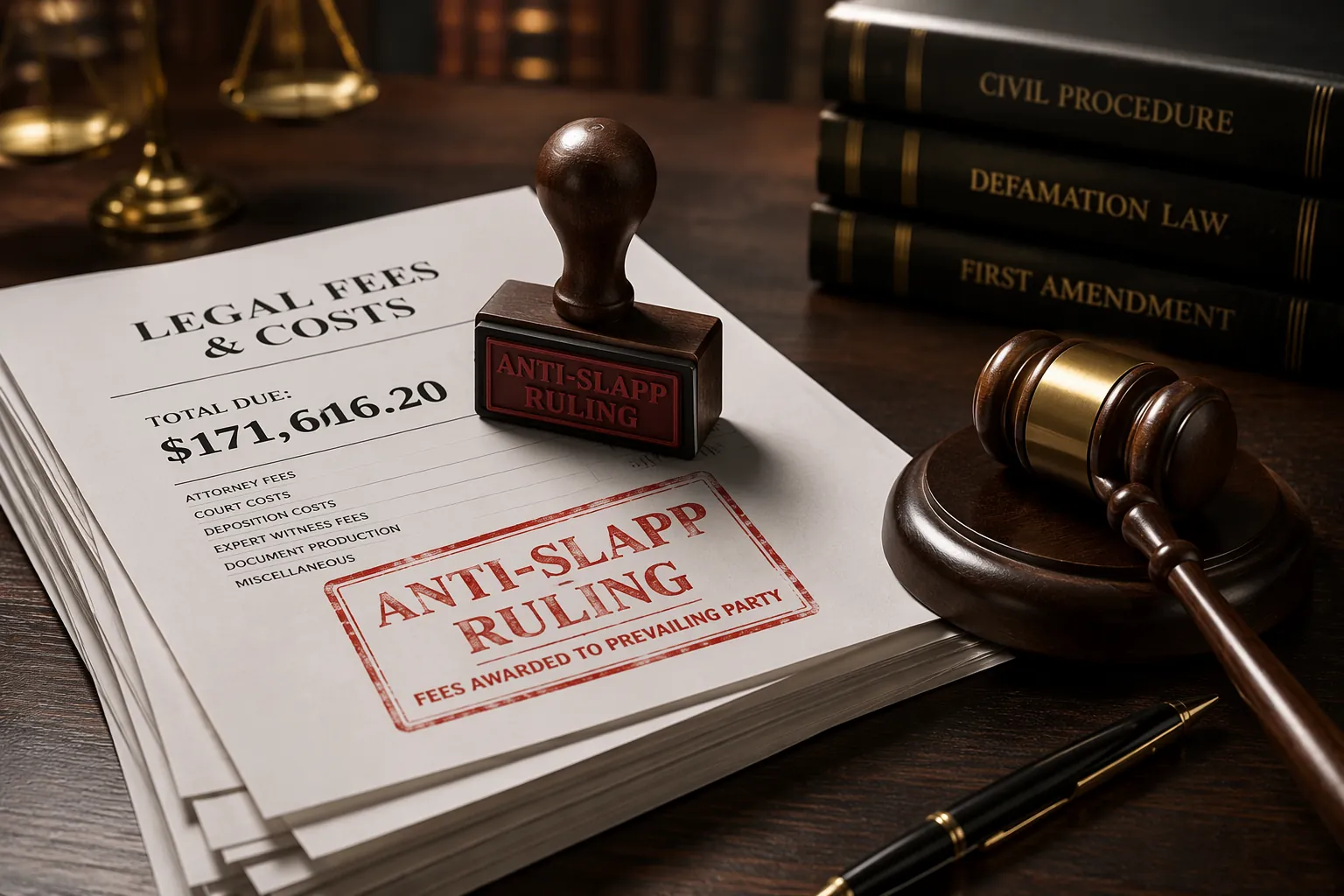
New York Supreme Court awarded The New York Times $171,616.20 in anti-SLAPP damages on July 27, 2026, after ruling that Wayfarer Studios' defamation suit lacked a substantial basis in fact and law. The award, reduced from $181,622.70, is final because the parties' May 2026 settlement waived appellate rights.
- Jurisdiction
- New York State
- Court
- New York Supreme Court
- Judge
- Gerald Lebovits
- AI tool named
- None
- Ruling date
- Jul 27, 2026
- Source document
- View primary court order ↗
- Last verified
- Jul 28, 2026
Lex Machina Review is an independent risk-tracking and reference resource. Nothing on this site is legal advice, and using it does not create an attorney-client relationship. Every record is reviewed against primary sources but may not reflect the most current status of a matter — always verify directly against the cited court order, rule text, or a licensed attorney before relying on it.
Companion explanation — secondary to the source document above
The New York Times–Justin Baldoni defamation costs lawsuit now has a concrete anti-SLAPP number: on July 27, 2026, New York Supreme Court Justice Gerald Lebovits awarded The New York Times $171,616.20 against Wayfarer Studios, after a request for $181,622.70. The court tied the award to findings that the defamation suit arose from reporting on a matter of public interest and lacked a substantial basis in fact and law; Wayfarer’s effort to stay the award pending appeal failed because a May 2026 settlement waived appellate rights.[1][2]
That is the useful record-level fact. The celebrity posture of the underlying dispute may explain why the case drew attention, but it does not explain why this ruling matters to litigators. The ruling matters because a media defendant did not merely obtain dismissal; it obtained a six-figure statutory award, and the court still cut the request by $10,006.50 rather than treating every post-dismissal dollar as recoverable.
This is not a full reconstruction of the Baldoni/Lively litigation, and it is not an AI-sanctions record. It belongs here as an adjacent litigation-risk entry: a filing decision against a news outlet produced court-imposed cost exposure, and the primary lesson is about anti-SLAPP fee shifting, recoverable billing categories, and settlement language that closed off appellate delay.
How dismissal became a six-figure award
The anti-SLAPP mechanism did the work. Once the court treated The Times’ reporting as speech on a matter of public interest and concluded that Wayfarer’s defamation claim lacked a substantial basis in fact and law, dismissal was no longer the end of the accounting. The statute allowed the defendant to seek recovery for the expense of responding to the suit.[1]
That distinction is easy to understate. A dismissal tells the plaintiff it cannot proceed on the pleaded claim. An anti-SLAPP award tells the plaintiff that the defendant’s cost of getting out may be shifted back. For a media defendant, that is the difference between winning an early motion and recovering a meaningful portion of the legal spend required to reach that result.
The court’s findings also identify the hinge that should matter in prefiling review. A defamation complaint against a news organization is not evaluated only for whether it sounds serious or alleges reputational harm. Where the reporting concerns a matter of public interest, counsel has to pressure-test whether the claim has a substantial factual and legal basis before filing. If that screen fails, the exposure is not limited to losing the motion.
The dismissal context, kept in its proper size
The fee award sits on top of an earlier federal dismissal. On June 9, 2025, U.S. District Judge Lewis Liman issued a 132-page order dismissing Baldoni’s $400 million countersuit, including claims against The New York Times.[3] The dismissal order found The Times’ reporting protected by fair report privilege and concluded that the pleadings did not plausibly allege actual malice.[4]
Those rulings are necessary background, not the center of this cost record. The later New York proceeding did not require observers to retry the public narrative around the underlying dispute. It asked a narrower billing question: after the defamation claims against The Times were dismissed on those grounds, what amount could the newspaper recover under New York’s anti-SLAPP framework?
The Times set up that question after the federal dismissal by filing an anti-SLAPP fee complaint in September 2025. That procedural step matters because the recovery did not arrive automatically with the dismissal order; the defendant still had to pursue the statutory fee-shifting remedy and support the amount requested.[5]
The $10,006.50 cut is part of the lesson
The Times asked for $181,622.70. Justice Lebovits awarded $171,616.20. The difference, $10,006.50, came from the court’s treatment of post-dismissal work that was not fully recoverable under the anti-SLAPP statute.[1]
That reduction is not a footnote for anyone managing litigation budgets. It shows that the court accepted the statutory premise for shifting costs but still reviewed the fee application for recoverability. The award therefore functions better as a benchmark than as a slogan. It tells a defendant that a substantial recovery is possible; it tells billing lawyers that the application still has to be built around work the statute actually reaches.
For defense counsel, the practical consequence is billing discipline. Time entries should separate work tied to obtaining dismissal and statutory recovery from work that may be harder to characterize as recoverable after dismissal. For plaintiff-side counsel and in-house reviewers, the number creates a prefiling budget item that is too concrete to ignore: if the complaint is later found to lack a substantial basis, the other side’s recoverable costs may become part of the client’s downside.
| Item | Amount or result | Why it matters |
|---|---|---|
| The Times’ request | $181,622.70 | The starting point for the anti-SLAPP fee application |
| Award entered | $171,616.20 | The recoverable amount approved by the court |
| Reduction | $10,006.50 | A reminder that post-dismissal work was not automatically recoverable |
| Stay pending appeal | Denied | The May 2026 settlement waiver foreclosed the appellate delay route |
Finality came from the settlement waiver
Wayfarer cross-moved to stay the award pending appeal. The court denied that request because the parties’ May 2026 settlement included a waiver of appellate rights, making the $171,616.20 award final rather than merely an interim number awaiting another round of review.[2]
That part of the ruling is as important as the arithmetic. A defendant can win a fee award and still face months of delay if the losing party has a viable appellate path. Here, the settlement language mattered after the merits fight was over. It prevented the stay motion from becoming a second-stage tool for postponing payment.
For settlement drafting, the lesson is not complicated: appellate waivers should be read as cost-control provisions, not only as peace clauses. If a party intends to preserve the ability to challenge later fee-shifting consequences, that reservation has to be handled with precision. If the waiver is broad enough, the post-dismissal accounting may become the last accounting.
A benchmark, not a universal price tag
As of Q3 2026, the ruling gives counsel a verified six-figure benchmark for one category of filing risk: a defamation suit against a media defendant, arising from reporting on a matter of public interest, later found to lack a substantial basis in fact and law. It does not establish a standard anti-SLAPP price for every media case, and it should not be treated as a prediction that future courts will award the same proportion of requested fees.
The related Blake Lively fee proceeding is larger on paper but legally distinct. Lively has requested $8,035,040.88 under California Civil Code § 47.1; the request followed a June 12, 2026 ruling granting fee entitlement but denying treble or punitive damages, and Baldoni challenged the amount on July 14, 2026. That request remains pending, so it should not be conflated with the New York anti-SLAPP award or described as an awarded amount.[1]
The reliable takeaway is narrower and more useful: Wayfarer now has a final $171,616.20 cost consequence from the New York anti-SLAPP proceeding, reduced from the amount sought and insulated from appeal by settlement waiver. That is enough to make the case a real prefiling risk reference without turning it into a universal forecast.
References
- Justin Baldoni's Wayfarer Must Pay $170K in NYT Defamation Damages, TheWrap
- Justin Baldoni's Wayfarer Studios Ordered to Pay The New York Times $171K, People.com
- NY Times sues Baldoni's production company to recoup costs, Courthouse News Service
- Wayfarer Studios, Justin Baldoni v. Blake Lively, The New York Times (U.S. District Court, New York 2025), First Amendment Encyclopedia
- Justin Baldoni Hit By NY Times For Attorney Fees, Deadline
Related records
Tool profile
Browse tool evaluations →Governing regulation
Browse the obligations tracker →Preventive workflow
Browse verification workflows →
Report a correction or tip
Spotted an outdated figure, a misstated fact, or a ruling this case record should reflect? Public comments are disabled for this content given the professional cost of a misreported case outcome, penalty amount, or rule text — use the structured correction channel instead.
Report a correction or tip for this record →