
Why NFL Mental Health Support Faces ERISA Roadblocks
The NFL's ERISA disability plans impose fiduciary duties to evaluate mental health claims impartially, but two recent federal cases—Alford and Cloud—demonstrate how procedural barriers have blocked systemic relief for former players.
- Jurisdiction
- US-Federal
- Court
- U.S. Court of Appeals for the Fifth Circuit
- AI tool named
- None
- Ruling date
- Jan 28, 2026
- Source document
- View primary court order ↗
- Last verified
- Jul 26, 2026
Lex Machina Review is an independent risk-tracking and reference resource. Nothing on this site is legal advice, and using it does not create an attorney-client relationship. Every record is reviewed against primary sources but may not reflect the most current status of a matter — always verify directly against the cited court order, rule text, or a licensed attorney before relying on it.
Companion explanation — secondary to the source document above
The hard part of identifying the NFL’s legal obligations around mental health support for former players is not finding a duty in the abstract. ERISA fiduciaries must administer disability plans loyally and prudently, and the NFL-related disability plans are not exempt from that baseline. The harder question is whether a former player can turn evidence of a bad benefits process into a court remedy. In Cloud v. Bert Bell/Pete Rozelle NFL Player Retirement Plan, the record contained judicially recognized evidence of serious fiduciary dysfunction; the Fifth Circuit still upheld the denial because the claimant could not satisfy the threshold requirement of changed circumstances for judicial review.[1]
That is the procedural posture worth taking seriously. This is not a general account of whether the NFL does enough for mental health, and it is not legal advice. The focus is narrower: federal ERISA litigation over NFL disability-plan administration, principally Cloud in the Fifth Circuit and Alford in the District of Maryland, as verified against the available record through July 26, 2026. The question is enforceability risk—what duties exist, which legal channel enforces them, and why recent plaintiffs have failed to obtain systemic relief even when the allegations and findings were not trivial.

The Cloud Problem: Bad Process Does Not Always Open the Courthouse Door
Cloud is uncomfortable because it separates two propositions that lay readers understandably tend to merge. A court may recognize that fiduciary administration looks deeply defective. A claimant may still lose if the governing plan terms and judicial-review rules require a showing the claimant cannot make.
The district court record described fiduciary failures as “shocking,” including more than 50 cases decided en masse by a law firm without individualized board-member review.[1] On appeal, the Fifth Circuit acknowledged the evidence as “devastating,” but it did not treat that evidence as enough to obtain review of the denied active-level disability benefits.[1] The dispositive problem was changed circumstances: Cloud could not show the kind of post-denial change required to justify judicial review under the plan framework applied by the court.[1]
That distinction matters for any counsel evaluating NFL disability-plan litigation. Evidence that administrators relied too heavily on outside counsel, failed to conduct individualized review, or operated with a compromised process may be powerful evidence of fiduciary exposure. It does not automatically answer the antecedent question: is this claimant entitled to have this denial reviewed now, under this plan language, in this procedural posture?
The active-level benefit issue sharpened the practical stakes. The Fifth Circuit opinion noted that only approximately 30 former players receive active-level disability benefits.[1] That number does not prove that other players were wrongly denied. It does show that the category is narrow enough for every threshold rule to carry real consequence. If changed circumstances are required and absent, the court never reaches the merits in the way the claimant needs it to.
| Cloud feature | Why it mattered |
|---|---|
| Court and posture | Fifth Circuit review of denial of active-level disability benefits |
| Record concern | District court found severe fiduciary-process failures, including bulk case handling without individualized board review |
| Appellate barrier | The claimant could not demonstrate changed circumstances required for judicial review |
| Practical result | Recognized fiduciary dysfunction did not produce benefit relief for the claimant |
There is a temptation to describe that result as a technicality. That understates the point. In ERISA litigation, plan language and exhaustion-adjacent review rules are not ornamental. They decide whether a court reaches the evidence at all, what standard of review applies, and whether procedural irregularities become a remedy or merely a record of institutional failure.
What ERISA Actually Requires
For former players seeking disability benefits tied to mental-health conditions, the relevant ERISA duty is not a freestanding duty to provide therapy, crisis care, or long-term clinical support. It is a fiduciary duty to administer the plan in accordance with ERISA and the governing plan documents, including an impartial evaluation of claims. That includes claims where mental-health symptoms, cognitive conditions, or psychiatric evidence form part of the disability presentation.
The legal obligation is therefore real but channeled. Administrators cannot fairly market a review process as neutral while using decision structures that systematically favor denial, if the evidence supports that claim. They cannot ignore material evidence, treat similarly situated claimants arbitrarily, or substitute a litigation-defense process for fiduciary deliberation. But ERISA does not convert every deficient process into a classwide injunction, a reopened claim, or an award of benefits. The remedy still depends on cause of action, proof, plan terms, standard of review, and procedural posture.
Cloud is the cleanest example because it did not require the court to pretend the process looked healthy. The evidence could be bad and the claimant could still lose. That is the gap non-lawyers often miss: ERISA fiduciary duties are enforceable only through the litigation tools ERISA and the plan permit.
Alford Shows Why a Systemwide Case Is Harder Than a Systemwide Allegation
Alford moves the problem from individual review to scale. Filed in February 2023 in the District of Maryland, the case sought class treatment against the NFL Player Disability Plan. On January 28, 2026, the court denied class certification on commonality grounds, pointing to five decades of differently situated claimants, varying plan terms, distinct disability categories, and individualized claim files.[2]
The allegations were not minor. The complaint alleged that doctors paid between $1.1 million and $1.8 million by the disability board produced denial-favorable reports and that the board represented those doctors as “absolutely neutral.”[2] Those allegations, if proven in an individual case, could be relevant to conflict, bias, and fiduciary process. They also explain why claimants would try to frame the problem as a common administrative machine rather than a series of isolated denials.
But commonality is not satisfied merely because many claimants distrust the same institution. A class action requires a common contention capable of classwide resolution. Alford ran into the administrative-record reality that benefits lawyers know too well: different claim dates, different plan versions, different categories of disability, different medical submissions, different reviewing physicians, and different denial rationales can make one umbrella theory too coarse to resolve liability in a single stroke.[2]
| Alford allegation or issue | Class-certification problem |
|---|---|
| Repeat use of paid reviewing doctors | Relevant to bias allegations, but not necessarily enough to prove every denial turned on the same defect |
| Neutrality representations | Potentially important if contradicted by payment relationships, but still tied to how each file used the reviewer |
| Five decades of claimants | Plan language and administrative practices may not be uniform across the proposed class period |
| Mental-health-related disability claims | The medical and vocational evidence remains claimant-specific |
That does not make the allegations irrelevant. It changes where they may matter. A repeat-reviewer payment theory may have force in an individual administrative record. It may support discovery arguments where discovery is available. It may affect how a court evaluates credibility, conflict, or procedural regularity. Alford’s class-certification denial means only that the proposed class did not clear Rule 23 commonality on the record before the court; it is not an appellate merits ruling, and no appeal ruling exists as of July 26, 2026.[2]
Mental Health Support and Disability Benefits Travel on Different Tracks
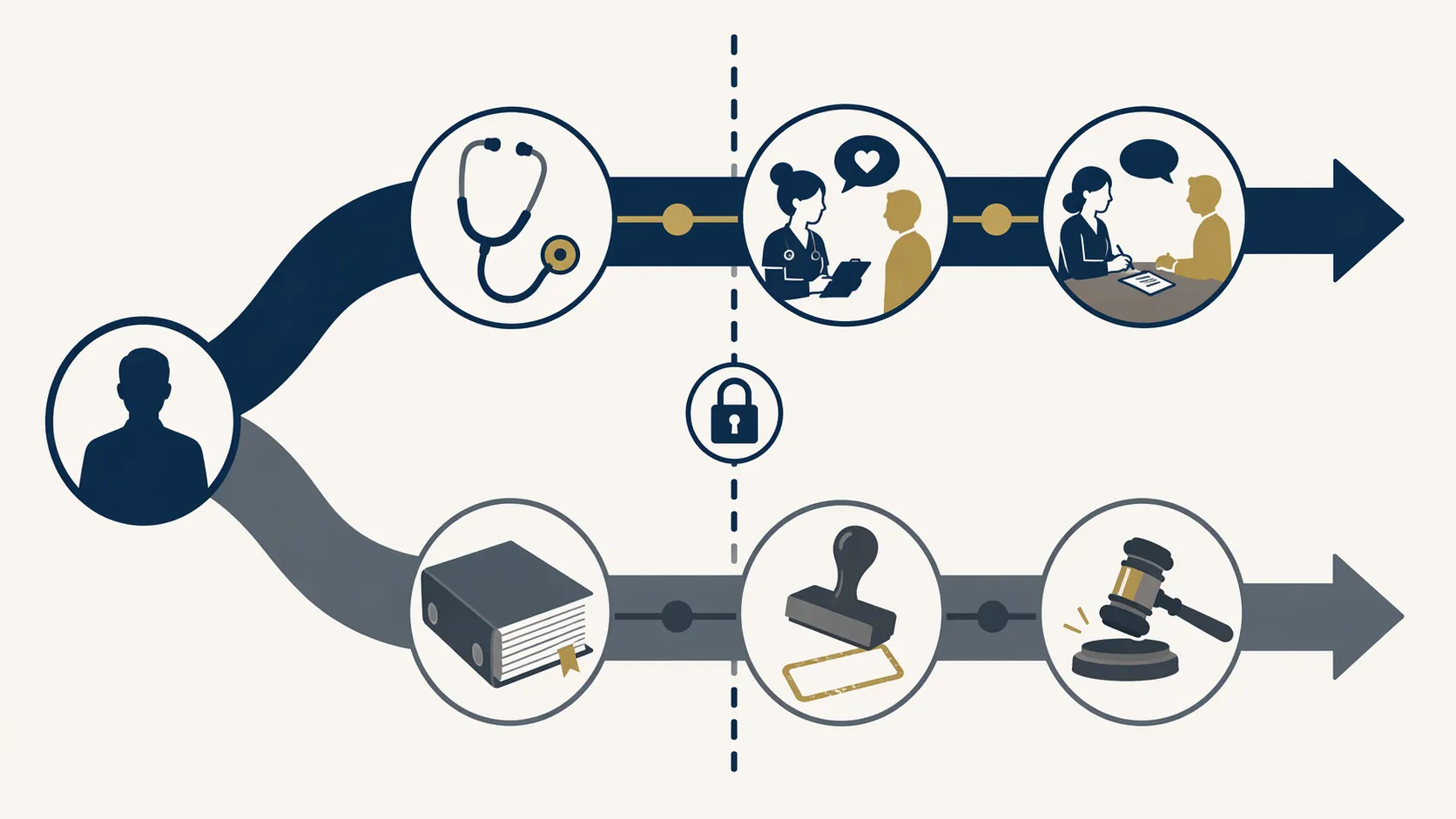
Some confusion in this area comes from using “mental health support” to describe two different legal regimes. The collective bargaining agreement addresses support services. ERISA governs disability-benefit decisions. A former player may encounter both, but they are not enforced the same way.
After two active player suicides during the 2025 season, NFL owners approved a March 2026 expansion of the Team Clinician requirement from 8–12 hours per week to a full-time presence at each facility.[3] That is a contractual workplace-support obligation arising from the CBA architecture, not an ERISA benefits determination. It may affect access, triage, transition planning, and crisis response. It does not decide whether a former player qualifies for disability benefits under an ERISA plan.
The 2020 CBA baseline is more specific than a general promise of concern. Article 39, Section 19 requires Team Clinicians with at least seven years of experience, annual Mental Health Emergency Action Plan drills, voluntary transition interviews for departing players, and minimum fines of $500,000 for unauthorized disclosure of mental-health records.[4] Enforcement runs through joint NFL-NFLPA committee processes and Article 16 arbitration, not ordinary federal court litigation over a denied ERISA disability claim.[4]
That division can feel artificial to the person living through it. A player leaving the league may receive a transition interview under the CBA framework and later face a denied disability claim under the ERISA plan. The facts may overlap medically, but the legal channels remain separate. One asks whether the collectively bargained support structure was provided and enforced through labor mechanisms. The other asks whether the plan fiduciaries administered a benefits claim lawfully under ERISA.
Other Player-Health Instruments Do Not Fix the ERISA Gap
The concussion-settlement context is a useful caution against collapsing every player-health dispute into one legal category. Reporting on the settlement has identified a 28% denial rate on approved-doctor diagnoses, a network shrinkage of more than 60% since 2018, and the continuing exclusion of behavioral and mood symptoms associated with CTE from the settlement’s compensable diagnoses.[5] Those facts may matter for broader player-health policy debates, but the settlement is a separate legal instrument from the disability plans.
For ERISA purposes, the question remains plan administration. A settlement limitation does not prove an ERISA breach. A CBA clinician obligation does not award disability benefits. A fiduciary-process failure does not automatically satisfy changed circumstances or Rule 23. These boundaries are inconvenient, but they are the boundaries counsel must work inside.
Where the Current Doctrine Leaves Former Players and Plan Fiduciaries
As of July 26, 2026, the supported conclusion is narrow. NFL disability-plan fiduciaries have legal duties when evaluating mental-health-related disability claims. They must administer those claims impartially and in accordance with ERISA and the plan. The recent litigation does not show that those duties are imaginary. It shows that the available federal litigation paths have not produced a systemic remedy.
Cloud demonstrates that severe fiduciary-process evidence can fail to produce relief when the claimant cannot satisfy a threshold review requirement. Alford demonstrates that allegations of a common denial-oriented structure can fail to produce class treatment when the proposed class spans decades of claimants, plan terms, disability categories, and individualized administrative records. The combined lesson is procedural, not sentimental: fiduciary-process exposure may be easier to document than to remedy at scale.
For counsel, that means the risk analysis should not stop at whether the facts look bad. It should ask which obligation is being enforced, which forum can enforce it, whether the claimant has crossed the threshold for review, and whether the proof can travel beyond one administrative record. The legal duty is real. The litigation leverage remains constrained.
References
- Cloud v. Bert Bell/Pete Rozelle NFL Player Retirement Plan analysis — DeBofsky Law / Law360
- Class certification denied in Alford v. NFL Player Disability Plan — Front Office Sports / NFL Disability Lawsuit, Jan. 28, 2026
- NFL owners approve full-time team clinician requirement — The Athletic, Mar. 31, 2026
- 2020 NFL Collective Bargaining Agreement, Article 39, Section 19 — NFLPA / OverTheCap
- NFL concussion settlement investigation — The Washington Post
Related records
Tool profile
Browse tool evaluations →Governing regulation
Browse the obligations tracker →Preventive workflow
Browse verification workflows →
Report a correction or tip
Spotted an outdated figure, a misstated fact, or a ruling this case record should reflect? Public comments are disabled for this content given the professional cost of a misreported case outcome, penalty amount, or rule text — use the structured correction channel instead.
Report a correction or tip for this record →