
What NHTSA's Three Tesla FSD Probes Mean for Litigators
This article examines how NHTSA's three concurrent investigations into Tesla's Full Self-Driving system—spanning an engineering analysis, a preliminary evaluation, and a remote-driving probe—create a federal regulatory record that litigators can use to strengthen design defect, failure to warn, and negligent marketing claims in product liability litigation.
- Jurisdiction
- US Federal
- Court
- NHTSA
- AI tool named
- Tesla Full Self-Driving (FSD)
- Ruling date
- Mar 19, 2026
- Source document
- View primary court order ↗
- Last verified
- Jul 29, 2026
Lex Machina Review is an independent risk-tracking and reference resource. Nothing on this site is legal advice, and using it does not create an attorney-client relationship. Every record is reviewed against primary sources but may not reflect the most current status of a matter — always verify directly against the cited court order, rule text, or a licensed attorney before relying on it.
Companion explanation — secondary to the source document above
Category: risk-digest. Last researched: July 29, 2026. This article is for litigation-risk analysis, not legal advice. One source-chain caveat matters at the outset: the EA26002 findings discussed here are described through secondary reporting that cites NHTSA’s ODI resume, because the underlying PDF was not reviewed directly here.
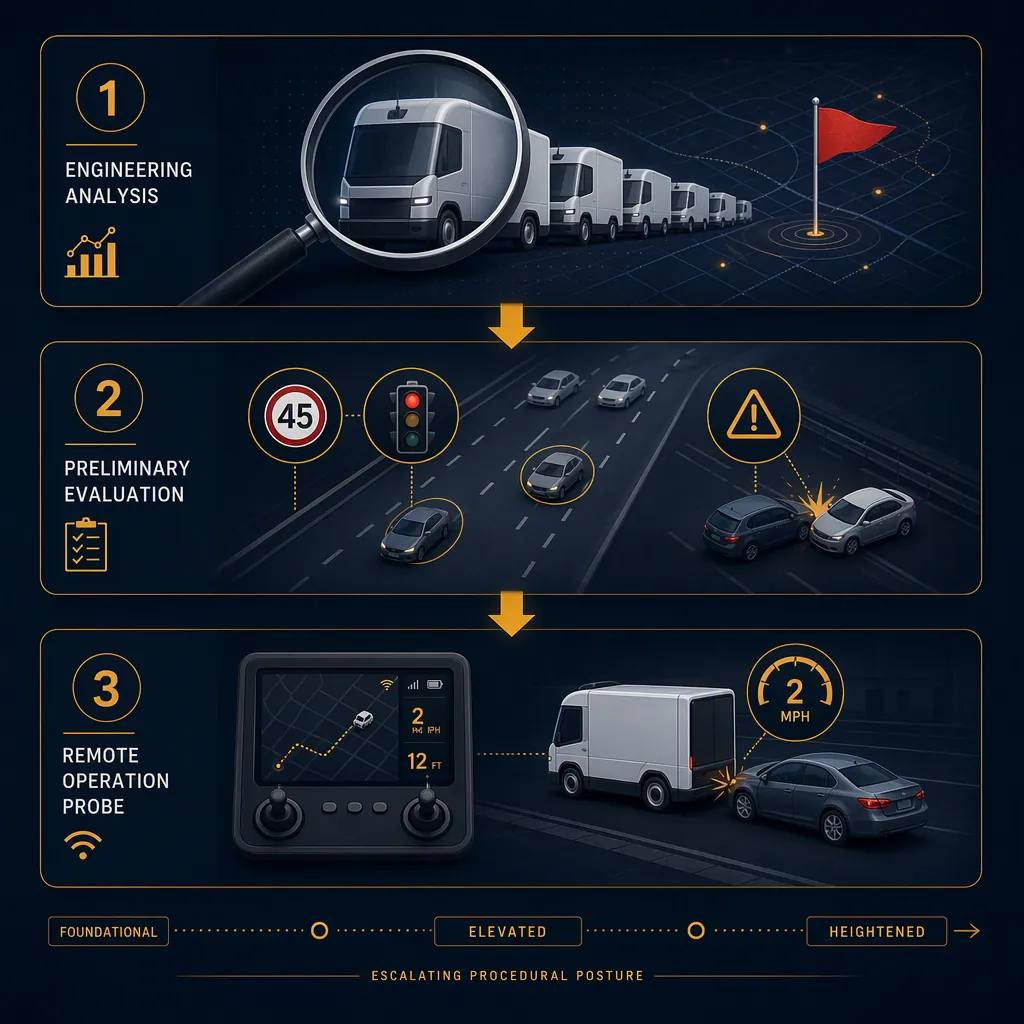
For Tesla Full Self-Driving litigation, the immediate problem is not whether NHTSA has already decided civil liability. It has not. The problem is that three federal investigations now place different slices of the FSD record into a public, regulator-organized file: an engineering analysis covering millions of vehicles, a preliminary evaluation focused on traffic-law behavior, and a remote-operation probe involving low-speed collisions. That is a very different case-management posture from a plaintiff trying to reconstruct a single crash through party discovery alone.

The legal implications of the NHTSA probe into Tesla Full Self-Driving crashes therefore depend on procedural precision. EA26002 carries the most weight because it is an engineering analysis, the final step before NHTSA can seek a forced recall. PE25012 is less procedurally mature but useful for behavior, warnings, marketing, and foreseeable misuse. The Actually Smart Summon investigation is narrower, but it keeps remote operation separate from highway-driving narratives. Together, the probes strengthen design defect, failure to warn, and negligent marketing theories, although not with equal force.
This topic belongs in a legal risk digest because NHTSA action can become litigation infrastructure. A regulator’s file is not a verdict, and an ODI resume is not a substitute for expert proof. But when a federal agency collects crash patterns, vehicle populations, software chronology, reporting gaps, and company responses, it changes what pleadings can allege, what experts can frame, what defendants must explain, and what preservation letters should demand.
Three Files, Three Different Litigation Uses
| NHTSA matter | Procedural posture | Reported scope | Primary litigation use |
|---|---|---|---|
| EA26002 | Engineering Analysis, opened March 2026 | 3,203,754 vehicles; nine reduced-visibility crashes; one pedestrian fatality; two injury crashes; six additional incidents under review | Design defect, failure to warn, recall pressure, expert framing |
| PE25012 | Preliminary Evaluation, opened October 2025 | 58 traffic safety violations; 14 crashes; 23 injuries; data and labeling limitations relevant to under-reporting | Negligent marketing, foreseeable misuse, warnings, reporting completeness |
| Actually Smart Summon probe | Remote-driving probe, opened January 2025 | 2.6 million vehicles; crashes involving remote operation, including a parked aircraft | Low-speed remote-operation defect theories distinct from on-road FSD behavior |
The distinction matters. A complaint that treats all three as one generic “federal investigation” loses evidentiary discipline. A discovery plan that separates them can ask better questions: what Tesla knew about camera degradation, what it told drivers about system capability, what crash data it labeled as FSD-related, and whether a remote-control feature failed in ways that do not fit the usual driver-assistance fact pattern.
EA26002 Is the Load-Bearing Record
EA26002 deserves first billing because of both size and stage. Reporting that cites NHTSA’s ODI resume says the engineering analysis covers 3,203,754 Tesla vehicles and examines nine crashes in reduced-visibility conditions, including sun glare, fog, and airborne dust. Those crashes include one pedestrian fatality and two injury crashes, with six additional incidents under review.[1]
That framing is narrower, and more useful, than a broad claim that cameras are inherently defective. The reported issue is that the system allegedly did not detect common roadway conditions that impaired its own camera visibility until immediately before impact. A plaintiff’s expert does not need to prove that every camera-only design is unsafe in every environment to make use of that record. The more precise question is whether this implementation adequately recognized and responded to the degradation of the sensors it depended on.
The software response is the part trial teams will read closely. According to reporting on the ODI resume, Tesla’s post-hoc analysis admitted that its updated degradation-detection software would have affected only three of the nine identified reduced-visibility crashes.[1] That is not a liability finding. It is, however, a pointed mismatch between the alleged hazard and the reported remedial scope.
In design-defect litigation, that mismatch helps sharpen the alternative-design question. If the alleged failure mode is late recognition of camera impairment, then the case is not only about whether a driver should have intervened. It is also about whether the product architecture, software monitoring, driver alerts, and fallback behavior reasonably accounted for conditions that predictably degraded the system’s perception.
The mid-2021 shift from camera-plus-radar to camera-only Tesla Vision belongs in that analysis as a design-choice frame, not as a verdict by comparison. Reporting and practitioner commentary identify that transition as relevant to the NHTSA scrutiny, while noting that competitors such as Waymo and GM Super Cruise use sensor fusion involving lidar, radar, and cameras.[2] In litigation terms, that comparison can support an argument about feasible alternative designs. It does not prove by itself that Tesla’s choice was legally defective.
Failure-to-warn theories also become more concrete when tied to the reduced-visibility pattern. A warning claim is stronger when it can identify the condition the user was allegedly not equipped to appreciate in time: not merely “pay attention,” but the risk that the system may continue operating until immediately before impact despite sun glare, fog, or dust impairing its camera visibility. That difference affects jury instructions, expert reports, and the wording of alleged omissions.
The Reporting Gap Changes the Chronology
The seven-month crash-reporting gap after the fatal Arizona pedestrian crash is not just a regulatory footnote. Automotive World reported that Tesla submitted the required crash report for the November 28, 2023 death of Johna Story on June 27, 2024, and began developing a software fix the following day.[3]
For litigators, that timing can matter even before anyone reaches a defect verdict. It affects preservation demands, spoliation arguments, notice theories, and the chronology of remedial work. If a company’s internal analysis, regulatory reporting, and software-development response cluster around a delayed report, the sequence becomes a discovery target in its own right.
The careful version of the argument is not that late reporting proves the product was defective. It is that late reporting can complicate Tesla’s position on what it knew, when it knew it, what data it preserved, and why the later fix addressed only part of the reported incident set.
PE25012 Supplies the Behavioral Record
PE25012 is not at the same procedural stage as EA26002, but it may be just as important for negligent marketing and foreseeable-misuse theories. Reuters reported that NHTSA opened the preliminary evaluation in October 2025 into driver-assistance software in 2.9 million Tesla vehicles after documenting 58 traffic safety violations during FSD engagement, including running red lights, wrong-way driving, and lane-change violations. The same reporting identified 14 crashes and 23 injuries.[4]
Those facts do a different kind of work from the reduced-visibility crashes. They point toward how the system behaves in traffic-rule contexts and how drivers may understand its capabilities. If a plaintiff alleges that Tesla encouraged users to trust a feature beyond its operational competence, PE25012 gives counsel a public record for targeted pleading rather than a generalized complaint about branding.
The “data and labeling limitations” issue is especially useful for discovery. Reuters reported that NHTSA said Tesla cited data and labeling limitations that may have caused under-reporting of FSD crashes during the investigation period.[4] That statement does not establish concealment. It does suggest lines of questioning about event classification, feature-engagement fields, crash-report triggers, internal dashboards, and how Tesla distinguished FSD, Autopilot, manual driving, and other driver-assistance states.
PE25012 also helps avoid a common defense-side simplification. If a crash involved a traffic violation while FSD was engaged, the litigation question is not limited to whether the human driver should have stopped the car. Counsel will ask whether the system’s design, labeling, user interface, alerts, and marketing made that violation foreseeable, and whether Tesla’s own data structure allowed the company and regulators to see the pattern clearly.
Remote Operation Is Not Just Another FSD Crash
The Actually Smart Summon probe should not be folded casually into the on-road FSD investigations. Reuters reported in January 2025 that NHTSA opened a probe covering 2.6 million vehicles over the remote-driving feature, including crashes where vehicles struck objects such as a parked aircraft.[5]
Remote operation changes the defect question. A user outside the vehicle, controlling or summoning it at low speed, occupies a different position from a driver seated behind the wheel during lane keeping, turning, or traffic-signal negotiation. The relevant warnings, interface design, reaction time, line of sight, obstacle recognition, and emergency-stop expectations all shift.
That distinction matters in pleadings. A remote-operation case should not borrow every allegation from an on-road FSD complaint. It may require a separate theory of foreseeable use in parking lots, private drives, airport environments, or other low-speed spaces where the user’s ability to perceive and interrupt the hazard differs from a conventional driver’s.
How the Probes Map Onto Civil Theories
A regulator’s file becomes litigation material only when it is attached to a theory of liability. The current FSD record points most cleanly toward three theories, each with different proof problems.
- Design defect: EA26002 supports allegations that the system failed to detect and respond to conditions impairing the camera visibility on which it depended, especially after the move to camera-only Tesla Vision.
- Failure to warn: the reduced-visibility crashes and traffic-violation record help specify what risk allegedly needed clearer disclosure, including limits under sun glare, fog, dust, traffic controls, and lane-change scenarios.
- Negligent marketing: PE25012’s traffic-violation allegations and data-labeling concerns can support arguments that consumers were led to overestimate the system’s competence or that known patterns were not adequately communicated.
- Preservation and spoliation: the delayed fatal-crash report can support targeted demands for internal timelines, original vehicle data, software-build records, incident-review notes, and regulatory communications.
- Remote-operation defect: the Actually Smart Summon probe supplies a distinct fact pattern for low-speed, user-outside-vehicle claims.
None of these theories is self-proving. Plaintiffs still need causation, admissible expert testimony, product-identification precision, damages proof, and jurisdiction-specific defect standards. Defense counsel will press driver supervision, misuse, comparative fault, software-version differences, and the limits of agency allegations that have not ripened into a recall order or final defect finding.
The practical change is that plaintiffs no longer have to begin with only a crash narrative and marketing screenshots. They can plead into an existing federal record, then use discovery to test what Tesla knew internally against what NHTSA had already organized publicly.
Benavides Is a Cross-Reference, Not a Shortcut
The Benavides verdict is relevant because it shows that Autopilot- and FSD-adjacent product-defect theories can reach a jury and survive post-trial attack. CNBC reported in February 2026 that Tesla lost its bid to toss a $243 million verdict in a fatal Autopilot crash suit, and that the jury had found Autopilot defective.[6]
That does not mean the NHTSA probes have produced equivalent liability findings. Benavides is a completed civil verdict in a specific case. The probes are regulatory investigations at different procedural stages. Their value is not that they pre-decide the next verdict; it is that they help litigators frame the next record.
Settlement activity should be treated with the same restraint. Confidential resolutions can signal risk appetite and litigation pressure, but they rarely create a public factual record. For knowledge managers and case teams, the better organizing documents are the ODI resumes, recall materials, crash-report timelines, expert filings, and court orders that can be cited, compared, and updated.
What Case Teams Can Do With the Record Now
The immediate litigation use is case architecture. Plaintiffs can separate reduced-visibility allegations from traffic-rule allegations and remote-operation allegations instead of pleading one undifferentiated “FSD failure.” Defense teams can do the same work in reverse, isolating which alleged agency facts apply to the vehicle model, software version, feature state, and crash environment at issue.
- Pleadings: tie allegations to the correct NHTSA matter, procedural stage, vehicle population, crash type, and alleged failure mode.
- Discovery: request software-build histories, degradation-detection work, FSD engagement logs, labeling taxonomies, regulatory submissions, and incident-review communications.
- Experts: frame opinions around visibility degradation, sensor architecture, driver-interface design, warnings, data completeness, and remote-operation environments.
- Preservation: send early demands for vehicle telemetry, camera data, event logs, owner communications, post-crash downloads, and documents surrounding delayed or corrected reports.
- Settlement evaluation: treat NHTSA posture as pressure and context, not as a damages multiplier that substitutes for causation proof.
Aggregate exposure estimates are less useful than the underlying factual record. Electrek’s April 2026 analysis reportedly discussed a high-end $14.5 billion exposure figure across more than 21 litigation tracks, alongside a more conservative $2.7 billion estimate.[7] Those numbers may matter for board-level risk monitoring, but they span more than FSD or ADAS alone and do not prove any individual defect claim.
The 2023 recall background should also be kept in its lane. The recall covering more than 2 million vehicles addressed driver monitoring through over-the-air software, but the available record does not support treating it as a fix for the camera-visibility limitation. NHTSA’s continued review of post-recall crashes keeps recall adequacy contested, not resolved.[8]
As of Q3 2026, the three NHTSA probes do not decide Tesla’s civil liability. They do materially change the evidentiary environment for FSD litigation. The public record now reaches vehicle populations, crash clusters, traffic violations, reporting chronology, software responses, and remote-operation incidents in a way no single plaintiff could realistically assemble alone before discovery. That is enough to shape pleadings, warnings theories, design-defect arguments, marketing claims, expert reports, settlement pressure, and preservation strategy.
References
- Tesla faces intensifying NHTSA probe, CNBC, March 19, 2026, link
- NHTSA Escalates Tesla Full Self-Driving Investigation, Panter Law, March 31, 2026, link
- NHTSA upgrades Tesla FSD probe, Automotive World, March 19, 2026, link
- US probes driver assistance software in 2.9 million Tesla vehicles over traffic violations, Reuters, October 9, 2025, link
- US opens probe into 2.6 million Tesla vehicles over remote driving feature, Reuters, January 7, 2025, link
- Tesla loses bid to toss $243 million verdict in fatal Autopilot crash suit, CNBC, February 20, 2026, link
- Tesla faces $14.5 billion in legal exposure, Electrek, April 2026, link
- 2023 Tesla Autopilot recall materials, NHTSA, 2023, link
Related records
Tool profile
Browse tool evaluations →Governing regulation
Browse the obligations tracker →Preventive workflow
Browse verification workflows →
Report a correction or tip
Spotted an outdated figure, a misstated fact, or a ruling this case record should reflect? Public comments are disabled for this content given the professional cost of a misreported case outcome, penalty amount, or rule text — use the structured correction channel instead.
Report a correction or tip for this record →