
Why the Nolan Wells case can't be ruled accident or homicide
This risk digest examines why drowning remains a diagnosis of exclusion, how decomposition and retained tissue prevent definitive classification in the Nolan Wells death investigation, and what the resulting evidentiary gap means for the grand jury and any potential criminal proceedings.
- Jurisdiction
- US-MS
- Court
- Jackson County Grand Jury
- AI tool named
- None
- Ruling date
- Jul 22, 2026
- Source document
- View primary court order ↗
- Last verified
- Jul 28, 2026
Lex Machina Review is an independent risk-tracking and reference resource. Nothing on this site is legal advice, and using it does not create an attorney-client relationship. Every record is reviewed against primary sources but may not reflect the most current status of a matter — always verify directly against the cited court order, rule text, or a licensed attorney before relying on it.
Companion explanation — secondary to the source document above
Developing story note, current as of July 28, 2026, UTC: the official state autopsy in the investigation into Nolan Wells’ death has not been released publicly, toxicology remains pending, and witness and digital-evidence reporting may change as investigators and the grand jury process continue.
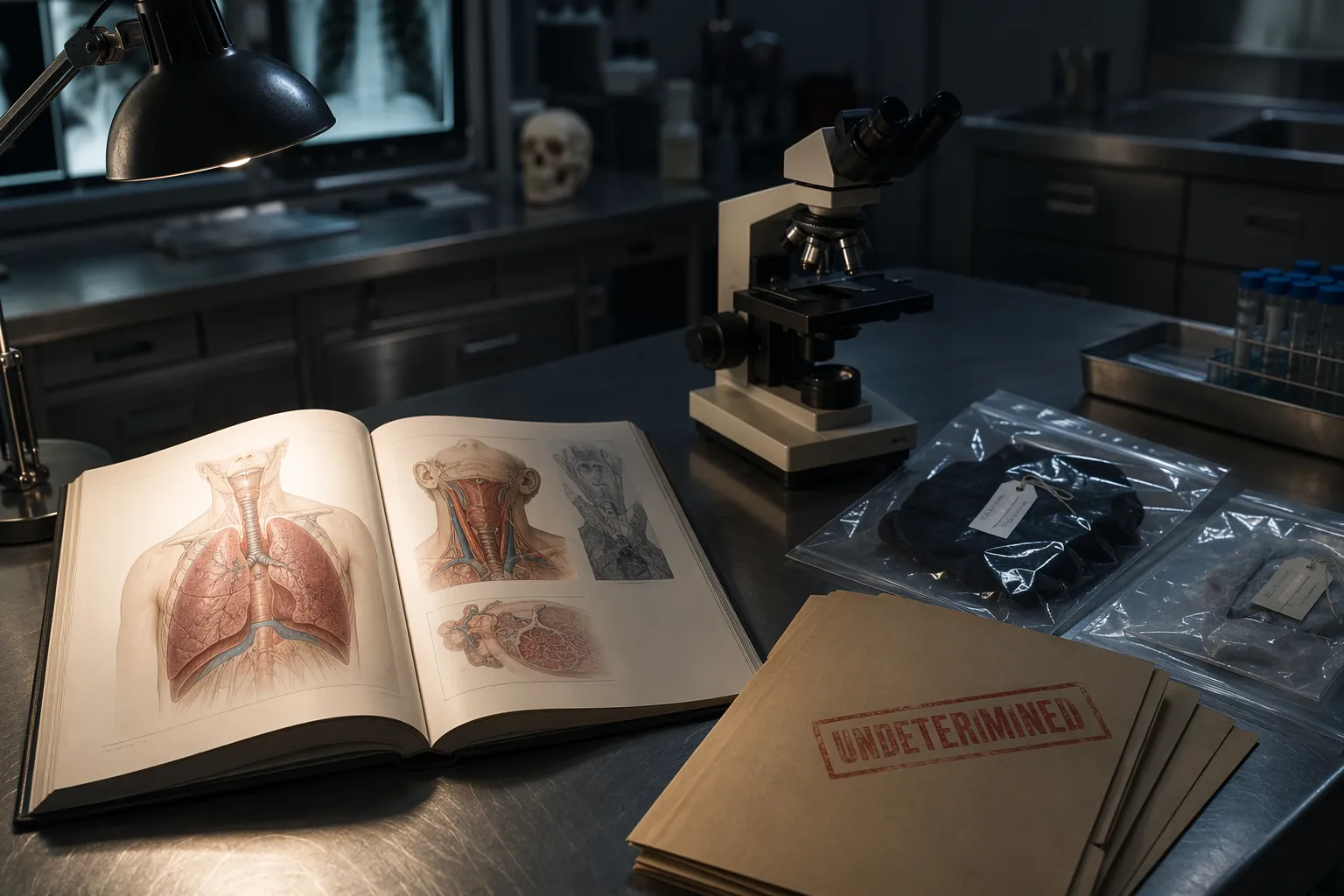
The available record does not medically close the Wells case as either accident or homicide. That is not a failure of nerve by the pathologist. It is the present evidentiary limit. In aquatic deaths, drowning has no single pathognomonic autopsy finding — no one physical marker that, by itself, proves drowning occurred. A drowning diagnosis is built by excluding competing explanations through autopsy, toxicology, scene investigation, and the broader investigative file.[1]
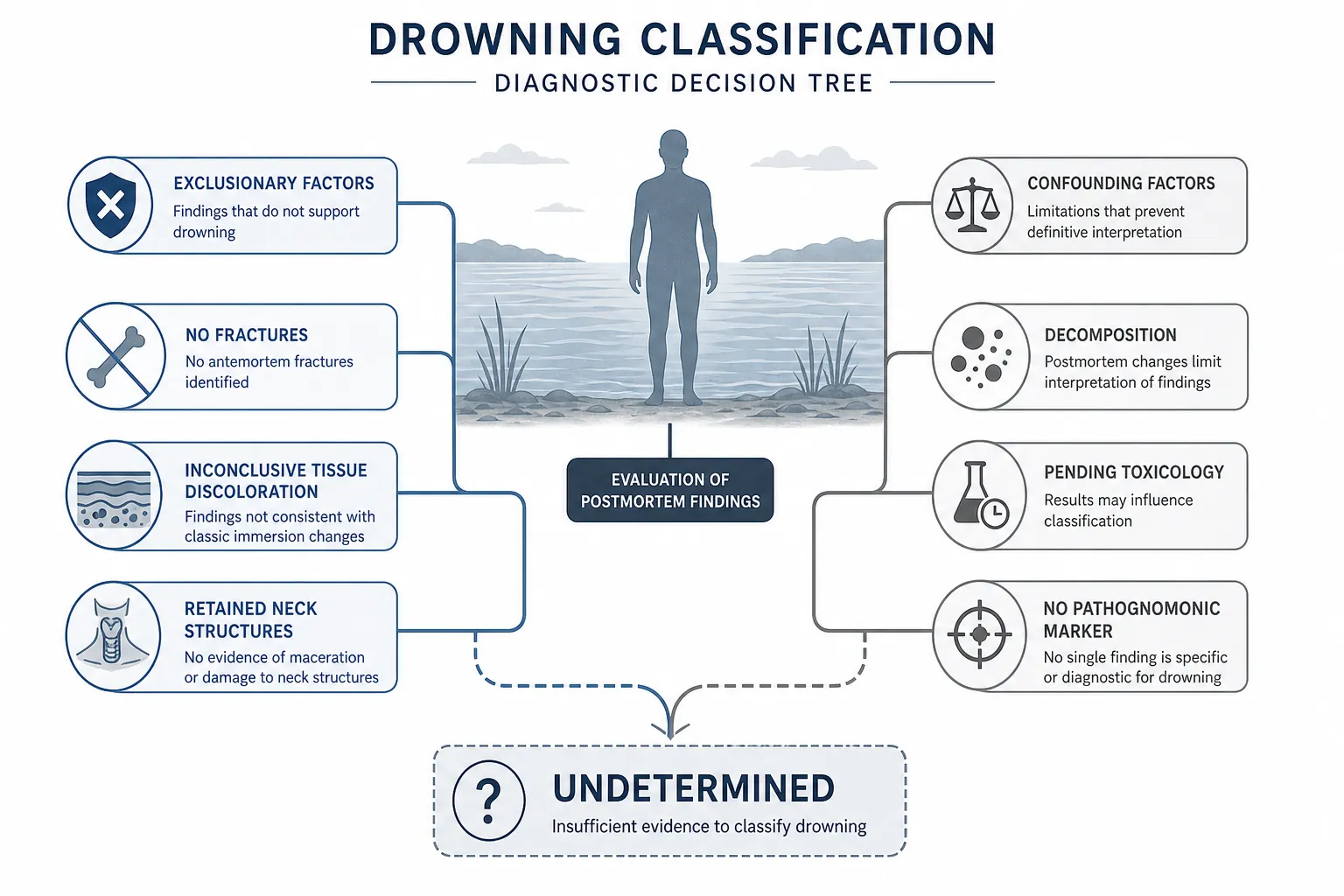
That scientific floor matters because the public forensic record is not the state’s sealed autopsy. It is Dr. Roger Mitchell Jr.’s reported independent autopsy and later investigative updates. Mitchell reportedly found no fractures and no deep tissue injuries, described red discoloration on the back of the head as inconclusive, noted that neck structures had been retained by the state examiner, and classified the case as “undetermined pending further investigation.”[2]
Why “undetermined” is doing real forensic work here
A death certificate and a courtroom ask different questions from the same body. Cause of death asks what physiological process killed the person. Manner of death asks how that death should be classified — accident, homicide, suicide, natural, or undetermined. In a water-related death, those questions can diverge sharply. A body may be recovered from water without yielding enough reliable medical information to say drowning occurred. Even if drowning is favored, the medical record may still be unable to say whether the entry into the water was accidental, forced, impaired, intentional, or otherwise caused.
Armstrong and Erskine’s practical review of drowning deaths is useful precisely because it resists the clean answer people often want. It describes drowning investigation as a process that depends on a complete autopsy, toxicology, examination of the scene, and exclusion of other causes. Findings often discussed in drowning cases — fluid in airways, foam, lung changes, or water-related artifacts — may support an interpretation, but none is individually definitive.[1]
That is the first restraint on the Wells record. “No fractures” does not equal accident. “Undetermined” does not equal concealed homicide. Absence of certain injuries can reduce support for one theory, but it does not supply affirmative proof for another. Likewise, a forensic refusal to choose between accident and homicide is not a backdoor accusation. It is a statement that the medical evidence, as presently available, cannot carry the classification.
The body cannot answer every question the investigation is asking
The Wells case is especially resistant to simple classification because several limiting conditions arrived together: a decomposed body, an aquatic recovery context, tissue retained by the state examiner, and pending toxicology. Each of those conditions can narrow what an independent examiner can say. Together, they make overstatement particularly dangerous.
Decomposition is not a minor inconvenience in forensic interpretation. It can obscure soft-tissue injury, alter the appearance of skin and internal organs, and introduce postmortem changes that mimic or mask antemortem findings. In drowning investigations, where the diagnosis already depends heavily on exclusion rather than a single positive marker, decomposition reduces the reliability of precisely the subtle findings that might otherwise help sort competing explanations.[1]
The reported red discoloration on the back of Wells’ head illustrates the point. A dramatic reading would treat it as a wound. A dismissive reading would wave it away as meaningless. Mitchell’s reported conclusion was narrower: the discoloration was inconclusive.[2] That is not evasive language. In a decomposed body, color change alone may not tell an examiner whether force was applied, when a change occurred, or whether the mark bears on the death at all.
The retained tissue issue has a different consequence. CNN reported that the state examiner retained lung, stomach, and neck tissue, and that the independent autopsy therefore could not fully re-examine those structures.[2] Those are not peripheral body parts in a case where the disputed possibilities include drowning, possible impairment, and possible neck injury. The lungs may matter to drowning analysis. Stomach contents may matter to timing, ingestion, aspiration, or toxicology context. Neck structures may matter if strangulation, restraint, or other neck trauma is alleged or suspected. Retention does not prove misconduct; medical examiners commonly retain tissue for further testing. But it changes the weight of the independent review because the second examiner did not have the same access to all material.
That is a procedural fact with legal consequences. When one autopsy is sealed and the public sees only an independent autopsy performed without all retained structures, public claims begin leaning on an incomplete medical record. The missing access does not make homicide more likely. It makes certainty less defensible.
Toxicology may matter, but it may not settle the classification
Pending toxicology is one reason the independent classification remains provisional. Toxicology can identify drugs, alcohol, or other substances that may bear on impairment, incapacitation, exposure, or competing medical explanations. In a drowning investigation, it can help explain why someone entered water, failed to escape, or died from something other than drowning.[1]
But toxicology is not a universal solvent. The forensic literature and reported case materials identify decomposition as a confounder, including because alcohol can be produced after death, complicating interpretation. The reported expected turnaround was six to eight weeks.[2] Even when results return, they will have to be read against the condition of the body, the collection sites, the retained samples, the scene, and the timeline. A positive result may be important without proving accident. A negative result may exclude some theories without proving homicide.
For legal readers, this is where the temptation to convert laboratory possibility into litigation certainty should be resisted. Toxicology can strengthen or weaken a theory. It can also generate disputes over postmortem production, sample integrity, timing, and significance. In a decomposed aquatic recovery, the number does not speak alone.
What the sealed state autopsy does and does not mean
The official state autopsy was reportedly performed on July 7 and remains sealed before the grand jury process.[3] That fact has become part of the public suspicion around the case, but the legal meaning is narrower than the public one. A sealed autopsy limits what outsiders can evaluate. It does not, by itself, indicate what the autopsy says.
Local reporting on the district attorney’s press conference described Mississippi Rules of Professional Conduct as the basis for limiting public release before grand jury presentation. Mississippi Christian University professor Matt Steffey put the institutional priority plainly: “In the conflict between the court of public opinion and the court of law, the court of law takes precedence.”[4]
That statement will not satisfy a family seeking answers, and it should not be used to trivialize that demand. A sealed record creates a vacuum. Into that vacuum go press conferences, family statements, online reconstructions, and selective disclosures. The risk is that each side begins treating the absence of public proof as proof of its preferred account.
The better distinction is simple: the official autopsy may contain facts not yet public; the independent autopsy is the main public medical record; neither the sealing of one nor the incompleteness of the other permits a reliable public classification of accident or homicide.
The investigation’s center of gravity moves away from the autopsy
Once the body cannot answer the core question, the legal inquiry shifts toward non-medical evidence. Reuters reported that Jackson County District Attorney Angel Myers McIlrath said all non-natural deaths go to a grand jury, that about 60 witnesses had been interviewed, and that the FBI was assisting with digital evidence.[3] Those are the facts that matter more than the louder public labels.
The basic timeline is short and grim. Wells reportedly left for Horn Island on July 4, and his body was found on July 5. Horn Island is part of Gulf Islands National Seashore, federal land, which helps explain the FBI’s jurisdictional role alongside local authorities.[5] Beyond that orientation, the chronology does not carry the answer. The harder question is whether the accounts, location data, scene evidence, and forensic findings form a consistent explanation.
Phone evidence is likely to be treated as more than background. USA Today reported family concerns about a conflict between Life360 and Snapchat location information, along with commentary from former FBI agent Jennifer Coffindaffer.[6] That kind of discrepancy can matter, but only after forensic extraction, metadata review, device-condition analysis, app-behavior interpretation, and chain-of-custody questions are addressed. A consumer location app is not a sworn eyewitness. Nor is an apparent inconsistency, standing alone, evidence of a crime.
Witness statements sit in the same category: necessary, potentially decisive, and easy to overread. People reported conflicting accounts about whether Wells stayed behind to speak with Katie McCormack or was ready to leave with the group, while noting the unsettled nature of some statements.[7] For a grand jury, the question will not be whether conflict exists in the public narrative. It will be whether sworn testimony, corroborated records, and physical or digital evidence can support probable cause for a criminal charge.
| Evidence category | What it can help show | What it cannot do by itself |
|---|---|---|
| Independent autopsy | Visible injuries, limits of medical classification, retained-tissue constraints | Resolve accident versus homicide without full context |
| Toxicology | Possible impairment, substances, competing medical explanations | Automatically prove why Wells entered or remained in the water |
| Witness accounts | Sequence of events, last known interactions, possible inconsistencies | Become reliable merely because they are repeated publicly |
| Phone and app data | Location patterns, timing, device activity, possible conflicts between accounts | Prove criminality without validation and interpretation |
| Scene evidence | Environmental context, accessibility, recovery conditions, physical consistency | Supply intent or manner without corroboration |
Why the grand jury question is not the same as the medical question
A pathologist’s “undetermined” ruling and a grand jury’s charging decision operate under different burdens and with different tools. The pathologist asks what the body and related medical evidence can support. The grand jury may consider testimony, digital evidence, scene investigation, law-enforcement interviews, and circumstantial consistency. It can act even when medicine cannot supply a definitive manner of death, but that does not make the medical uncertainty disappear.
In practical terms, the prosecution problem becomes one of linkage. If there is no definitive medical classification, any criminal theory would need non-medical evidence strong enough to explain how Wells died, who did what, and why the competing innocent or accidental explanations are insufficient. Defense counsel, in turn, would be expected to press the absence of pathognomonic drowning findings, decomposition limits, retained-tissue constraints, toxicology uncertainty, and any inconsistency among witnesses or digital records.
That does not mean an indictment is impossible. It means the public medical record, as of this writing, does not supply the classification that public argument is trying to extract from it. The grand jury may hear more than the public has seen. It may also hear contested evidence that looks cleaner in a press account than it does under oath.
The celebrity-adjacent facts are procedural, not dispositive
The independent autopsy drew national attention because it was released on July 22 at the NAACP National Convention, commissioned by civil-rights attorney Ben Crump, funded by Colin Kaepernick, and performed by Mitchell in Washington, DC.[2] Those facts explain why the findings entered public debate so forcefully. They do not tell us whether Wells’ death was accidental or homicidal.
The family’s demand for answers deserves to be separated from the evidentiary shortcuts made in its name. Grief can be legitimate while a theory remains unproven. Public pressure can force attention to a case while still outrunning what the record can bear. In a water death with decomposition, retained tissues, and pending toxicology, the most careful answer may be the least satisfying one: the body has not yielded a medically definitive manner.
For now, “undetermined” is neither a loophole nor a verdict of innocence or guilt. It is the boundary of medical proof on the public record. If any criminal proceeding crosses that boundary, it will have to do so with witness testimony, validated digital evidence, scene evidence, and circumstantial proof strong enough to carry what the autopsy currently cannot.
References
- Investigation of Drowning Deaths: A Practical Review, PMC, 2018.
- Wells autopsy/investigation update, CNN, July 23, 2026.
- Grand jury referral report, Reuters, July 24, 2026.
- DA press conference coverage on sealed autopsy, Clarion Ledger, July 24–25, 2026.
- Initial case facts on Horn Island and federal jurisdiction, CNN, July 9, 2026.
- Family phone forensics and Life360 versus Snapchat report, USA Today, July 25, 2026.
- Wells case summary and conflicting witness accounts, People.
Related records
Tool profile
Browse tool evaluations →Governing regulation
Browse the obligations tracker →Preventive workflow
Browse verification workflows →
Report a correction or tip
Spotted an outdated figure, a misstated fact, or a ruling this case record should reflect? Public comments are disabled for this content given the professional cost of a misreported case outcome, penalty amount, or rule text — use the structured correction channel instead.
Report a correction or tip for this record →