
The Tariff War's Legal Toll on Northern Border Communities
Northern border crossings are posting steep documented losses — Sault Ste. Marie bridge traffic down nearly 24%, with at least $82.9M in lost local spending — while municipalities hold no direct cause of action. Relief can realistically move through four channels: Court of International Trade refund litigation, USMCA and WTO state-to-state proceedings, congressional action, and fiscal planning.
- Jurisdiction
- US federal
- Court
- Supreme Court of the United States
- AI tool named
- none
- Ruling date
- Feb 20, 2026
- Source document
- View primary court order ↗
- Last verified
- Aug 3, 2026
Lex Machina Review is an independent risk-tracking and reference resource. Nothing on this site is legal advice, and using it does not create an attorney-client relationship. Every record is reviewed against primary sources but may not reflect the most current status of a matter — always verify directly against the cited court order, rule text, or a licensed attorney before relying on it.
Companion explanation — secondary to the source document above
Last verified: August 3, 2026. This article is legal information for municipal and border-community planning, not legal advice for any importer, authority, county, municipality, or business.
At Sault Ste. Marie, the tariff war is not an abstraction about leverage or supply chains. It is 270,000 fewer crossings over the International Bridge, traffic down nearly 24% from 2024, and at least $82.9 million in lost local spending — $62.7 million on the Michigan side and $20.2 million on the Ontario side — as reported from local records and officials by ProPublica.[1]
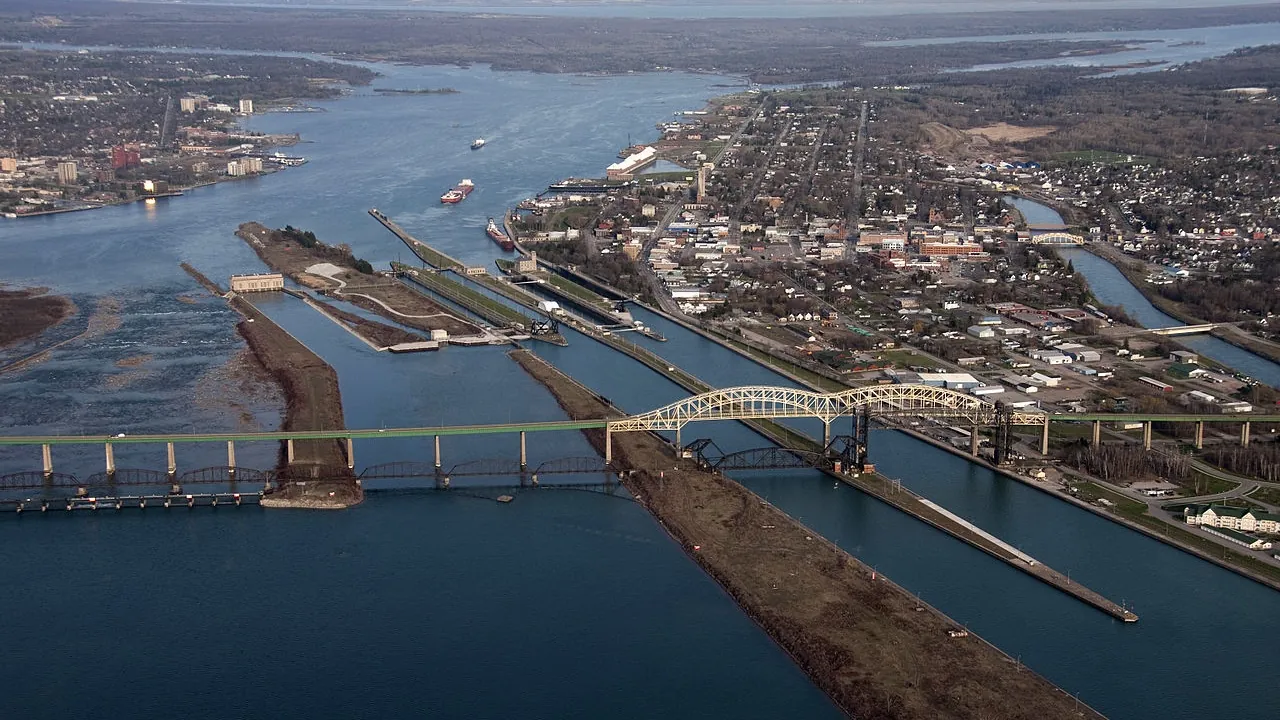
The operational warning is sharper than the political language around it. Commercial traffic was still falling by mid-2026, down nearly another 15%, and the bridge authority’s 2026–2030 business plan warned that border challenges “may significantly reduce bridge revenue or increase expenditures beyond operational sustainability.”[1] That is the sentence that matters in a county commission packet: not whether a national tariff argument polls well, but whether a binational bridge authority can keep revenue, debt service, staffing, maintenance, and traffic assumptions inside the same spreadsheet.
The hard legal answer is less satisfying. Measurable local damage does not, by itself, give a municipality, county, port authority, tourism bureau, or bridge authority a direct cause of action to recover tariff-related losses from the federal government. On these facts, the legally positioned claimant is usually the importer that paid the duty, not the community that lost the hotel room, restaurant sale, toll, dock fee, or sales-tax increment.
That is not a moral judgment about who was hurt most. It is a standing-and-remedy problem. Tariffs are assessed at importation. Refunds generally move through customs entries, protests, reliquidation, and suits involving the party whose goods were entered and whose duties were paid. Local governments can document the fallout, support businesses, lobby Congress, and revise budgets. They are not usually the plaintiff in the refund case.
The injured community is not always the legally positioned claimant
A northern border community may be the place where the harm is easiest to see. The docket, however, follows the entry paperwork. If a Canadian-origin good is imported into the United States and a contested duty is paid, the importer has a path that a municipality usually does not: challenge the assessment and seek a refund, often through the U.S. Court of International Trade.
The Rivian litigation illustrates the shape of that channel. After the Supreme Court’s February 20, 2026 decision rejecting the use of the International Emergency Economic Powers Act for the challenged global tariffs, Rivian sued in the Court of International Trade seeking refunds with interest through reliquidation of affected entries, according to Law Commentary’s report on the suit.[2][3] Whether any particular importer can recover depends on its entries, timing, protest posture, and the legal basis for the duties. But the important municipal point is simpler: the refund claim is attached to import transactions, not to the city budget that suffered second-order damage.
Small-business litigation over Section 301 tariffs points in the same direction. Burlap & Barrel and Collective Horology were reported to have challenged new Section 301 tariffs tied to forced-labor findings, again as businesses facing duties rather than as local governments seeking lost economic activity damages.[4] Border officials may care deeply about those suits because a favorable ruling can change landed costs, release working capital, and affect local employers. Still, the legal vehicle belongs to the importer.
| Channel | Who controls it | What it can realistically do for a border community |
|---|---|---|
| Court of International Trade refund or reliquidation litigation | Importers and other legally positioned trade plaintiffs | Potentially recover duties, change entry treatment, or create precedent that affects local businesses |
| USMCA Chapter 31 or WTO dispute settlement | National governments | Address treaty-level disputes; communities supply facts and pressure, not the formal claim |
| Congressional action | Members of Congress and the legislative process | Repeal, narrow, condition, or fund around tariff measures if there is political support |
| Local fiscal planning | Municipalities, counties, bridge and port authorities | Manage revenue exposure, document losses, revise assumptions, and assist affected firms |
That table is not tidy because the problem is not tidy. The community bearing the visible loss may control only the least glamorous channel: records, budgets, reserves, fee schedules, procurement timing, and constituent services. The more direct legal remedies sit elsewhere.
What municipal counsel can do with importer litigation
Municipal lawyers do not need to turn into customs brokers to be useful. They do need to know where the municipal file ends and the importer file begins. A city attorney advising a border-town council should not promise that the city can sue for lost restaurant spending. A county economic-development lawyer can, however, help local firms identify whether they need customs counsel, whether entries were affected, whether protests or refund claims are time-sensitive, and whether a trade association is coordinating litigation.
The municipal record still matters. If an importer suit succeeds, a court will not award the city its lost parking revenue. But documented local effects can support congressional testimony, agency comments, amicus participation where appropriate, state-level requests, and bridge-authority financial disclosures. The Sault Ste. Marie numbers are useful precisely because they are operational: crossings, spending, commercial traffic, and sustainability warnings.[1]
There is also a practical triage function. Some local firms may be importers of record; others may only be retailers, restaurants, service providers, or carriers feeling demand shocks. The first group may have a customs-law question. The second group more often has a financing, workforce, lease, or tax-payment problem. Treating both as if they have the same tariff lawsuit available is how local boards get bad expectations before the next budget amendment.
Fast-moving tariff research deserves special caution. The rate in force, the exception that applied last month, and the protest deadline on a particular entry are not good places for casual AI answers; this site has separately documented why time-sensitive legal research needs verification rather than confident automation in its Risk Digest on AI hallucination. A municipal office can use research tools, but the final answer should be checked against the entry documents, Customs notices, court filings, and current trade-law guidance.
State-to-state remedies are real, but they are not county lawsuits
The trade agreements do not leave disputes without a forum. They do, however, assign the keys to federal governments. Canada requested WTO consultations in DS634 over U.S. tariff measures in March 2025, placing the dispute on a state-to-state track rather than a municipal one.[5] Under USMCA Chapter 31, disputes are likewise government-to-government; the United States Trade Representative’s public Chapter 31 page reflects prior panels, including dairy tariff-rate quota disputes, as federal enforcement proceedings.[6]
For a northern border community, that distinction has consequences. A county cannot file a USMCA Chapter 31 complaint because a bridge plaza lost crossings. A port authority cannot initiate WTO consultations because maintenance revenue is deteriorating. Local officials can push their federal representatives, provide affidavits and economic evidence, coordinate with state officials, and make the local record hard to ignore. They do not become the disputing party.
This is where local evidence should be written for use, not outrage. A federal trade office or member of Congress can work with a record that separates passenger crossings from commercial traffic, distinguishes Canadian visitors from U.S. return trips where possible, and ties revenue loss to specific public obligations. A general resolution condemning tariffs may be politically appropriate. A bridge-authority memo showing traffic decline, debt covenant assumptions, deferred maintenance risk, and operating-reserve drawdown is more likely to survive the trip from a local meeting room to a federal file.
Congress is a legal channel, even when it looks like politics
Legislation is not a consolation prize. It is one of the few channels that can change the rules directly for communities that are not proper refund plaintiffs. The reported February 2026 House vote to repeal certain tariff measures, 219–211, shows that Congress can become the forum for tariff relief, although that figure should be treated as reported rather than independently confirmed here against a primary congressional record.[7]
That path is representative, not judicial. A city does not get a docket number; it gets a member of Congress, a delegation, a hearing record, a coalition, and perhaps statutory language. If a bridge authority needs immediate revenue stabilization, a repeal bill may move too slowly or fail entirely. But Congress can do things a court in an importer refund case generally will not do for local governments: appropriate money, create transition assistance, amend tariff authority, condition future measures, or direct agency reporting on border-community effects.
Local resolutions have value when they connect to that machinery. A resolution that merely announces injury may satisfy a public meeting. A resolution that attaches verified crossing data, identifies affected employers, requests specific statutory relief, and authorizes staff to transmit the record to named committees and delegation offices is more useful.
The pending Section 338 layer
The next compliance layer is not yet a realized local loss as of this verification date. Trade-law alerts report that the administration has announced first-ever Section 338 tariffs of 50% on certain Canadian products, effective August 19, 2026.[8][9] Because that date is still ahead of August 3, 2026, border officials should treat the measure as pending for planning purposes, not as a duty already collected.
The details matter for importers near the border. White & Case and Wiley both describe the announced Section 338 tariffs as lacking a USMCA exemption and as potentially stacking with other duties rather than replacing them.[8][9] If that understanding governs entries after the effective date, a product that previously survived the first round of analysis because it was USMCA-qualifying may still require a separate Section 338 review.
That is not a municipal lawsuit either. It is a compliance problem for importers, customs brokers, carriers, and purchasers, with municipal consequences if traffic drops again or if local employers pause shipments. A border community preparing for the August 19 date should be asking different questions of different actors: importers about classification, origin, contract pricing, and broker instructions; bridge and port authorities about traffic and cash-flow assumptions; economic-development staff about firms exposed to the covered products; and state and federal offices about whether relief, clarification, or delay is being sought.
The WAMC report on northern border reaction captured a subdued regional response to the latest tariff announcement and noted expectations that litigation could follow, including challenges tied to Section 338 and forced-labor issues.[10] That is a fair posture for local governments too: prepare for litigation to matter, but do not build the local budget as if litigation belongs to the municipality or will arrive before the revenue line moves.

Fiscal planning is not surrender
For bridge and port authorities, the legal memo should eventually become a budget memo. If crossings are down, commercial traffic is weakening, and federal remedies are indirect, boards need to know which assumptions no longer hold. That may mean revised traffic forecasts, reserve-policy review, capital-project sequencing, grant-timing analysis, bond-covenant monitoring, and public explanations that do not overpromise federal relief.
The local record should be built before the emergency. At minimum, officials should preserve monthly crossing data, toll revenue, commercial-vehicle counts, customs-delay evidence if available, downtown sales indicators, tourism and hotel information, employer reports, and authority spending changes tied to border disruption. Where figures are reported but not primary-source verified, they should be labeled that way. The reported New York–Canada crossing decline of more than 21%, for example, should not be treated as a checked primary figure unless the underlying source is obtained and reviewed.
That discipline matters because every channel uses evidence differently. Importer litigation needs entry-specific records. USMCA and WTO tracks need treaty-relevant facts that federal governments can carry. Congress needs district-level consequences and statutory asks. Local finance officers need revenue and expenditure assumptions they can defend at a public meeting.
Sault Ste. Marie shows the mismatch cleanly. The local losses are named, counted, and tied to a public bridge. The most direct legal remedy, if one exists for a particular duty, is likely to be pursued by an importer in trade court. The treaty remedies belong to national governments. The legislative remedy belongs to Congress. The remaining work — documentation, business support, fiscal planning, and public accountability — stays with the communities standing at the crossing after the speeches end.
References
- Trump's Canada Tariffs Decimate Border Crossings, Business in Upper Michigan, ProPublica
- Learning Resources, Inc. v. Trump, Supreme Court of the United States, February 20, 2026
- Rivian Sues US for Refund of Trump Tariffs After Supreme Court Ruling, Law Commentary
- Small Businesses Sue Trump Administration Over New Section 301 Tariffs, Law Commentary
- Canada initiates WTO dispute complaint against the United States regarding tariff measures, World Trade Organization, March 5, 2025
- Chapter 31 Disputes, Office of the United States Trade Representative
- 2025–2026 United States trade war with Canada and Mexico, Wikipedia
- Trump administration imposes 50% tariffs on certain Canadian products in first use of Section 338, White & Case
- President Trump Imposes New 50% Tariffs on Certain Canadian Imports, Wiley
- Subdued response from northern border interests regarding latest tariff announcement, WAMC, July 27, 2026
Related records
Tool profile
Browse tool evaluations →Governing regulation
Browse the obligations tracker →Preventive workflow
Browse verification workflows →
Report a correction or tip
Spotted an outdated figure, a misstated fact, or a ruling this case record should reflect? Public comments are disabled for this content given the professional cost of a misreported case outcome, penalty amount, or rule text — use the structured correction channel instead.
Report a correction or tip for this record →