
NVIDIA-OpenAI Deal Creates a Hidden Risk for Legal AI Buyers
The $100B NVIDIA-OpenAI data center financing deal, with its circular structure and opaque debt, introduces a new fragility vector for legal AI tool pricing and vendor continuity that most law firm procurement processes overlook.
- Jurisdiction
- US-Federal
- Court
- U.S. Federal Court
- AI tool named
- OpenAI
- Ruling date
- Sep 22, 2025
- Source document
- View primary court order ↗
- Last verified
- Jul 28, 2026
Lex Machina Review is an independent risk-tracking and reference resource. Nothing on this site is legal advice, and using it does not create an attorney-client relationship. Every record is reviewed against primary sources but may not reflect the most current status of a matter — always verify directly against the cited court order, rule text, or a licensed attorney before relying on it.
Companion explanation — secondary to the source document above
Most legal AI procurement reviews still begin in the same place: confidentiality, hallucination controls, data retention, privilege risk, and whether the vendor will accept the firm’s preferred security addendum. Those are necessary questions. They do not answer the newer question for legal AI buyers: whether the price and continuity of a tool now depend on an infrastructure financing stack the buyer never reviews.
Last verified July 28, 2026: CNBC reported that NVIDIA would make a progressive investment of up to $100 billion in OpenAI, with a first 1-gigawatt phase scheduled for the second half of 2026 and a total commitment of 10 gigawatts. The same report described the arrangement as a letter of intent, not a completed definitive agreement, so the structure, timing, and obligations may still change.[1]
The procurement issue is not the size of the headline number by itself. It is the combination of a circular commercial structure and a capital cycle that is already far ahead of current AI revenue. The available record notes roughly $60 billion in AI industry revenue in 2025 against roughly $400 billion in infrastructure capex, more than $120 billion in off-balance-sheet SPV debt over 18 months, and separate analysis pointing to a projected $5.2 trillion AI infrastructure buildout and more than $200 billion in new debt in 2025 alone.[2]
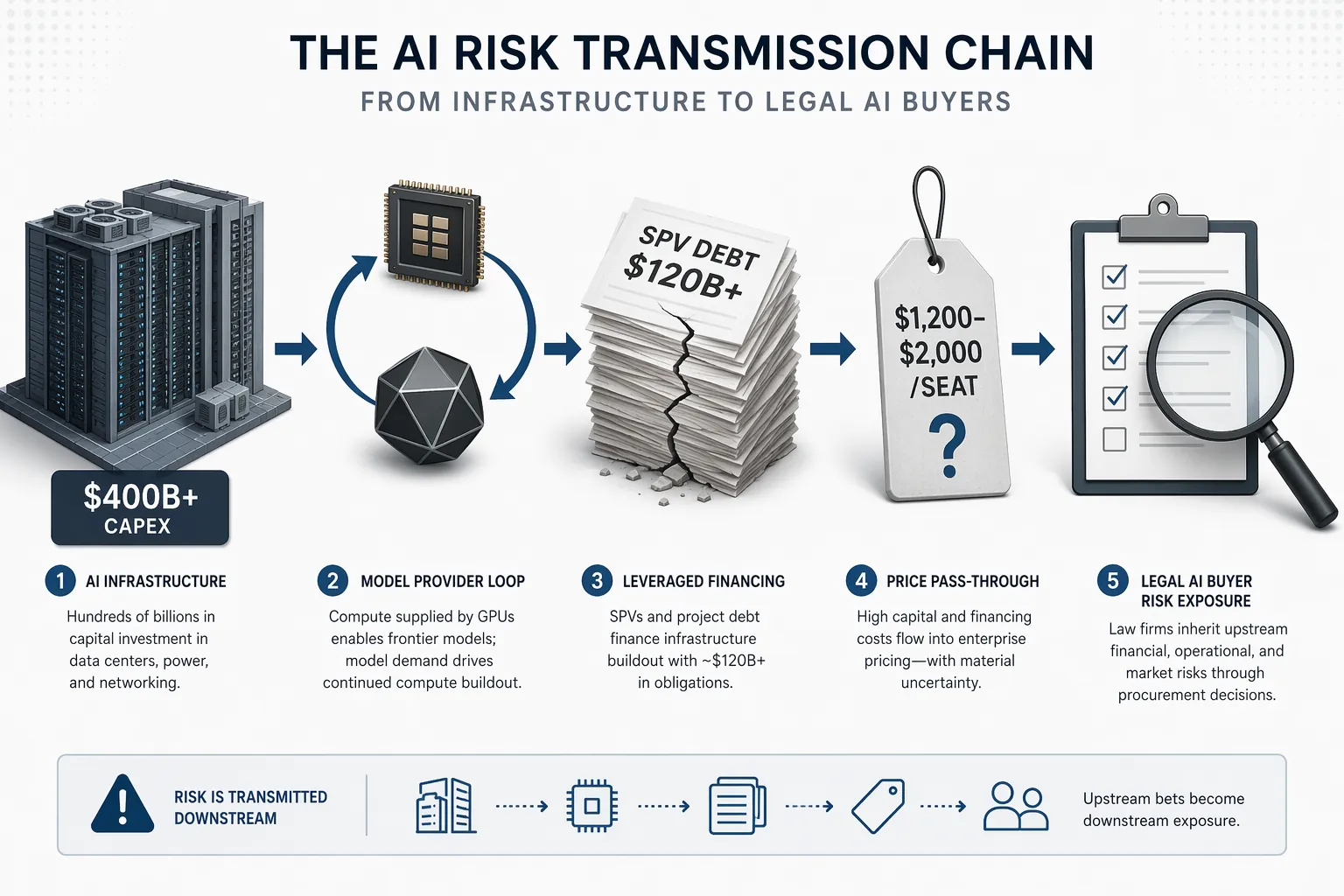
None of that proves that the NVIDIA-OpenAI arrangement will fail, that data center financing is unsound, or that legal AI vendors are about to disappear. It does mean that a law firm buying an AI research, drafting, review, or knowledge tool may be exposed to upstream financing assumptions that are not visible in the vendor questionnaire.
How infrastructure financing pressure reaches a legal AI contract
The risk path is not complicated, but it is usually outside the legal procurement file. Capital moves to an AI model company. The model company uses that capacity to buy or reserve infrastructure that depends heavily on the investor’s chips. The chip supplier books revenue. Debt, leases, cloud commitments, power contracts, and special-purpose financing vehicles sit around that chain. If the economics tighten, the downstream buyer may see the result as a pricing revision, usage cap, degraded service tier, model substitution, or a vendor continuity problem rather than as a data center financing issue.
Legal AI vendors are especially exposed because many of them are not merely selling traditional software with a familiar marginal cost profile. They are packaging model access, inference, retrieval, workflow design, support, security review, and sometimes third-party cloud capacity into a product that procurement teams experience as a seat license. The vendor’s invoice may look like SaaS. Its cost base may behave more like metered infrastructure.
That distinction matters when GPU access, inference costs, and model-provider terms change. A vendor can keep the same product name while changing how many documents can be processed, which model tier is used for default answers, how quickly large matters are queued, whether premium drafting is reserved for higher plans, or whether overages are billed separately. Buyers often notice those changes only when a pilot becomes a rollout or a renewal arrives with less forgiving usage language.
This is the same mechanism traced in AI Server Demand Is Reshaping Legal Tech Pricing — Here's How: the legal tech buyer sees a licensing discussion, while the vendor is managing compute exposure. The NVIDIA-OpenAI structure adds another layer. It asks procurement teams to consider not only the vendor’s immediate model costs, but also whether the model and infrastructure market supporting those costs is being financed through arrangements that could become more expensive, disputed, or concentrated.
Pricing opacity is where the risk becomes practical
Bloomberg Law’s July 2026 pricing review found that only 3 of 10 benchmarked legal AI tools published real per-seat pricing, and that inference cost pass-through may be embedded but undisclosed. The same reporting placed Harvey at $1,200 to more than $2,000 per seat and Legora at $300 to $800 per seat. Those figures are third-party reporting, not vendor rate cards, but they are useful because they show how little public pricing discipline buyers can rely on before a negotiation begins.[3]
A hidden pass-through does not need to be labeled “GPU surcharge” to affect the buyer. It can appear as a higher minimum seat count, a committed annual spend, a narrower definition of included usage, separate charges for bulk document review, premium model access, matter-level workspaces, private deployment, or administrative controls that used to be bundled. The clause that matters may not be in the data processing addendum. It may be in the order form, fair-use policy, service description, or renewal mechanics.
The procurement danger is that firms compare legal AI products as if they were choosing among stable subscription tiers. They may ask whether Tool A hallucinates less than Tool B, whether the vendor trains on customer data, and whether the product integrates with iManage, NetDocuments, Microsoft 365, or the firm’s research stack. Those questions still belong in the review. They do not reveal whether the vendor can absorb a major shift in model pricing, GPU availability, or cloud capacity without moving the cost to the customer.
Harvey is the obvious example to watch because it is both a prominent legal AI vendor and a product whose cost exposure is closely associated with high-end model access. The point is not that Harvey is uniquely fragile; the narrower point is that OpenAI-dependent legal AI pricing makes the upstream infrastructure cycle visible in a form law firms can actually interrogate. The firm evaluating that exposure should read pricing and total cost through the lens used in Harvey AI Pricing 2026: What Mid-Market Firms Actually Pay: not only the quoted seat price, but the conditions that make the quote hold.
| Upstream pressure | Likely procurement manifestation | Question the buyer should ask |
|---|---|---|
| Higher inference or model access costs | Seat increases, usage caps, premium model tiers, or overage charges | Which usage is included, which usage is metered, and who bears model-provider price changes? |
| Constrained GPU or cloud capacity | Queueing, throttling, slower bulk analysis, or limits on high-volume matters | What service levels apply to AI processing, not just platform uptime? |
| Dependence on one model or infrastructure provider | Model substitution, degraded output quality, or changed feature availability | Can the vendor switch models, and must it notify the customer before doing so? |
| Debt, lease, or financing stress in the infrastructure chain | Changed terms, delayed roadmap, support cuts, or vendor consolidation | What continuity commitments survive financing changes, acquisitions, or platform dependency shifts? |
The circularity matters even if the letter of intent changes
Because the NVIDIA-OpenAI arrangement remains a letter of intent, it would be too strong to treat its reported terms as a settled operating model. The circular feature is still worth recording. Supplier capital supports a customer that will buy supplier-linked infrastructure, and the resulting demand can support supplier revenue. In a fast-growing market, that can look like strategic alignment. In a stressed market, it can raise harder questions about revenue quality, counterparty dependence, and whether reported demand is being pulled forward by financing rather than paid for by end-user revenue.
Legal AI buyers do not need to resolve those accounting and capital-markets questions. They do need to know whether their vendor’s economics assume cheap and abundant inference. A tool that is affordable during a pilot can become expensive at enterprise scale if the vendor has priced the pilot to win logos, absorb model costs temporarily, or postpone hard usage boundaries until renewal.
That is where the standard “vendor viability” checkbox is too thin. A procurement memo that says the vendor is well funded, reputable, and responsive may still miss the dependency that matters: whether the vendor’s service depends on a small number of model providers, GPU suppliers, cloud regions, or infrastructure contracts whose cost and availability the vendor does not control.
Antitrust pressure is a continuity issue for buyers
The antitrust question should not be inflated into a prediction of enforcement outcome. Reuters’ analysis of the NVIDIA-OpenAI deal identified concerns around vertical integration and GPU-market concentration, citing NVIDIA’s greater-than-50% GPU market share and comments from DOJ official Gail Slater that enforcement attention would focus on exclusionary conduct.[4]
For legal AI buyers, that matters before any final agency action or court result. If model access, chip supply, cloud capacity, and legal workflow tools become more vertically integrated, today’s vendor can become tomorrow’s reseller, platform partner, acquisition target, or stranded dependency. The legal department may think it bought a point solution. In practice, it may have bought into a platform stack whose commercial rules are set elsewhere.
Bloomberg Law has separately reported that Anthropic, OpenAI, and Google are moving further into direct legal AI tool provision, a development that could compress the distance between foundational model providers and the legal user interface.[5]
That does not make Big Tech provision inherently worse than specialist legal tech. It changes the dependency map. A specialist vendor may offer domain expertise, legal workflow design, and customer support that a broader platform does not prioritize. A platform provider may offer infrastructure scale, security resources, and product bundling that a smaller vendor cannot match. The procurement file should make those tradeoffs explicit instead of treating the vendor name on the order form as the whole supply chain.
Litigation signals should be read narrowly
Quinn Emanuel’s March 2026 client alert is useful because it names litigation categories that procurement teams rarely connect to legal AI tools: securities fraud, credit ratings litigation, GPU-collateral valuation disputes, and other financing-related claims arising from the AI data center boom. The alert identifies nine categories of emerging litigation risk and draws a structural comparison to Nortel-era vendor financing in 1999–2000.[6]
That comparison should be handled with restraint. The Nortel parallel does not prove that the current AI infrastructure cycle will repeat an earlier telecom cycle. It is a warning about structure: when suppliers, customers, lenders, and infrastructure assets become financially entangled, disputes can appear in places that ordinary product buyers did not monitor.
The already-filed securities class actions—Ohio Carpenters' Pension Plan v. Oracle and Masaitis v. CoreWeave, both filed in January 2026—should be read the same way. They are early legal-stress markers in the infrastructure financing ecosystem, not proof that the broader financing cycle is breaking or that any specific legal AI vendor will fail.[6]
What to add to legal AI diligence now
The practical adjustment is modest. Firms and legal departments do not need to become data center finance analysts before buying AI tools. They do need to add infrastructure-financing exposure to the same diligence file that already covers accuracy, confidentiality, data retention, privilege protection, support, and termination rights.
- Ask which model providers, cloud providers, and infrastructure dependencies are material to the product, and whether the vendor will disclose changes that affect output quality, availability, or pricing.
- Separate seat price from usage economics. Confirm what is included, what is metered, what is subject to fair-use limits, and what happens when the customer moves from pilot volume to production volume.
- Review renewal language for unilateral price changes, pass-through rights, minimum commitments, overage charges, and changes to model tier availability.
- Ask whether the vendor can substitute models or infrastructure providers, what notice is required, and whether the customer can test material changes before they reach live matters.
- Tie service commitments to AI-specific performance where possible: bulk processing queues, retrieval speed, matter workspace availability, and support response for degraded outputs.
- Treat vendor funding and revenue claims as incomplete unless paired with a credible explanation of compute cost control, gross margin discipline, and continuity planning.
The existing procurement framework in “How to Evaluate Legal AI Software in 2026” remains the right baseline, but it now needs one more column. A buyer who asks only whether the tool is accurate and secure may still miss whether the tool’s economics depend on a financing cycle that can change the terms of service after adoption.
This is not legal advice and not a recommendation to reject legal AI tools. The narrower judgment is enough: the hidden risk is not that NVIDIA and OpenAI announced a large data center financing arrangement. The risk is that legal AI buyers may be underwriting part of that infrastructure cycle without asking where the cost, debt, and continuity risk ultimately lands.
References
- NVIDIA's $100B progressive investment in OpenAI, CNBC, Sept. 22, 2025.
- Circular Deals in AI: Legal Visible, Dave Friedman.
- AI Legal Software Flails on Pricing Models, Frustrating Buyers, Bloomberg Law, July 2026.
- Nvidia's $100 billion OpenAI play raises big antitrust issues, Reuters, Sept. 23, 2025.
- Big Tech Advances Into Crowded Legal AI Arena as Next Frontier, Bloomberg Law.
- Client Alert: Emerging Litigation Risks in Financing AI Data Centers Boom, Quinn Emanuel, March 2026.
Related records
Tool profile
Neither Codex nor Claude Code Is Safe for Legal AI AgentsGoverning regulation
Browse the obligations tracker →Preventive workflow
Browse verification workflows →
Report a correction or tip
Spotted an outdated figure, a misstated fact, or a ruling this case record should reflect? Public comments are disabled for this content given the professional cost of a misreported case outcome, penalty amount, or rule text — use the structured correction channel instead.
Report a correction or tip for this record →