
Obama Center Subcontractor Layoff: WARN Act and Illinois Lien Law Risks
This article analyzes the labor-law and construction-law exposure facing subcontractors when a high-profile payment dispute forces a mass layoff, using the Adamson Plumbing case at the Obama Presidential Center to evaluate WARN Act compliance obligations, mechanic's lien remedies, and the interaction of Illinois statutory protections.
- Jurisdiction
- Illinois (state)
- Ruling date
- Jun 25, 2026
- Source document
- View primary court order ↗
Lex Machina Review is an independent risk-tracking and reference resource. Nothing on this site is legal advice, and using it does not create an attorney-client relationship. Every record is reviewed against primary sources but may not reflect the most current status of a matter — always verify directly against the cited court order, rule text, or a licensed attorney before relying on it.
Companion explanation — secondary to the source document above
Adamson Plumbing’s legal problem did not wait for the Obama Presidential Center payment dispute to be resolved. The company reportedly laid off 25 union workers on June 25 after a promised $100,000 release payment did not arrive, then filed a $1.72 million mechanic’s lien while also claiming a broader $3.9 million loss tied to the project dispute.[1] Those are not just construction-payment facts. They are labor-law facts, because a layoff clock can start running while the lien claim, invoice dispute, and contract defenses are still being sorted.
Editor’s note: Lex Machina Review normally covers AI reliability failures in legal practice. This digest is outside that lane because the search issue is a statutory legal-risk problem involving construction payment remedies, lien leverage, WARN analysis, and wage-payment exposure.
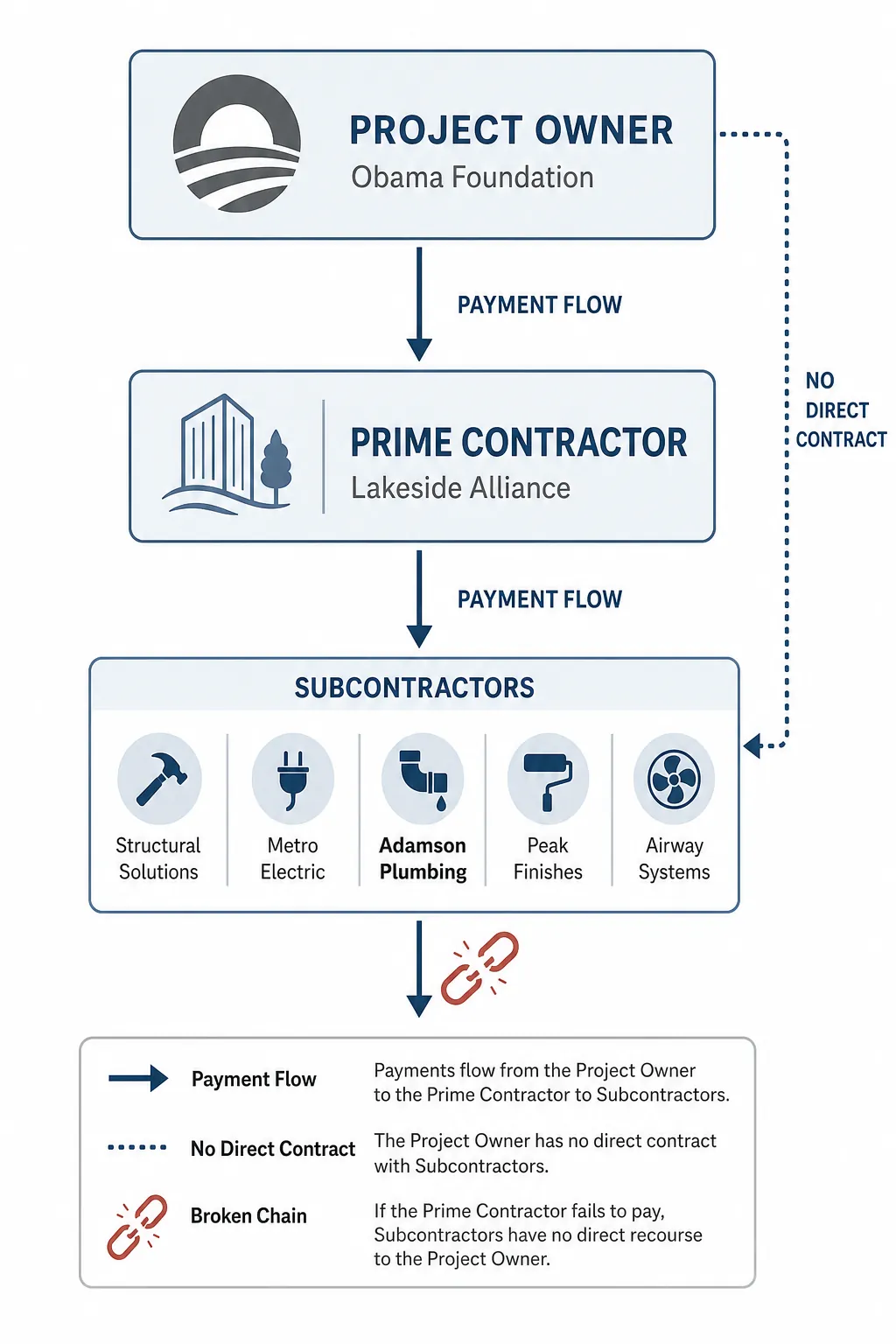
The contract chain matters at the start. FactCheck.org reported that the Obama Foundation does not directly contract with the subcontractors and that the payment structure runs through Lakeside Alliance; construction attorney Stan Martin described that kind of no-direct-contract arrangement as industry-normal rather than unusual.[2] That does not answer whether Adamson is owed money. It does keep the analysis in the right lane: this is a subcontractor-payment dispute moving through a prime-contractor structure, not a simple owner-to-plumber invoice.
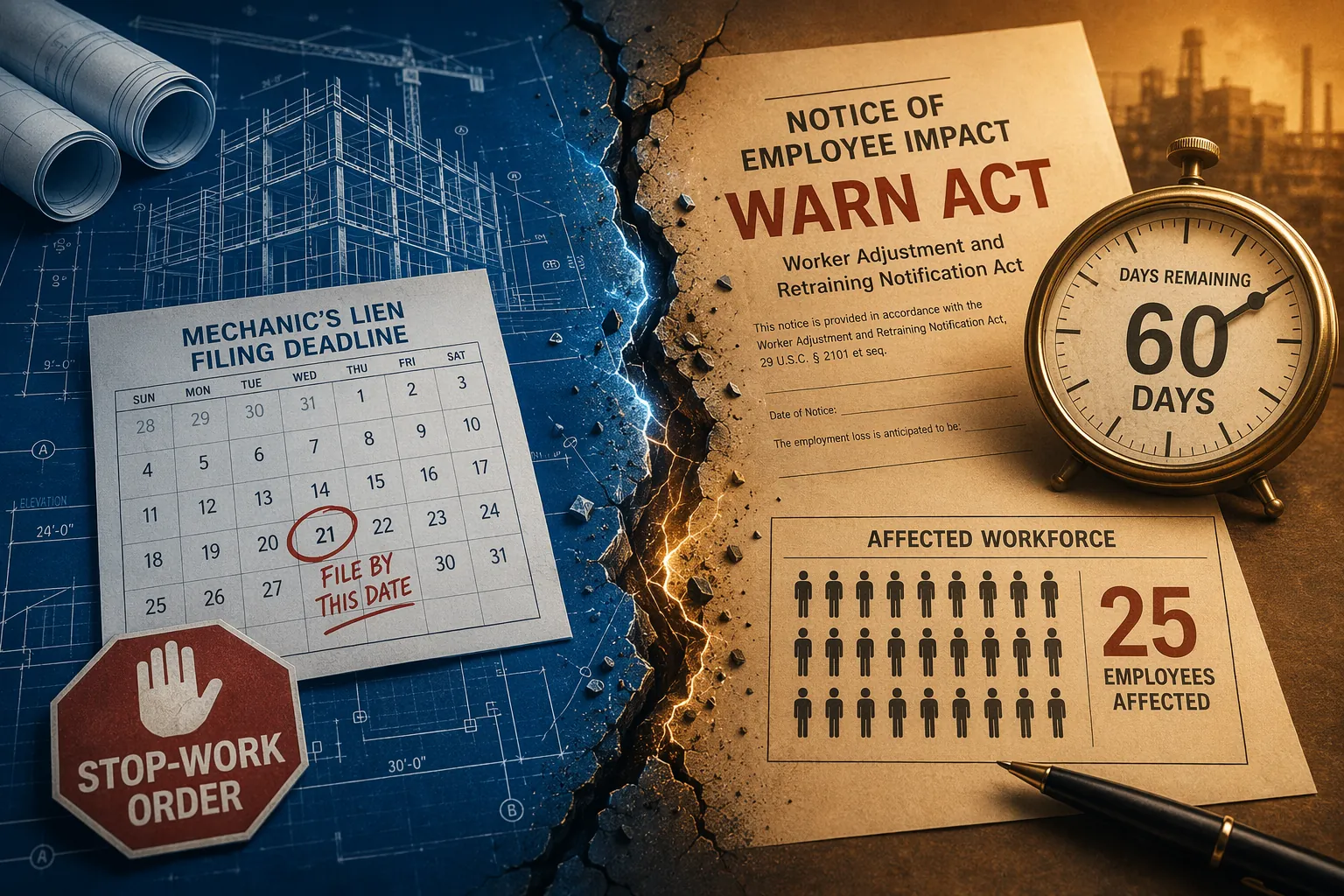
The WARN question starts with 25 workers, but it does not end there
The easy mistake is to see “25 workers laid off” and jump straight to an Illinois WARN Act conclusion. The Illinois Department of Commerce and Economic Opportunity describes the state WARN Act as requiring 60 days’ advance notice for covered plant closings or mass layoffs, with a 25-or-more-full-time-employee threshold, a one-third-of-the-workforce trigger, and penalties that can reach up to $500 per day.[3] That makes the Adamson layoff a serious compliance signal. It does not, by itself, prove that notice was required.
The missing public fact is Adamson’s total full-time employee headcount during the relevant period. The research materials do not confirm whether Adamson had 75 or more full-time employees at any point in the preceding 12 months. Without that number, the WARN analysis cannot be completed. If Adamson crossed the 75-employee coverage threshold and the 25 laid-off workers also represented at least one-third of the workforce, the 60-day notice obligation becomes the central labor-law issue. If Adamson did not cross that threshold, or if the one-third calculation does not work on the actual headcount, the same 25-person layoff may not trigger Illinois WARN.
That is why the first document request is not the lien packet. It is the payroll census. Counsel would need to know the number of full-time employees, the lookback period, the employees affected by the June 25 layoff, whether any other layoffs were close enough in time to matter, and who made the layoff decision. The invoice dispute explains why the layoff happened. WARN asks whether the employer had a duty to warn before it happened.
| Question | Why it matters |
|---|---|
| Were 25 full-time employees laid off? | That figure is publicly reported and matches one Illinois WARN numerical trigger, but it is not the full test.[1][3] |
| Did Adamson have 75 or more full-time employees during the relevant 12-month period? | Coverage depends on headcount, and that number is not publicly confirmed. |
| Did the 25 workers equal at least one-third of the workforce? | The Illinois WARN materials identify a one-third workforce trigger, so the denominator matters.[3] |
| Was 60 days’ notice given or excused? | If the statute applied, notice timing and any defense would control the exposure analysis. |
The practical trap is timing. A subcontractor can believe it is being forced into an emergency by nonpayment and still face a separate statutory question about notice. The Illinois WARN clock is not paused because a lien is being prepared, a release payment is disputed, or a prime contractor denies liability.
Lien rights can create leverage, not payroll
Adamson’s $1.72 million mechanic’s lien is the clearest construction-law move in the record. Illinois mechanic’s lien law gives contractors and subcontractors a statutory route to secure payment for covered labor and materials, with a four-month timing rule that matters for preserving lien rights against third parties.[4] Filing a lien can change the leverage in a payment dispute. It can cloud title, complicate financing, and force parties to account for the claim. It does not establish that the full amount is owed.
The distinction between the $1.72 million lien and the broader $3.9 million claimed loss should stay visible. The lien is the filed statutory claim identified in the reporting. The $3.9 million figure is a larger Adamson-side claimed loss that has not been adjudicated in the materials provided.[1] Treating those numbers as interchangeable would overstate the record and flatten the very thing counsel has to preserve: which dollars are lienable, which are contractual, which are disputed, and which are only alleged.
Illinois prompt-payment remedies add another tool, but they run on their own conditions. The Illinois Contractor Prompt Payment Act materials describe a 15-day payment requirement, 9% annual interest, and a right to suspend work after 10 days’ written notice.[5] For a subcontractor facing a stalled payment stream, that combination can be meaningful. Interest changes the cost of delay. Written notice creates a record. Suspension rights can keep the subcontractor from continuing to finance work it says is unpaid.
None of those remedies automatically funds the next payroll. That is the hard part in the Adamson sequence. A subcontractor may have lien rights, prompt-payment arguments, and a credible reason to stop work, yet still reach the point where workers are sent home before the dispute is resolved. The law can preserve claims faster than it can produce cash.
The payment chain keeps the owner dispute separate from the subcontractor remedies
The Obama Foundation’s no-direct-contract position is important, but it should not be asked to do too much. FactCheck.org reported the Foundation’s position that it has no direct contracts with subcontractors and no outstanding disputed charges with Lakeside Alliance.[2] Lakeside Alliance has also denied owing the claimed amounts, according to the materials summarized for this dispute. Those denials matter because the unpaid-invoice figures are disputed, not established debt.
At the same time, no direct contract is not the end of statutory analysis. Lien statutes and prompt-payment statutes exist partly because construction payment chains are layered. The relevant question is not whether the subcontractor had a neat direct invoice to the project owner. It is whether the statute gives the subcontractor a remedy against the property, the contracting party, or another participant in the chain under the facts that can be proven.
There is also a wage-payment layer that sits beside, not inside, the invoice dispute. The 2022 amendment to the Illinois Wage Payment and Collection Act, 820 ILCS 115/13.5, can create joint-liability risk for a primary contractor if a subcontractor fails to pay covered wages. That is not a finding that Lakeside Alliance owes Adamson’s invoices, and it is not a finding that Adamson failed to pay wages. It is a reason counsel for a prime contractor would not treat a subcontractor payroll crisis as someone else’s purely private problem.
The broader subcontractor complaints add context, not proof
Adamson is not being discussed in a vacuum. Fox News reported in June 2026 that more than 10 subcontractors claimed roughly $100 million in aggregate unpaid invoices and described allegations that nondisclosure agreements suppressed public complaint.[6] That figure should be handled carefully. The research materials say the aggregate number includes the $40 million Concrete Collective discrimination lawsuit, which remains pending and disputed. It is therefore a pressure point in the public record, not a judicial finding that $100 million is owed.
The same caution applies to the two 2024 Chapter 11 filings identified in the surrounding reporting, Vision Painting & Decorating and Glass Management Services. They are relevant because they show that payment-chain stress has appeared around the project before. They do not establish that Obama Center work alone caused those companies’ financial distress.[2]
For counsel, the value of that background is diagnostic. It suggests the Adamson dispute may be part of a larger pattern of contested payment claims. It does not eliminate the need to prove each contract path, each invoice, each change-order dispute, each lien amount, and each statutory precondition.
What has to be run in parallel
A subcontractor in Adamson’s position cannot afford to sequence the analysis as if payment law comes first and labor law comes later. The layoff decision itself can create a second file, with different deadlines, different notices, and different consequences.
- Preserve the lien record: identify the last date of lienable work, the contract balance, approved and disputed change work, labor and material backup, and the amount that can be supported under the Illinois Mechanic’s Lien Act.
- Send prompt-payment and suspension notices deliberately: the right to suspend work after written notice is useful only if the notice, timing, recipient, and grounds can later be defended.
- Run the WARN count before the layoff is final: 25 affected employees is enough to demand immediate headcount analysis, especially where the employer may have approached or crossed the 75-full-time-employee threshold.
- Separate invoice liability from wage liability: a prime contractor may deny the subcontractor’s payment claim and still need to assess whether unpaid wages could create exposure under Illinois wage-payment law.
- Document the decision path: who promised payment, who relied on it, who decided to stop work, who decided to lay off workers, and when counsel first evaluated statutory notice.
The Adamson Plumbing dispute is not a clean example of one statute solving another statute’s problem. Illinois lien law and prompt-payment remedies may give a subcontractor real leverage against nonpayment. WARN and wage-payment law ask different questions once workers are laid off or wages are at risk. The defensible answer is not that Adamson violated WARN, and it is not that lien law protects every decision made after nonpayment. The defensible answer is that employee-count, notice, lien, suspension, and wage-liability analysis have to begin at the same time.
References
- Obama Center subcontractor shuts down amid $4M fight, lays off 25 — WFMD, July 23, 2026
- Explaining What We Know About the Obama Presidential Center Contractor Disputes — FactCheck.org, July 2026
- Worker Adjustment and Retraining Notification Act (WARN) — Illinois Department of Commerce and Economic Opportunity
- Illinois Mechanic's Lien Act — Illinois General Assembly
- Illinois Contractor Prompt Payment Act Overview — The Cromeens Law Firm
- Subcontractors say they're owed millions, face financial ruin helping build Obama Presidential Center — Fox News, June 2026
Related records
Tool profile
Browse tool evaluations →Governing regulation
Browse the obligations tracker →Preventive workflow
Browse verification workflows →
Report a correction or tip
Spotted an outdated figure, a misstated fact, or a ruling this case record should reflect? Public comments are disabled for this content given the professional cost of a misreported case outcome, penalty amount, or rule text — use the structured correction channel instead.
Report a correction or tip for this record →