
Ohio Anti-SLAPP Law Tested in Max Miller Defamation Case
Miller v. Moreno provides an early test of Ohio's new Uniform Public Expression Protection Act. The court upheld a discovery stay and is set to hear a dismissal motion that could mandate fee-shifting for the public-figure plaintiff.
- Jurisdiction
- Ohio
- Court
- Cuyahoga County Court of Common Pleas
- Judge
- Joy Kennedy
- AI tool named
- None
- Ruling date
- Jul 7, 2026
- Source document
- View primary court order ↗
- Last verified
- Jul 30, 2026
Lex Machina Review is an independent risk-tracking and reference resource. Nothing on this site is legal advice, and using it does not create an attorney-client relationship. Every record is reviewed against primary sources but may not reflect the most current status of a matter — always verify directly against the cited court order, rule text, or a licensed attorney before relying on it.
Companion explanation — secondary to the source document above
The useful starting point in Miller v. Moreno is not the marital history, the campaign noise, or even the truth or falsity of the domestic-violence allegations. It is the July 7, 2026 discovery order. On that date, the Cuyahoga County Court of Common Pleas denied Rep. Max Miller’s emergency request for discovery after Emily Moreno invoked Ohio’s new anti-SLAPP statute, leaving the statutory discovery stay in place.[1]
For lawyers tracking the Max Miller defamation lawsuit over domestic violence allegations, that is the first risk signal. Ohio’s Uniform Public Expression Protection Act is no longer a newly enacted abstraction. In one of its earliest high-profile tests, a public-figure plaintiff asked to move quickly into discovery, and the court refused.
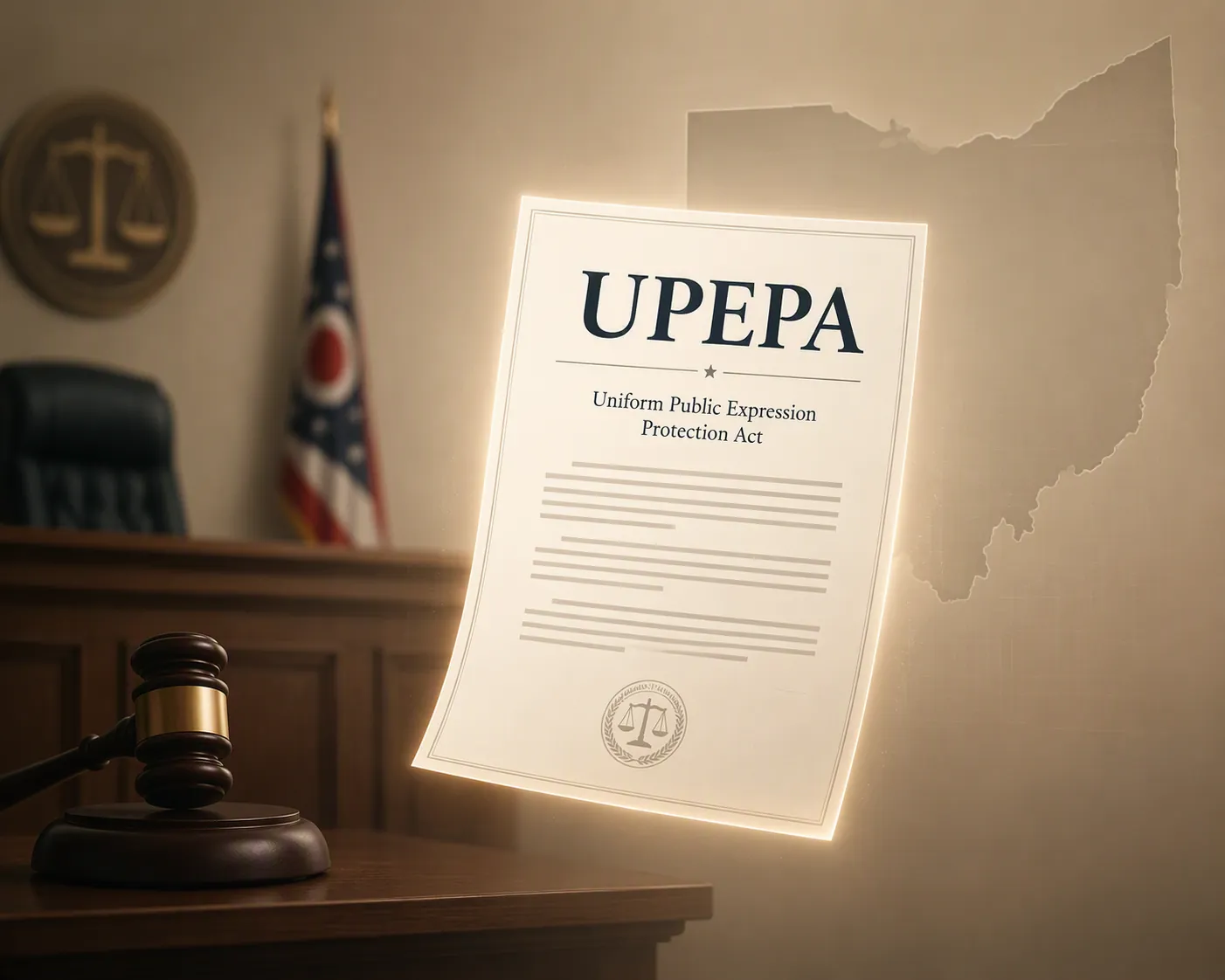
The case was filed on May 14, 2026, in Cuyahoga County before Judge Joy Kennedy. Miller, a sitting member of Congress, sued his ex-wife, Emily Moreno, for defamation after she made accusations involving domestic violence; Moreno responded with an anti-SLAPP dismissal motion under Ohio’s UPEPA, which triggered the automatic discovery stay.[2][3]
That procedural sequence matters more than the public personalities attached to it. If Moreno prevails on the anti-SLAPP motion, the statute requires dismissal with prejudice and an award of attorney fees and costs to the moving party.[4][5] That is a different litigation posture from the ordinary public defamation suit, where discovery costs can become part of the pressure campaign long before a court reaches the merits.
The compact procedural record
| Date or event | Procedural significance |
|---|---|
| April 9, 2025 | Ohio’s UPEPA took effect, making Ohio the 35th state with an anti-SLAPP statute.[4][5] |
| May 14, 2026 | Miller filed the defamation complaint in Cuyahoga County Court of Common Pleas.[2][3] |
| After complaint | Moreno filed an anti-SLAPP dismissal motion, invoking UPEPA’s automatic stay of discovery.[2] |
| July 7, 2026 | The court denied Miller’s emergency discovery motion and kept the discovery stay intact.[1] |
| July 23, 2026 | Available sources identify this as the scheduled anti-SLAPP dismissal hearing date, but they do not provide a verified post-hearing docket outcome. |
Because publication is after July 23, the hearing cannot responsibly be described as merely upcoming. Nor can the dismissal motion be described as granted, denied, or still under advisement from the cited sources. The established court action in the available record is narrower: the July 7 discovery denial preserved the stay, and any post-hearing merits ruling would have to be confirmed against the Cuyahoga County docket.
What Ohio’s UPEPA changed before anyone reached the merits
Ohio’s UPEPA, codified in R.C. Chapter 2747, gives a defendant a fast procedural route when a claim targets speech covered by the statute. Its central litigation effects are immediate: the filing of the dismissal motion stays discovery; discovery may proceed only if the court authorizes limited discovery for good cause; and a successful movant receives dismissal with prejudice plus mandatory fees and costs.[4][5]
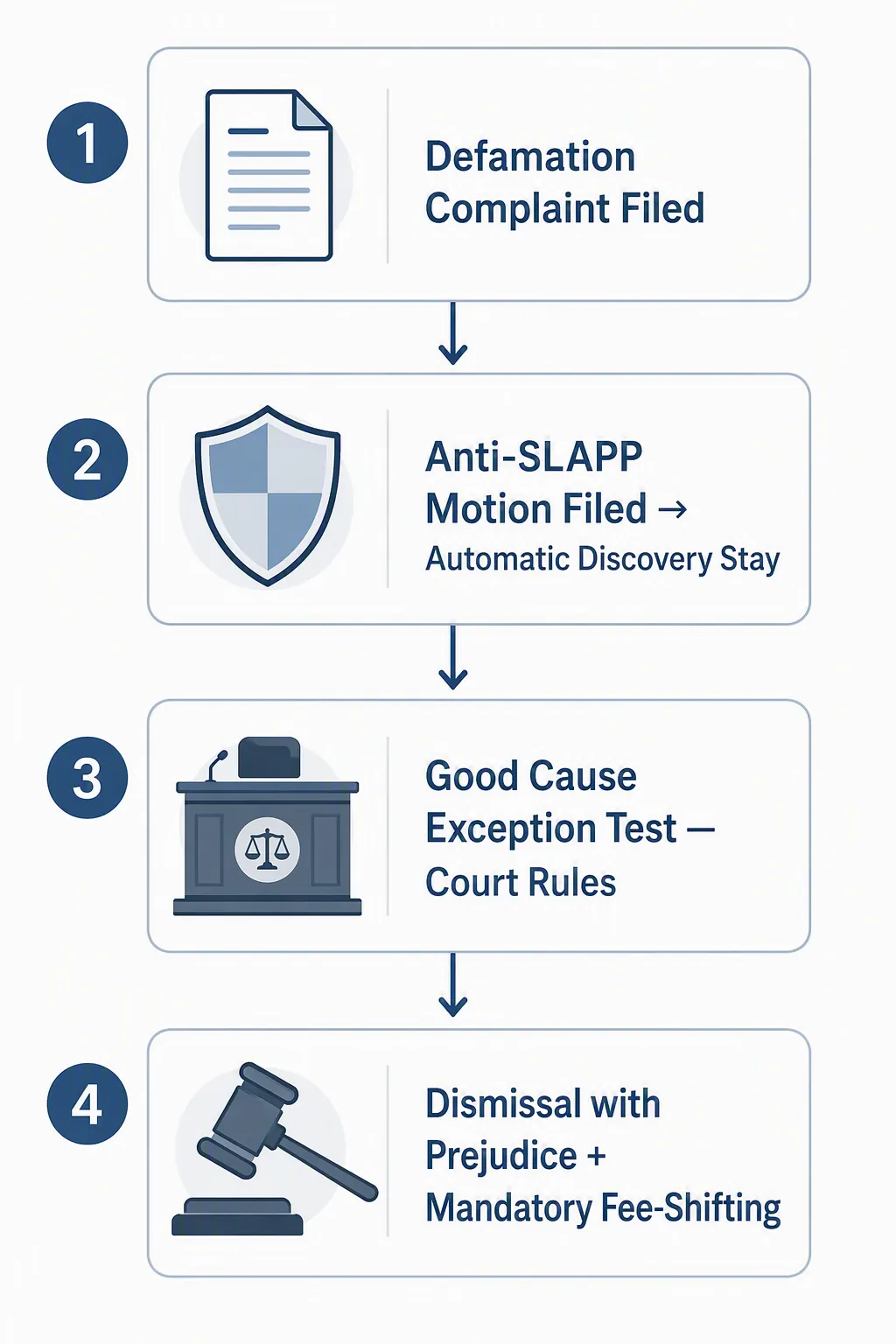
The stay is the feature now doing visible work in Miller v. Moreno. Without it, a defamation plaintiff can demand documents, communications, depositions, and third-party discovery while the defendant is still trying to test whether the case should proceed at all. With it, the plaintiff must first persuade the judge that discovery is needed despite the statute’s preference for an early threshold ruling.
That is why the July 7 order is more than a scheduling skirmish. Moreno’s counsel describes Miller’s emergency request as sweeping and argues that it fell outside UPEPA’s narrow limits; the court denied the request and kept the stay in place.[1] The source is an advocacy post from Moreno’s law firm, so its adjectives should be discounted. The procedural result should not be: Miller sought emergency discovery, and the court did not let him have it.
That early ruling gives the statute practical force. A discovery stay that collapses at the first claim of urgency is mostly ornamental. A discovery stay that survives a high-profile plaintiff’s emergency motion changes settlement leverage, litigation cost, and the timing of factual development.
The good-cause exception is the narrow gate
The important distinction is between discovery that would help a plaintiff litigate the whole case and discovery that is necessary to answer the anti-SLAPP motion. UPEPA allows only the latter when the court finds good cause and specifies what may be taken.[4][5]
In ordinary defamation litigation, a plaintiff may want discovery into the defendant’s sources, communications, motives, publication history, and contacts with reporters or political actors. Under UPEPA, that ordinary appetite is not enough. The plaintiff must connect the proposed discovery to the immediate dismissal question. The July 7 denial suggests Judge Kennedy was not prepared to treat broad emergency discovery as compatible with the statutory stay.[1]
Moreno’s side framed the request as procedurally improper on several grounds: that Miller could not use discovery to force her to prove a negative, that the requests were duplicative, that they implicated attorney-client privilege, that some requests ran into Ohio’s media-shield protections, that statute-of-limitations issues existed, and that the discovery was burdensome or harassing.[1] Those are Moreno’s arguments, not findings on the merits. But they show the kind of objections UPEPA invites defendants to make at the threshold rather than after months of production.
The supplements are arguments for decision without discovery
Moreno’s supplemental filings belong in the case analysis only after the procedural mechanism is clear. They do not establish what happened between Miller and Moreno. They show what Moreno’s counsel says the court can decide before allowing discovery.
In a June 3 supplement, Moreno’s counsel points to an audio recording that Miller allegedly leaked to the New York Post. The filing quotes Miller as saying, “The water incident — I never thought that hurt you” and “I didn’t mean to hurt you. It wasn’t done with intent.” Moreno’s counsel argues that those statements support a substantial-truth defense, which would defeat a defamation claim under Ohio law.[6]
That argument should be kept in its lane. The transcript excerpts are litigation material described by Moreno’s counsel; they are not an independent adjudication of domestic violence. Their relevance here is procedural: Moreno is using them to argue that the court does not need discovery to decide whether Miller can carry the defamation claim forward.
A later supplement, dated June 29, takes a different route. Moreno’s counsel cites Miller’s own media statements to the Akron Beacon Journal and Spectrum News predicting an easy re-election victory, then argues those statements undercut his claimed reputational and financial damages. The same supplement invokes the Sixth Circuit’s defamation-proof plaintiff doctrine.[7]
Again, that is a defense argument. It does not mean Miller suffered no harm. It means Moreno’s counsel is trying to confine the case to materials already before the court: Miller’s public statements, the challenged accusations, the alleged audio transcript, and the legal standards governing defamation and UPEPA dismissal.
Why fee-shifting is the real pressure point
The dismissal motion is not just a request to end the case early. Under UPEPA, a prevailing movant receives dismissal with prejudice and mandatory attorney fees and costs.[4][5] That combination gives the motion a sharp edge.
Dismissal with prejudice would prevent the plaintiff from refiling the same claim. Mandatory fees and costs would shift some of the economic burden of the suit back to the plaintiff. In a public-figure defamation case, that matters because the litigation itself can otherwise impose substantial defense costs even if the defendant ultimately wins.
The fee provision also changes prefiling advice. A public official or candidate considering a defamation suit over speech about domestic-violence-related conduct now has to account for a front-loaded statutory test. If the speech falls within UPEPA and the defendant can frame a persuasive early dismissal motion, the plaintiff may not get discovery first. If the motion succeeds, the plaintiff may leave the case owing fees.
That does not make every accusation protected or every defamation claim doomed. UPEPA is a procedural filter, not a license to defame. But the filter has immediate consequences when the plaintiff is a public figure, the speech concerns conduct of public concern, and the defendant can argue that the case should be tested on existing materials before discovery begins.
The domestic-violence allegations are legally relevant, not adjudicated
The domestic-violence allegations sit at the center of the defamation claim, but they should not be treated as resolved facts. The available materials do not establish that a court or law-enforcement agency has adjudicated the allegations against Miller. They also do not establish, merely because Miller sued, that the accusations were false.
For UPEPA purposes, the allegations matter because of the speech context and because Moreno says the challenged statements can be defended without discovery. That is a narrower point than the public debate around the case. It is also the point the court must confront if it reaches the anti-SLAPP motion on the merits.
That distinction is especially important in domestic-violence-related defamation litigation. A court can decide whether a complaint survives an anti-SLAPP motion without making the article, the docket, or the public record into a substitute trial on the underlying family allegations. The procedural question is whether the suit may proceed, whether discovery is allowed now, and whether the statute requires dismissal and fee-shifting.
What can be said after the July 23 hearing date
The cited materials identify July 23, 2026, as the anti-SLAPP dismissal hearing date, but they do not include a verified docket entry showing whether Judge Kennedy granted the motion, denied it, or took it under advisement. That missing status is not a minor housekeeping issue. It determines whether this case has already produced Ohio’s first major UPEPA dismissal result or remains an important discovery-stay signal awaiting a merits ruling.
The verified point is still consequential. The court has already enforced the stay against emergency discovery in a high-profile public-figure defamation case involving domestic-violence-related speech. If the dismissal motion is later granted, UPEPA’s mandatory prejudice and fee provisions will become the next lesson for Ohio plaintiffs. If it is denied, the July 7 order will still show that the statute can halt discovery while the threshold motion is litigated.
For Ohio litigants, the immediate lesson is procedural: a defamation complaint does not necessarily buy discovery when UPEPA is invoked. The first fight may be over whether discovery happens at all, and in Miller v. Moreno, the first answer was no.
References
- THWARTED: Court denies Congressman Max Miller's emergency discovery motion — Chandra Law Firm
- US Rep. Max Miller Sues His Ex-Wife for Defamation — First Amendment Watch
- Rep. Max Miller files defamation lawsuit against ex-wife — Roll Call
- Ohio Enacts Uniform Public Expression Protection Act — Frantz Ward LLP
- Ohio Anti-SLAPP Guide — Reporters Committee for Freedom of the Press
- Reputational Self-Immolation — Chandra Law Firm
- Congressman Max Miller's re-election boasts torpedo his own defamation lawsuit — Chandra Law Firm
Related records
Tool profile
Browse tool evaluations →Governing regulation
Browse the obligations tracker →Preventive workflow
Browse verification workflows →
Report a correction or tip
Spotted an outdated figure, a misstated fact, or a ruling this case record should reflect? Public comments are disabled for this content given the professional cost of a misreported case outcome, penalty amount, or rule text — use the structured correction channel instead.
Report a correction or tip for this record →