
Legal Implications of the OLC Memo on Drug Boat Strikes
The September 2025 OLC memo classifying drug cartels as a non-international armed conflict creates a legal architecture that leaves military personnel exposed to future murder or war-crimes charges and JAG dissenters vulnerable to retaliation, even while the memo remains binding.
- Jurisdiction
- US Federal
- Court
- U.S. District Court for the Southern District of New York
- Judge
- Lewis J. Engelmayer
- AI tool named
- None
- Ruling date
- Sep 5, 2025
- Source document
- View primary court order ↗
- Last verified
- Jul 28, 2026
Lex Machina Review is an independent risk-tracking and reference resource. Nothing on this site is legal advice, and using it does not create an attorney-client relationship. Every record is reviewed against primary sources but may not reflect the most current status of a matter — always verify directly against the cited court order, rule text, or a licensed attorney before relying on it.
Companion explanation — secondary to the source document above
The legal implications of the Trump administration’s drug-boat controversy begin with a practical question: if a classified Office of Legal Counsel memo told the executive branch that alleged drug-smuggling boat strikes fit inside an armed-conflict framework, who carries the risk if that framework is later rejected?
As of July 2026, the September 5, 2025 OLC memo has not been publicly released. This risk digest is therefore based on reported descriptions of the memo and expert legal analysis, not independent review of the full text. It is not legal advice. The important distinction is immediate: an OLC opinion may be treated as controlling inside the executive branch while it remains operative, but that internal force does not guarantee that later prosecutors, courts, foreign authorities, inspectors general, or congressional investigators will accept its legal theory.

The reported theory is stark. Just Security’s FAQ, by Tess Bridgeman, Michael Schmitt, and Ryan Goodman, describes a classified OLC opinion that reportedly treated the United States as engaged in a non-international armed conflict, or NIAC, with 24 unilaterally designated drug-trafficking organizations and built a legal architecture for lethal strikes around that classification.[1] If that description is accurate, the most vulnerable point is not the rhetoric around “cartels.” It is whether Common Article 3 can bear the weight placed on it.
The scale also matters. WOLA has documented 221 people killed, 67 boats, and 63 strike events in its review of the campaign, using source verification to separate confirmed events from weaker claims.[2] Those numbers do not prove illegality. They do explain why the memo cannot be treated as a one-off targeting judgment or an isolated operational mistake. If the legal premise is wrong, the exposure multiplies across repeated decisions, advice chains, strike approvals, and after-action records.
The secrecy problem is procedural before it is political
The ACLU’s FOIA case is the clearest public procedural window into the memo’s continued opacity. The case seeks records on the legality of the boat strikes and was argued before Judge Lewis J. Engelmayer in the Southern District of New York on June 24, 2026.[3] That litigation matters because it frames the institutional problem cleanly: the government is asking uniformed personnel and lawyers to rely on a classified legal conclusion while withholding the reasoning from the public, from outside experts, and in many respects from the future forums that may judge the acts.
Press coverage has filled some of the gap, but only partially. The New York Times reported that the Justice Department memo relied on Article II authority as part of the justification for the strikes.[4] Article II can answer some domestic separation-of-powers questions about presidential control over military operations. It does not, by itself, convert alleged drug smuggling into an armed conflict under international humanitarian law, and it does not make every lethal strike lawful under the Uniform Code of Military Justice or federal criminal law.
The “DEA” component of the controversy is narrower than some headlines suggest. The legally relevant point is not a separate DEA operation; it is the asserted drug-intelligence premise for using military force. On that premise, the administration has had an evidentiary problem. The DoD Lead Inspector General report includes the DEA-linked statement that Venezuela is not a fentanyl source, undercutting a central fentanyl-sourcing claim tied to the strikes.[5] FactCheck.org separately assessed the administration’s factual assertions about the boat-strike campaign and found important claims unsupported or contradicted by available data.[6]
Why the reported NIAC classification is the load-bearing weakness
Common Article 3 is not triggered because the executive branch dislikes an organization, designates it, or describes it as violent. A NIAC requires a factual threshold: an organized armed group and hostilities of sufficient intensity. The reported OLC theory, as analyzed by Bridgeman, Schmitt, and Goodman, tries to treat profit-seeking drug-trafficking organizations as armed-conflict parties even though cartels are not naturally built for the legal role that Common Article 3 assigns to an organized armed group.[1]
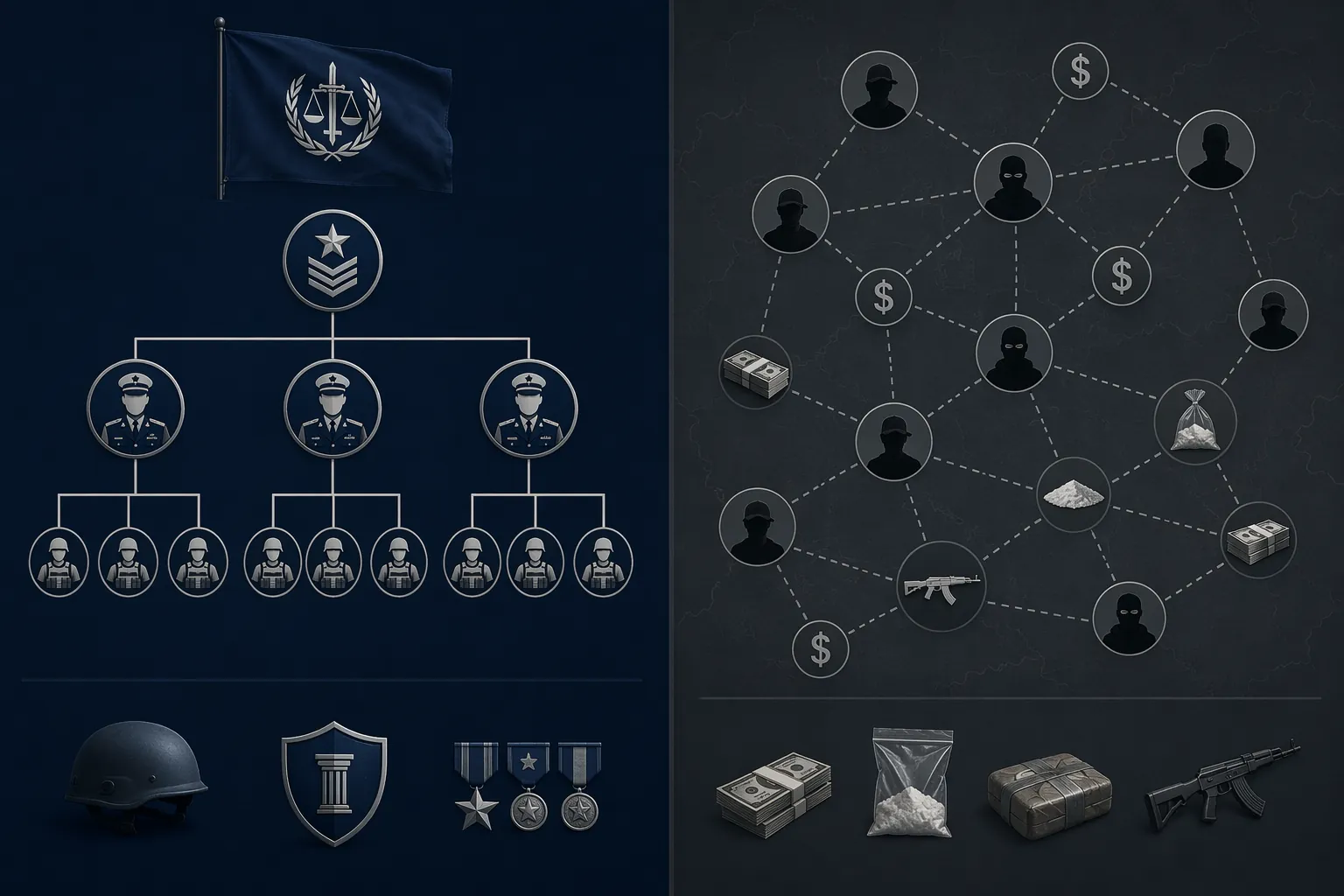
The organizational requirement is not a branding exercise. It asks whether the group has enough structure to function as a party to armed conflict: command arrangements, discipline, the capacity to conduct sustained military operations, and the ability to comply with basic humanitarian-law obligations. Some cartels may have hierarchy. Some may have armed wings. Some may control territory for periods of time. Those facts are not the same as showing that 24 designated entities, across different geographies and business models, each satisfy the Common Article 3 threshold.
The intensity requirement is equally unforgiving. Criminal violence can be extreme without becoming armed conflict. Drug-trafficking violence may involve killings, intimidation, corruption, and firefights with police or military units. But Common Article 3 asks whether the confrontation between the relevant parties has crossed into sustained armed hostilities. A unilateral U.S. decision to strike boats associated with alleged traffickers cannot supply the missing intensity by itself. If the government could create a NIAC by designating criminal groups and then attacking them, the threshold would do little work.
That is why the reported number of designated groups matters legally. The broader the designation list, the harder it becomes to defend the theory as a careful application of Common Article 3 to particular parties. A single armed group with a defined command structure and sustained hostilities would still require proof. A basket of 24 drug-trafficking organizations makes the problem worse: it risks substituting executive designation for the separate factual inquiry that international humanitarian law requires.[1]
Nor does the profit motive automatically answer every question. Armed groups can finance themselves through crime, and criminal activity can occur in war. The difficulty is the reverse move: treating profit-seeking trafficking networks as armed-conflict parties because they are violent, transnational, and dangerous. That move collapses law-enforcement and war paradigms in a way Common Article 3 was not designed to permit.
| Reported legal move | Why it matters for later risk |
|---|---|
| Classifying the campaign as a NIAC with 24 designated drug-trafficking organizations | Makes combatant-style targeting depend on whether Common Article 3’s organization and intensity thresholds are actually met. |
| Relying on Article II authority for presidential direction | May support internal executive action but does not independently establish an armed conflict or immunize individual conduct. |
| Keeping the OLC memo classified | Leaves operators and legal advisers relying on an authority they may not be able to explain or defend in a later forum. |
| Using drug-intelligence claims as part of the public premise | Creates vulnerability where official material contradicts or narrows those claims, including the DEA-linked statement on fentanyl sourcing. |
Internal authority does not eliminate personal exposure
The hardest institutional mismatch is this: OLC can create a binding answer for the executive branch today, while leaving individual service members and lawyers exposed to a different answer tomorrow. That mismatch is not theoretical. Just Security’s analysis identifies possible exposure under UCMJ Article 118 murder, federal murder under 18 U.S.C. § 1111, conspiracy theories under 18 U.S.C. § 956, and foreign universal-jurisdiction theories if a future administration or foreign court rejects the NIAC premise.[1]
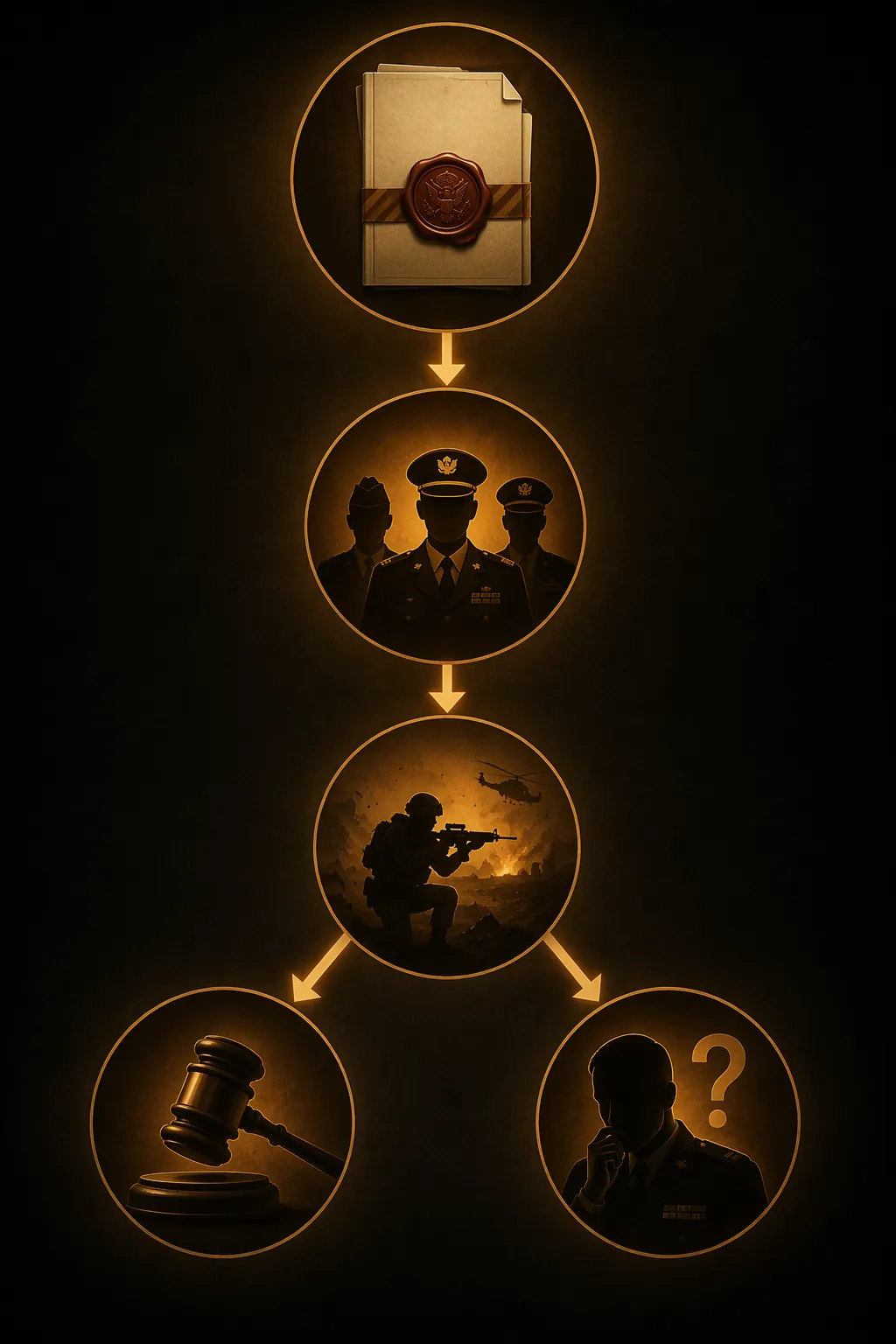
Those are exposure categories, not predictions. A later murder prosecution would have to prove the elements of the charged offense. A war-crimes theory would have to fit the applicable statute and conflict classification. A foreign universal-jurisdiction case would depend on the forum, the alleged victims, the suspects’ travel, and the charging theory. The point is narrower and more durable: reliance on a classified OLC opinion is not the same thing as immunity.
For a commander or operator, the legal risk turns on the status of the people killed and the legal frame governing the use of lethal force. If the targets were not lawful military objectives in a valid NIAC, the strike does not become lawful merely because the alleged passengers were suspected traffickers. In that setting, the question shifts from targeting law to homicide law, self-defense, law-enforcement constraints, and the factual basis for identifying an imminent threat.
For lawyers, the exposure looks different. The immediate problem may be professional and institutional rather than criminal: what advice was given, what doubts were recorded, what caveats were stripped out, and whether the legal review was used to launder an operational decision already made elsewhere. A classified memo can be a shield inside a meeting. It can become a brittle exhibit later.
The dissent record is already part of the risk environment
NBC News reported that Col. Paul Meagher, a top military lawyer, raised legal concerns about the boat strikes and was overruled.[7] That report matters less as personnel drama than as institutional evidence that the legal concerns were not confined to outside commentators. Once internal lawyers object, future reviewers will ask who saw the objection, who answered it, whether the answer engaged the Common Article 3 problem, and whether the dissenting lawyer faced adverse consequences.
Adm. Alvin Holsey’s early retirement has also been treated as part of the institutional signal surrounding the campaign.[7] The available public record should not be overread into proof of retaliation. But in a legal-risk assessment, the signal still matters: if senior officers or JAGs perceive that dissent carries career consequences, the advice chain becomes less reliable precisely where independent legal judgment is most needed.
That risk is not limited to the dissenters. Retaliation pressure can contaminate later institutional defenses. If the government eventually argues that every strike received careful legal review, opposing counsel will ask whether dissent was welcomed, suppressed, bypassed, or punished. A paper trail showing serious objections may protect some individuals, but it can also expose the weakness of the decision process that overrode them.
The Inter-American Commission proceedings sharpened the same point from outside the U.S. chain of command. In March 2026, legal experts appearing in proceedings highlighted the alleged illegality of the Caribbean strikes.[8] That does not decide U.S. criminal exposure. It does show that international and regional legal forums are already treating the campaign as a live legal controversy rather than a settled matter of domestic military discretion.
What a future reviewer would likely ask
A future prosecutor, inspector general, court, or congressional committee would not need to begin with the broadest accusation. The first questions would be more exacting and more uncomfortable.
- What did the September 5, 2025 OLC memo actually say, and which officials received it?
- Did the memo analyze each designated organization separately, or did it treat the 24 groups as a legal category?
- What evidence supported organization and intensity for each alleged NIAC party?
- What intelligence identified the people on each boat, and what alternatives to lethal force were considered?
- Which JAG officers objected, what did they say, and how were those objections handled?
- Did any later official contradict the factual premise used to justify the strikes, including the fentanyl-sourcing premise?
- Were service members told enough about the legal basis to make reliance reasonable, or were they asked to trust a conclusion they could not test?
Those questions are not designed to win a public argument about the Trump administration’s drug policy. They are the questions that decide whether a classified legal architecture holds together when the people who relied on it no longer control the forum.
The memo’s binding force is not the end of the analysis
The strongest government defense, while the memo remains operative, is institutional reliance. OLC opinions are not casual legal blog posts; within the executive branch, they can settle contested questions for officials who must act. That is exactly why a classified OLC memo is so powerful in real time.
But reliance has limits. It is stronger for a service member who had no access to the underlying legal reasoning and followed an apparently lawful order than for senior officials who requested, shaped, or knowingly stretched the opinion. It is stronger where the memo candidly addressed contrary facts than where later records show that inconvenient evidence was ignored. It is stronger where dissenting JAG views were preserved and answered than where objections were sidelined.
The classified status of the memo also cuts both ways. Secrecy may protect operational details and privileged legal deliberation, but it deprives affected personnel of a public, stable legal account they can invoke if the theory is later disowned. A future administration could rescind the memo. A court could reject its Common Article 3 analysis. A foreign prosecutor could refuse to treat it as a defense. None of those outcomes is inevitable, but none is made impossible by the memo’s current force.
That is the legal risk left by the reported OLC architecture: not a guaranteed prosecution, not an automatic war-crimes case, and not a clean answer from the public record. The risk is relocation. A secret theory adopted at the top pushes uncertainty downward onto service members who execute orders, JAG officers who object or sign off, and future institutional decision-makers who may have to defend or unwind the theory after the facts are already irreversible.
References
- FAQ: Legal Issues Raised by U.S. Military Strikes Against Alleged Drug Traffickers, Just Security.
- Killing Spree: U.S. Military Strikes in the Caribbean and Eastern Pacific, WOLA.
- FOIA Case Seeking Legality of Trump Administration’s Boat Strikes, ACLU.
- Boat Strikes DOJ Memo Trump, The New York Times, November 13, 2025.
- Operation Southern Spear: Lead Inspector General Report to the United States Congress, Q2 FY 2026, U.S. Department of Defense, May 21, 2026.
- Assessing the Facts, FactCheck.org, October 2025.
- Top military lawyer raised legal concerns about boat strikes, NBC News.
- Legal Experts Underscore Illegality of U.S. Military Strikes in the Caribbean Before the Inter-American Commission on Human Rights, ACLU, March 2026.
Related records
Tool profile
Browse tool evaluations →Governing regulation
Browse the obligations tracker →Preventive workflow
Browse verification workflows →
Report a correction or tip
Spotted an outdated figure, a misstated fact, or a ruling this case record should reflect? Public comments are disabled for this content given the professional cost of a misreported case outcome, penalty amount, or rule text — use the structured correction channel instead.
Report a correction or tip for this record →