
Knox County Lawsuit Reveals Pattern of On Patrol Live Staged Arrests
Four civil-rights lawsuits from 2019 to 2026 allege that law enforcement staged arrests for On Patrol: Live, creating a documented pattern of camera-driven escalation and contractual gaps that expose municipal liability exceeding $7.5 million in known settlements.
- Jurisdiction
- Tennessee, USA
- Court
- U.S. District Court for the Eastern District of Tennessee
- AI tool named
- None
- Ruling date
- Jun 1, 2026
- Source document
- View primary court order ↗
- Last verified
- Jul 26, 2026
Lex Machina Review is an independent risk-tracking and reference resource. Nothing on this site is legal advice, and using it does not create an attorney-client relationship. Every record is reviewed against primary sources but may not reflect the most current status of a matter — always verify directly against the cited court order, rule text, or a licensed attorney before relying on it.
Companion explanation — secondary to the source document above
Donna Dillon’s lawsuit is too new to prove what happened inside Knox County’s decision-making, and it is too familiar to treat as a stray publicity mishap. Filed in June 2026, the case alleges that Knox County deputies served a roughly 2.5-year-old misdemeanor warrant while an On Patrol: Live crew was present, handcuffed Dillon behind her back despite her disclosed shoulder replacement surgery, kept her in that position for more than four hours, and caused a reinjury that required her to restart physical therapy.[1][2][3]
That is an allegation, not an adjudication. As of July 26, 2026, defendants had not answered on the merits, and the full complaint was not available in the crawled materials used for this analysis. The available record comes from detailed news accounts that quote or describe the complaint. Still, the filing lands in a recognizable place: four civil-rights actions from 2019 through 2026 have now alleged that police reality-television production distorted ordinary law-enforcement choices into broadcastable encounters.
The risk ledger is short but not small. Javier Ambler’s family received a $5 million settlement after his 2019 death following a Live PD-filmed pursuit in Williamson County, Texas.[4][5] Gary Watsky’s case over an alleged staged SWAT raid in the same county settled for $2.5 million in 2024.[6][7] Kairi Myrick’s 2025 suit in Frederick, Maryland, remains unresolved after an arrest aired on On Patrol: Live; Dillon’s 2026 Knox County case is newly filed. Known settlements already exceed $7.5 million before counting Myrick or Dillon.
The Current Knox County Allegation
The Dillon facts that matter most for liability are not the ones that make the cleanest television scene. They are the timing of the warrant, the reported presence of the production crew, the claimed notice of a medical limitation, the duration of the restraint, and the alleged physical consequence afterward.
According to reporting on the complaint, Dillon was arrested on a misdemeanor warrant that was approximately 2.5 years old while On Patrol: Live was filming with Knox County deputies.[1][2][3] She allegedly told deputies that she had undergone shoulder replacement surgery. The complaint says she was nevertheless handcuffed behind her back, transported, and held that way for more than four hours before release, after which she had to resume physical therapy.[1][2]
For a Section 1983 lawyer or municipal-risk reviewer, the age of the warrant is not a throwaway detail. A stale misdemeanor warrant can still be legally enforceable, depending on the warrant and governing law. The litigation question is different: why was this warrant served then, in that manner, with a camera crew present, and were any enforcement choices affected by production value rather than public-safety need?
Knox County may have answers that are not yet in the public record. The complaint may also include state-law claims or municipal-liability allegations that are not fully visible in the reporting. But the allegation is not merely that a televised arrest was embarrassing. It is that broadcast participation changed the timing and handling of a low-level enforcement event, then left the person filmed to absorb the medical and legal consequences.
Four Cases, One Recurring Mechanism
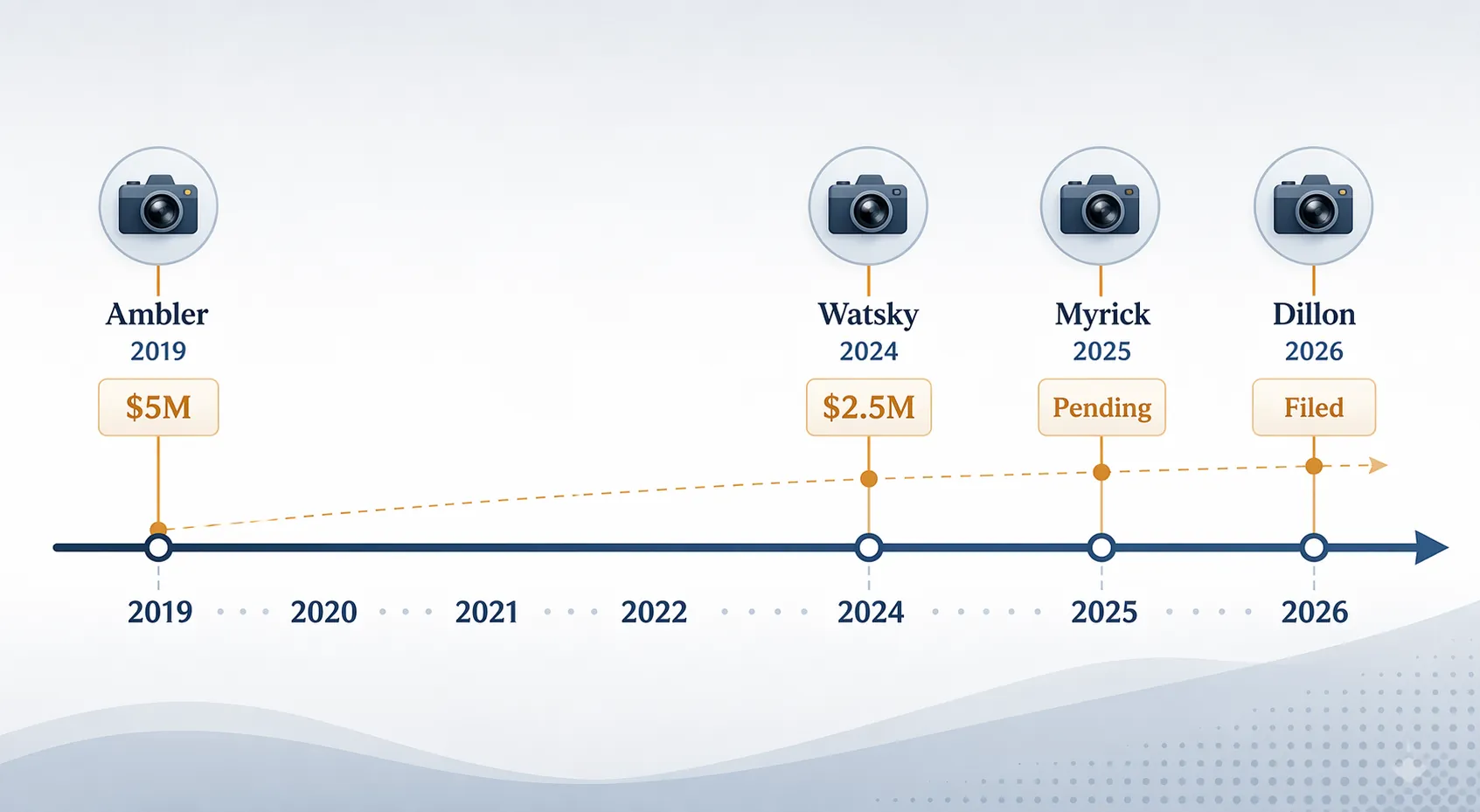
| Case | Core allegation | Status in available materials | Known financial exposure |
|---|---|---|---|
| Javier Ambler, Williamson County, Texas, 2019 | Death after a Live PD-filmed pursuit | Settled; Texas later enacted Javier Ambler's Law | $5 million settlement |
| Gary Watsky, Williamson County, Texas, 2024 | Alleged staged SWAT raid for Live PD; warrant allegedly kept out of normal court systems | Settled | $2.5 million settlement |
| Kairi Myrick, Frederick, Maryland, 2025 | Alleged false arrest aired on On Patrol: Live despite officer notes describing discrepancies with the suspect description | Pending in available reporting; city and production company moved to dismiss | Unresolved |
| Donna Dillon, Knox County, Tennessee, 2026 | Alleged service of a 2.5-year-old misdemeanor warrant with On Patrol: Live crew present and medically harmful restraint | Filed June 2026; defendants not yet answered on the merits in available materials | Unresolved |
Ambler is the most serious case in the sequence because it ended in death. He died after a 2019 pursuit filmed by Live PD in Williamson County, and his family later received a $5 million settlement.[4][5] Texas’s legislative response, House Bill 54, was signed in 2021 and became known as Javier Ambler’s Law.[4][5] The law is important not because it resolves the national issue, but because it shows one state legislature identified the production arrangement itself as a regulatory problem.
Watsky presents a different version of the same concern. In 2024, Williamson County agreed to pay $2.5 million to settle his lawsuit alleging a staged SWAT raid connected to Live PD filming.[6][7] Reporting on the settlement described allegations that the warrant was hidden from the court system, a fact that, if proved in an active case, would move the issue from bad optics into the integrity of judicial process.[6]
Myrick’s case is still pending in the available reporting, so it should not be treated as a finding of false arrest. Its value as a pattern case is narrower. He alleges that officers arrested him in an encounter aired on On Patrol: Live even though their own notes described discrepancies between his appearance and the suspect description; charges were later dropped, and the city and production company sought dismissal of the civil suit.[8][9] If the notes are accurately described, the broadcast did not merely document an arrest. It allegedly preserved the public version of an identification that the paperwork itself complicated.
Dillon then supplies the current 2026 variant: not a fatal chase, not a SWAT raid, not a disputed suspect identification, but the sudden service of an old misdemeanor warrant with a camera crew present and an alleged avoidable injury during custody.[1][2][3] It is a less cinematic allegation than Ambler or Watsky, which is precisely why it matters. Municipal liability often grows out of ordinary decisions repeated under abnormal incentives.
Where Broadcast Value Can Touch Police Discretion
The shared mechanism across these cases is not that every officer set out to violate the Constitution on television. The more durable risk is operational: a private show needs encounters, officers retain discretion, and the public entity remains responsible when the encounter becomes a civil-rights claim.
In a conventional patrol setting, discretion appears in small places: whether to initiate a stop, whether to wait for backup, whether to serve a warrant immediately or later, whether to tighten or loosen restraints, whether a discrepancy in a description is enough to pause. Police reality television adds a second audience to those choices. The person being stopped still experiences state power. The department also receives footage, recruitment narrative, and public visibility. The production company receives content.
That does not prove causation in any individual case. It does explain why the same factual pressure points keep appearing in complaints. In Ambler, the pressure point was a filmed pursuit and death.[4][5] In Watsky, it was an allegedly staged tactical operation and the handling of a warrant.[6][7] In Myrick, it was an allegedly flawed identification that became televised arrest footage.[8][9] In Dillon, it is the timing of a years-old misdemeanor warrant and the treatment of a known medical condition while cameras were present.[1][2][3]
The word “staged” can obscure as much as it reveals. A plaintiff does not always need to prove a scripted scene. The liability theory may turn on less theatrical conduct: selecting a warrant for service because filming is underway, prolonging an encounter that would otherwise have ended, accepting weaker identification evidence because the encounter has momentum, or allowing production access without preserving footage for defense or civil discovery. Those are not production details when the actor on screen is also exercising state authority.
The Harvard-linked finding sometimes cited in this debate should be used carefully. Secondary accounts report that Live PD camera presence increased arrests for low-level quality-of-life offenses by about 20% in targeted communities, concentrated in lower-income areas. Because the original SSRN paper was not directly available in the crawled materials, that finding is best treated as a risk signal, not as the evidentiary backbone for Dillon or any other single lawsuit.
The Contract Gap Is Not a Side Issue
The most revealing documents in police reality-television litigation may not be body-camera clips or broadcast episodes. They may be the production agreements.
Analyses by The Garrison Project and Clutch Justice describe standard Live PD and On Patrol: Live terms that give police a 48-hour editorial review window and allow officers to stop filming, while omitting citizen consent requirements and footage-disclosure obligations to defense counsel.[10][11] Clutch Justice’s July 2026 analysis also describes the absence of restrictions on timing warrant service for entertainment purposes.[11] The Knox County contract may differ; the specific local agreement was not established in the crawled materials. But the standard structure, as reported, allocates reputational control to the agency without creating matching protections for the person filmed.
A 48-hour editorial review clause is easy to underestimate. It suggests the parties anticipated reputational risk to the department and built a process to manage it. The absence of a parallel citizen-consent clause suggests the person who becomes the episode’s content was not given the same contractual dignity. The absence of a defense-disclosure obligation is even more practical. If footage captures the basis for a stop, arrest, search, identification, or use of force, then criminal defendants and civil litigants will eventually ask who had it, who edited it, who deleted it, and who knew it existed.
This is where indemnity and public-law exposure can part company. A production contract may decide who pays for certain claims between the agency and the producer. It does not decide whether a seizure was reasonable, whether a municipality had a policy or custom that caused a constitutional violation, whether evidence was withheld, or whether a plaintiff can show damages from broadcast dissemination. The public defendant cannot contract away the constitutional character of the encounter.
Texas remains the outlier. House Bill 54 prohibits law-enforcement agencies from authorizing reality-television crews to accompany officers in a way that permits filming of a person being detained or arrested for entertainment purposes.[4][12] The law followed Ambler’s death and is, in the available materials, the lone state-level statutory response of its kind.[5][12] No comparable federal statute governs the production model.
What Knox County Actually Faces Now
Dillon’s complaint should not be treated as a liability finding against Knox County. The county may contest the warrant narrative, the medical-notice allegation, causation, damages, municipal policy, or any connection between filming and enforcement choices. It may also argue that the deputies would have acted the same way with no camera present.
The harder risk-management point is that Knox County is not defending in a vacuum. Plaintiffs’ lawyers now have a four-case sequence to cite when framing discovery: Ambler for filmed escalation and legislative response, Watsky for alleged staging and warrant-process irregularity, Myrick for broadcast arrest despite alleged identification discrepancies, and Dillon for stale-warrant timing and injury during custody. Not all of those cases are adjudicated. Two settled. Two remain unresolved. But settlement approvals and pending complaints can still shape litigation strategy, document requests, deposition outlines, and municipal appetite for risk.
A plaintiff pursuing a municipal-liability theory would likely look beyond the arresting deputies. The practical questions would include who approved the show’s access, what written policy governed warrant selection during filming, whether supervisors knew old warrants might be served for episodes, whether footage was preserved, whether arrestees were told how the footage could be used, and whether Knox County reviewed episodes before broadcast. Those questions do not decide the case. They identify where the case stops being about one handcuffing decision and starts being about an agency arrangement.
The unrelated May 2026 corruption indictment involving current and former Knox County Sheriff’s Office employees is not evidence that Dillon’s arrest was staged or unconstitutional. It may affect public confidence or settlement atmosphere, but using it as proof of causation would overstate the available record. The cleaner litigation issue is narrower: whether participation in On Patrol: Live affected the timing, manner, documentation, or review of Dillon’s arrest.
The Liability Control Points
For jurisdictions still considering police reality-television partnerships, the repeated cases point to controls that should be treated as legal infrastructure, not public-relations preferences.
- Warrant-service timing: agencies need a documented law-enforcement reason for serving warrants during filming, especially old or low-level warrants.
- Citizen consent: a person detained by police is not in an ordinary bargaining position, so consent cannot be handled as an afterthought.
- Footage preservation: raw and edited footage should be treated as potential evidence from the moment an enforcement encounter begins.
- Defense access: if footage bears on probable cause, identification, force, search, or restraint, criminal-defense disclosure cannot depend on production-company convenience.
- Editorial review: agency review rights should be paired with rules that prevent reputation management from becoming evidence management.
Those controls would not eliminate constitutional claims. They would make the public entity decide, in advance and in writing, whether the operational value of the partnership justifies the legal exposure. The current pattern shows what happens when that decision is left to contracts built around access, review, and broadcast rather than around the person on the receiving end of state power.
Knox County is therefore facing more than bad optics. It is entering a documented litigation pattern in which municipalities have already paid more than $7.5 million in known settlements, while the contractual architecture allegedly creating the risk remains largely unregulated outside Texas. Dillon’s outcome is unresolved. For other jurisdictions, warrant-service timing, citizen consent, footage preservation, defense access, and editorial review are liability controls, not production details.
References
- Donna Dillon lawsuit coverage, Knox News Sentinel
- Donna Dillon lawsuit coverage, WVLT, June 29, 2026
- Grandmother arrest police reality show, CNN, July 25, 2026
- HB 54 bill text, Texas Legislature
- Insights: Javier Ambler Law, Police Reality Television, JW.com
- Live PD settlement Williamson County, Variety, 2024
- Williamson County Live PD settlement Gary Watsky, Fox 7 Austin
- City requests dismissal of On Patrol: Live suit, Frederick News-Post
- Man sues On Patrol: Live police department after being arrested on the show, PennLive, June 2025
- Reality Policing TV, The Garrison Project
- Reality TV Law Enforcement Accountability: First 48, Live PD, Cops, Clutch Justice, July 22, 2026
- Texas Code of Criminal Procedure Section 614.232, Texas Constitution and Statutes
Related records
Tool profile
Browse tool evaluations →Governing regulation
Browse the obligations tracker →Preventive workflow
Browse verification workflows →
Report a correction or tip
Spotted an outdated figure, a misstated fact, or a ruling this case record should reflect? Public comments are disabled for this content given the professional cost of a misreported case outcome, penalty amount, or rule text — use the structured correction channel instead.
Report a correction or tip for this record →