
Oracle Pentagon Deal Signals New AI Vendor Risk for Law Firms
Oracle's $7 billion Pentagon software consolidation deal and its classified AI network clearance create an indirect but material vendor-concentration risk for any legal AI tool running on Oracle infrastructure. This article examines the deal's implications for legal-tech procurement and offers a framework for evaluating fourth-party dependency exposure.
- Jurisdiction
- US Federal
- Court
- U.S. Department of Defense
- AI tool named
- Oracle
- Ruling date
- Jul 23, 2026
- Source document
- View primary court order ↗
- Last verified
- Jul 26, 2026
Lex Machina Review is an independent risk-tracking and reference resource. Nothing on this site is legal advice, and using it does not create an attorney-client relationship. Every record is reviewed against primary sources but may not reflect the most current status of a matter — always verify directly against the cited court order, rule text, or a licensed attorney before relying on it.
Companion explanation — secondary to the source document above
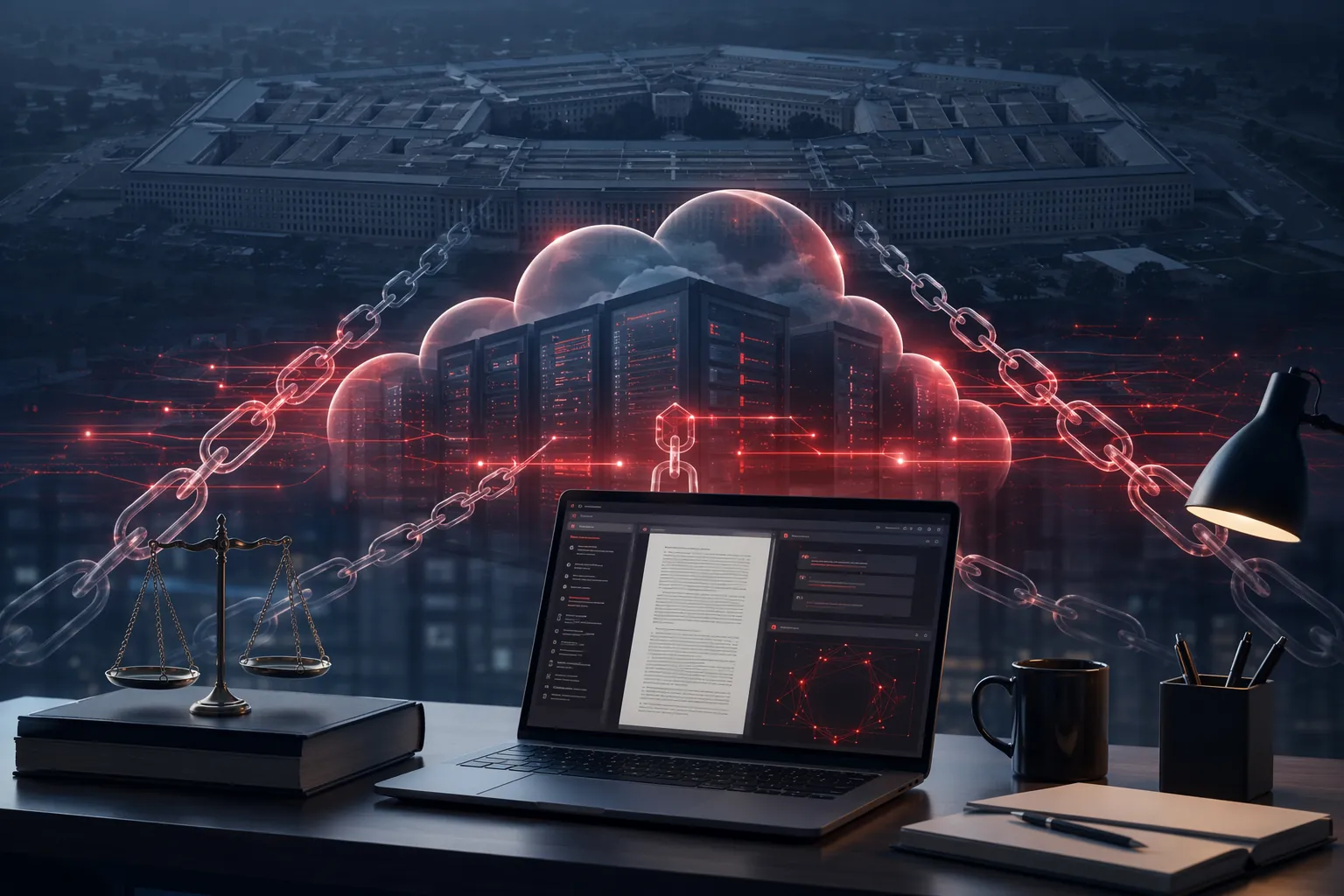
The Oracle-Pentagon enterprise software consolidation deal belongs in a risk digest, but not because it is a sanction case, a court-order record, or evidence that any legal AI product is presently noncompliant. Its significance is quieter: on July 23, 2026, Oracle became the Pentagon’s single enterprise-wide provider for on-premises software across a large defense procurement footprint, less than three months after Oracle was cleared to deploy AI on classified Department of Defense networks. For law firms buying AI tools, that combination changes the vendor-dependency map.
The contract has a ceiling value of $6.99 billion over 10 years, with a $3.31 billion base award. Reuters reported that it consolidates fragmented Oracle procurement across all military service branches, the Coast Guard, and the Intelligence Community, and is expected to save the Department of Defense $441 million annually.[1] CNBC separately described the award as a 10-year Pentagon software contract worth up to $7 billion.[2]
Oracle’s own description matters because it does not frame the award as mere license housekeeping. Oracle executive vice president Kim Lynch said the agreement creates a “standardized and efficient path to Oracle cloud and AI technology” for mission-critical scenarios.[3] That phrase is the bridge from an ordinary enterprise software consolidation story to a legal AI infrastructure question.
What Changed On The Procurement Map
The immediate change is not that Oracle suddenly became a defense technology company. Oracle was already a major cloud and software provider to government customers. The more precise change is that the Department of Defense has now put a broad set of Oracle software purchasing behind one enterprise-wide vehicle, with a long term, a large base award, and an explicit path toward cloud and AI adoption.
That is the kind of procurement fact that tends to disappear inside vendor questionnaires. A law-firm buyer may ask whether a legal AI vendor encrypts data, trains on customer prompts, supports single sign-on, or offers a data processing addendum. Those are necessary questions. They do not always reveal whether the vendor’s infrastructure provider has just become more deeply embedded in Pentagon-wide software standardization.
The timing sharpens the point. In May 2026, DefenseScoop reported that Oracle was one of eight companies cleared to deploy AI on classified DoD networks at Impact Level 6 and IL7 through the GenAI.mil platform, alongside OpenAI, Google, AWS, Microsoft, NVIDIA, Reflection, and SpaceX.[4] Defense One reported the same classified-network clearance group.[5] The July software consolidation deal and the May classified AI clearance are separate records, but together they show Oracle sitting in both the enterprise software lane and the classified AI infrastructure lane.
| Procurement Fact | Why It Matters For Legal AI Buyers |
|---|---|
| $6.99 billion ceiling value over 10 years | Signals long-term institutional dependency rather than a short pilot. |
| $3.31 billion base award | Shows that the commitment is already substantial before optional expansion. |
| $441 million in expected annual DoD savings | Indicates the government is using consolidation to replace fragmented purchasing. |
| Coverage across service branches, Coast Guard, and Intelligence Community | Makes the relationship relevant to more than one agency or isolated program. |
| Oracle path to cloud and AI technology | Connects software consolidation to infrastructure choices that may sit beneath legal AI tools. |
| IL6/IL7 classified AI clearance | Adds a government-cloud and classified-workload dimension to ordinary vendor dependency. |
The Legal-Tech Issue Is Fourth-Party Concentration
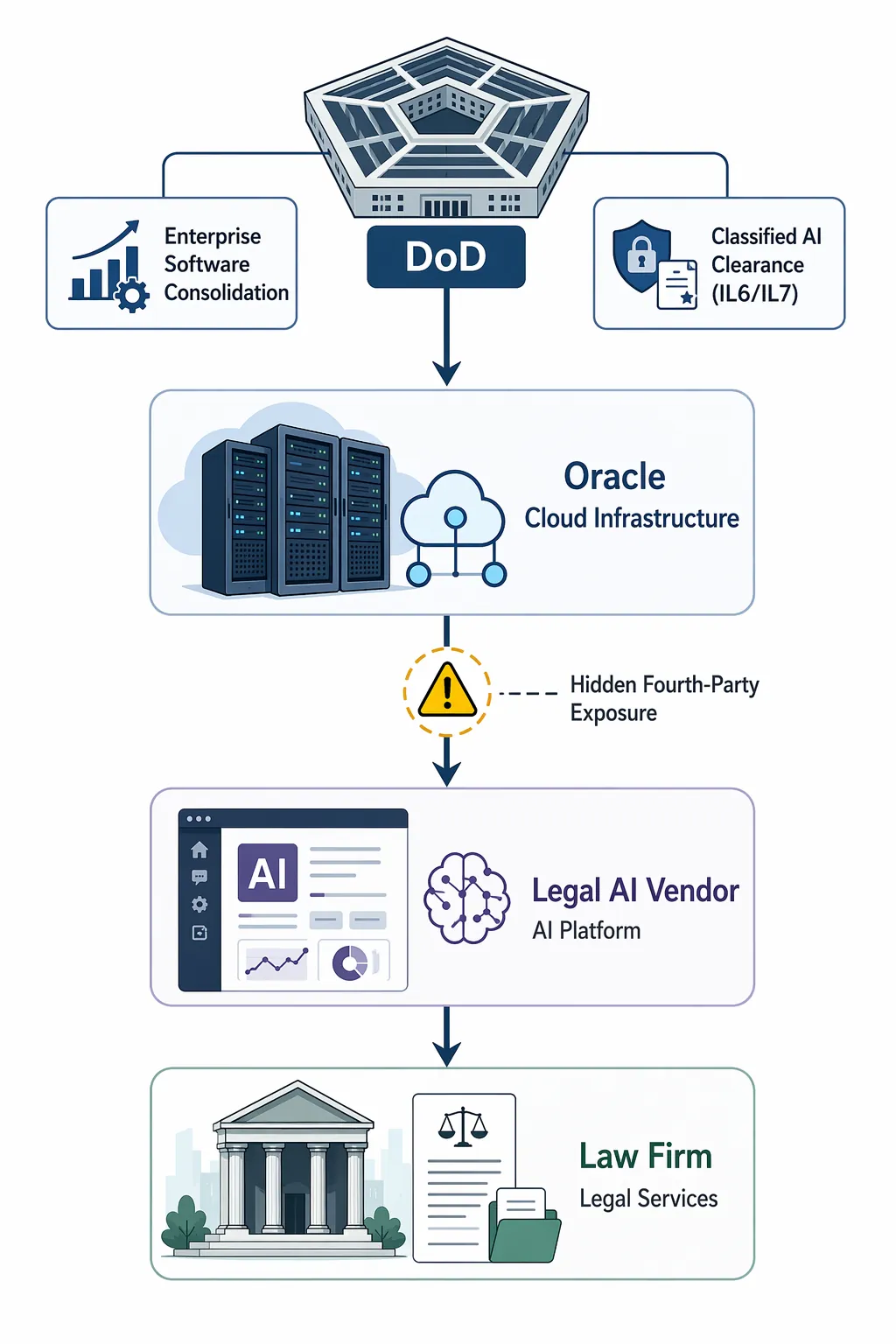
For a law firm, the relevant chain is rarely direct. The firm contracts with a legal AI vendor. The legal AI vendor may run some or all of its product on a cloud platform, use managed AI services, rely on model hosting, or route certain workloads through infrastructure it does not own. If that underlying provider is Oracle Cloud Infrastructure or an Oracle AI service, the law firm has a fourth-party dependency even if Oracle’s name never appears on the invoice.
That dependency is not automatically disqualifying. Oracle’s government posture may be a strength for some buyers: more mature controls, more auditable environments, and a better-defined compliance architecture than a patchwork of smaller suppliers. Consolidation can reduce shadow procurement. The danger is treating the cloud layer as plumbing after it has become part of the regulatory surface.
A defensible procurement file should therefore distinguish three things that are often blurred in sales conversations: whether the legal AI vendor uses OCI for ordinary commercial hosting, whether it uses Oracle AI services directly or indirectly, and whether any operational dependency touches government cloud regions, classified workloads, or teams and controls shared with government-cleared environments.
The last point is not a claim that commercial law-firm data is commingled with Pentagon systems. The available materials do not support that claim. The narrower and more useful point is that Oracle’s government-cloud and classified-AI posture can become relevant to the resilience and acceptability of downstream legal AI tools if a future government action affects Oracle’s status, terms, clearance, or procurement eligibility.
Where The Exposure Could Travel
The practical chain looks like this: a law firm approves a legal AI tool; the vendor uses Oracle infrastructure or Oracle AI services; Oracle’s government cloud and AI approvals become part of the vendor’s operational dependency; a future Pentagon, classified-network, acceptable-use, or supply-chain decision changes Oracle’s government-facing posture; the legal AI vendor must adjust its infrastructure, disclosures, continuity plans, or customer commitments.
No adverse step in that chain has happened here. There is no public basis to say Oracle has lost clearance, been designated a supply-chain risk, violated procurement rules, or made legal AI tools unsafe. The risk is contingent. It becomes material because the contract is large, long, and government-wide, and because Oracle’s AI clearance places it inside a sensitive DoD infrastructure category.
That is enough to justify diligence. It is not enough to justify blacklisting Oracle-dependent tools.
The Anthropic Precedent Should Be Used Carefully
The closest recent warning sign is not Oracle. It is Anthropic. Bloomberg Law reported that, on February 27, 2026, Defense Secretary Pete Hegseth designated Anthropic a supply-chain risk under the Federal Acquisition Supply Chain Security Act after Anthropic refused to remove acceptable-use-policy restrictions on mass surveillance and autonomous weapons; the designation triggered a presidential directive to phase out Claude within six months and prompted legal-tech vendors to examine their own exposure.[6]
Mayer Brown also analyzed the Pentagon’s Anthropic designation as a FASCSA supply-chain risk event and described the government-contractor implications.[7] The precedent is unstable: Anthropic sued in March 2026, and the phase-out order has been subject to injunction activity.[6] It should not be treated as proof that Oracle faces the same problem.
Its value is narrower. It shows that federal AI supply-chain designations can move downstream into tool ecosystems that were not the original target of a law-firm procurement review. A legal team that approved a drafting, research, or knowledge-management product may later discover that the critical issue is not the user interface, the model output, or the vendor’s privacy policy, but a government decision about a technology provider one layer below the contracting party.
That is why the Oracle record belongs beside, not inside, the Anthropic file. Anthropic is an active supply-chain-risk dispute. Oracle is a consolidation and classified-AI-clearance record. The common lesson is procedural: AI procurement files need to identify fourth parties before a government action makes them urgent.
What A Buyer Can And Cannot Know Today
The deal was announced only three days before the current date of July 26, 2026, and implementation is scheduled for Summer 2026.[1][3] The contract’s operational details may evolve. The legal-tech market’s exact exposure is also not public. There is no authoritative list of legal AI vendors using OCI, Oracle AI services, or Oracle government-cloud-adjacent operational arrangements.
That uncertainty changes the diligence question. A buyer should not accuse a vendor of undisclosed Oracle dependency without evidence. The buyer should ask for the evidence needed to close the file.
- Does the product run on OCI in whole or in part?
- Are Oracle AI services, model-hosting services, databases, identity tools, analytics tools, or support services used directly or indirectly?
- Which cloud regions process, store, back up, or log customer data?
- Are any government cloud regions, classified-workload controls, or government-cleared operational teams implicated in commercial service delivery?
- Does the vendor maintain an exit or substitution plan if a fourth-party infrastructure provider becomes unavailable, restricted, or contractually unacceptable?
Those questions are not Oracle-specific in principle. They should be asked of vendors using AWS, Azure, Google Cloud, model providers, data-labeling services, and retrieval infrastructure. Oracle becomes the immediate example because the July 2026 Pentagon deal increases the importance of facts that many legal AI questionnaires still treat as background.
Contract Terms Worth Asking For
A standard AI vendor review often asks for security documentation, privacy commitments, model-training terms, and breach notice. For infrastructure concentration risk, the better request is narrower: show the fourth-party map and tell the customer what happens if that map changes.
- Notice rights for material changes to cloud providers, AI service providers, model-hosting providers, and government-region dependencies.
- A contractual obligation to disclose whether OCI or Oracle AI services are used for processing, storage, retrieval, logging, analytics, support, or failover.
- Audit or attestation rights that reach fourth parties at least through reports, certifications, architecture summaries, and exception notices.
- Notice if a fourth-party provider is designated a supply-chain risk, loses a relevant government clearance, becomes subject to a government phase-out, or changes acceptable-use terms in a way that affects service delivery.
- Termination, suspension, or migration rights if the vendor cannot maintain an approved infrastructure posture.
The most important drafting point is not a broad promise that the vendor uses “enterprise-grade” cloud infrastructure. That phrase does little work when the issue is fourth-party concentration. The agreement should identify which infrastructure facts are material, who must give notice, how quickly notice must be given, and what the buyer can do if the dependency becomes unacceptable for client, regulatory, or conflicts reasons.
For higher-risk deployments, the file should also capture whether client data can be segregated by region, whether logs and embeddings follow the same infrastructure path as primary content, whether customer-managed encryption keys are available, and whether the vendor can move workloads without degrading core functionality. A vendor that cannot answer those questions may still have a safe product. It does not yet have a complete procurement record.
Financial Scale Is Context, Not The Main Risk
CNBC reported that Oracle’s stock was down about 38% in 2026 amid more than $50 billion in AI data-center capital expenditure, even as the Pentagon award added a large government contract to the company’s book.[2] That financial context is worth noting, but it should not be overread. A stock decline does not establish operational weakness, and a defense contract does not eliminate execution risk.
For legal AI buyers, the more durable point is institutional dependency. The Department of Defense is trying to reduce fragmentation and cost through consolidation. Oracle is positioning the agreement as a path to cloud and AI technology. Law firms using Oracle-dependent tools may therefore be connected, indirectly, to a supplier whose government relationships are becoming more consequential.
The Procurement File After July 23, 2026
A cautious buyer does not need to reject an AI product because Oracle sits somewhere in the stack. That would be a blunt response to a record that calls for precision. The better posture is to document the dependency, decide whether it matters for the firm’s client base and practice profile, and obtain contractual rights that survive a change in the fourth-party environment.
Different firms will draw the line in different places. A litigation team handling ordinary commercial matters may care mainly about continuity and confidentiality. A government-contracts practice, sanctions practice, national-security group, or firm serving defense-adjacent clients may need deeper disclosure about infrastructure regions, cleared environments, and supply-chain contingencies. The same Oracle dependency can carry different weight depending on who is using the tool and what client commitments sit above it.
The facts available today support a limited conclusion. The Oracle-Pentagon consolidation deal has not produced an adverse legal consequence for legal AI buyers. The implementation details are fresh. The exact legal-tech exposure depends on vendor-specific infrastructure disclosures that may not yet be public. But Oracle dependence is no longer just a background hosting fact that can be left outside the diligence memo.
References
- Pentagon awards Oracle nearly $7 billion deal, Reuters, July 23, 2026, link
- Oracle wins 10-year Pentagon software contract worth up to $7 billion, CNBC, July 23, 2026, link
- U.S. Department of War Speeds Procurement of Oracle Solutions, Oracle, July 23, 2026, link
- DOD expands its classified AI work with 8 companies — excluding Anthropic, DefenseScoop, May 1, 2026, link
- 8 AI firms cleared to provide tools for classified Pentagon networks, Defense One, May 2026, link
- Anthropic's Clash With Pentagon Puts Legal Tech Vendors on Edge, Bloomberg Law, 2026, link
- Pentagon Designates Anthropic a Supply Chain Risk, Mayer Brown, March 2026, link
Related records
Tool profile
How to verify a bazi chart when tools disagreeGoverning regulation
Browse the obligations tracker →Preventive workflow
Browse verification workflows →
Report a correction or tip
Spotted an outdated figure, a misstated fact, or a ruling this case record should reflect? Public comments are disabled for this content given the professional cost of a misreported case outcome, penalty amount, or rule text — use the structured correction channel instead.
Report a correction or tip for this record →