
Who pays when an orca sinks your yacht?
A structured liability map for Iberian orca interactions: why no party is legally responsible for wildlife-caused damage, how hull insurance has become the only practical recovery, and the criminal and civil exposure skippers create by harming the animal in response.
- Jurisdiction
- EU
- Court
- None
- AI tool named
- None
- Source document
- View primary court order ↗
- Last verified
- Jul 31, 2026
Lex Machina Review is an independent risk-tracking and reference resource. Nothing on this site is legal advice, and using it does not create an attorney-client relationship. Every record is reviewed against primary sources but may not reflect the most current status of a matter — always verify directly against the cited court order, rule text, or a licensed attorney before relying on it.
Companion explanation — secondary to the source document above
Last verified: 2026-07-31. In maritime-law terms, the legal-liability problem behind so-called orca boat attacks is less dramatic than the loss itself: a wild animal damages or sinks a yacht, no crew member is injured, no human tortfeasor appears, and the owner still has invoices for salvage, towing, repair, or total loss.
| Actor or issue | Liability answer | Practical consequence |
|---|---|---|
| Wild orca | Not a legal person and not a suable defendant for property damage. | The claim cannot be routed against the animal. |
| Vessel owner | Bears the property loss unless a policy, contract, or another identified legal duty shifts it. | The owner’s first useful document is the hull/CASCO policy, not a wildlife complaint. |
| Skipper or crew | Not liable merely because an orca caused damage, but their response can create separate exposure. | Improvised deterrence that harms or harasses a protected animal can turn a no-fault casualty into an enforcement file. |
| Coastal state | No compensation scheme for these losses is identified in the materials reviewed. | Reporting and safety compliance matter; reimbursement should not be assumed. |
| Insurer | Pays only if the wording covers the event and no exclusion applies. | Coverage turns on perils, exclusions, navigation limits, notice, survey, salvage, and deductibles. |
| Wildlife or maritime authority | May investigate human conduct toward the animals. | The owner may have no defendant for the damage, while the skipper may still face administrative, civil, or criminal exposure for the response. |
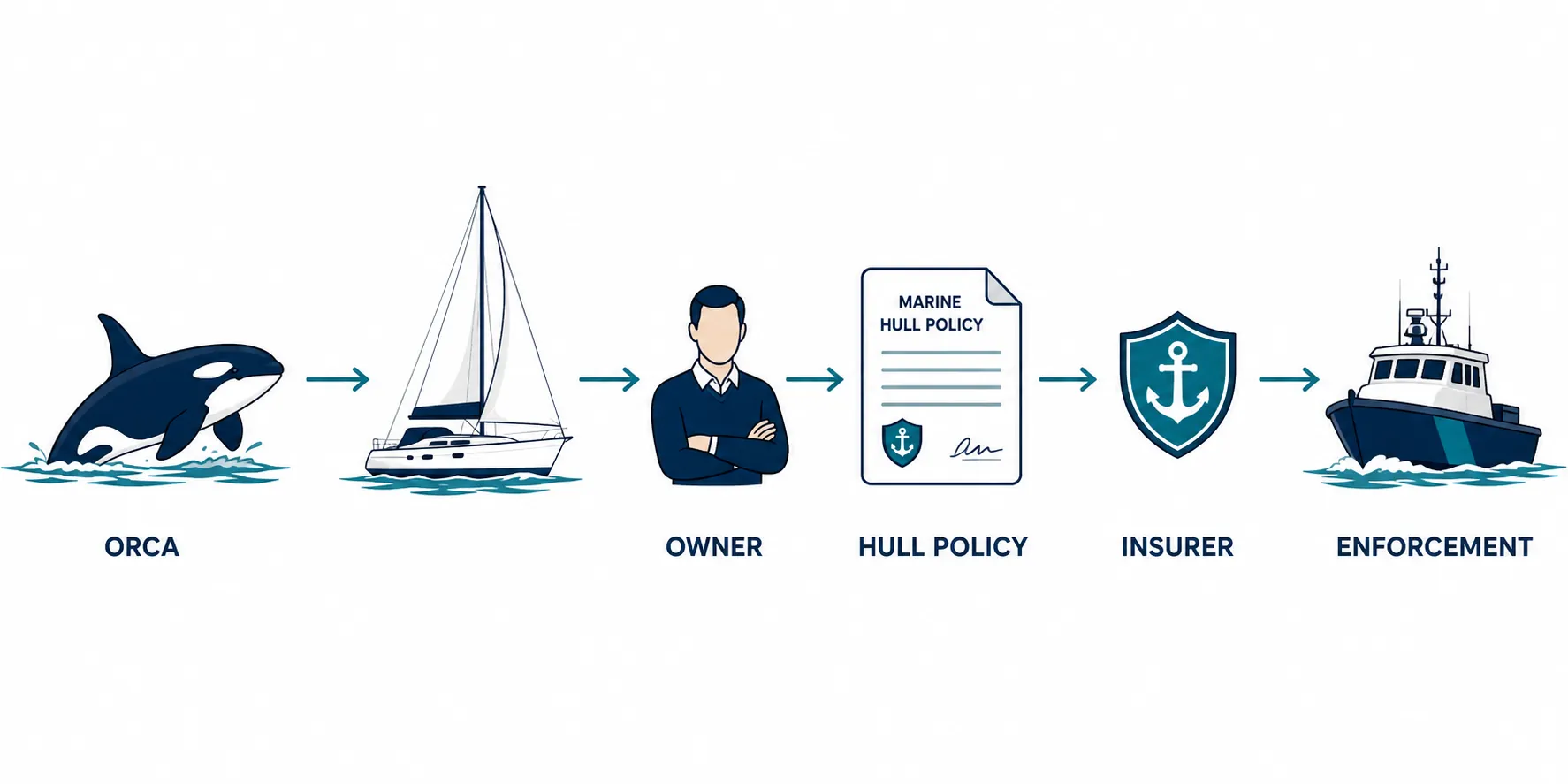
The incident numbers matter, but only if they are date-stamped. Public summaries describe more than 500 Iberian orca-vessel interactions and more than 250 damaged vessels since 2020, with no reported human injuries; those same summaries have not always counted sinkings the same way, with Wikipedia summarizing roughly 500 interactions and four sinkings through 2023, Outside Online describing roughly 600 boats and five sinkings by mid-2024, and the February 2024 Madrid workshop referring to six sinkings before later 2025 losses pushed commonly cited totals to at least seven by October 2025.[1][2][3]
The Cruising Association’s reported-interaction data gives a more claims-like view of severity. Of 154 reported interactions in its library, 24.7% required extensive repair and 21.7% required towing.[4] Those percentages do not make every passage through Iberian or Gibraltar waters an insurance event. They do explain why the question is no longer academic for underwriters, charter operators, and owners whose rudders are the point of contact.
The empty defendant column
If the question is “who can I sue,” the practical answer is usually nobody. A wild orca is not a legal person. It does not own assets, carry liability insurance, owe a navigational duty, or become a maritime defendant because it damaged a rudder. The animal is the cause of the physical loss, not a party who can be served.
Nor do the materials reviewed identify a coastal-state compensation scheme that pays yacht owners for wildlife-caused property damage in these interactions. A state may regulate navigation, issue guidance, restrict conduct toward protected animals, or investigate unlawful deterrence. That is different from being a strict-liability payor for every wild-animal casualty inside or near its waters.
The same distinction matters inside the owner’s own operation. A skipper may have questions to answer if the vessel ignored routing guidance, violated charter instructions, failed to report, or used unlawful deterrents. But the mere fact that an orca damaged the yacht does not supply a human tortfeasor. If a charter dispute exists, it will usually sound in contract, seaworthiness, route planning, disclosure, or instructions to guests and crew—not in an invented liability of the animal.
No primary court order in the reviewed materials decides an orca-specific yacht-damage liability claim. The no-liability conclusion here is therefore a doctrinal synthesis: wild-animal causation, absent a responsible human act or a compensation statute, does not itself create a recoverable maritime defendant. That is a narrower and more useful answer than pretending that an unusual casualty has already produced settled case law.
Insurance is the real recovery route, and the wording is not uniform
Once the defendant column is empty, the file moves to hull insurance. That is where outcomes can diverge sharply between two owners with the same damage. One owner may have an all-risks or named-perils hull policy that treats the event as a covered collision or peril of the sea. Another may discover a marine-life exclusion, a navigation warranty problem, or a reporting condition that makes the loss harder to recover.
The reassuring side of the market is real. Practical Boat Owner reported that Stoneways Marine treated orca damage as “collision with a mammal — a peril of the sea” and said it did not plan to exclude such damage; the same report said Haven Knox-Johnston’s All Weather policy would respond to orca damage.[5] Bishop Skinner, in guidance produced with reference to RYA material, states that orca-related damage is covered under its standard policy wording, subject to the terms of the individual contract.[6] Yachts Croatia describes similar CASCO practice in which orca damage may be covered where the policy wording is broad enough and no exclusion applies.[7]
That does not make coverage automatic. The counter-evidence is less formal, but it is exactly the kind of evidence boat owners meet first: wording in their own documents. A YBW Forum thread reports a marine-life exclusion in policy language, and the Outside Online author described finding a similar exclusion in his own policy.[8][2] Those examples do not establish a litigated rule. They do show why a casual assurance that “insurance covers it” is too broad.
No litigated ruling in the reviewed materials upholds or rejects a marine-life exclusion in an orca claim. That leaves the legal risk where insurance lawyers expect it to be: in the contract wording. The decisive clause may not say “orca.” It may say “marine life,” “animal,” “collision,” “perils of the sea,” “latent defect,” “wear and tear,” “consequential loss,” “navigation limits,” or “reasonable precautions.”
| Policy point | Why it matters in an orca claim |
|---|---|
| Insuring clause | Determines whether the starting grant is broad enough to include collision, impact, or accidental physical loss. |
| Marine-life or animal exclusion | Can remove precisely the peril the owner thought was insured. |
| Navigation limits and cruising area | Can matter if the yacht was in Iberian, Strait of Gibraltar, Portuguese, Spanish, or offshore waters outside declared limits. |
| Reasonable precautions clause | May become relevant if the skipper used a method known to be unlawful or contrary to official guidance. |
| Salvage, towing, and sue-and-labor | Often decide how much of the expensive response is recoverable even where hull damage is covered. |
| Notice and survey requirements | Late notice, undocumented damage, or repair before inspection can create avoidable coverage fights. |
| Charter or commercial use | May change warranties, deductibles, crew obligations, and who must give notice. |
The RYA’s guidance lands in the same practical place: skippers and owners should check their insurance position before navigating areas where interactions have been reported.[9] That advice is sometimes treated as seamanship housekeeping. It is really the core recovery question. If the boat is lost and the policy excludes marine life, the fact that the casualty was frightening, unusual, and widely reported does not create a substitute defendant.
What counsel should ask for before giving a coverage view
- The full policy wording, not only the certificate or declarations page.
- All endorsements, cruising-area extensions, and renewal changes.
- The precise position, time, sea state, and passage plan at the first contact.
- Photographs, video, survey reports, tow invoices, salvage invoices, and yard estimates.
- The skipper’s log of actions taken during the interaction, including any deterrent or attempted deterrent.
- Any reports made to coast guard, maritime police, insurer, charter company, flag state, or wildlife authority.
- For chartered yachts, the charter agreement, safety briefing materials, route instructions, and allocation of insurance deductibles.
That list is not paperwork for its own sake. It separates three questions that are easily blurred after a dramatic casualty: whether the hull damage occurred as described, whether the policy grants cover, and whether anything the humans did created a separate exclusion, defense, or regulatory problem.
The skipper’s response can create the liability the orca did not
The legal file changes when the human response becomes the event. A yacht owner may have no defendant for the rudder damage, but a skipper who strikes, shoots at, harasses, chases, or otherwise harms a protected animal can give enforcement authorities a much cleaner target: a person, a vessel, conduct, witnesses, video, and a statute.
The February 2024 Madrid workshop conclusion is important because it removes a common excuse. The experts convened there concluded that harmful deterrents are both illegal and ineffective, and may reinforce the behavior they are meant to stop.[3] That is not a moral aside. If a deterrent is officially characterized as unlawful and counterproductive, it becomes harder to defend later as an emergency measure, a reasonable precaution, or prudent seamanship.
RYA guidance keeps the skipper in the middle of both duties: protect the safety of crew and vessel, and comply with wildlife law.[9] Those duties can be uncomfortable in real time, especially if steering is compromised. They are not solved by choosing the most aggressive response available. The post-incident question will be what the skipper did, why it was necessary, whether official guidance was followed, and whether the animal was harmed or harassed.
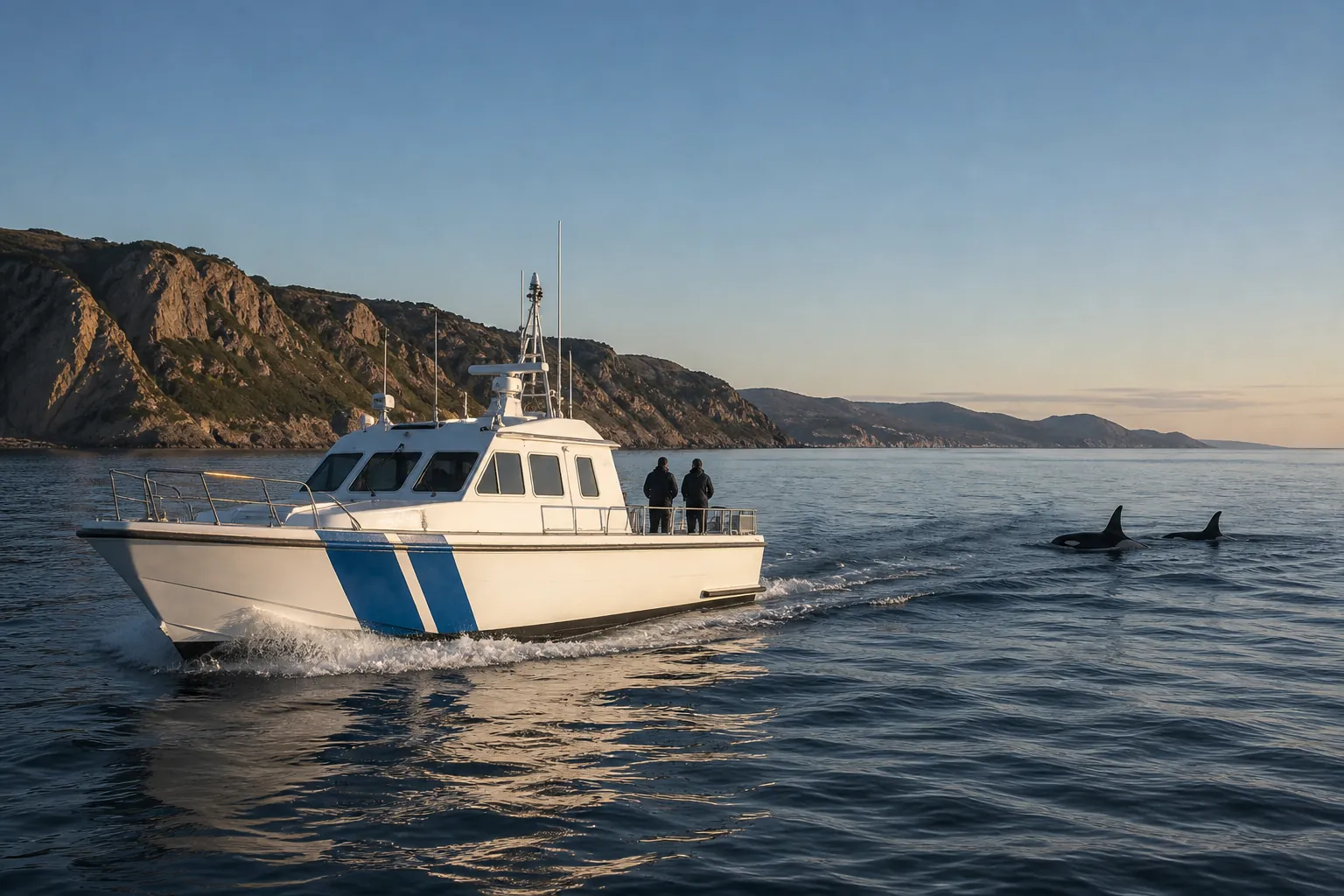
The enforcement signals are already visible, though they are not all orca-yacht damage cases. OceanCare reported that Spain’s SEPRONA identified and searched the crew of the sailing yacht NAKULA after video appeared to show sailors shooting at orcas in Spanish waters on August 17, 2023; the reviewed materials do not confirm the outcome of that investigation.[10] The limit matters. A search and identification are not a conviction. But they are enough to show that a skipper’s response can become a wildlife-law matter rather than an insurance footnote.
Other jurisdictions point in the same direction. NOAA Fisheries reported a 2024 civil-penalty settlement in which a Bellingham, Washington boater paid $1,000 after driving through a pod of killer whales; the agency described an initial $300 settlement offer and a later $3,000 notice before the $1,000 settlement.[11] In New Zealand, the Department of Conservation issued a $600 infringement after a man body-slammed an orca.[12] Neither matter decides Iberian yacht coverage. Both are useful reminders that authorities do not need a sunken vessel to treat human conduct around orcas as enforceable conduct.
Spanish protection context points the same way. El País reported in 2020 that Spain’s ecological transition ministry prohibited measures that could kill, capture, chase, or disturb the orcas involved in these interactions.[13] The conservation-number materials are not perfectly aligned—different sources describe the Iberian subpopulation and listing dates differently—but the risk point is not dependent on choosing between roughly 40 and roughly 50 animals. A small, protected population makes the enforcement posture less forgiving, not more.
This is also where insurance and wildlife law meet. A skipper who uses a harmful deterrent may not only face an authority’s investigation. The same conduct can complicate a hull claim if the policy contains reasonable-care language, unlawful-acts wording, pollution or weapons exclusions, or conditions requiring compliance with law. Whether an insurer could successfully rely on those clauses would turn on the policy and facts. The avoidable point is that the skipper has supplied the insurer and the regulator with a new issue that did not exist when the animal first touched the rudder.
What the liability answer leaves standing
After an Iberian orca interaction, the owner’s financial recovery is mainly a hull-policy question. The useful legal work is to read the policy before the passage, preserve the evidence after the casualty, give timely notice, and avoid turning a coverage file into a wildlife-enforcement file.
That leaves a clean but unsentimental answer. The orca does not pay. The coastal state is not identified here as a compensation payor. The skipper does not become liable merely because a wild animal caused damage. The insurer pays only if the policy says so. And the person most able to create new liability is often the frightened human on deck who decides, in the wrong few seconds, to harm a protected animal.
References
- Iberian orca attacks, Wikipedia
- Orca Boat Attacks, Outside Online
- Recommendations to avoid orca interactions in Iberian waters, OceanCare
- Orca Interaction and Deterrent Library, The Cruising Association
- Boat insurance: does your policy cover you for orca damage?, Practical Boat Owner
- Orca attacks: what you need to know and how to protect your boat, Bishop Skinner Marine
- Orca attacks covered by insurance, Yachts Croatia
- Insurance exclusion marine life, YBW Forum
- RYA Orca Guidelines, Royal Yachting Association
- Sailors shoot at orcas, OceanCare
- Boater Drove Through Pod of Killer Whales. Turns Out, Wildlife Videographer Was Filming, NOAA Fisheries
- Orca body slam shocks DOC, leads to infringement fine, New Zealand Department of Conservation
- Why killer whales are targeting boats in northwestern Spain, El País, 2020-09-29
Related records
Tool profile
Browse tool evaluations →Governing regulation
Browse the obligations tracker →Preventive workflow
Browse verification workflows →
Report a correction or tip
Spotted an outdated figure, a misstated fact, or a ruling this case record should reflect? Public comments are disabled for this content given the professional cost of a misreported case outcome, penalty amount, or rule text — use the structured correction channel instead.
Report a correction or tip for this record →