
The PCAC Peptide Vote Didn't Reduce Hims' Legal Exposure
The PCAC's July 2026 peptide recommendation sent Hims stock up, but the non-binding advisory vote does not alter the company's compounding enforcement risk. This entry breaks down the vote's procedural limits, the ongoing FDA GLP-1 crackdown, and why the market reaction may overstate the near-term regulatory change.
- Jurisdiction
- US-Federal
- Court
- U.S. Food and Drug Administration
- AI tool named
- None (compounding peptides)
- Ruling date
- Jul 24, 2026
- Source document
- View primary court order ↗
- Last verified
- Jul 24, 2026
Lex Machina Review is an independent risk-tracking and reference resource. Nothing on this site is legal advice, and using it does not create an attorney-client relationship. Every record is reviewed against primary sources but may not reflect the most current status of a matter — always verify directly against the cited court order, rule text, or a licensed attorney before relying on it.
Companion explanation — secondary to the source document above
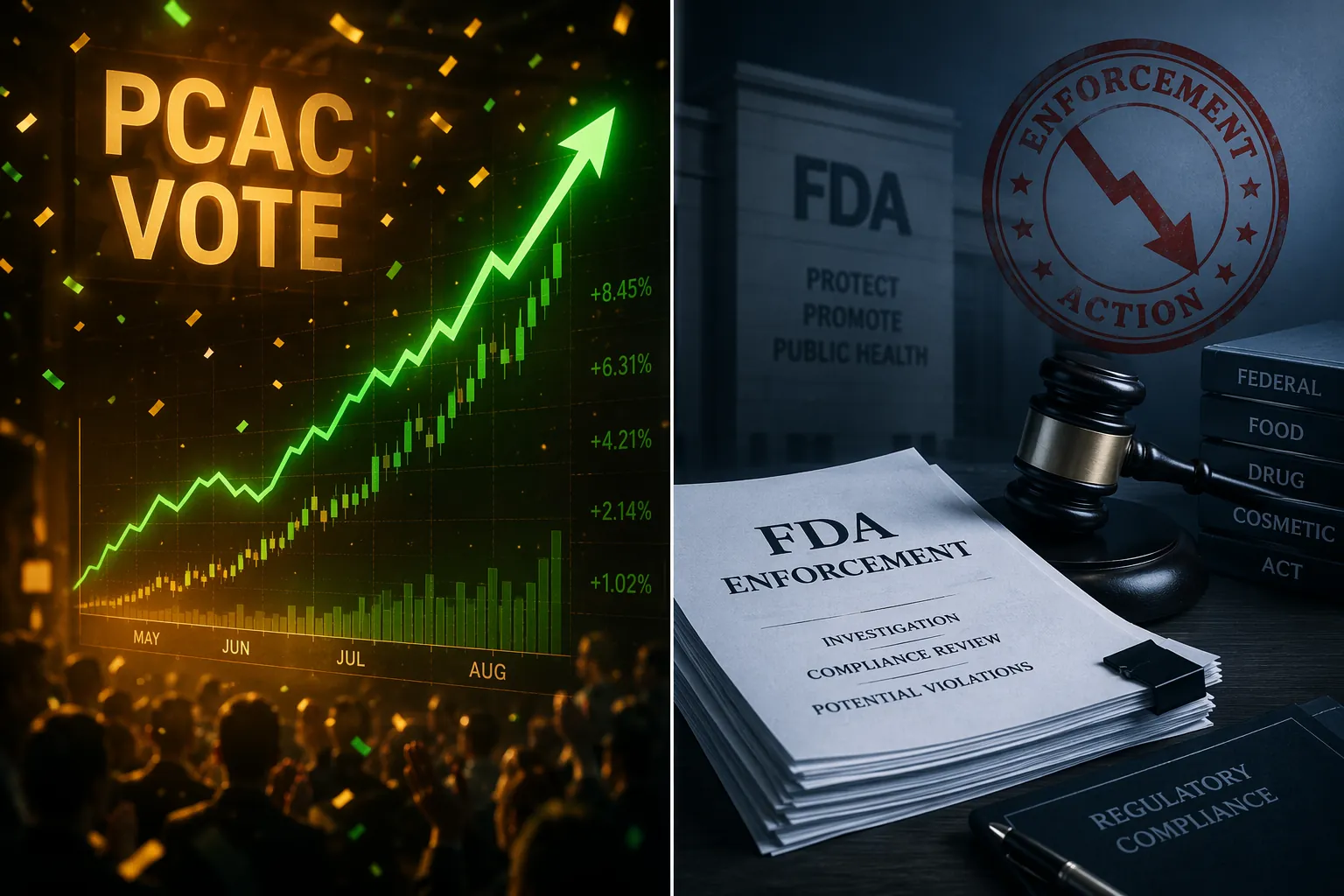
Hims & Hers Health got the kind of market reaction that makes legal departments nervous: an FDA advisory committee voted favorably on several compounded peptides, and HIMS shares rose about 7.9% on July 23, 2026. The legal event was narrower. The Pharmacy Compounding Advisory Committee recommended BPC-157 and KPV for Category 1 treatment by an 8-6-1 vote, with favorable recommendations also reported for MOTS-c and TB-500; Day 2 voting on Emideltide, Semax, and Epitalon was still incomplete as of July 24, 2026.[1][2]
That recommendation may matter later. It does not clear Hims’ current compounding posture now. The exposure most relevant to Hims is still the FDA’s GLP-1 enforcement campaign, including an unresolved September 2025 warning letter, a February 2026 agency announcement naming Hims, and an April 2026 proposal to exclude semaglutide, tirzepatide, and liraglutide from the 503B bulks list.[3][4][5]
The Risk Digest
| Item | What Happened | Legal Weight |
|---|---|---|
| PCAC peptide vote | Committee recommended several peptides, including BPC-157 and KPV, for Category 1 treatment | Advisory only |
| HIMS stock reaction | Shares rose about 7.9% on July 23, 2026 | Market pricing of optionality, not FDA clearance |
| Current Hims exposure | FDA GLP-1 compounding scrutiny remains active | Separate enforcement and rulemaking track |
| Rulemaking status | FDA still must proceed through formal process before a final bulks-list change | Months-to-years risk, not immediate authorization |
| Open procedural fact | Day 2 PCAC results were not complete as of July 24, 2026 | Record still incomplete |
The cleanest way to brief the event is to keep the dockets separate. A favorable peptide recommendation is not the same thing as a final 503A bulks-list rule. A 503A advisory vote is not the same thing as a 503B bulk-drug policy. And neither one resolves an FDA warning letter or a named enforcement campaign.
The Timeline Matters More Than The Rally
The regulatory record did not begin with the July peptide meeting. In September 2025, FDA issued a warning letter to Hims & Hers Health Inc. d/b/a Hers. That letter remains part of the company’s enforcement backdrop unless and until the agency’s concerns are resolved, narrowed, or overtaken by later action.[3]
In February 2026, FDA Commissioner Marty Makary announced that the agency intended to take action against non-FDA-approved GLP-1 drugs and publicly named Hims in that announcement. The agency described a broader enforcement effort involving more than 30 warning letters related to unapproved GLP-1 drugs.[4]
In March 2026, Hims announced a partnership with Novo Nordisk. Commercially, that was a meaningful move toward a branded pathway in a market shaped by obesity-drug demand. Legally, it did not erase the earlier enforcement record or transform compounded GLP-1 products into FDA-approved drugs.
Then, on April 30, 2026, FDA proposed excluding semaglutide, tirzepatide, and liraglutide from the 503B bulks list. That proposal concerns GLP-1 active ingredients that sit much closer to Hims’ current compounding risk than the July PCAC peptide recommendations do.[5]
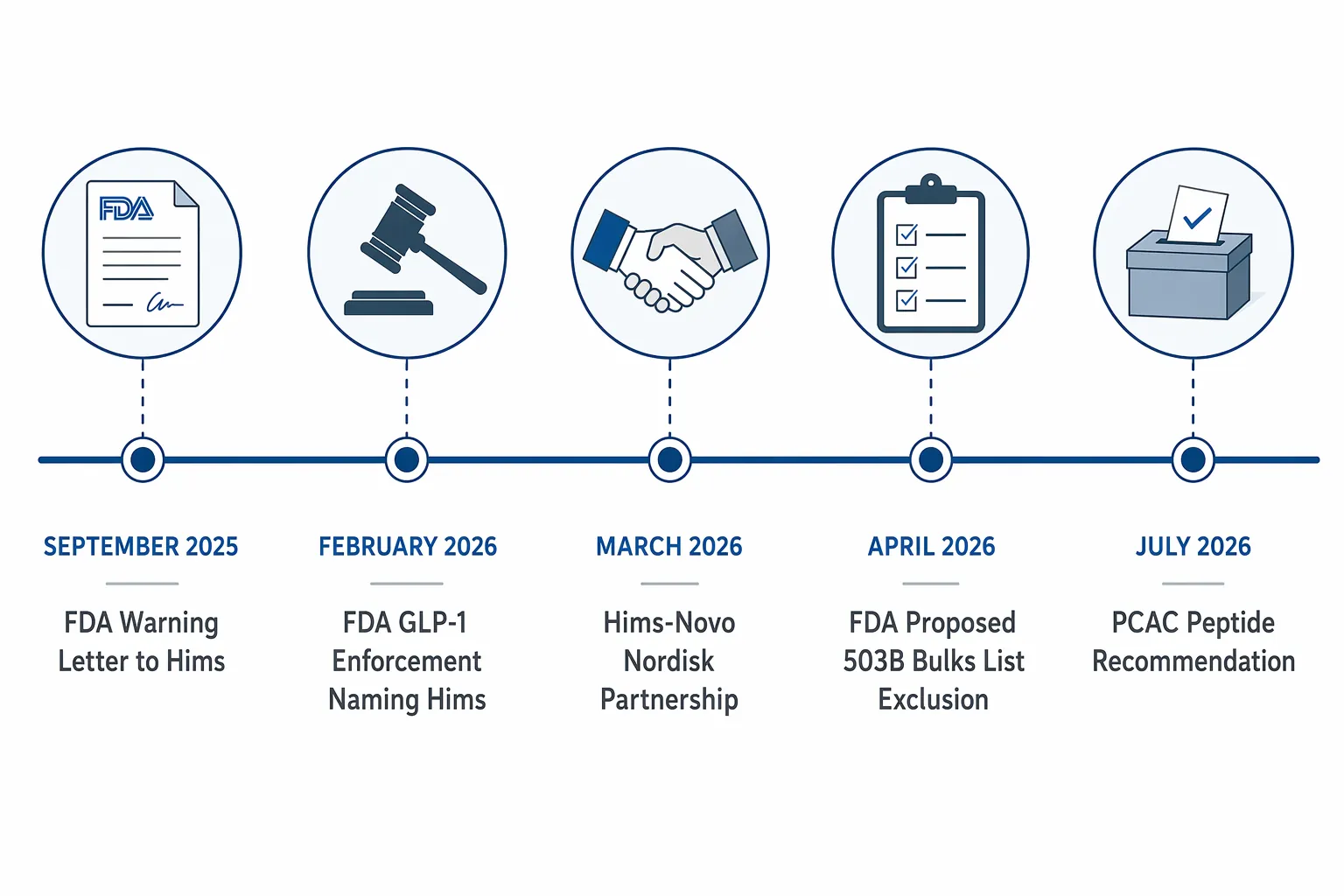
Only after that sequence comes the July 2026 PCAC vote. The meeting may become important for certain peptides if FDA later accepts the recommendation and completes rulemaking. It does not travel backward through the record to neutralize a GLP-1 enforcement campaign.
What The PCAC Vote Actually Does
Under 21 U.S.C. § 353a(c), FDA consults the Pharmacy Compounding Advisory Committee in connection with identifying bulk drug substances that may be used in compounding under section 503A. The committee’s role is consultative. It can recommend; it does not itself add a substance to the final list or immunize commercial conduct from enforcement.[6]
The next step is not a trading headline but an administrative process. FDA’s regulation at 21 C.F.R. § 216.23 sets out the process for developing the list of bulk drug substances that may be used in compounding under section 503A. That process includes agency evaluation and rulemaking mechanics that are separate from the committee vote.[6]
The historical pace is not fast. LumaLex Law’s analysis of the July 2026 PCAC peptide meeting notes that only about 10 substances have completed the full 503A bulks-list rulemaking process historically. That figure is not a prediction about these peptides, but it is a useful brake on any assumption that an advisory recommendation becomes commercial authorization on a near-term schedule.[6]
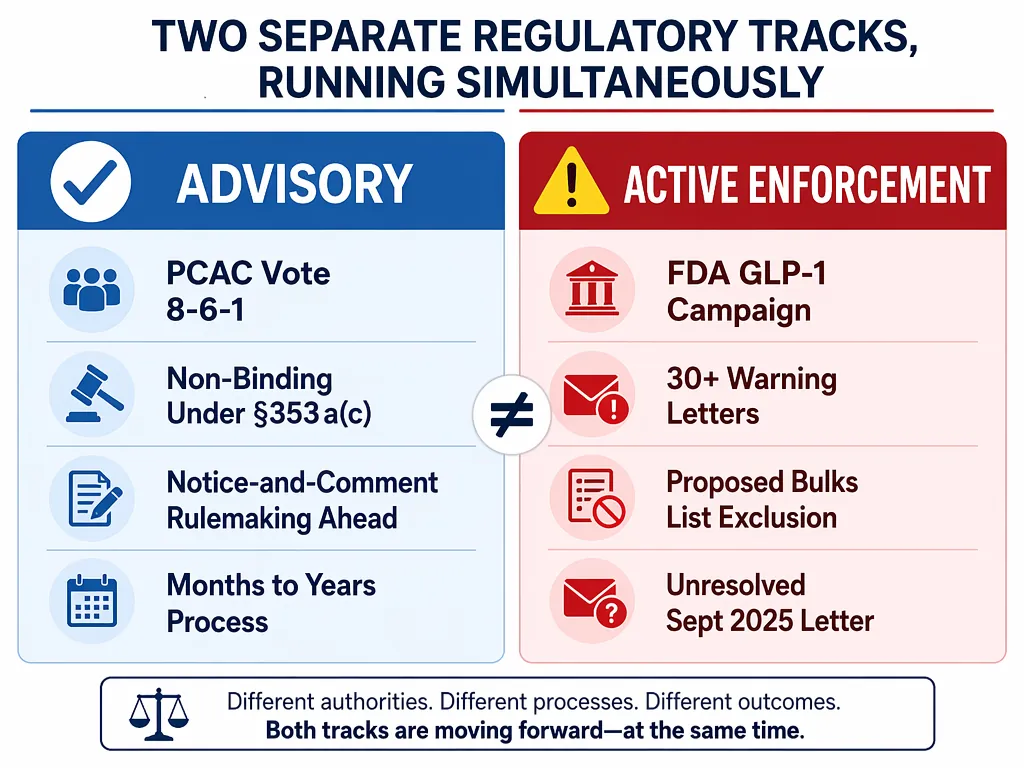
FDA also is not bound to adopt the committee’s recommendation. The agency may diverge from advisory advice, and public-health considerations can still shape the final rulemaking posture. For counsel, that means the adjective “non-binding” is not cosmetic. It is the difference between an event that changes the administrative record and an event that changes legal exposure.
Why The GLP-1 Track Is Different
The July meeting concerned peptides such as BPC-157, KPV, MOTS-c, and TB-500. The FDA actions weighing on Hims’ current compounding business concern GLP-1 drugs, including semaglutide, tirzepatide, and liraglutide. Those are not interchangeable regulatory buckets.
The distinction between 503A and 503B matters as well. Section 503A is the patient-specific pharmacy compounding pathway. Section 503B concerns outsourcing facilities. FDA’s April 2026 proposal to exclude semaglutide, tirzepatide, and liraglutide from the 503B bulks list is a different action from a PCAC recommendation about which peptides may be eligible for 503A treatment.[5]
That is where the market narrative can become legally sloppy. A company may plausibly benefit from future peptide optionality while still carrying unresolved GLP-1 enforcement risk. Both propositions can be true at the same time.
For a narrower look at one peptide, the site’s article “BPC-157 Compounding Remains Risky Despite PCAC Vote” addresses BPC-157-specific compounding risk. The Hims question is broader because the company’s stock reaction was tied to a multi-peptide docket while its active regulatory exposure sits in a GLP-1 enforcement file.
The Market Is Pricing Optionality
The stock move was not irrational simply because it outran the legal consequence. Markets often price optionality before final agency action. HIMS had already risen more than 20% in June 2026 ahead of the PCAC meeting, and the July 23 move extended that pre-meeting enthusiasm.[2]
Analyst caution makes the split visible. Leerink maintained a $25 price target, while Morningstar assigned Hims a “Very High” uncertainty rating. Those are not enforcement conclusions, but they do show that the equity story remains sensitive to unresolved regulatory and commercial assumptions.[2]
The most aggressive number in circulation is a speculative estimate from FirstWave Fund’s CEO that Hims could generate $10 billion to $19 billion in annual peptide revenue by 2030 at 4% to 5% market share. That estimate is useful only as a window into bullish optionality. It should not be treated as an independent forecast of FDA action, a measure of current revenue, or evidence that GLP-1 enforcement risk has declined.[2]
The Conflict Question Is Real, But Not Dispositive
Conflict-of-interest reporting around the PCAC meeting deserves attention because advisory credibility affects how comfortably FDA can rely on the committee record. AP/Healio reported that more than six new PCAC members had financial ties to the peptide industry.[7]
That reporting does not, by itself, invalidate the vote. It also does not create a new legal defense for Hims in the GLP-1 matter. The more precise consequence is procedural: if FDA leans on the advisory record in later rulemaking, the composition and disclosures of the committee may become part of the credibility debate around that rulemaking.
Marketing Risk Has Its Own File
The FDA dispute also is not limited to which bulk substances can be compounded. Marketing and promotion matter. Frier Levitt has flagged Thompson v. Western States Medical Center, 535 U.S. 357 (2002), as a possible First Amendment limit on FDA enforcement against compounding marketing, in the context of FDA warning letters involving Hims, Novo Nordisk, and compounded GLP-1 products.[8]
That argument may matter in a litigated posture. It does not mean a promotional claim becomes safe because an advisory committee favored unrelated or only partially overlapping peptide candidates. The risk officer’s task is still to separate product status, compounding pathway, advertising claim, and enforcement history before the commercial team turns a vote into a campaign.
The Practical Read As Of July 24, 2026
The July PCAC vote improves the procedural record for certain peptides if FDA later follows the recommendation and completes the required rulemaking. It may support a bullish optionality story for companies that can build compliant offerings around whatever final list emerges.
It does not reduce Hims’ current FDA compounding enforcement risk. The GLP-1 campaign remains active, the September 2025 warning letter remains part of the record, the April 2026 503B proposal points in the opposite direction for semaglutide, tirzepatide, and liraglutide, and Day 2 PCAC results were still incomplete as of July 24, 2026.[1][3][4][5]
References
- July 23-24, 2026 Meeting of the Pharmacy Compounding Advisory Committee, U.S. Food and Drug Administration
- Market reports on HIMS July 2026 stock reaction, June 2026 run-up, analyst price target, uncertainty rating, and FirstWave Fund peptide-revenue estimate, Investing.com, Investor's Business Daily, Stocktwits, Yahoo Finance
- Hims & Hers Health Inc. dba Hers - 716825 - 09/09/2025, U.S. Food and Drug Administration, September 9, 2025
- FDA Intends to Take Action Against Non-FDA-Approved GLP-1 Drugs, U.S. Food and Drug Administration
- FDA Proposes to Exclude Semaglutide, Tirzepatide, and Liraglutide from the 503B Bulks List, U.S. Food and Drug Administration
- The July 2026 PCAC Peptide Meeting, LumaLex Law, July 15, 2026
- FDA advisory committee for peptides stocked with conflicts of interest, Healio, July 1, 2026
- FDA Warning Letters, Hims, Novo Nordisk & Compounded GLP-1, Frier Levitt
Related records
Tool profile
Browse tool evaluations →Governing regulation
Browse the obligations tracker →Preventive workflow
Browse verification workflows →
Report a correction or tip
Spotted an outdated figure, a misstated fact, or a ruling this case record should reflect? Public comments are disabled for this content given the professional cost of a misreported case outcome, penalty amount, or rule text — use the structured correction channel instead.
Report a correction or tip for this record →