
The PGA Tour's Anti-Doping Waiver Has Limits on Judicial Review
This article examines the PGA Tour's contractual waiver of judicial review in anti-doping disputes. Using Singh and Barron case law, it shows that the clause bars direct challenges to sanction decisions but leaves room for procedural and good-faith claims to survive.
- Jurisdiction
- United States
- Court
- New York State Supreme Court
- AI tool named
- None
- Ruling date
- Jul 1, 2026
- Source document
- View primary court order ↗
- Last verified
- Jul 30, 2026
Lex Machina Review is an independent risk-tracking and reference resource. Nothing on this site is legal advice, and using it does not create an attorney-client relationship. Every record is reviewed against primary sources but may not reflect the most current status of a matter — always verify directly against the cited court order, rule text, or a licensed attorney before relying on it.
Companion explanation — secondary to the source document above
A legal analysis of the PGA Tour anti-doping policy after a six-month ban has to start in a less dramatic place than the suspension announcement. In July 2026, Trey Mullinax was reported to have received a six-month anti-doping sanction; his public statement acknowledged that “my lack of knowledge is not an excuse” and said he was evaluating his options. [1]
That last phrase is where the legal issue lives. The harder question is not whether a court would re-decide the anti-doping finding. The harder question is whether the PGA Tour’s disciplinary documents prevent every courthouse claim connected to the process, or only a direct attempt to overturn the final sanction.
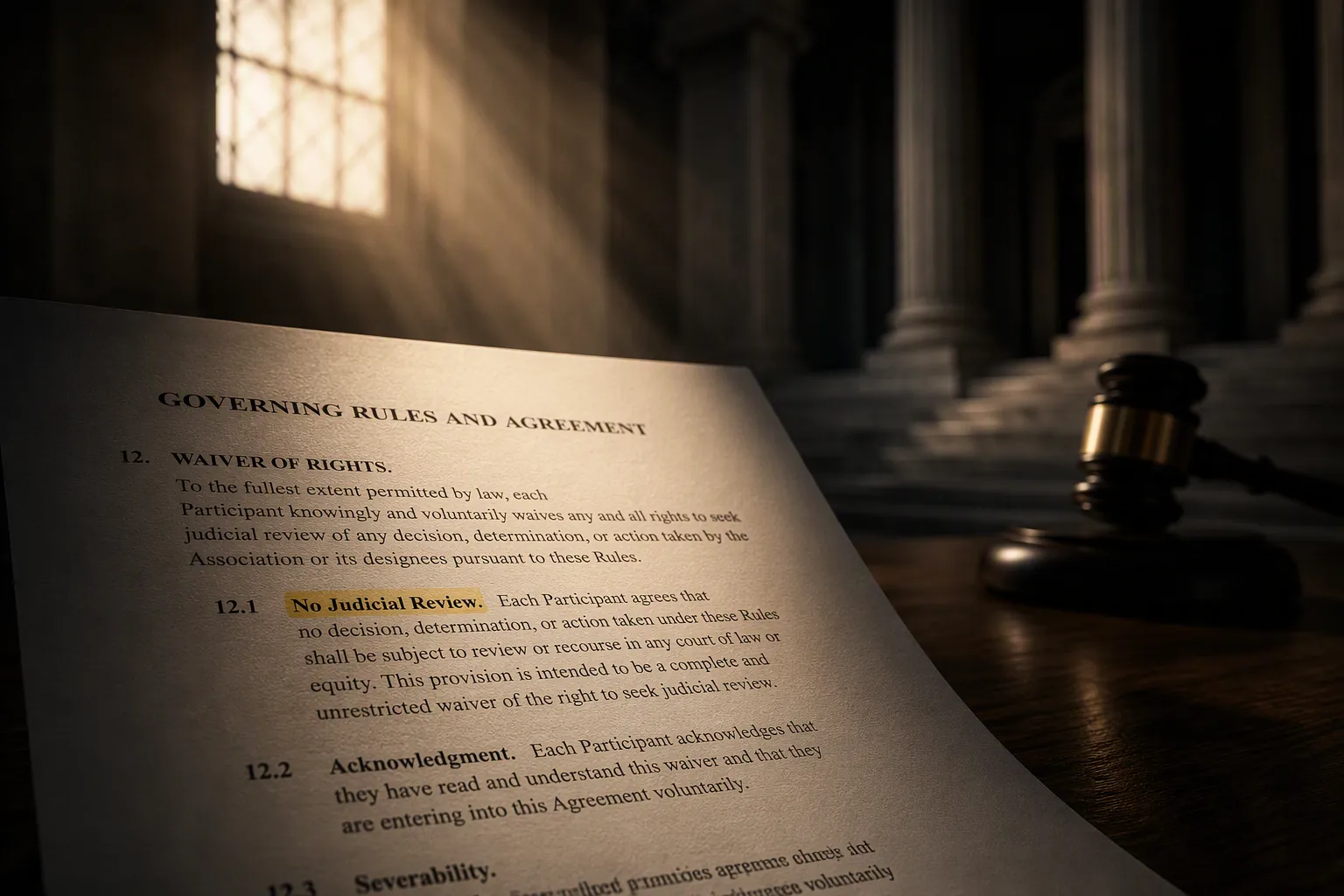
The clause usually described as the obstacle is the Tour’s “no judicial review” language. The 2026 Anti-Doping Program Manual PDF is not treated here as independently verified text; the relevant provisions are being addressed through court decisions and secondary reporting that quote or describe the Tour’s program. The key formulation reported in those materials is that players “expressly waive the right to seek judicial review of final decisions under the Program.” [2]
That wording matters. “Final decisions” is narrower than “all disputes,” “all claims,” or “all litigation.” A lawyer reading the clause for motion practice should separate a barred merits challenge from a claim that attacks the way the Tour administered the contractual process.
The waiver is strongest against a direct appeal of the sanction
If a player files a complaint asking a court to decide that the Tour got the anti-doping result wrong, the waiver gives the Tour a serious early defense. The Tour can frame the suit as exactly what the member agreed not to bring: judicial review of a final disciplinary decision.
That is not a small thing. Private sports bodies use closed disciplinary systems because finality has operational value: schedules continue, eligibility decisions take effect, and other competitors are not asked to wait while a judge becomes an anti-doping tribunal. Courts often take private-association agreements seriously, especially where the member accepted internal procedures as a condition of participation.
But a strong defense is not the same as an absolute bar. The useful question is claim design. Is the plaintiff asking the court to review the correctness of the sanction, or alleging that the Tour violated a separate legal duty while reaching or publicizing it?
| Claim theory | Likely waiver problem |
|---|---|
| The player asks the court to overturn the final anti-doping decision because the Tour was wrong on the merits. | The waiver is at its strongest; this looks like judicial review of a final decision. |
| The player alleges the Tour manipulated, delayed, or inconsistently administered the process in bad faith. | The waiver is weaker; the claim is aimed at process and contractual performance, not simply the correctness of the sanction. |
| The player alleges selective enforcement or unequal treatment under the Tour’s own rules. | The viability depends on pleading and governing law, but it is not automatically the same as a merits appeal. |
| The player alleges breach of the implied covenant of good faith and fair dealing. | Singh shows that this type of claim can survive the waiver at least past an early dismissal attempt. |
Singh is the load-bearing case
Vijay Singh’s lawsuit is the reason the waiver cannot be described cleanly as a courthouse lock. Singh sued the PGA Tour after an anti-doping dispute involving deer-antler spray. At the trial-court stage, the Tour argued that the waiver barred his claims. The New York court did not accept the bluntest version of that argument. [2]
The court read the waiver as “limited to a waiver of the right to seek judicial review of final decisions” under the anti-doping program. It allowed Singh’s breach-of-implied-covenant-of-good-faith claim to proceed because that claim was directed at the Tour’s conduct in administering the program, not merely at obtaining judicial review of the final disciplinary decision. [2]
That distinction is not decorative. On a motion to dismiss, it can decide whether the case ends before discovery. A complaint that says, in substance, “the suspension was wrong” invites the Tour to point to the waiver. A complaint that says “the Tour had contractual discretion, but used that discretion in bad faith or ignored its own procedural commitments” occupies different ground.
The implied covenant theory is especially important because it does not require the court to sit as a substitute anti-doping panel. It asks whether one contracting party exercised discretion in a way that deprived the other of the benefit of the bargain. In a disciplinary system, that can include allegations about timing, notice, internal consistency, evidentiary handling, or disparate treatment. The plaintiff still has to plead and prove the claim. Singh only establishes that the waiver did not erase that category at the threshold.
That is the careful reading the clause demands. The Tour may have contracted for finality on the anti-doping decision. Singh does not show that it contracted out of every obligation to administer the process in good faith.
Barron raised the federal question without settling it
Doug Barron’s 2009 dispute is useful, but only if kept in its lane. Barron challenged a suspension connected to medically prescribed treatment and a therapeutic-use-exemption issue. The Tour relied on the anti-doping program’s waiver language, and the federal court had to confront the question whether that waiver could block the case. [3]
Barron does not supply a definitive enforceability rule. The matter proceeded through emergency-relief litigation and later resolved without a published appellate opinion squarely deciding the clause’s reach. It shows that the waiver defense appears quickly when a player goes to federal court. It does not show that the defense always wins. [3]
The medical-treatment and TUE posture also explains why anti-doping process claims can become more complicated than a simple positive-test narrative. Strict-liability concepts, therapeutic-use procedures, Commissioner discretion, and coordination with broader anti-doping bodies can all create procedural seams. Those seams do not guarantee a viable lawsuit, but they give pleading room that a pure merits appeal lacks.
The Singh settlement signals risk, not liability
Singh and the PGA Tour eventually settled in November 2018 after more than five years of litigation. The parties agreed to dismiss the case, and the terms were undisclosed. [4]
That settlement should not be converted into an admission. It does not tell us whether money changed hands, whether records were adjusted, whether both sides simply wanted finality, or whether trial risk drove the resolution. It does tell us something narrower: after the waiver defense failed to eliminate the good-faith claim at the pleading stage, the Tour did not obtain a public trial judgment or appellate ruling that would have made the clause categorically preclusive.
For future disputes, that absence matters. The Tour can cite the waiver. A plaintiff can cite Singh. Neither side can cite a controlling appellate decision holding that the clause bars every process-based claim arising from an anti-doping sanction.
Sparse public challenges do not prove the waiver is absolute
Publicly visible litigation is rare. Byeong Hun An, for example, received a three-month suspension in 2023 after the Tour said an over-the-counter cough medicine contained a banned substance; the public record described the sanction, not a lawsuit challenging it. [5]
Reporting has also described a small number of public PGA Tour anti-doping suspensions across the program’s history, including a nine-player count for the 2008–2026 period. [1]
That is context, not a dataset capable of doing more work. The Tour does not maintain a complete public discipline database, and undisclosed matters may exist. A low number of public lawsuits may reflect waiver pressure, reputational cost, settlement incentives, lack of appetite for discovery, or the merits of particular cases. It should not be treated as proof that the waiver would defeat every claim.
What survives is not an appeal by another name
The distinction is easy to overstate in both directions. A player cannot avoid the waiver by relabeling a merits challenge as “process.” If the requested relief requires the court to decide that the Tour’s final anti-doping decision was substantively wrong, the waiver problem remains central.
But the Tour also cannot make the word “final” do unlimited work. A claim alleging breach of the implied covenant, procedural irregularity, or selective enforcement may ask a different legal question: whether the Tour honored the limits of its own discretion. Singh is the clearest available example of that claim surviving the waiver. [2]
In practical pleading terms, the line looks like this: the court is unlikely to become a super-review panel for anti-doping science or sanction length; it may still hear a claim that the private association’s disciplinary machinery was administered in bad faith or in a way inconsistent with the contractual relationship.
The legal-risk answer
The PGA Tour’s anti-doping waiver is a serious defense. It is strong enough to make a direct judicial challenge to the correctness of a final anti-doping decision an uphill case, and often a poor one.
The available litigation history does not support the broader statement that the waiver categorically bars all lawsuits arising from an anti-doping dispute. Singh preserved a process-and-good-faith path. Barron raised the federal enforceability issue without producing a definitive answer. The Singh settlement ended the case without admissions or a public ruling on the full limits of the clause. [2][3][4]
For counsel, the unresolved points are the useful points: no appellate decision squarely forecloses process-based claims; Barron did not settle the federal question; the Tour’s public discipline record is incomplete; and undisclosed settlements cannot be read as findings of liability. The waiver narrows the courthouse door. It has not been shown to lock it.
References
- Trey Mullinax suspended six months for anti-doping violation, AP News, July 2026.
- Singh v. PGA Tour, Inc., FindLaw, 2014.
- Barron Awaits Ruling, Golf Digest, 2009.
- Singh, PGA Tour settle lawsuit, Golf Channel, November 2018.
- PGA TOUR statement regarding Byeong Hun An, PGA TOUR, 2023.
Related records
Tool profile
Browse tool evaluations →Governing regulation
Browse the obligations tracker →Preventive workflow
Browse verification workflows →
Report a correction or tip
Spotted an outdated figure, a misstated fact, or a ruling this case record should reflect? Public comments are disabled for this content given the professional cost of a misreported case outcome, penalty amount, or rule text — use the structured correction channel instead.
Report a correction or tip for this record →