
Can PG&E Be Sued for PSPS Power Shutoff Damages?
The California Supreme Court's 2023 Gantner ruling bars most tort claims for PG&E Public Safety Power Shutoff damages, but several legal pathways—including pre-shutoff negligence and inverse condemnation for wildfire—remain available. This article maps the limits of PG&E's liability shield and the remedies still open to customers and claimants.
- Jurisdiction
- California
- Court
- California Supreme Court
- AI tool named
- None
- Ruling date
- Jan 1, 2023
- Source document
- View primary court order ↗
- Last verified
- Jul 30, 2026
Lex Machina Review is an independent risk-tracking and reference resource. Nothing on this site is legal advice, and using it does not create an attorney-client relationship. Every record is reviewed against primary sources but may not reflect the most current status of a matter — always verify directly against the cited court order, rule text, or a licensed attorney before relying on it.
Companion explanation — secondary to the source document above
Last verified July 30, 2026. For searches about PG&E power shutoff legal liability, the first answer is now blunt: after Gantner, most tort claims seeking damages because PG&E de-energized power during a Public Safety Power Shutoff are preempted by Public Utilities Code § 1759. That does not mean every PG&E-related loss belongs in the trash. It means the file has to be sorted before anyone starts talking about liability.
This is a claim-screening map, not advice on any individual loss. The relevant question is not “Can PG&E be sued?” in the abstract. The question is whether the pleaded theory attacks the CPUC-supervised de-energization decision itself, or instead invokes a different duty, a different injury, or a different remedy channel.
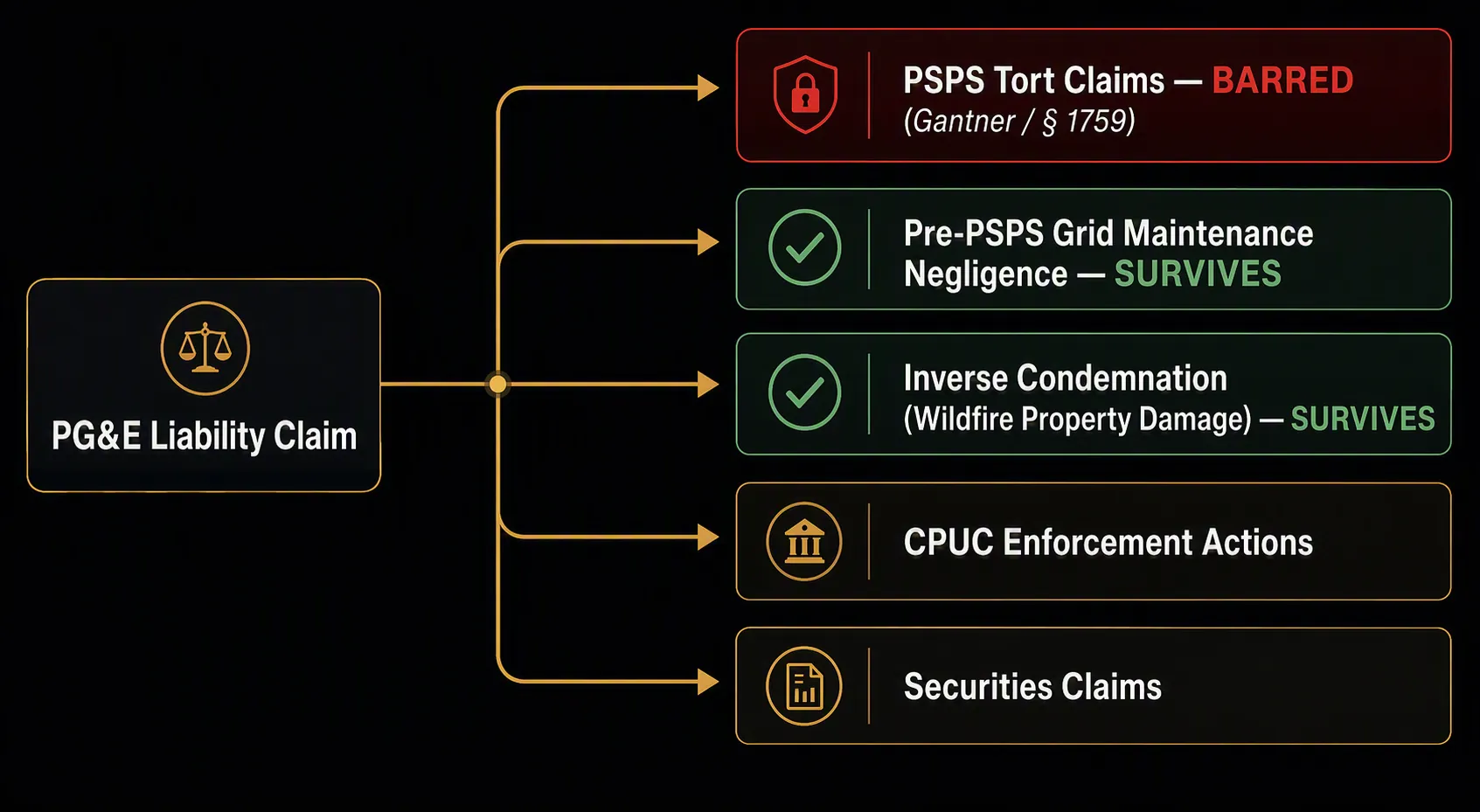
| Claim route | Screening consequence after Gantner |
|---|---|
| Direct tort claim for PSPS outage damages | Usually barred if the claim would impose damages for the shutoff decision itself. |
| Pre-PSPS grid-maintenance negligence | Potentially distinct if the duty pleaded is maintenance conduct before the shutoff, not the de-energization order. |
| Wildfire property damage / inverse condemnation | Separate lane; Gantner did not erase wildfire-caused property exposure. |
| CPUC enforcement or regulatory consequences | Separate public-regulatory channel, not a private damages workaround. |
| Securities claims | Investor-remedy lane, not compensation for customer outage losses. |
What Gantner actually bars
Gantner arose from PG&E’s 2019 PSPS blackouts and a proposed class action seeking about $2.5 billion in damages. The California Supreme Court rejected the suit under § 1759, applying the Covalt preemption framework and concluding that private damages liability for those shutoff decisions would interfere with the California Public Utilities Commission’s comprehensive supervision of de-energization decisions.[1][2]
That holding matters because it closes the most attractive ordinary tort route: a customer or business cannot simply plead negligence, nuisance, or related tort labels and ask a superior court jury to award damages because PG&E shut off power during a PSPS event. If the requested damages would punish or second-guess the very decision the CPUC regulates—whether, when, and where to de-energize—the claim runs into § 1759.
The preemption analysis is not a mystical utility-law fog. It is a jurisdictional interference rule. Under the Covalt test described in the Gantner summaries, the court asked whether the CPUC had authority over the subject matter, whether the CPUC had exercised that authority, and whether the superior court damages action would hinder or interfere with the CPUC’s regulatory program. On the 2019 PSPS damages theory, the answer to the third question was yes.[1][2]
One point should not be overread. PG&E also raised an alternative defense under Tariff Rule 14, but the California Supreme Court did not reach that argument. The operative Gantner shield, for claim-screening purposes, is the § 1759/Covalt interference holding, not an appellate endorsement of every tariff-based immunity argument PG&E may raise later.[3]
Counsel still should read the opinion and docket materials before briefing. A defense-side victory summary is useful for orientation, especially when it is consistent with other published law-firm analyses, but it is not the pleading, the record, or the holding itself. The practical takeaway is narrower and stronger than most online summaries: Gantner is a serious bar to direct PSPS damages suits, not a universal release for every PG&E act before and after the shutoff.
The maintenance-negligence line is where many files are won or lost
The first surviving route is also the one easiest to plead badly. A claim framed as “PG&E should not have shut off my power” is the claim Gantner bars. A claim framed as “PG&E negligently maintained its grid before the PSPS season, and that independent negligence forced or worsened later de-energization” is different in kind. The Gantner materials recognize that pre-shutoff maintenance negligence sounds in a different duty than the CPUC-supervised shutoff decision itself.[1][3]
That does not make every upstream-negligence allegation viable. A complaint cannot avoid preemption by stapling the words “maintenance failure” onto a demand for outage damages. The pleaded conduct has to be anchored in something other than a damages attack on the de-energization decision: inspection, vegetation management, equipment replacement, or other pre-event conduct that allegedly breached an independent duty before the PSPS switch was thrown.
The damages theory has to be kept equally clean. If the requested recovery is, in substance, compensation because the CPUC-regulated PSPS happened, Gantner will be waiting. If the injury is traceable to separate pre-shutoff conduct and the court can adjudicate that conduct without deciding that PG&E should have energized the line during dangerous conditions, the case is at least in a different lane.
This is the point at which client intake usually needs less sympathy and more sorting. Lost inventory, spoiled food, generator costs, missed work, and business interruption all sound compelling. They do not answer the jurisdictional question. The intake question is: what duty was breached, when was it breached, and can the court decide that breach without intruding on the CPUC’s PSPS supervision?
Wildfire inverse condemnation was not folded into the PSPS shield
The biggest category mistake is treating Gantner as though it solved PG&E’s wildfire liability problem. It did not. PSPS damages and wildfire-caused property damage are different legal animals. One challenges a preventive shutoff. The other may arise after utility equipment allegedly contributes to a fire that damages private property.
California inverse condemnation doctrine is the lane that has made utility wildfire exposure so large. Legal Planet’s wildfire-liability primer describes the doctrine as a central feature of California wildfire litigation against utilities, separate from ordinary negligence and separate from CPUC PSPS supervision.[4]
The scale explains why the distinction matters. PG&E filed for Chapter 11 protection in 2019 while facing roughly 750 lawsuits and about $30 billion in wildfire liability. Gantner blocked a new PSPS class-damages theory; it did not retroactively convert wildfire property claims into shutoff claims or move inverse-condemnation exposure inside § 1759.[4]
For lawyers tracking wildfire files, the better comparison is not between “liable” and “immune.” It is between the legal significance of the utility’s preventive de-energization decision and the legal significance of utility infrastructure allegedly causing or contributing to a fire. Readers working through fire aftermath, evacuation consequences, insurance disputes, and landlord-tenant spillover may need a broader map of wildfire evacuation legal implications, because the shutoff question is only one part of the legal event.
The 2026 reform discussion confirms that inverse condemnation remains a live exposure, not a resolved footnote. A Legal Planet discussion of California’s SB 254 Natural Catastrophe Resilience Study reports that the California Wildfire Fund was estimated at nearly $40 billion and that the study recommended a constitutional amendment to eliminate inverse condemnation for utilities—an amendment that would require a statewide ballot measure.[5]
That proposal is important for what it implies. If existing inverse-condemnation exposure could be dismissed under Gantner, there would be no need to discuss a constitutional amendment to eliminate it. The fight over reform exists because wildfire-caused property liability remains in its own channel.
The same lane discipline applies when containment percentages, causation narratives, and property-loss claims start circulating after a fire. A containment number is not a liability finding; an ignition theory is not a judgment; and a PSPS immunity ruling is not an inverse-condemnation defense. For more on that separate wildfire-claim frame, see this discussion of wildfire containment and inverse-condemnation significance.
CPUC oversight is a remedy channel, not a private damages substitute
The CPUC’s role cuts both ways. It is the reason § 1759 preemption has force in direct PSPS damages cases, and it is also one of the places where PSPS conduct can still produce consequences. The CPUC maintains the state’s PSPS regulatory program and supervises de-energization practices through its public-utility authority.[6]
That does not give a customer a private damages award for spoiled groceries or lost sales. Regulatory enforcement, reporting requirements, utility directives, penalties, and public oversight operate on a different remedial plane. A claimant who needs money damages should not mistake CPUC supervision for a superior court tort remedy. A utility should not mistake CPUC supervision for a promise that no consequence can follow.
Customer credits and claims: useful, limited, and often disappointing
After the legal map is clear, the ordinary customer-compensation materials can be read for what they are: practical screening tools, not hidden class-action fuel. PG&E’s claims process exists, but its public claims page states that claims may be denied where outages are caused by weather-related conditions outside PG&E’s control.[7]
The Safety Net and Storm Inconvenience Payment materials create a similar collision between expectation and exclusion. KQED’s food-spoilage explainer reports that PG&E’s automatic Storm Inconvenience Payments are tiered credits of $25 to $100 after storm outages lasting more than 48 hours, but that PSPS events are excluded from that automatic program.[8]
That distinction is small on a webpage and large at intake. A tenant with a refrigerator full of spoiled food may have a real loss. A small restaurant may have a real business interruption. But if the loss was caused by a PSPS de-energization, the ordinary credit and claim materials do not defeat Gantner, and they do not create a general damages entitlement.
Deadlines still matter for any theory that survives preemption. A claimant-side limitations summary identifies one year for food-spoilage claims, two years for personal injury, and three years for property damage in this setting.[9] That kind of summary is not a substitute for a limitations analysis, tolling review, government-claim issue check, or tariff review, but it is enough to warn against leisurely intake.
Securities claims belong in a different file
Investor claims are another source of confusion. Securities litigation may produce PG&E-related recoveries when investors allege market, disclosure, or loss-causation theories. A pending $100 million PG&E securities class settlement, with a final hearing set for Aug. 25, 2026, illustrates that separate remedy stream. It is not a remedy for customers whose freezer failed during a PSPS event, and it is not an exception to Gantner for customer outage damages.
The distinction is elementary but often lost in search results. A securities class member is recovering, if at all, as an investor. A PSPS customer wants compensation as a utility customer. The defendant may be the same corporate family, and the wildfire or PSPS history may appear in both narratives, but the duty, class definition, proof, and remedy are not the same.
A practical screening frame for PG&E shutoff files
A PSPS intake file should be sorted in this order.
- Identify the harm: spoiled food, business interruption, personal injury, property damage, wildfire loss, investor loss, or regulatory noncompliance.
- Identify the challenged conduct: the de-energization decision itself, maintenance before the shutoff, equipment that allegedly caused a fire, post-event claims handling, or public disclosures to investors.
- Ask whether adjudicating the claim would require a court to second-guess a CPUC-supervised PSPS decision.
- If the answer is yes, treat Gantner and § 1759 as central obstacles, not background noise.
- If the answer is no, place the claim in the correct alternate lane: pre-PSPS negligence, wildfire inverse condemnation, CPUC enforcement, securities, or ordinary claims-program review.
- Then check the source documents, tariff arguments, CPUC materials, and limitations periods before promising a remedy.
Gantner is close to a total shield only for the direct PSPS-damages tort theory. It is not a shield for every act of grid maintenance before a shutoff. It is not a wildfire inverse-condemnation ruling. It is not a bar to CPUC enforcement. It is not a customer remedy hiding inside an investor case. “PG&E liability” becomes actionable only after the claim is put in the correct legal lane.
References
- Supreme Court of California Rejects Class Action Suit Against PG&E for Its 2019 Blackouts — Downey Brand LLP
- Gantner v. PG&E Corp. (2023) — Horvitz & Levy
- PG&E Secures California Supreme Court Victory Shielding Company from Liability for Public Safety Power Shutoffs — Cravath
- Wildfire Liability in California: A Primer — Legal Planet, April 14, 2025
- $75k and a Dead Bird: Inverse Condemnation — Legal Planet, April 13, 2026
- Public Safety Power Shutoffs — California Public Utilities Commission
- Claims — PG&E
- Power Outages: How to Claim Lost Food — KQED
- Who Can Be Held Liable for Damages and Injuries Resulting from Power Shutoffs? — Penney & Associates
Related records
Tool profile
Browse tool evaluations →Governing regulation
Browse the obligations tracker →Preventive workflow
Browse verification workflows →
Report a correction or tip
Spotted an outdated figure, a misstated fact, or a ruling this case record should reflect? Public comments are disabled for this content given the professional cost of a misreported case outcome, penalty amount, or rule text — use the structured correction channel instead.
Report a correction or tip for this record →