
Pima County deputies face $176M swatting shooting claim
Pima County and Sheriff Chris Nanos now face a $176M notice of claim over the April 10, 2026 swatting-related deputy shooting that left Axeel Melendez paralyzed; the notice sits within Arizona’s 60-day deemed-denial window under A.R.S. § 12-821.01(E). This Risk Digest record details the disputed timeline, the named respondents, and the procedural path to a likely late-September 2026 Pima County Superior Court complaint.
- Jurisdiction
- Arizona, USA
- Court
- Pima County Superior Court
- AI tool named
- None
- Ruling date
- Jul 23, 2026
- Source document
- View primary court order ↗
- Last verified
- Jul 31, 2026
Lex Machina Review is an independent risk-tracking and reference resource. Nothing on this site is legal advice, and using it does not create an attorney-client relationship. Every record is reviewed against primary sources but may not reflect the most current status of a matter — always verify directly against the cited court order, rule text, or a licensed attorney before relying on it.
Companion explanation — secondary to the source document above
The $176 million number is a notice demand, not a recovery
The $176 million demand in the Pima County deputies swatting shooting matter is still a pre-complaint claim. It is not a judgment, not a settlement, and not yet a filed lawsuit in Pima County Superior Court. The reported demand was submitted through Arizona’s notice-of-claim process after the April 10, 2026 shooting of Axeel Melendez, 24, who was left paralyzed from the chest down with a T4 spinal injury, according to public reporting on the claim.[1]
Current status: reported / claim filed, pre-complaint, allegations unproven. The reported public respondents include Pima County, the Pima County Sheriff’s Department, Sheriff Chris Nanos, and deputies Santiago Casillas-Velazquez and Andres Vasquez. That list matters for tracking exposure, but it does not convert the allegations into findings.
| Item | Current record |
|---|---|
| Legal posture | Notice of claim; no complaint or court order identified in the available record |
| Reported demand | $176 million total demand [1] |
| Incident date used for accrual | April 10, 2026 |
| Notice filing date | Reported as July 23 or July 24, 2026; the one-day conflict does not change the 180-day analysis |
| Next procedural gate | Written denial by the county or deemed denial 60 days after filing under A.R.S. § 12-821.01(E) [2] |
| Likely next court milestone | A complaint in Pima County Superior Court after the late-September 2026 denial window, if the claim is not resolved earlier |
The Arizona notice clock is the first thing to get right
Arizona’s notice statute requires a person with a claim against a public entity or public employee to file a notice within 180 days after the cause of action accrues. It also requires facts supporting the claimed liability and a specific amount for which the claim can be settled. A claim that is not filed within the statutory period is barred.[2]
Using April 10, 2026 as the accrual date, both reported filing dates — July 23 and July 24, 2026 — fall well inside the 180-day period. On the face of the current record, the question is therefore not whether the notice was late. It is what happens after notice: Arizona law says a claim is deemed denied 60 days after filing unless the public entity or public employee denies it in writing earlier.[2]
That puts the next confirmable milestone in late September 2026. If the July 23 date controls, the 60-day mark falls around September 21. If July 24 controls, it falls around September 22. A written denial could arrive sooner. If not, deemed denial would clear the way for a complaint, and the docket — not the demand letter — would then become the operative record.

That distinction is not pedantry. A notice of claim is meant to give the public entity a chance to evaluate and settle before litigation. It can contain serious factual allegations and a large settlement figure, but it is not tested pleading. No answer has been filed, no discovery has occurred, and no court has accepted the claim’s version of events.
The disputed swatting timeline is why the claim is being framed as law-enforcement exposure
The claim’s liability theory turns on the warnings before deputies reached the bedroom window. The public record, as reported, describes two prior hoax-related events before the April 10 shooting. On April 8, Melendez’s household allegedly received reassurance from a dispatcher that “nothing’s going to happen” after a hoax report. A separate false report involving “Sam” was also reported that day.[3]
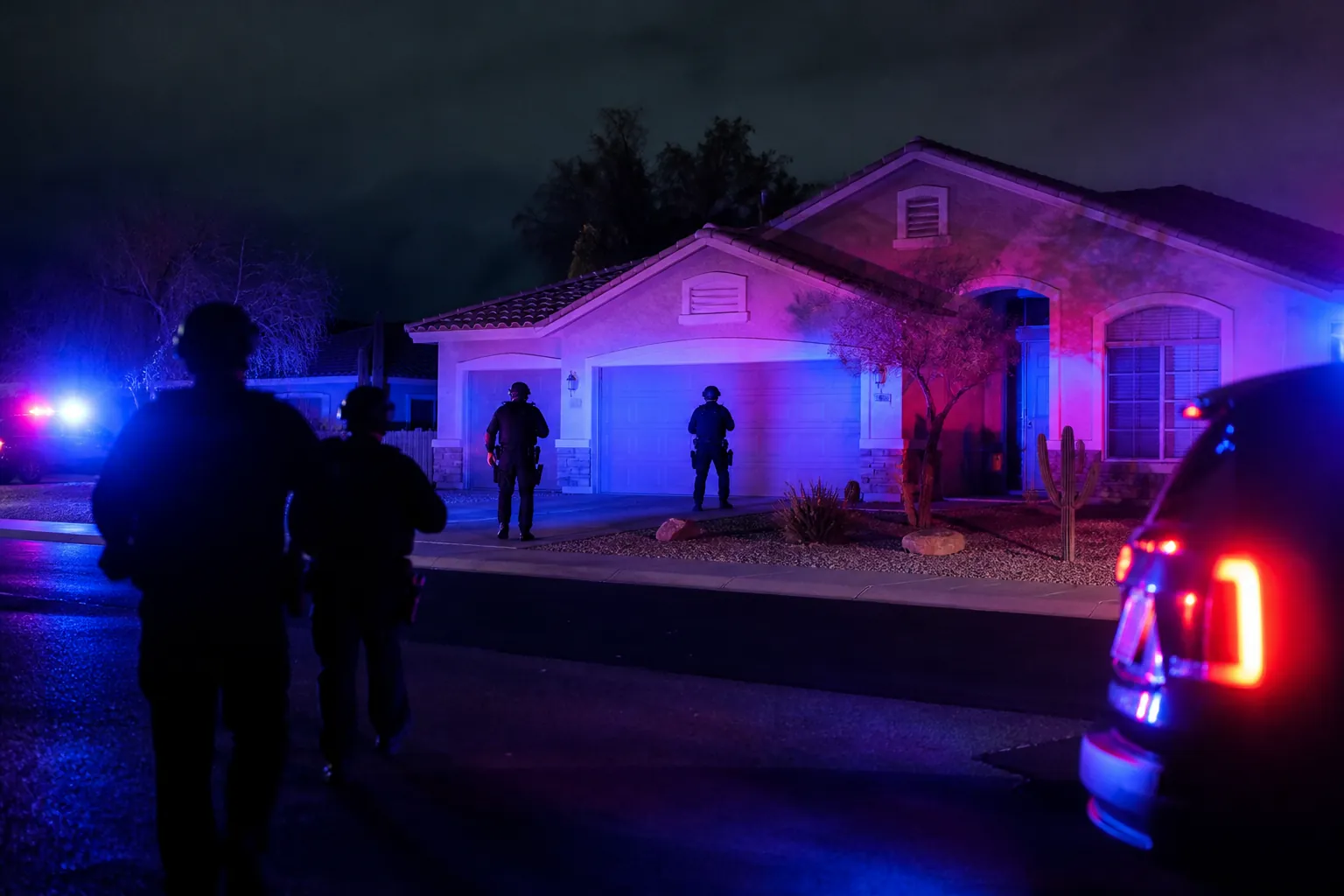
Then came the April 10 call. Reporting describes it as a 5:40 a.m. 311 call from a Wisconsin area code. The caller allegedly mispronounced Melendez’s name, provided a report that deputies were warned could be swatting, and did not include the kinds of background sounds one might expect from the violent emergency being described. Those details are allegations and reported facts at this stage, but they are not peripheral; they are the reason the notice treats the shooting as something different from an ordinary emergency-entry case.[3][4]
One deputy reportedly warned over the radio that the call could be swatting. Deputies later approached the home and breached Melendez’s bedroom window with a shovel. Melendez was holding his mother’s legally registered handgun when deputies fired. The majority of available reporting says eight rounds were fired by Deputies Santiago Casillas-Velazquez and Andres Vasquez, with two rounds striking Melendez.[3][4]
The handgun detail should not be stripped out of the account. It is part of why any later complaint will likely focus on what deputies knew before entry, what warnings were available to dispatch and field units, how the window breach was executed, and whether a resident awakened or confronted inside his bedroom could reasonably be expected to understand that the people entering were law enforcement rather than intruders. Those are litigation questions, not resolved facts.
| Date / moment | Reported event | Why it matters procedurally |
|---|---|---|
| April 8, 2026 | Prior hoax report and alleged dispatcher reassurance that “nothing’s going to happen” [3] | Supports notice theory that authorities had warning of a swatting pattern before April 10 |
| April 8, 2026 | Separate false “Sam” report [3] | Adds to the alleged pre-incident context |
| April 10, 2026, 5:40 a.m. | 311 call from a Wisconsin area code, with reported warning signs including name mispronunciation and lack of background sounds [3][4] | Central to whether the call should have been treated as a hoax risk |
| Before entry | Deputy radio warning that the call could be swatting [3] | Potentially important to notice, training, supervision, and tactical-decision allegations |
| Bedroom-window breach | Deputies used a shovel to breach the bedroom window [3][4] | Likely to become a factual focus if a complaint is filed |
| Shots fired | Majority reporting says eight rounds fired and two strikes while Melendez held his mother’s legally registered handgun [3][4] | Goes to force, perception, warning, and causation issues |
Sheriff Nanos previously characterized the April 10 report as false and made with intent to harm Melendez, while the sheriff’s department later declined comment on the claim by citing pending litigation.[4] That is not an admission of liability. It is, however, a notable public statement because the claim’s theory depends on the event being understood as a malicious hoax that law enforcement allegedly had reason to suspect before force was used.
What the $176 million demand contains
The reported settlement demand is divided into three headline pieces: $80 million against Pima County, $80 million against the sheriff’s department, and $16 million for Carmen Melendez’s emotional damages. The same reporting describes $25 million in past and future medical costs and up to $7 million in lost wages as part of the itemization.[1]
| Demand component | Reported amount |
|---|---|
| Against Pima County | $80 million [1] |
| Against Pima County Sheriff’s Department | $80 million [1] |
| For Carmen Melendez’s emotional damages | $16 million [1] |
| Medical costs itemized within the claim framing | $25 million past and future medical [1] |
| Lost wages itemized within the claim framing | Up to $7 million [1] |
The $176 million figure is the one that should be used for this record unless and until the actual claim document reconciles the totals differently. A higher $320 million figure has appeared as an outlier in separate reporting, but the majority-sourced figure in the available materials is $176 million. Until the claim itself is reviewed, the safer legal record is to flag the discrepancy rather than average it, amplify it, or silently choose the larger number.
There is a second verification issue: shot count. Tucson.com, Law&Crime, and KOLD reporting support eight rounds fired and two hits; AZPM reporting is described in the available materials as using seven total shots. For present purposes, the majority-supported formulation is eight fired and two strikes, with the conflict noted. If a complaint is filed, the pleading, body-camera evidence, dispatch records, and any investigative findings should settle that number more cleanly than a pre-complaint news record can.
Related local records should stay separate
Sheriff Nanos is also the subject of a separate Brady/perjury-related record. Readers tracking institutional risk can compare the respondent overlap through the Sheriff Nanos perjury/Brady record, but that matter should not be imported as proof in the Melendez shooting claim. Same public official, separate factual file.
For the same reason, broader Tucson-area police-liability materials are useful only as procedural context. A reader looking at qualified immunity and civil-liability framing in the same jurisdiction may want the Tucson police shooting legal implications record. For review mechanics after a local use-of-force event, the Empire Pizza dual-track investigation record is a closer process companion. Neither changes the posture here.
Comparisons help calibrate the demand, not prove liability
The $176 million demand appears to be the largest documented swatting-liability demand against an Arizona law-enforcement agency in the available record. That statement is narrower than “largest case” or “largest recovery.” The comparison set includes settlements and verdicts in different postures, with different defendants, evidence records, and procedural histories.
| Matter | Outcome or amount | Why it is useful, and why it is limited |
|---|---|---|
| Melendez / Pima County | $176 million notice-of-claim demand [1] | Pre-complaint Arizona public-entity claim; allegations unproven |
| Finch v. Rapp / Wichita swatting death | $5 million Wichita settlement; Tyler Barriss separately received a 20-year federal sentence [5][6] | Swatting-liability comparison, but resolved by settlement and criminal sentence in a different jurisdiction |
| Leonard Thomas | $15 million jury verdict [7] | High-value tactical-response verdict, but not the same factual posture as a pre-complaint swatting claim |
| Jose Guerena / Pima County SWAT raid | $3.4 million Pima County settlement [8] | Arizona and Pima County relevance, but a different raid fact pattern and a resolved settlement |
| 2013 PCSD swatting payout | $1.25 million reported payout [1] | Arizona swatting-related comparison; useful for local calibration, not predictive proof |
The comparison table should restrain the headline, not inflate it. A demand can be far larger than the amount ultimately litigated, settled, or awarded. A verdict reflects a trial record. A settlement reflects negotiated risk. A notice of claim reflects a pre-suit demand under a statute. Treating those as interchangeable is how a risk record turns into noise.
No source ties the April 10 call to AI voice cloning
This incident belongs near harassment, doxing, and swatting-risk coverage, but not because the current record identifies AI voice cloning. It does not. The available reporting describes a 311 hoax call with warning signs; it does not report that the caller used synthetic audio, voice cloning, or an AI-generated impersonation.[3][4]
That boundary matters because swatting is already a severe enough risk without adding unsupported technology claims. AI-enabled impersonation may be relevant to other hoax-emergency scenarios, and this site’s doxing and harassment-adjacent record is a better place to track that surrounding risk. In the Melendez matter, AI is context at most, not a reported fact.
What can be tracked next
There are only a few near-term events that should change the status label. First, Pima County or another public respondent could issue a written denial before the 60-day deemed-denial period expires. Second, if no written denial issues, the claim should be treated as denied by operation of A.R.S. § 12-821.01(E) after the 60-day period runs.[2]
After that, the next confirmable milestone is whether Melendez and Carmen Melendez file a complaint in Pima County Superior Court. A complaint would matter because it would fix the pleaded defendants, causes of action, factual allegations, damages theories, and forum. Until then, the record remains a reported notice-of-claim demand arising from a catastrophic shooting, not a judicial finding about who is liable for it.
References
- Paralyzed Tucson man files claim against county for $176M, Tucson.com
- 12-821.01. Authorization of claim against public entity or public employee, Arizona Legislature
- ‘Nothing’s going to happen’: Man was shot, paralyzed by deputies who ignored swatting warnings, filing states, Law&Crime
- Family of man shot by deputies during swatting situation, Pima County speaks out, KOLD, June 25, 2026
- Finch v. Rapp, MacArthur Justice Center
- California Man Sentenced In Deadly Wichita Swatting Case, U.S. Attorney’s Office, District of Kansas
- Jury Awards $15 Million to Family of Unarmed Man Killed by SWAT Sniper, MacDonald Hoague & Bayless
- $3.4M settlement in deadly ’11 Ariz. SWAT raid, Police1
Related records
Tool profile
Browse tool evaluations →Governing regulation
Browse the obligations tracker →Preventive workflow
Browse verification workflows →
Report a correction or tip
Spotted an outdated figure, a misstated fact, or a ruling this case record should reflect? Public comments are disabled for this content given the professional cost of a misreported case outcome, penalty amount, or rule text — use the structured correction channel instead.
Report a correction or tip for this record →