
Goldstein's 72-Month Sentence Reshapes Attorney Gambling Risk
The 72-month sentence imposed on SCOTUSblog co-founder Tom Goldstein for tax evasion tied to hidden poker winnings sets a new benchmark for prosecutions of attorneys with unreported gambling income and signals near-automatic disbarment proceedings under ABA Model Rule 8.4(b) and (c).
- Jurisdiction
- US-District of Maryland
- Court
- U.S. District Court for the District of Maryland
- Judge
- Lydia Kay Griggsby
- AI tool named
- none
- Ruling date
- Jul 24, 2026
- Source document
- View primary court order ↗
- Last verified
- Jul 25, 2026
Lex Machina Review is an independent risk-tracking and reference resource. Nothing on this site is legal advice, and using it does not create an attorney-client relationship. Every record is reviewed against primary sources but may not reflect the most current status of a matter — always verify directly against the cited court order, rule text, or a licensed attorney before relying on it.
Companion explanation — secondary to the source document above
Verification Posture
Tom Goldstein was sentenced on July 24, 2026, in the U.S. District Court for the District of Maryland to 72 months in prison for tax evasion tied to hidden poker winnings, according to the ABC News/AP report from the sentencing hearing.[1] The case is identified in available case materials as No. 8:25-cr-00006-LKG before Judge Lydia Kay Griggsby. As of this writing, the full written sentencing memorandum may not yet be publicly available, so the safest reading is hearing-reported sentence first, guideline reconstruction second.
That posture matters for anyone trying to understand the legal implications of poker-related tax evasion sentencing. The 72-month sentence is concrete. The judge’s full reasoning, if not yet public, should not be paraphrased as if it has already been reviewed. The most responsible conclusion is narrower but still serious: this is now a credible benchmark for attorney gambling-income prosecutions because it is far above the ordinary federal tax-fraud baseline and because the concealment pattern was not ordinary.

The prosecutors had previously sought a 97-month sentence, and Reuters reported that their June 3, 2026 sentencing position described a guideline range in the six-to-eight-year neighborhood.[2] The imposed sentence came in below the government’s request, but still landed at six years. For law-firm risk purposes, the important point is not that every attorney with unreported gambling income now faces six years. It is that a court accepted imprisonment at a level that only makes sense against a high-loss, high-concealment record.
The Benchmark Is the Loss Pattern, Not the Poker Label
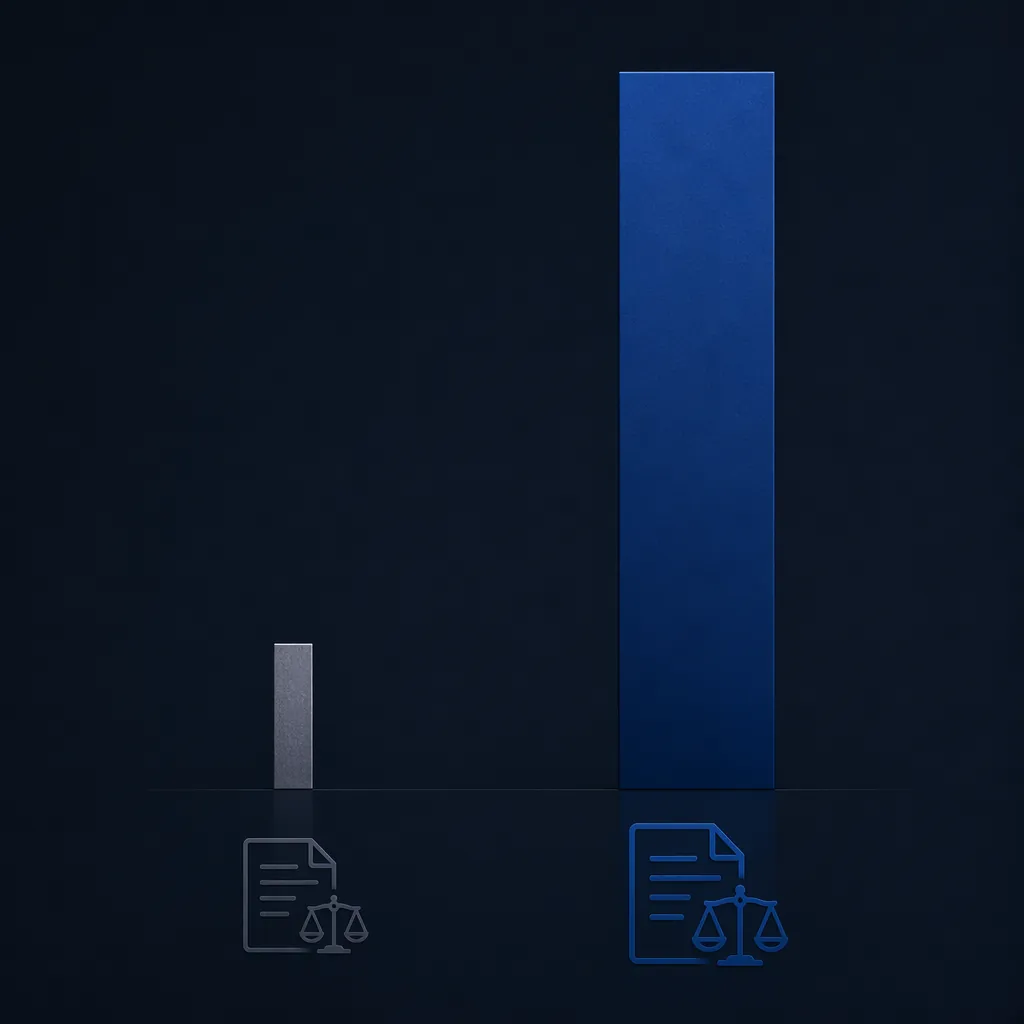
The federal baseline is useful because it keeps the sentence from being discussed as atmosphere. In fiscal year 2025, the U.S. Sentencing Commission reported 324 tax-fraud cases, a 68% imprisonment rate, an average sentence of 17 months, and a median tax loss of $546,562.[3] Goldstein’s reported 72-month sentence is more than four times that average. The reported tax loss exceeded $9.5 million.[1]
| Measure | FY2025 federal tax-fraud baseline | Goldstein sentencing record |
|---|---|---|
| Cases measured | 324 tax-fraud cases | Single case |
| Imprisonment rate | 68% | Imprisonment imposed |
| Average sentence | 17 months | 72 months |
| Loss measure | $546,562 median loss | $9.5M+ tax loss reported |
That comparison has two limits. First, the USSC data covers fiscal year 2025, from October 2024 through September 2025, and therefore does not include Goldstein’s July 2026 sentence.[3] Second, a national average does not control an individual sentence. It tells risk counsel when a case has moved out of the usual operating band.
The reported fact pattern explains the scale. IRS Criminal Investigation described a conviction involving tax evasion and mortgage fraud, and said Goldstein concealed millions of dollars of poker winnings, caused payments from his law firm to be made to satisfy personal gambling debts, used offshore entities or accounts, and made false statements to mortgage lenders.[4] Reuters separately reported the February 2026 conviction after trial on tax and mortgage-fraud charges.[5]
That is why “hidden poker winnings” is an incomplete shorthand. A lawyer who fails to report gambling income has a tax problem. A lawyer who pairs that failure with diverted firm receipts, offshore concealment, false mortgage applications, and a loss above $9.5 million has a criminal-sentencing problem of a different order.
What the Guideline Point Really Adds
The guideline mechanics do not need to be overworked. In criminal tax cases, tax loss is a central driver of the offense level under U.S.S.G. §2T1.1, and larger tax losses produce higher advisory sentencing ranges.[6] That explains why the government’s reported 97-month recommendation and six-to-eight-year guideline framing matter.[2] It does not mean the final judicial calculation can be quoted until the court’s written explanation is available.
For other attorneys with unreported gambling income, the sentencing implication is therefore conditional. The Goldstein sentence is not a universal six-year tariff for gambling-related tax evasion. It is a high-severity reference point where gambling income sits inside a broader concealment architecture and a very large tax loss.
The Bar Problem Is More Predictable Than the Month Count
The attorney-specific risk does not depend on whether the prison sentence was 48, 72, or 97 months. ABA Model Rule 8.4 says it is professional misconduct for a lawyer to commit a criminal act that reflects adversely on the lawyer’s honesty, trustworthiness, or fitness as a lawyer, and separately to engage in conduct involving dishonesty, fraud, deceit, or misrepresentation.[7]
Once a conviction record contains tax evasion, mortgage fraud, false statements, offshore concealment, and law-firm money moving toward personal gambling obligations, the disciplinary file almost writes its own opening memorandum. The bar does not need to prove that the lawyer’s poker play was professionally relevant. It can focus on dishonesty, financial deception, and conduct that reflects on fitness.
That is the institutional consequence that law firms should not miss. Criminal sentencing asks how much punishment this defendant receives under federal law. Professional discipline asks whether the conduct is compatible with the privilege of practicing law. The second question can be answered by the conviction facts even when reasonable lawyers continue to debate the precise sentencing range.
When a Private Tax Case Becomes a Firm-Risk Event
The hard moment for a managing partner or general counsel is not after sentencing. It comes earlier, when the firm has to classify the matter. A lawyer’s undisclosed gambling income may begin as a personal tax exposure. It crosses into firm-risk territory when the facts include firm receipts, client-adjacent funds, false financial statements, concealment structures, or statements to third parties that could implicate firm systems.
- Unreported gambling income alone raises tax and candor concerns, but does not by itself establish the Goldstein risk profile.
- Offshore accounts or entities turn the inquiry toward concealment rather than omission.
- False mortgage or lender statements add third-party fraud exposure beyond the tax return.
- Law-firm receipts used for personal obligations require immediate internal accounting, privilege, insurance, and reporting analysis.
- A conviction involving dishonesty triggers professional-discipline risk independent of the sentence length.
That classification matters because the audience inside the firm is larger than the accused lawyer and the criminal-defense team. Conflicts personnel may need to know whether client matters are touched. Finance may need to preserve payment records. The general counsel may need to assess notification duties. Disciplinary counsel will eventually read the same fact pattern through the language of honesty, trustworthiness, fraud, deceit, and misrepresentation.
The Transferable Lesson
Goldstein’s 72-month sentence is now a high-severity reference point for attorney gambling-income prosecutions. Its force, however, comes from the combination: hidden poker winnings, very large tax loss, offshore concealment, false mortgage information, and law-firm money used for personal gambling-related obligations. Remove those aggravating features, and the benchmark weakens.
For attorneys with undisclosed gambling income, the criminal exposure rises sharply when the government can show organized concealment rather than late reporting or poor recordkeeping. For law-firm risk staff, the immediate implication is not fascination with the six-year number. It is recognizing the point at which a private tax problem has become a professional-responsibility emergency.
References
- Supreme Court litigator gets 6 years in prison for tax evasion tied to poker winnings, ABC News/AP.
- US prosecutors seek 8-year prison term for ex-Supreme Court lawyer Goldstein, Reuters, June 3, 2026.
- Quick Facts: Tax Fraud, United States Sentencing Commission.
- Prominent Lawyer Thomas Goldstein Convicted of Tax Evasion and Mortgage Fraud, IRS Criminal Investigation.
- Prominent Washington lawyer Tom Goldstein convicted at tax trial, Reuters, February 25, 2026.
- Tax Loss and Criminal Tax Case Sentencing, TaxLawyersGroup.
- Rule 8.4: Misconduct, American Bar Association.
Related records
Tool profile
Browse tool evaluations →Governing regulation
Browse the obligations tracker →Preventive workflow
Browse verification workflows →
Report a correction or tip
Spotted an outdated figure, a misstated fact, or a ruling this case record should reflect? Public comments are disabled for this content given the professional cost of a misreported case outcome, penalty amount, or rule text — use the structured correction channel instead.
Report a correction or tip for this record →