
Why officers get suspended for unauthorized records access
A sourced digest of police officers disciplined for unauthorized records access, from two-day suspensions to felony charges. It maps a recurring discipline pattern and flags which outcomes are confirmed rather than reported.
- Jurisdiction
- United States (multi-state)
- Court
- Multiple state and local courts
- AI tool named
- Flock (ALPR)
- Ruling date
- Jul 25, 2026
- Source document
- View primary court order ↗
- Last verified
- Jul 31, 2026
Lex Machina Review is an independent risk-tracking and reference resource. Nothing on this site is legal advice, and using it does not create an attorney-client relationship. Every record is reviewed against primary sources but may not reflect the most current status of a matter — always verify directly against the cited court order, rule text, or a licensed attorney before relying on it.
Companion explanation — secondary to the source document above
Trust frame: last verified July 31, 2026, UTC. This is a sourced risk digest, not legal advice. It maps documented and reported unauthorized records-access discipline from 2013 through 2026, with source-status labels separating confirmed outcomes from reported, pending, or not-yet-reverified items. The target question is narrow: when a police officer is suspended for unauthorized records access, is that an isolated personnel story or part of a recurring discipline category with known escalation paths?
The short answer is that the category recurs across different systems and jurisdictions. In a 50-state investigation covering 2013 through 2015, the Associated Press found more than 325 officers and employees who resigned, were fired, or were suspended for unauthorized database queries, with roughly 250 more receiving lower-level discipline, as summarized by the Electronic Frontier Foundation.[1] That number does not establish a current national rate. It does establish that unauthorized records access has been a documented misconduct category for years, not merely a string of anecdotes.

Record table: unauthorized records-access discipline and related outcomes
The useful unit here is the record: date or period, agency or jurisdiction, database or system, conduct, outcome, status, and source. A suspension means something different from a pending suspension, a resignation means something different from a criminal charge, and an aggregate audit finding means something different from a named disciplinary case.
| Date or period | Jurisdiction / agency | Database or system | Conduct described | Outcome or count | Status and source |
|---|---|---|---|---|---|
| 2013–2015 | AP 50-state investigation | Law-enforcement databases | Unauthorized database queries by officers and employees | More than 325 resigned, fired, or suspended; roughly 250 more received lower-level discipline | Documented aggregate window; not a national incidence rate. [1] |
| 2013 | Minnesota state audit | Driver-data systems | Misuse of driver data by law-enforcement personnel | More than half of roughly 11,000 officers were found to have misused driver data | State-audit figure as summarized by EFF; jurisdiction-specific. [1] |
| 18-month window reported before 2016 | Florida | DAVID driver-information database | Misuse of the state driver-information database | 432 misuse incidents | Florida database window as reported by Tampa Bay Times and summarized by EFF. [1] |
| 2022 | Fort Bend County, Texas lieutenant | ALPR system | Reported ALPR misuse in the romantic-interest stalking category | Two-day suspension | Named outcome in Institute for Justice ALPR catalog; reported case-level status. [2] |
| 2025–2026 | Milwaukee officer | ALPR system | Reported repeated ALPR searches; catalog identifies about 180 searches | Resignation | Named outcome in Institute for Justice ALPR catalog; reported case-level status. [2] |
| 2026 | Monroe County, Florida deputy | ALPR system | Reported unauthorized ALPR access in the romantic-interest stalking category | Felony computer-access charge | Named outcome in Institute for Justice ALPR catalog; charge status, not conviction status. [2] |
| November 2019 | Peoria, Arizona officer | Background-check / records access | Unauthorized background check without a Fair Credit Reporting Act permissible purpose | Class six felony charge | Reported charge; not treated here as proof of conviction. [3] |
| March 18, 2026 | Toronto Police | Police database | Alleged unlawful database access | Officer charged | Non-U.S. comparator; useful for conduct category only, not for U.S. discipline frequency. [4] |
| October 2025 | Liberty, Texas lieutenant Ramiro Lozano | Records access involving a jailed person of interest | Accused of unauthorized access in a near-drowning-related matter | Suspended pending investigation | Reported pending internal investigation; no final adjudication shown in this file. [5] |
What the aggregate counts can and cannot prove
The AP window is the strongest broad record in this file because it looked across all 50 states for a defined period, 2013 through 2015. Its more-than-325 figure is limited to officers and employees who resigned, were fired, or were suspended for unauthorized database queries. Its roughly-250 additional figure covers lower-level discipline. Those are outcome bands, not a measure of how many unauthorized searches actually occurred.[1]
The Minnesota and Florida figures are narrower but important. Minnesota’s 2013 audit finding — more than half of roughly 11,000 officers misused driver data — is a state-specific audit result. Florida’s DAVID figure — 432 misuses in an 18-month period — is a database-specific window. Both help show that driver-data misuse was visible in institutional records before the current ALPR era, but neither should be converted into a national frequency statement.[1]
Two commonly cited datasets are deliberately not counted as confirmed figures in this digest: California CLETS discipline totals and Los Angeles Sheriff’s Department database-misuse figures for 2019 through 2023. Both require primary-page reverification before publication. They may belong in a later version of the table, but they do not belong in a confirmed-count paragraph until the primary source and status are pinned down.
That restraint changes the tone but not the risk finding. Even with California and Los Angeles held out, the AP, Minnesota, Florida, and named-case records are enough to show a repeated misconduct category with consequences that range from short suspension to job loss and criminal exposure.
The escalation ladder: suspension, job loss, licensing risk, charges
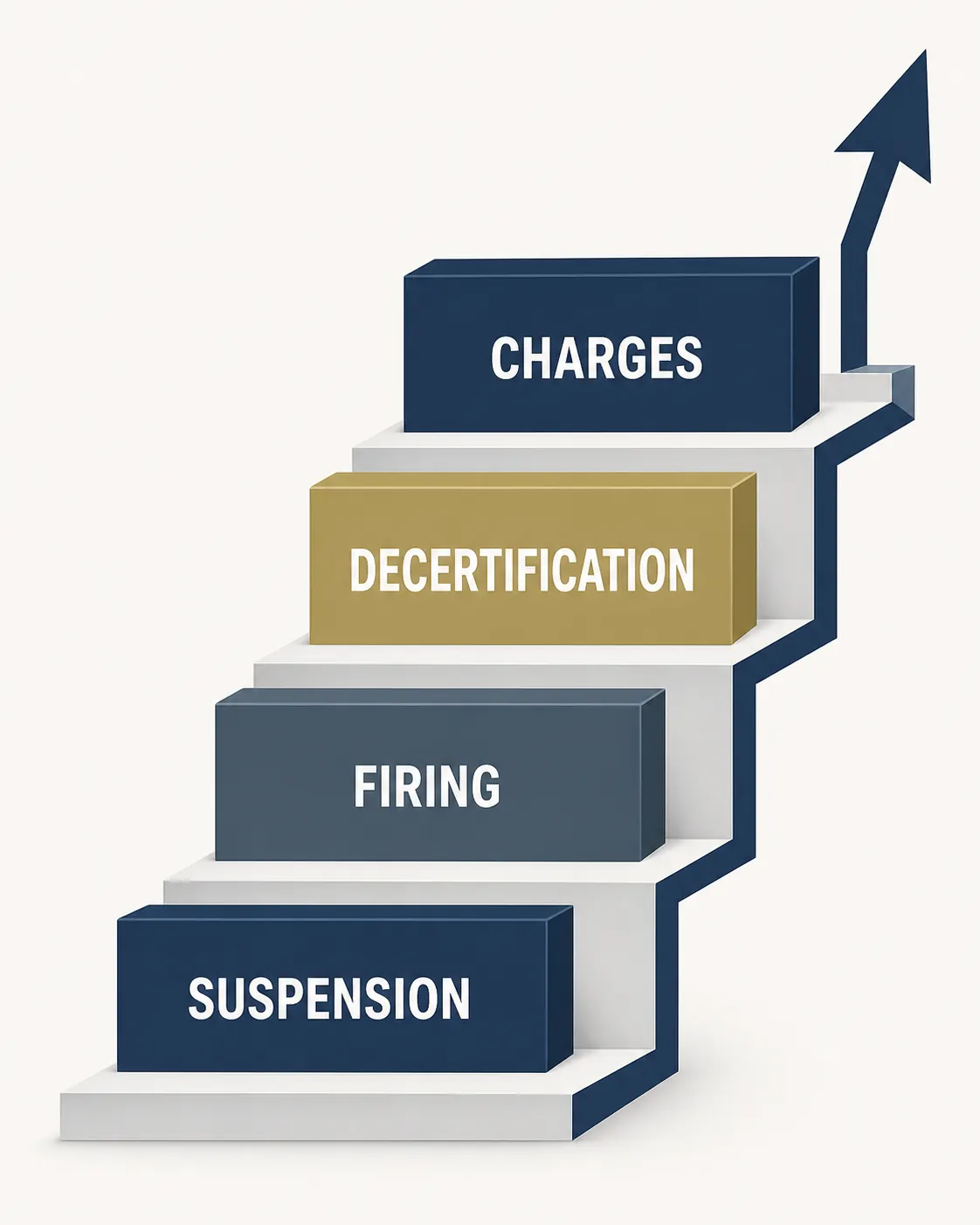
Unauthorized access does not carry one predictable sanction. The same conduct category can sit in different bands depending on system, motive, repetition, victim impact, local policy, employment posture, and whether prosecutors treat the access as a computer-crime event.
| Outcome band | What it means in the records | Named examples in this file |
|---|---|---|
| Short suspension | Agency treats the conduct as sustained misconduct but imposes brief employment discipline | Fort Bend County, Texas lieutenant: two-day suspension in the ALPR romantic-interest category. [2] |
| Suspension pending investigation | Agency removes or restricts the officer while the matter is unresolved; not final discipline | Liberty, Texas lieutenant Ramiro Lozano: suspended pending investigation after an accusation of unauthorized access. [5] |
| Resignation or firing | Employment ends during or after the misconduct process; the record may not read like a litigated finding | Milwaukee officer: resignation after reported repeated ALPR searches, including about 180 searches. [2] |
| Licensing / POST consequences | A state certification body may act separately from the employer | A Massachusetts POST decertification entry was flagged in review but is not counted here without primary-source reverification. |
| Criminal charge | The access is treated as potential criminal computer or records misuse; charge status is not conviction status | Monroe County, Florida deputy: felony computer-access charge; Peoria, Arizona officer: class six felony charge tied to an unauthorized background check. [2][3] |
The Fort Bend County example matters because it is easy to overlook: a two-day suspension can disappear inside a personnel file even though it marks sustained or reported misconduct in a sensitive system. For a later defense lawyer, civil litigator, or agency risk reviewer, the useful fact is not the drama of the sanction. It is that the officer had a records-query misuse event attached to a named system and a dated outcome.[2]
The Milwaukee and Monroe County examples show the next bands. A resignation after repeated ALPR searches is an employment outcome. A felony computer-access charge is a criminal-law outcome. They should not be merged into one “discipline” label, and neither should be treated as proof of a conviction unless the source says so.[2]
The Peoria case sits outside the ALPR subset but belongs in the same records-access map. Backgrounds Online reported in November 2019 that a Peoria, Arizona officer faced a class six felony charge for an unauthorized background check without a permissible purpose under the Fair Credit Reporting Act.[3] The database type differs from ALPR, but the risk pattern is familiar: an officer uses official-access machinery for a purpose the system did not authorize.
The ALPR subset sharpens the detection problem

The modern ALPR record is not just another technology chapter. The Institute for Justice catalog, updated July 25, 2026, reports at least 28 officers who used ALPR systems to stalk romantic interests; nearly all were criminally charged and fired or resigned, and most were discovered through victim complaints rather than internal audits.[2]
That last clause is the hinge. If misuse is usually surfaced because the person being watched complains, the audit trail is functioning as after-the-fact evidence, not necessarily as a timely control. That matters to anyone relying on database-derived evidence: the query log may be cleanly preserved while the control process around it failed to catch misuse until the target noticed the intrusion.
For the full ALPR stalking case list, see the separate Risk Digest catalog, At least 28 officers used Flock to stalk romantic partners. This digest stays broader: ALPR misuse is one current subset inside a longer records-access discipline pattern.
Pending and reported items should stay visibly pending
The Liberty, Texas record is included because it is on point for the target query — an officer suspended after an accusation of unauthorized access — but its status is not final. Click2Houston reported in October 2025 that Lt. Ramiro Lozano was suspended pending investigation after being accused of unauthorized access involving the jailed father of children in a near-drowning case.[5] In this digest, that is a pending suspension record, not a confirmed sustained finding.
The Toronto record is also kept in its lane. CBC reported on March 18, 2026, that a Toronto police officer was charged in connection with unlawful database access.[4] It is useful as a comparator showing that the conduct category appears outside U.S. agencies, but it is not evidence of U.S. law-enforcement frequency and does not belong in a U.S. aggregate count.
A Reading, Ohio LEADS-misuse story and a Massachusetts POST decertification item are noted only with limited status. The available information is paywalled, snippet-level, or still needs primary confirmation. They should not be upgraded into final findings without the underlying disciplinary entry, docket, or agency record. This is the difference between a useful verification note and a bad database.
Why this belongs in litigation and disclosure risk review
Unauthorized records access is often described as a privacy problem, which it is. For litigation work, it is also a record-integrity problem. A query history can identify who looked up a plate, a driver record, a background report, or a person of interest; it can also identify whether the officer had a prior misuse event involving similar systems.
That does not mean every suspension becomes Brady or Giglio material in every case. It means the status field has to be preserved: pending investigation, sustained suspension, resignation, firing, decertification, charge, conviction if any, and source. A defense lawyer evaluating a database-derived stop, a civil lawyer tracing ALPR use, or an agency risk officer reviewing witness files cannot do much with “database issue.” They can do something with a dated unauthorized-access finding tied to a system and an outcome.
The records also point to an audit-control question. In the ALPR subset, most reported romantic-interest stalking cases were discovered through victim complaints rather than internal audits.[2] That fact does not prove every agency audit is weak. It does mean that, where a matter depends on records-derived evidence, the absence of an early internal alert should not be mistaken for the absence of misuse.
The clean risk finding is limited but solid: unauthorized records access is a recurring, documented discipline category; outcomes run from short suspension through resignation, firing, and criminal charges; and unresolved or weakly documented items need visible status labels before they are used in litigation, journalism, or compliance work.
References
- Police Around the Country Regularly Abuse Law Enforcement Databases, Electronic Frontier Foundation, 2016.
- Police have reportedly used license plate readers to stalk romantic interests at least 14 times in recent years, Institute for Justice, updated July 25, 2026.
- Officer Faces Felony Unauthorized Background Check, Backgrounds Online, November 2019.
- Toronto police officer charged for unlawful database access, CBC, March 18, 2026.
- Liberty police officer suspended, accused of unauthorized access to father of children in near-drowning case, Click2Houston, October 6, 2025.
Related records
Tool profile
Browse tool evaluations →Governing regulation
Browse the obligations tracker →Preventive workflow
Browse verification workflows →
Report a correction or tip
Spotted an outdated figure, a misstated fact, or a ruling this case record should reflect? Public comments are disabled for this content given the professional cost of a misreported case outcome, penalty amount, or rule text — use the structured correction channel instead.
Report a correction or tip for this record →