
Why the DSM-5 Makes Postpartum Psychosis Insanity Defenses Harder
Prosecutors exploit the DSM-5's refusal to recognize postpartum psychosis as a distinct diagnosis to challenge insanity defense expert testimony, creating a structural vulnerability that forces defense attorneys into diagnostic workarounds. This article explains the gap, its consequences in criminal trials, and available counter-strategies for defense counsel and forensic experts.
- Jurisdiction
- US-New York
- Court
- New York State Supreme Court, Bronx County
- AI tool named
- Not applicable
- Ruling date
- Jul 29, 2026
- Source document
- View primary court order ↗
- Last verified
- Jul 29, 2026
Lex Machina Review is an independent risk-tracking and reference resource. Nothing on this site is legal advice, and using it does not create an attorney-client relationship. Every record is reviewed against primary sources but may not reflect the most current status of a matter — always verify directly against the cited court order, rule text, or a licensed attorney before relying on it.
Companion explanation — secondary to the source document above
The hardest part of a postpartum psychosis insanity defense is often not persuading a clinician that the condition exists. It is keeping the diagnosis from being made to look legally homeless before the jury ever hears the full psychiatric story. DSM-5 does not recognize postpartum psychosis as a distinct disorder. In criminal court, where DSM labels are routinely treated as shorthand for professional acceptance, that silence gives prosecutors a clean line of attack: the defense expert is not diagnosing from the manual, so the opinion can be framed as idiosyncratic, advocacy-driven, or insufficiently reliable.

That is the structural vulnerability in postpartum psychosis insanity-defense litigation. The clinical record may describe an abrupt postpartum psychiatric emergency, delusions organized around the infant, and impaired reality testing. The legal record still needs an admissible expert opinion tied to a recognized mental disease or defect and then tied again to the jurisdiction’s insanity standard. The DSM gap interferes at both points.
The gap is not ancient diagnostic fog. DSM-II recognized the condition in 1968 as “Psychosis with Childbirth.” DSM-III removed it in 1980 without an official explanation, and the diagnosis has not returned across later editions, including DSM-5.[1] For a defense team, that history matters because it shows the present posture is not inevitable. The manual once had a category for what the expert is trying to describe. The courtroom problem is that the current one does not.
What the DSM gap lets the prosecution do
A prosecutor does not need to prove postpartum psychosis is imaginary. The more effective move is narrower: make the defense expert explain why the jury should accept a diagnosis that DSM-5 does not list. That question sounds clerical. It is not. It reaches admissibility, expert credibility, and the causal chain the defense has to build between childbirth, psychosis, and the charged act.
Once the expert says “postpartum psychosis,” cross-examination can move quickly: Where is it in DSM-5? Is it a formal diagnosis or a descriptive phrase? If it is not a formal diagnosis, what exactly is the mental disease? If the actual DSM diagnosis is bipolar disorder, major depressive disorder with psychotic features, or brief psychotic disorder, why should the jury believe childbirth is central rather than incidental? The questions are not medically neutral. They force the expert to translate a postpartum-specific syndrome into a category built for something else.
DSM-5 does contain a peripartum-onset specifier, but that does not solve the problem. The specifier requires onset during pregnancy or within four weeks after delivery, while clinical literature describes postpartum psychosis as capable of emerging up to twelve weeks postpartum.[2] The mismatch creates an avoidable evidentiary seam. A woman whose symptoms begin outside the DSM-5 specifier window may still fit the clinical postpartum psychosis course described in the literature, but the lawyer has to explain why the manual’s timing language should not control the forensic opinion.
Even inside the four-week window, the manual’s architecture changes the shape of the testimony. The expert is not simply saying, “This was postpartum psychosis.” The expert is saying something closer to: “This was a DSM-recognized disorder, with postpartum onset, presenting in a way the literature calls postpartum psychosis.” That may be accurate enough for clinical communication. Under cross-examination, it can sound like a workaround.
The Bamenga trial shows the machinery, not just the tragedy
Lisette Bamenga’s case is the clearest illustration of how the classification gap becomes a trial weapon. Bamenga killed her two children in the Bronx in a case described by forensic psychiatrist Margaret Spinelli as involving postpartum psychosis. At trial, the Bronx District Attorney used DSM-5’s exclusion of postpartum psychosis as a distinct diagnosis to attack the defense expert’s opinion. Bamenga was sentenced to eight years.[3]
The evidentiary point is more important than the biographical horror. The prosecution did not have to disprove every feature of the postpartum course. It could press the diagnostic absence: if DSM-5 does not recognize postpartum psychosis, then what is the expert asking the court to accept? That move shifts the defense from explaining mental state at the time of the act to defending the legitimacy of the label itself.
The same facts would likely have traveled a different legal road in the United Kingdom. The Infanticide Act 1938 allows reduced culpability where the balance of the mother’s mind was disturbed by childbirth or lactation, without requiring a DSM diagnosis as the gateway.[4] That comparison should not be overworked. U.S. criminal law cannot simply borrow the UK model and paste it into state insanity doctrine. But it does expose the U.S. dependency on classification: the American defense has to fight through DSM recognition before it can fully litigate culpability.
Why the workaround is unstable
The usual forensic workaround is to diagnose a DSM-recognized disorder and use postpartum onset as the clinical context. Depending on the presentation, the expert may reach for bipolar disorder, major depressive disorder with psychotic features, or brief psychotic disorder. Sometimes that is defensible. Sometimes it is the only admissible way to describe a defendant’s mental illness in DSM terms. But the fit is not merely a paperwork inconvenience.
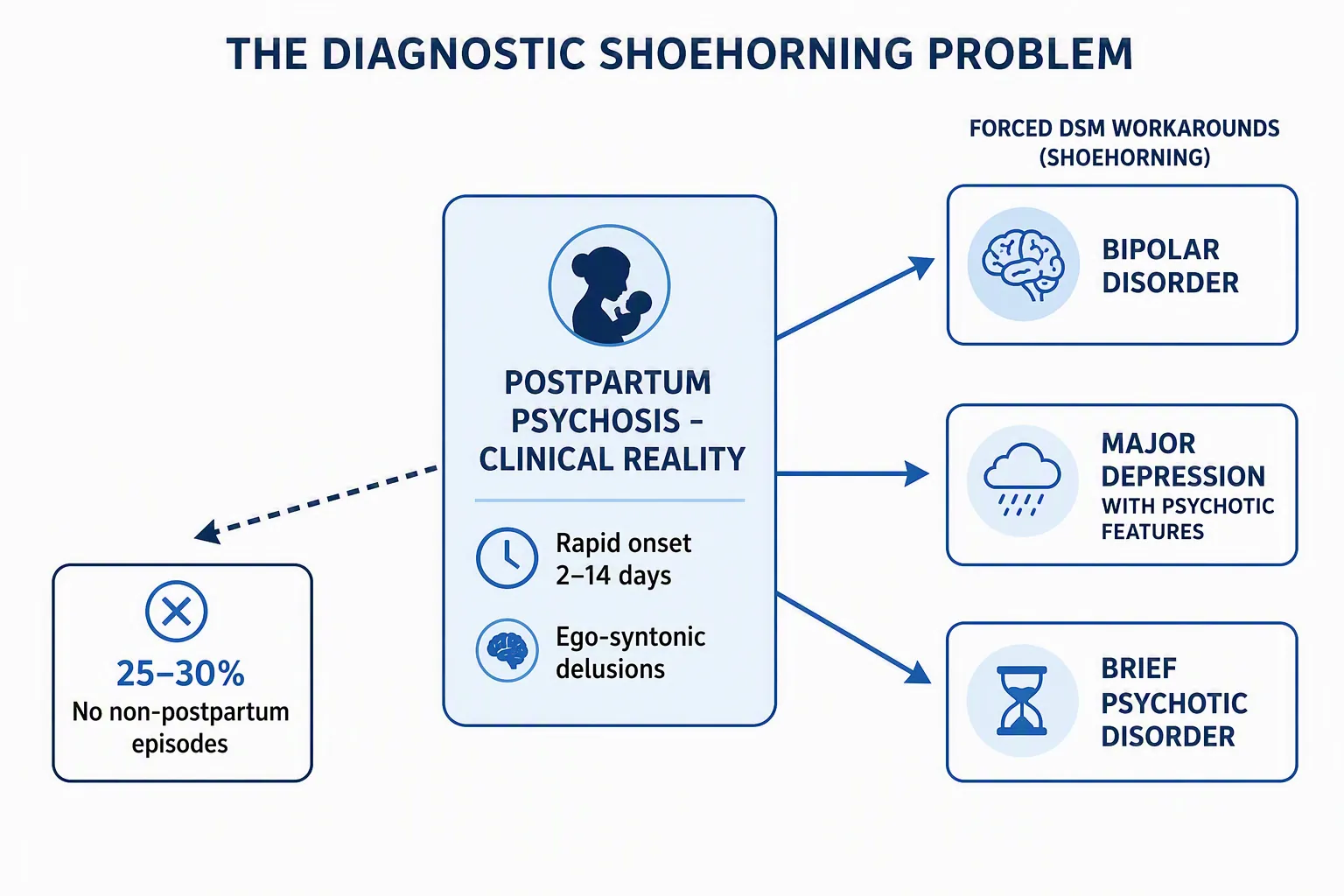
Friedman and Sorrentino describe evidence that first-onset postpartum psychosis has a distinctive genetic risk profile that only partially overlaps with bipolar disorder.[1] That matters in court because it gives the expert more than sympathy or clinical habit to support distinctiveness. If the science supports a partially distinct condition, then requiring the expert to bury the postpartum syndrome inside bipolar disorder can distort the very mechanism the defense is trying to explain.
The distortion becomes sharper for the subgroup of women who never have affective episodes outside the postpartum period. The literature identifies that group as 25–30% of postpartum psychosis patients.[1] For them, a bipolar-disorder formulation may preserve DSM footing but weaken factual fit. The defendant’s psychiatric history may not show the expected non-postpartum pattern. The jury may hear “bipolar disorder” and look for prior manic episodes, prior treatment, or prior warnings that are not there. The expert then has to spend time explaining why the label is technically necessary and clinically incomplete.
That explanation is not harmless surplus. In an insanity defense, the diagnosis is supposed to support a mental-state conclusion. If the diagnosis appears strained, the causal narrative appears strained with it. A prosecutor can argue that the expert has chosen a convenient category after the fact, that childbirth is being used as mitigation rather than diagnosis, or that the defendant’s symptoms do not match the disorder the expert finally placed on the report. The manual’s omission has done its work: it has turned a clinical timing question into a credibility problem.
The clinical facts are powerful, but they must be used carefully
Postpartum psychosis is typically described as a rapid-onset psychiatric emergency, often beginning within days after delivery. Clinical accounts emphasize delusions, hallucinations, disorganization, mood symptoms, insomnia, and impaired insight; in the most legally consequential cases, delusions may be ego-syntonic and centered on the infant.[2] Those facts explain why the condition is so relevant to criminal responsibility. They do not automatically satisfy an insanity standard.
The commonly cited estimates of 4% infanticide risk and 5% suicide risk are serious, but they should not be handled as if they came from a fresh, large contemporary prospective study. They are well-established clinical estimates associated with older psychiatric literature, including Kaplan and Sadock, and they are useful for showing why postpartum psychosis is an emergency rather than for predicting an individual defendant’s conduct with precision.[3]
That distinction is where sloppy expert preparation gets punished. Population-level risk figures can help explain urgency, severity, and why immediate hospitalization would have been clinically expected. They cannot carry the legal burden by themselves. The forensic question remains defendant-specific: what symptoms existed, when they emerged, how they changed perception or appreciation, and how those symptoms bore on the charged act under the governing legal standard.
What defense counsel has to build before the admissibility fight
The DSM-5 gap does not make postpartum psychosis unusable in criminal court. It means the defense cannot let the gap surface for the first time in cross-examination. The expert report should make the translation explicit: the DSM diagnosis, the postpartum psychosis formulation, the scientific basis for treating the postpartum course as meaningful, and the reason the chosen DSM category does not exhaust the clinical picture.
- Identify the DSM-recognized diagnosis being offered for admissibility purposes, without pretending it fully resolves the postpartum-specific presentation.
- Document timing with precision: delivery date, sleep disruption, first observed symptoms, first delusional content, treatment contacts, emergency presentations, and changes in functioning.
- Prepare the differential diagnosis, including bipolar disorder, major depression with psychotic features, brief psychotic disorder, substance-related conditions, neurological explanations, and malingering where relevant.
- Explain the scientific basis for postpartum psychosis as a clinically coherent syndrome, including the DSM history, timing literature, and genetic evidence where the expert is qualified to discuss it.
- Connect symptoms to the legal standard in the jurisdiction, rather than relying on the diagnosis to imply incapacity.
The causal narrative needs particular care. It is not enough to say the defendant had recently delivered and then acted violently. The useful testimony traces the psychiatric sequence: the postpartum period, onset of insomnia or mood instability, emergence of psychotic symptoms, content of delusions or hallucinations, loss of reality testing, and the specific way those symptoms affected knowledge, appreciation, intent, or moral/legal understanding. Different jurisdictions ask the final question differently. The report should not blur those differences.
Counsel should also expect the state to exploit any gap between the clinical label and the DSM diagnosis. If the expert writes “postpartum psychosis” in one place and “bipolar disorder with peripartum onset” in another, the report should explain the relationship before the prosecutor does. If symptom onset occurred after four weeks postpartum, the report should not hide from the DSM-5 specifier problem; it should distinguish the manual’s specifier window from the clinical literature describing onset up to twelve weeks.[2]
Why reform signals remain messy
Comparative law is useful here only if it is kept modest. The UK Infanticide Act shows one way to route childbirth-related mental disturbance through a criminal statute instead of through DSM classification.[4] It does not answer the American federalism problem, the politics of infant-death cases, or the doctrinal resistance many U.S. jurisdictions have to expanding diminished-responsibility concepts.
Illinois is the complicated U.S. signal. Public Act 100-0574, enacted in 2018, created a postpartum-psychosis-specific route, but the statute has been criticized because it requires the disorder to have been undiagnosed at the time of the offense.[5] That condition produces an obvious forensic tension: the cleaner the treatment record, the harder it may be to qualify; the less treatment a woman received, the more the statute may appear to help. A reform that rewards non-diagnosis is not a clean solution to a diagnostic-recognition problem.
Current high-profile postpartum homicide prosecutions, including the ongoing Lindsay Clancy case as of July 29, 2026, keep the issue visible, but they do not change the underlying trial problem. A defense may describe postpartum psychosis to the public. In court, it still has to pass through a DSM framework that does not give the condition its own diagnostic home.
The practical posture
Until DSM classification changes or U.S. statutes supply a clearer route, defense counsel and forensic psychiatrists should assume the DSM gap will be attacked. The answer is not to overstate the science or ask the court to treat postpartum psychosis as a magic phrase. The answer is to prepare the bridge before it is challenged: DSM diagnosis, postpartum-specific science, timing evidence, differential diagnosis, and a defendant-specific causal account tied to the legal standard.
That preparation will not make every insanity defense viable. It will, however, reduce the chance that a clinically recognizable postpartum psychiatric emergency is lost in the narrow space between what experts know how to describe and what DSM-5 formally knows how to name.
References
- Commentary: Postpartum Psychosis, Infanticide, and Insanity—Implications for Forensic Psychiatry, Journal of the American Academy of Psychiatry and the Law, 2012.
- Postpartum Psychosis: A Preventable Psychiatric Emergency, PMC.
- An Infanticide Trial, The Journal of Clinical Psychiatry.
- An Update on the Law of Infanticide: A Review of Cases over the Past 20 Years, Doughty Street Chambers, 2024.
- Postpartum Psychosis and the Law, PubMed.
Related records
Tool profile
Browse tool evaluations →Governing regulation
Browse the obligations tracker →Preventive workflow
Browse verification workflows →
Report a correction or tip
Spotted an outdated figure, a misstated fact, or a ruling this case record should reflect? Public comments are disabled for this content given the professional cost of a misreported case outcome, penalty amount, or rule text — use the structured correction channel instead.
Report a correction or tip for this record →