
The Legal Cascade After a Psychiatrist's License Revocation
When a psychiatrist loses their license for sexual misconduct, regulatory, criminal, and civil liability streams converge, creating permanent professional records that block interstate licensing and future employment. This article maps the three parallel fronts and the state laws that shape them.
- Jurisdiction
- United States
- Court
- State medical boards and courts
- AI tool named
- None
- Ruling date
- Jan 1, 2023
- Source document
- View primary court order ↗
- Last verified
- Jul 31, 2026
Lex Machina Review is an independent risk-tracking and reference resource. Nothing on this site is legal advice, and using it does not create an attorney-client relationship. Every record is reviewed against primary sources but may not reflect the most current status of a matter — always verify directly against the cited court order, rule text, or a licensed attorney before relying on it.
Companion explanation — secondary to the source document above
When a psychiatrist's license is revoked for sexual misconduct, the legal consequence is severe, but it is rarely the whole consequence. Revocation ends the state-granted authority to practice in that jurisdiction. It does not, by itself, resolve whether the conduct will be reported to law enforcement, whether prosecutors will file charges, whether patients will sue, whether a hospital must explain credentialing decisions, or whether another state board will treat the record as a bar to future licensure.
That is the first practical correction for lawyers and risk managers handling the legal consequences of a psychiatrist's license revocation for sexual misconduct: the case does not move through one punishment system. It can move through three systems at once. The medical board controls licensure. Criminal authorities decide whether the same conduct is chargeable as a crime. Civil courts decide damages, including malpractice and, in sexual-misconduct cases, potential punitive exposure. The National Practitioner Data Bank then gives the professional record a kind of durability that a local disciplinary order alone would not have.
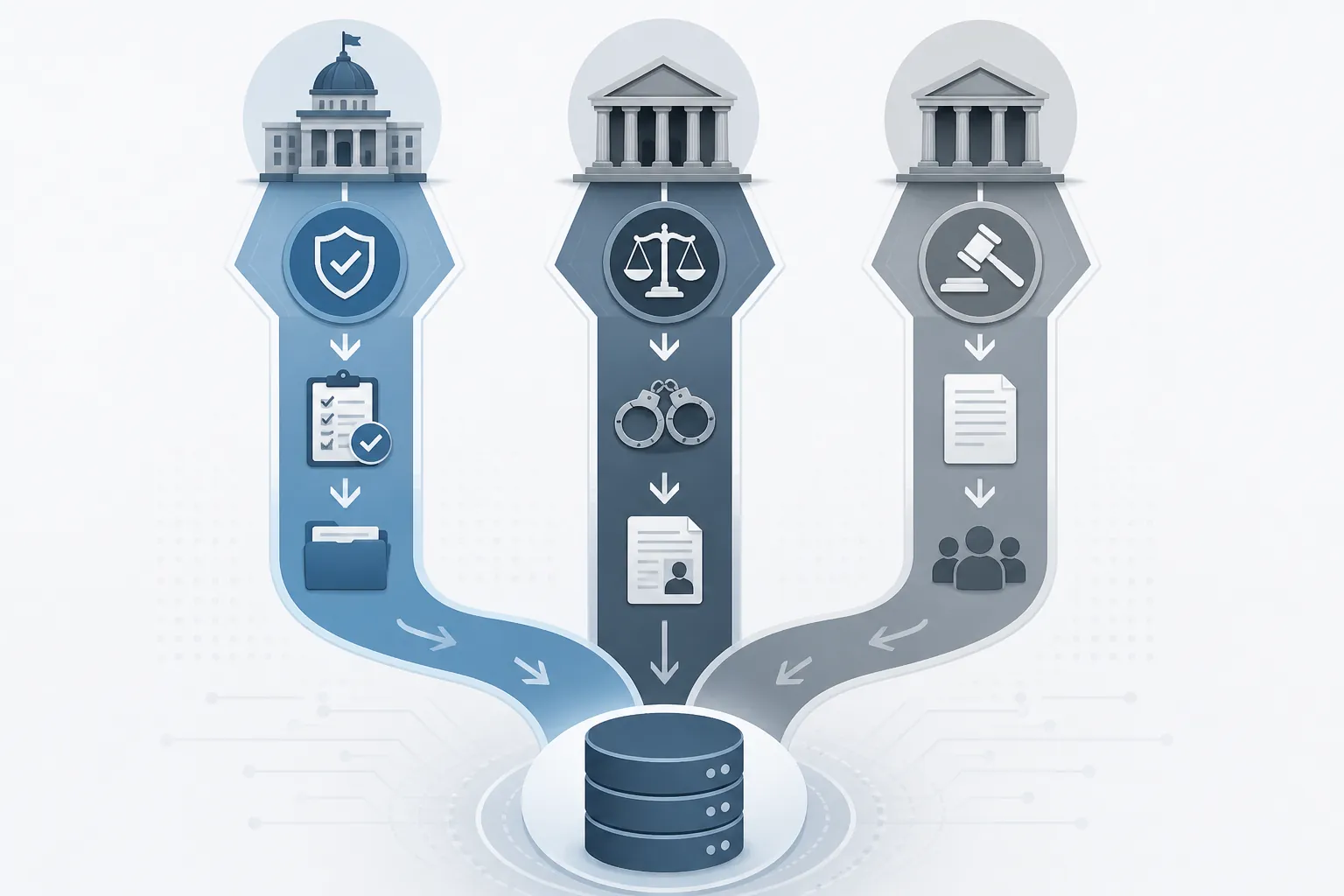
Revocation Is the Sharpest Board Sanction, Not the Whole Legal Event
Medical-board discipline begins before the word “revoked” appears in an order. A complaint or inquiry must be opened. Staff or investigators must decide what can be documented. The board may close the matter, issue nonpublic or lesser action where available, negotiate a surrender, impose probation, suspend the license, or revoke it after the applicable process. For a psychiatrist, the underlying allegation may involve treatment boundaries, exploitation of the therapeutic relationship, sexual contact with a patient, or related conduct that a board treats as professional misconduct.
The available data cautions against assuming that every sexual-misconduct inquiry reaches formal discipline, much less revocation. A Murphy Falcon analysis of sexual-misconduct disciplinary actions across all healthcare professionals from 2000 to 2017 found that about 25% resulted in license revocation; the figure is not physician-only data and should not be read as a psychiatrist-specific revocation rate.[1] A Georgia audit reported an even starker filtering problem: 81% of sexual-misconduct inquiries closed without formal discipline, and only 2% resulted in formal action.[2]
Those numbers matter because a revoked license is often the end product of a process that has already screened out many matters. The legal question after revocation is therefore not simply “what did the board do?” but “what else did the board record, report, or trigger?” A revocation order can become evidence in later civil litigation, a credentialing red flag, a basis for reciprocal action in another state, and a reportable event in the national professional record system.
The Regulatory Path Runs Through Process, Sanction, and Reporting
A board case is not a malpractice case with a different caption. The board is protecting the public and the integrity of licensure. It may use administrative standards, negotiated orders, expert review, and statutory definitions of unprofessional conduct. The patient may be a complainant and a witness, but the board, not the patient, owns the licensing remedy.
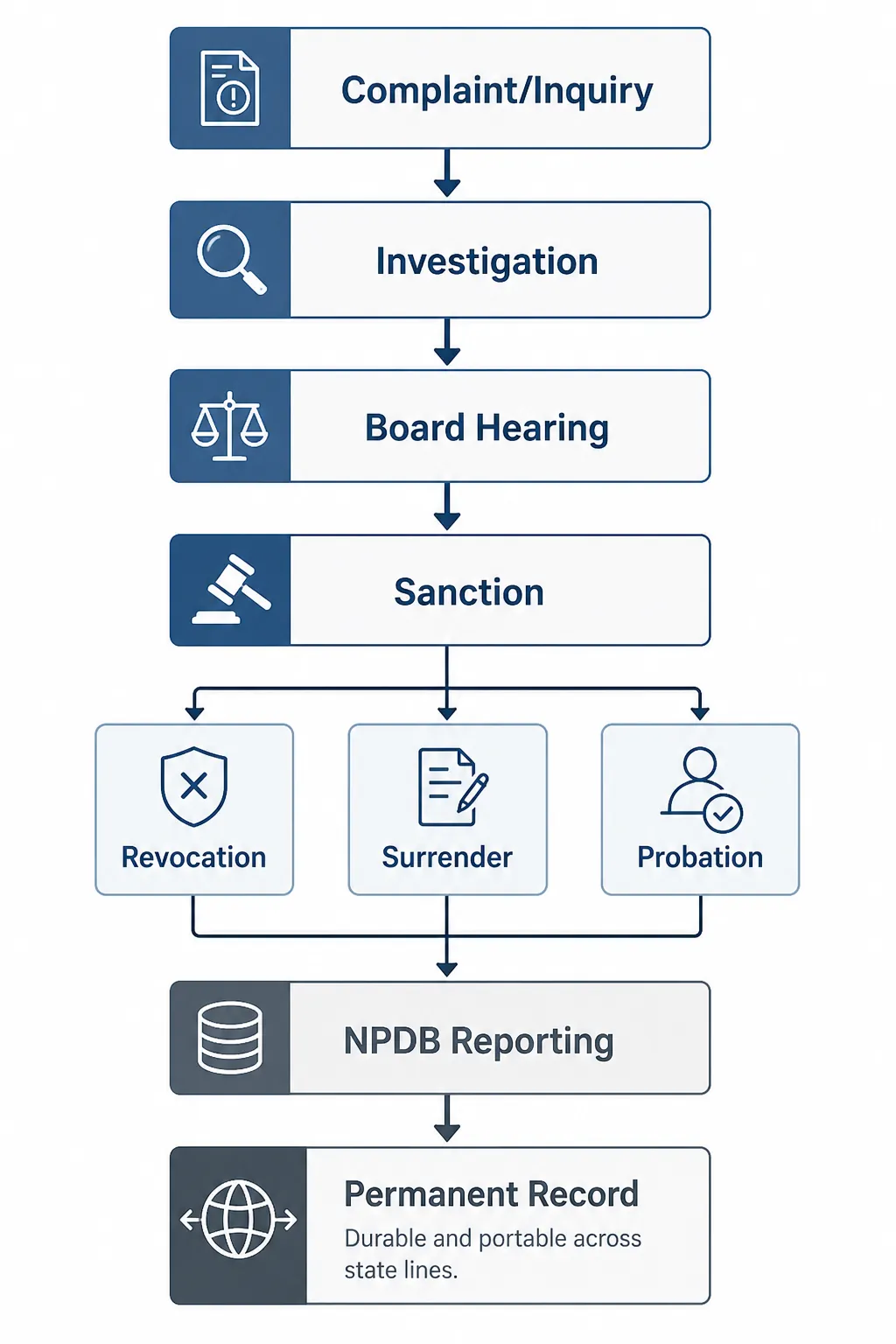
That sequence is why a negotiated surrender is not the same as a quiet exit. A psychiatrist who surrenders a license while under investigation may avoid a contested revocation hearing, but the surrender can still be treated as a disciplinary event. Probation is also not an acquittal; it may carry monitoring, treatment, chaperone requirements, practice restrictions, or other terms. Revocation is the most severe licensure endpoint, but lesser sanctions can still produce reportable and discoverable consequences.
The Federation of State Medical Boards’ 2020 workgroup report shows where reform pressure has been aimed. It made 38 recommendations, including that boards presumptively revoke a physician’s license for serious sexual misconduct and report all complaints or allegations of physician sexual misconduct to law enforcement.[3] The distinction is important: the FSMB report is guidance from a national medical-board organization, not a statute that automatically binds every state board.
For compliance counsel, the report is still useful because it describes a benchmark against which state boards, hospitals, and professional entities may be judged. If a later credentialing file shows repeated complaints, no referral, and no meaningful restriction, the problem is no longer only the psychiatrist’s conduct. It becomes an institutional-sequencing problem: who received the information, which forum acted, which forum did not, and what was preserved in a record that another institution could have checked.
Why the NPDB Changes the Afterlife of a Board Order
The National Practitioner Data Bank is not a public-shaming website. Its significance is narrower and more practical: it is a professional-access database used in licensing, credentialing, privileging, and employment-related review. Once a qualifying adverse action or malpractice payment is reported, the record can follow the practitioner across state lines and across institutions.
A cross-sectional analysis of 1,039 U.S. physicians reported to the NPDB for sexual misconduct from 2003 to 2013 found an annual reporting rate of 10.78 per 100,000 physicians, while also noting that NPDB data likely undercounts actual incidents because misconduct may never be reported by patients, hospitals, colleagues, or other entities.[4] That undercount caveat cuts in both directions for legal risk: the database is incomplete as a measure of incidence, but a report that does exist is difficult for a later applicant to explain away as a local misunderstanding.
This is where revocation becomes portable. A psychiatrist may lose one state license, then seek licensure elsewhere, staff privileges, managed-care participation, or employment in a setting that requires credentialing. The later reviewer may not have the complete investigative file, the patient’s testimony, or the board’s internal deliberations. What the reviewer may have is the disciplinary order, NPDB query results, malpractice-payment history, and the applicant’s own disclosures. Omissions in that setting can become a separate credentialing or licensure problem.
Criminal Exposure Does Not Wait for the Board to Finish
The same sexual conduct can be professional misconduct, a crime, and a tort. Those categories overlap, but they are not interchangeable. A board can revoke a psychiatrist’s license without proving a criminal offense beyond a reasonable doubt. Prosecutors can decline charges even when a board imposes discipline. A patient can bring civil claims even if the criminal case never materializes.
Criminal exposure varies sharply by jurisdiction, charge, victim status, number of counts, plea posture, and sentencing law. The sourced examples are intentionally broad rather than predictive: Larry Nassar received a 40-to-175-year sentence in one highly publicized abuse case, while other physician sexual-abuse cases have produced sentences in the 5-to-40-year range or short misdemeanor jail terms.[5] Those examples do not establish a typical sentence for a psychiatrist. They show why criminal risk cannot be inferred from the board sanction alone.
The timing is also not linear. A board may act first because the licensing record is sufficient to show unprofessional conduct. A prosecutor may wait for additional witness development. A criminal investigation may generate facts that later appear in board filings. A civil plaintiff may use the board order as one part of a negligence, fiduciary-duty, battery, fraud, or intentional-infliction theory, depending on state law and the pleaded facts. None of those tracks has to serve as the master calendar for the others.
Civil Liability Adds Damages, Discovery, and Institutional Defendants
Civil malpractice litigation asks different questions from a licensing board. It asks what duty the psychiatrist owed, how that duty was breached, what injury resulted, and what damages are legally recoverable. In sexual-misconduct cases, plaintiffs may also plead intentional torts or claims against clinics, hospitals, group practices, or employers for negligent hiring, retention, supervision, credentialing, or failure to respond to warning signs.
The damages posture can be materially different from ordinary psychiatric-malpractice litigation. The research materials identify a $750,000 settlement involving psychiatric boundary-violation malpractice and note that punitive damages are routinely available for sexual-misconduct claims in a way they often are not for standard malpractice claims.[5] That does not mean punitive damages are automatic. It means the alleged conduct can move the case out of a purely professional-negligence frame and into a category where intentional, exploitative, or reckless conduct may be argued.
For a healthcare entity, the civil file may be more dangerous than the board order because discovery reconstructs institutional memory. Plaintiffs can seek complaint logs, prior patient reports, peer-review-adjacent records where discoverable, credentialing materials, employment files, supervision notes, text messages, scheduling records, and communications with the board. Even when privileges or confidentiality rules limit production, the litigation pressure often lands on the same question: did someone have enough information to intervene sooner?
The psychiatrist’s revoked license may simplify parts of the plaintiff’s story, but it does not automatically prove every civil element. Causation, damages, statute of limitations, comparative fault doctrines where asserted, institutional duty, insurance exclusions, and damages caps still have to be analyzed under state law. The revocation is powerful evidence; it is not a substitute for pleading and proof.
California Shows How State Law Can Make Revocation More Final
State law determines how permanent a revoked license really is. California is the clearest recent example because AB 1636 changed the reinstatement consequence for physicians whose licenses were revoked for sexual misconduct. Effective January 2023, the law made such revocations permanent, making California the first state to enact that kind of permanent bar for sexual misconduct.[6]
The pre-2023 context should not be blurred into the post-2023 rule. A Los Angeles Times investigation published in 2021 found that 10 of 17 California doctors whose licenses had been revoked after findings of sexual abuse or misconduct later had their licenses reinstated.[7] That finding describes the earlier reinstatement environment. It is not a description of California’s current rule after AB 1636.
Other states have also tightened physician sexual-misconduct discipline since 2020, including Georgia, Florida, West Virginia, and Tennessee.[8] The details differ. Some reforms change reporting obligations, some change discipline presumptions, some affect reinstatement, and some alter how boards must handle complaints. For counsel, the useful lesson is not that there is a single national rule. It is that the same underlying conduct can have different permanence depending on where the license is held, where the patient was treated, and where the practitioner later applies.
The Three Tracks Converge, but They Do Not Merge
The cleanest way to manage these cases is to resist collapsing the tracks. A board order is not a criminal sentence. A criminal conviction is not a malpractice judgment. A civil settlement is not a licensing order. Each forum has its own standard, remedies, parties, and recordkeeping consequences.
| Track | Decision-maker | Main consequence | What remains after the immediate case |
|---|---|---|---|
| Regulatory | State medical board or licensing authority | Revocation, suspension, surrender, probation, restrictions, or other discipline | Board order, possible reciprocal discipline, NPDB reporting, credentialing disclosures |
| Criminal | Prosecutors and criminal courts | Charges, plea, conviction, jail or prison sentence, probation, registration consequences where applicable | Criminal record and collateral consequences shaped by jurisdiction and offense |
| Civil | Patient-plaintiffs, defendants, insurers, and civil courts | Settlement, verdict, compensatory damages, possible punitive damages | Malpractice-payment reporting where applicable, discovery record, institutional-risk findings |
The tracks can nevertheless feed each other. A board investigation may alert prosecutors. A criminal plea may make board revocation nearly inevitable under a state statute or board rule. A civil complaint may reveal prior institutional knowledge that was not visible in the board’s public order. A malpractice payment may create another NPDB entry. A later state board may rely on the first board’s findings rather than reinvestigating the patient encounter from the ground up.
This interaction creates particular problems for hospitals and group practices. If they treat a board revocation as the final chapter, they may miss continuing duties to preserve documents, report where required, respond to subpoenas, review other patients’ files, suspend privileges, notify insurers, reassess credentialing procedures, and evaluate whether earlier complaints were handled consistently. The legal exposure is not only retrospective. It is also about what the institution does once the misconduct record becomes impossible to ignore.
Psychiatry Adds Boundary Evidence, but the Source Record Is Uneven
Psychiatry cases often involve evidence that looks different from procedure-based specialties. The patient relationship may be long-running. The alleged misconduct may be intertwined with transference, dependency, trauma history, medication management, or private communications. The file may turn on notes, appointment patterns, texts, boundary exceptions, gifts, after-hours contact, or changes in treatment posture.
The specialty-specific empirical record should be used with age warnings. A 1998 JAMA study on physicians disciplined for sex-related offenses remains frequently cited in this area, but it is not contemporary discipline data for 2026 practice.[9] More recent reviews discuss physician sexual misconduct and board responses, but the available specialty-level material still does not justify confident national claims about current psychiatrist-specific revocation rates.[5]
That evidentiary caution does not make psychiatric sexual misconduct less serious. It means the legal analysis should avoid overclaiming. A lawyer can usually say that psychiatry presents acute boundary and vulnerability concerns. A lawyer should be much more careful before claiming a current national percentage of psychiatrists revoked for sexual misconduct unless the source actually measures that population.
Reinstatement, Rehabilitation, and the Problem of Prior Offenders
Reinstatement is where professional-redemption language can outrun the legal record. Some states may permit an application after a waiting period or after conditions are met. Other states may impose permanent bars for specified sexual misconduct. A board may also face evidence of treatment, remorse, monitoring, or expert opinion. None of that matters unless the state’s statute and board rules leave a legal path back to practice.
The concern is not theoretical. The FSMB report and related scholarship discuss recidivism concerns and the absence of strong evidence that rehabilitation programs reduce recidivism among physicians who have committed sexual misconduct.[3][5] That is one reason permanent-revocation statutes and presumptive-revocation recommendations have become central to reform debates. The legal system is not merely asking whether a doctor can express insight after discipline; it is asking who bears the risk if the board is wrong.
The Practical Risk Judgment
For counsel evaluating a revoked psychiatrist, the first file to build is not a morality file. It is a record map. Identify the board orders and investigative posture in every state. Confirm whether there was a surrender, revocation, suspension, probation, or reinstatement petition. Query and reconcile NPDB-reportable events where access is available. Check whether law enforcement was notified or separately investigated. Locate civil claims, settlements, malpractice payments, insurance coverage positions, and institutional defendants.
The second file is a timing map. A patient complaint may predate the board order by years. A criminal investigation may still be open after licensure ends. A civil complaint may arrive after the institution has already told itself the licensing matter is closed. A later employer may discover the NPDB report before it ever sees the underlying order. The sequence affects privilege, preservation, reporting duties, coverage notices, settlement posture, and witness availability.
Revocation is severe, but it is not self-contained. In the most serious sexual-misconduct matters, the decisive legal risk is the convergence of board discipline, possible prosecution, civil exposure, and NPDB reporting. State law determines how final each consequence becomes, and the professional record may outlast the forum that created it.
References
- Sexual Misconduct Among Healthcare Professionals — Murphy, Falcon & Murphy
- Contextualizing and Strengthening State Medical Board Responses to Physician Sexual Misconduct — Saint Louis University Journal of Health Law & Policy, 2021
- Report and Recommendations of the FSMB Workgroup on Physician Sexual Misconduct — Federation of State Medical Boards, 2020
- Cross-Sectional Analysis of the 1039 U.S. Physicians Reported to the NPDB for Sexual Misconduct, 2003–2013 — PLOS ONE
- Honoring the Public Trust: Curbing the Bane of Physician Sexual Misconduct — Journal of Law and the Biosciences
- New California Law: Docs Who Sexually Abuse Patients Can't Get Their Licenses Back — MedPage Today
- California Medical Board Reinstated Doctors Who Sexually Abused Patients — Los Angeles Times, 2021
- States Cracking Down Harder on Docs Who Sexually Abuse Patients — Medscape
- Physicians Disciplined for Sex-Related Offenses — JAMA, 1998
Related records
Tool profile
Browse tool evaluations →Governing regulation
Browse the obligations tracker →Preventive workflow
Browse verification workflows →
Report a correction or tip
Spotted an outdated figure, a misstated fact, or a ruling this case record should reflect? Public comments are disabled for this content given the professional cost of a misreported case outcome, penalty amount, or rule text — use the structured correction channel instead.
Report a correction or tip for this record →