
How the Quiet Skies Act Finally Closes the In-Flight Phone Ban Gap
No federal statute currently bans in-flight cell phone voice calls on U.S. flights because the DOT never finalized the rule Congress ordered in 2018. This article explains how the 2026 Quiet Skies Act (H.R. 9530) imposes a 180-day deadline to close that gap and what changes if it passes.
- Jurisdiction
- United States
- Ruling date
- Jun 29, 2026
- Source document
- View primary court order ↗
Lex Machina Review is an independent risk-tracking and reference resource. Nothing on this site is legal advice, and using it does not create an attorney-client relationship. Every record is reviewed against primary sources but may not reflect the most current status of a matter — always verify directly against the cited court order, rule text, or a licensed attorney before relying on it.
Companion explanation — secondary to the source document above
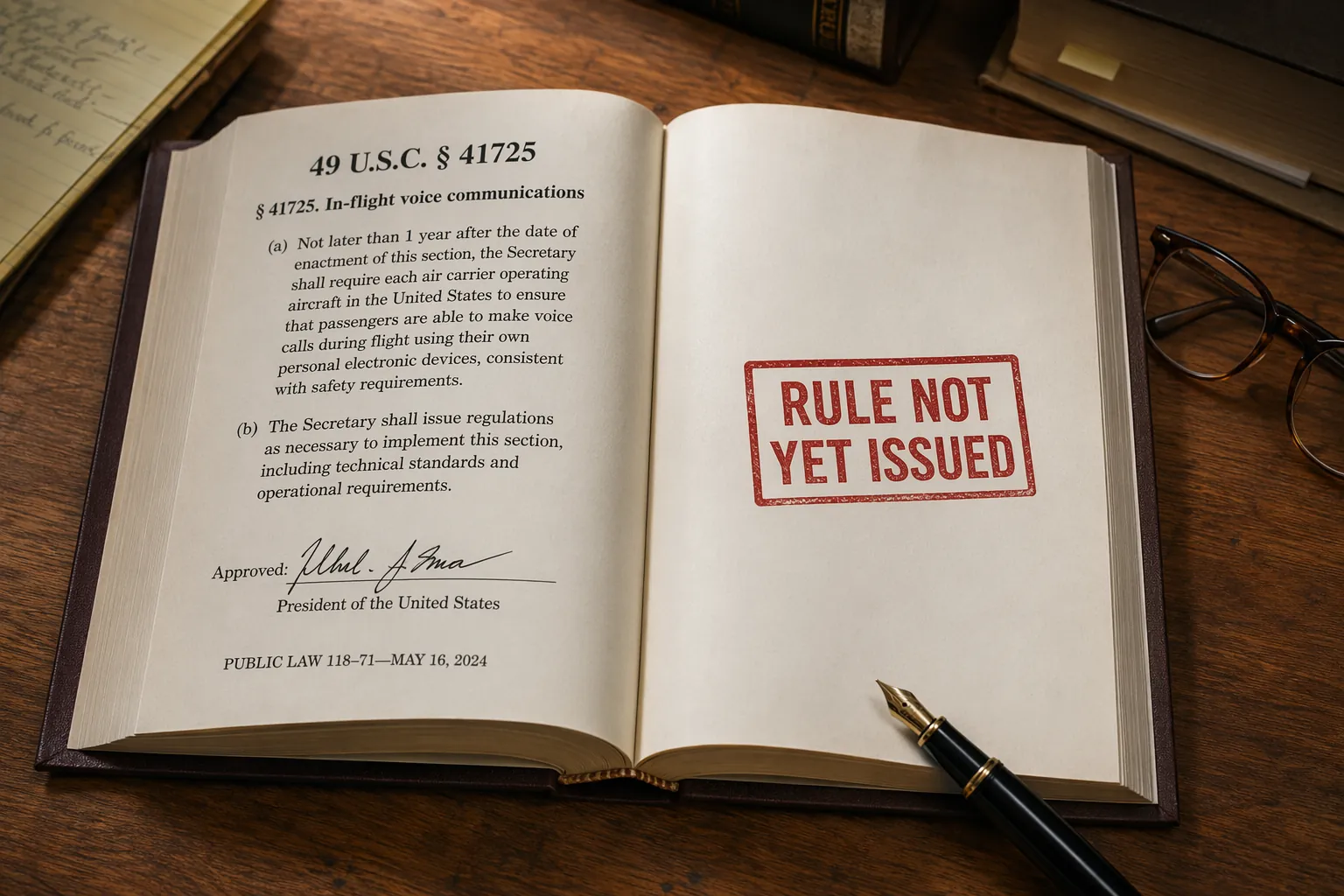
The oddity behind the search for a “flight cell phone ban bill 2025 law” is that Congress already put the instruction in the U.S. Code. Section 41725 of Title 49 says the Secretary of Transportation must issue regulations prohibiting an individual on an aircraft from engaging in voice communications using a mobile communications device during a flight of that aircraft in scheduled passenger interstate or intrastate air transportation.[1] That language did not arrive this summer. It traces back to the FAA Reauthorization Act of 2018, which directed the Department of Transportation to do the rulemaking.[2]
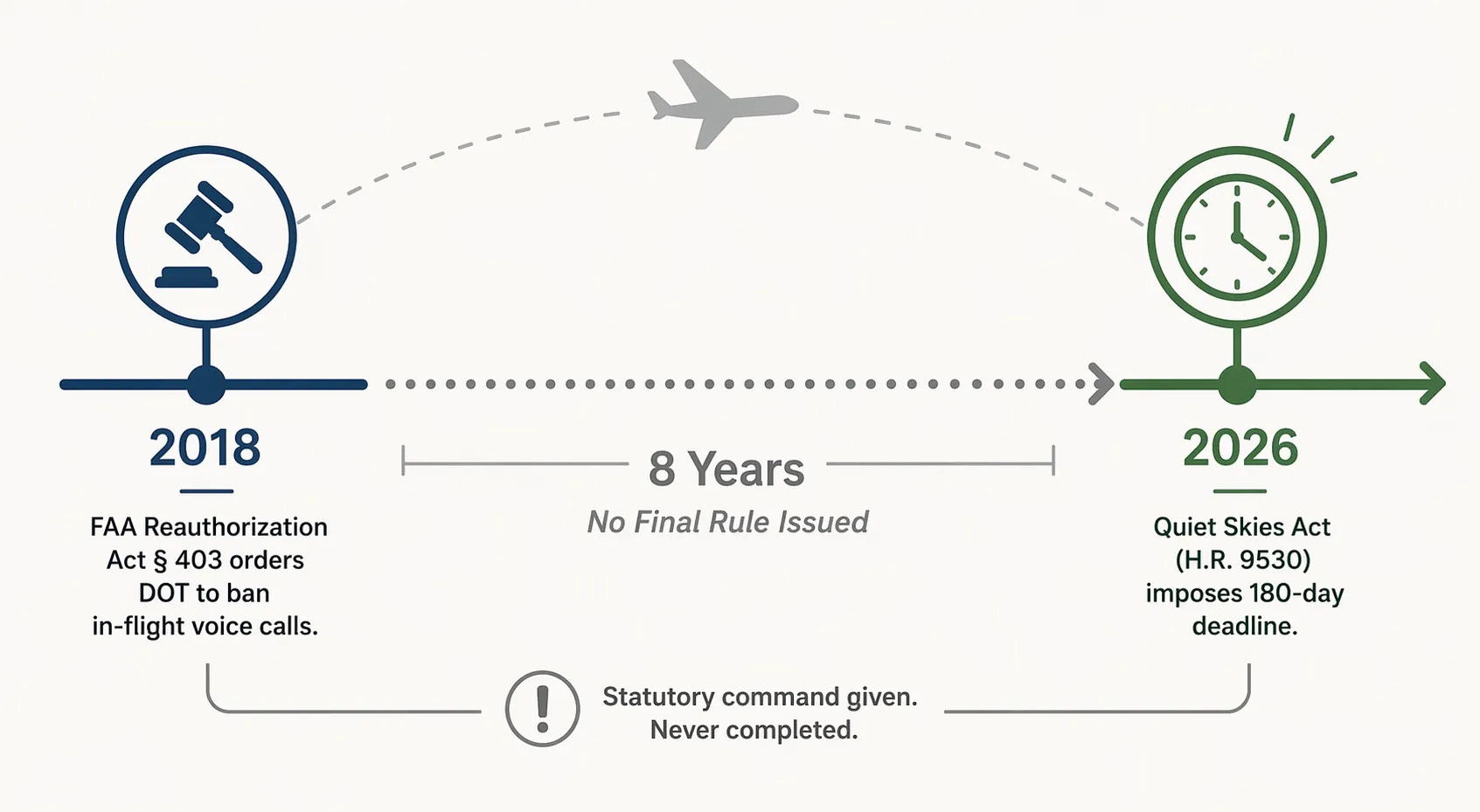
Yet, as of Q3 2026, there is still no completed federal passenger-conduct rule that makes in-flight cell phone voice calls illegal on U.S. commercial flights. What passengers mostly experience as a ban is, in practice, a patchwork of airline policies and crew instructions. The Quiet Skies Act, H.R. 9530, is aimed at that implementation gap. It was introduced in 2026, not enacted as a 2025 law, and its central move is blunt: give DOT 180 days after enactment to issue the final rule Congress already ordered.[3]
The Ban Exists as an Instruction, Not as an Enforceable DOT Rule
The legal texture matters because three things that sound similar are doing different work. A congressional directive tells an agency what to do. A codified section records that command in the U.S. Code. A final rule tells regulated parties what the operative standard is, when it applies, and how it will be enforced.
Section 41725 is the middle object. It is real law, and it is not a rumor about congressional preference. But it is written as a command to the Secretary of Transportation: “The Secretary of Transportation shall issue regulations.”[1] That formulation leaves the operational work at DOT. Until the agency completes the rulemaking, a flight attendant, airline lawyer, or compliance officer does not have a finished DOT conduct rule to cite in the same way they would cite a final regulation with defined enforcement consequences.
That is why the public experience can feel more settled than the federal law actually is. Major U.S. carriers may prohibit voice calls as a matter of policy, and passengers may assume those instructions reflect a direct federal ban. But the legal basis is not the same. A carrier policy can be revised by the carrier. A final DOT rule would be a federal standard.
| Instrument | What it does | What it does not do by itself |
|---|---|---|
| 2018 FAA Reauthorization Act, Section 403 | Directs DOT to begin rulemaking and issue final regulations prohibiting in-flight voice calls | Does not itself supply the completed DOT rule |
| 49 U.S.C. § 41725 | Codifies Congress’s instruction to the Secretary of Transportation | Does not replace the missing final regulation |
| Quiet Skies Act, H.R. 9530 | Would require DOT to issue the final rule within 180 days after enactment | Is not, as introduced, already enacted law |
What H.R. 9530 Actually Changes
H.R. 9530, the Quiet Skies Act, was introduced on June 29, 2026, in the 119th Congress by Representatives Hillary Scholten, Greg Stanton, Rick Crawford, and Rob Bresnahan.[3] The bill’s design is not elaborate because the missing piece is not a new policy architecture. The missing piece is final agency action.
The bill directs the Secretary of Transportation to issue, within 180 days of enactment, a final rule prohibiting an individual on an aircraft from engaging in voice communications using a mobile communications device during a flight in scheduled passenger interstate or intrastate air transportation.[3] In practical terms, it tries to convert the 2018 instruction from an unfinished mandate into an enforceable federal rule on a fixed clock.
- Deadline: DOT would have 180 days after enactment to issue the final rule.[3]
- Scope: the prohibition would apply to scheduled passenger interstate and intrastate air transportation.[1][3]
- Covered conduct: the target is voice communications using a mobile communications device during flight, not every use of a phone or internet-connected device.[1]
- Exemptions: the statutory language preserves exceptions for on-duty members of the flight crew and federal law enforcement officers.[1][3]
That last distinction is important. The bill is not a general anti-phone measure. It is not aimed at texting, reading, streaming, or using Wi-Fi-connected applications silently. Its subject is voice communication in the cabin, where the operational concern is no longer only spectrum management or device interference but passenger conduct in a shared aircraft environment.
Why a 2026 Bill Is Being Mistaken for a 2025 Law
There is no 2025 enacted law matching the Quiet Skies Act’s current role. The confusion is understandable because the 119th Congress spans 2025 and 2026, and because the underlying statutory command is older than both. But the bill at issue is H.R. 9530, introduced in June 2026, with later bill-tracking activity recorded in July 2026.[3][4]
As of the available bill records, H.R. 9530 had been introduced and referred to the House Committee on Transportation and Infrastructure. That status is not enactment. It matters because the bill’s 180-day clock would start only after enactment, not after introduction, committee referral, a press release, or public support from stakeholders.[3][4]
The Current System Leaves Airlines Holding the Line
In the absence of the DOT rule, airline policies do much of the practical work. That may be tolerable when carriers all choose the same restraint, but it is a fragile form of uniformity. A voluntary policy is easier to change than a federal regulation, and it leaves frontline personnel enforcing a norm that passengers may wrongly believe is already backed by a completed federal ban.
This is where the compliance problem is more interesting than the etiquette problem. A cabin can be noisy for many reasons. The harder institutional issue is that Congress gave DOT a conduct mandate in 2018, the mandate was codified, and the people charged with maintaining order in the cabin still operate without the final rule that was supposed to follow.
The Quiet Skies Act’s sponsors frame the bill as a way to finalize the ban that Congress already required. Stanton’s office described the proposal as legislation to “finalize” a ban on in-flight cell phone calls, and Scholten’s office likewise presented the bill as finishing the unresolved 2018 directive.[2][5] That wording is doing real work: the bill is not being sold as a first congressional look at the question, but as a forcing mechanism after years of noncompletion.
Connectivity Has Made the Gap Less Theoretical
For years, the missing rule could be treated as a dormant defect because in-flight voice calls were not a normal passenger option. That is becoming a less comfortable assumption. British Airways began allowing voice and video calls on Starlink-equipped aircraft in April 2026 and expanded the policy across Wi-Fi-equipped aircraft in May 2026, according to aviation trade coverage.[6]
The British Airways example does not prove that U.S. airlines will make the same policy choice. It does show why relying on technical inconvenience is not a durable regulatory substitute. As satellite Wi-Fi becomes more capable, the question is no longer whether an aircraft cabin can support more connected behavior. It is who decides whether voice calls belong there, and through what legal instrument.
The Federal Communications Commission’s separate airborne cellular restriction is not the missing answer. FCC rules have long addressed cellular use aboard aircraft for spectrum-interference reasons, including the rule codified at 47 C.F.R. § 22.925.[7] That is a technical communications regime. The Quiet Skies Act is about a DOT passenger-conduct rule for voice communications during scheduled passenger flights.
The Support Is Organized, but It Does Not Decide the Legal Question
The bill’s bipartisan sponsorship is useful because it keeps the proposal from being too easily reduced to partisan travel etiquette. The listed sponsors include Democrats Scholten and Stanton and Republicans Crawford and Bresnahan.[3] That does not make passage inevitable. It does make the bill harder to dismiss as a single-party complaint about cabin manners.
Institutional backing also matters, but it should be kept in its lane. The Global Business Travel Association supported the proposal in Stanton’s announcement, with CEO Suzanne Neufang quoted as saying that business travelers and travel managers value “productive and peaceful” cabins.[2] Flight attendant support has been reported around the same safety-and-order concern. Those views help explain the political constituency for finalizing the rule; they do not supply the missing regulation themselves.
Nor should old public-opinion data be made to carry too much weight. The available national polling commonly cited on passenger attitudes toward in-flight calls is dated. Even if travelers dislike the idea, dated attitudes are not the legal reason DOT has authority to act. Congress already supplied that reason in 2018.
If the Bill Passes, the Operational Change Is Narrow but Important
If H.R. 9530 is enacted, the immediate legal consequence is a deadline for DOT, not an instant cabin-by-cabin enforcement script. The Secretary would have 180 days to issue the final rule.[3] Airlines and their counsel would then be looking for the usual operational details: effective date, enforcement posture, crew guidance, passenger notices, and how the rule interacts with existing carrier policies.
The rule would likely make current voluntary policies easier to defend and standardize. A carrier would no longer be relying only on its own conditions of carriage or crew announcements to keep voice calls out of the cabin. A flight attendant facing a passenger who insists that the call is technically possible would have a federal conduct rule behind the instruction, not merely a carrier preference.
The exemptions also keep the rule from interfering with aviation and law-enforcement functions. On-duty crew and federal law enforcement officers are carved out in the statutory design.[1][3] That is not a decorative exception; it is what prevents a passenger-conduct rule from sweeping into operational communications that may be necessary during flight.
If It Stalls, the Gap Remains
If the bill stalls, the legal situation does not become newly permissive. It remains unfinished. Section 41725 would still sit in the U.S. Code as Congress’s instruction to DOT, and airlines could still maintain their own no-call policies. The difference is that the federal government would still lack the final DOT rule that Congress told it to produce.
That is the cleanest way to read the Quiet Skies Act. The absence of a federal in-flight voice-call ban is not evidence that Congress chose permissiveness after a completed debate. It is the result of an uncompleted rulemaking, and H.R. 9530 tries to force that rulemaking closed within 180 days.
References
- 49 U.S. Code § 41725 - Voice communications using mobile communications devices on scheduled flights, Cornell Legal Information Institute.
- Stanton Introduces the Quiet Skies Act, Stanton.house.gov, July 2026, https://stanton.house.gov/2026/7/stanton-introduces-the-quiet-skies-act-to-finalize-ban-on-in-flight-cell-phone-calls
- H.R. 9530 (IH), GovInfo, https://www.govinfo.gov/app/details/BILLS-119hr9530ih
- Quiet Skies Act (HR 9530), PoliScore, https://poliscore.us/2026/bill/hr/9530
- Congresswoman Scholten Introduces Quiet Skies Act to Finalize Ban on In-Flight Cell Phone Calls, Scholten.house.gov, https://scholten.house.gov/media/press-releases/congresswoman-scholten-introduces-quiet-skies-act-finalize-ban-flight-cell
- British Airways is Now Allowing Voice and Video Calls Across All Wi-Fi Equipped Planes, Paddleyourownkanoo.com, May 6, 2026, https://www.paddleyourownkanoo.com
- Cell Phones on Aircraft: Nuisance or Necessity?, U.S. Department of Transportation, July 14, 2005, https://www.transportation.gov/testimony/cell-phones-aircraft-nuisance-or-necessity
Related records
Tool profile
Browse tool evaluations →Governing regulation
Browse the obligations tracker →Preventive workflow
Browse verification workflows →
Report a correction or tip
Spotted an outdated figure, a misstated fact, or a ruling this case record should reflect? Public comments are disabled for this content given the professional cost of a misreported case outcome, penalty amount, or rule text — use the structured correction channel instead.
Report a correction or tip for this record →