
How the Red Sea Houthi Attacks Cascade Into Insurance and Contract Breaches
As the Red Sea blockade drives war risk premiums to record highs and insurers withdraw cover, shipping companies face cascading breaches of charterparty insurance clauses, loan covenants, and trade finance documentary conditions. This article traces the contractual dangers that extend beyond the direct attack risk and outlines the legal steps counsel should take now.
- Jurisdiction
- United Kingdom Supreme Court
- Ruling date
- Jan 1, 2024
- Source document
- View primary court order ↗
Lex Machina Review is an independent risk-tracking and reference resource. Nothing on this site is legal advice, and using it does not create an attorney-client relationship. Every record is reviewed against primary sources but may not reflect the most current status of a matter — always verify directly against the cited court order, rule text, or a licensed attorney before relying on it.
Companion explanation — secondary to the source document above
Last updated July 24, 2026. A vessel does not need to be struck in the Red Sea for the legal file to become difficult. The more common sequence is quieter: war risk cover becomes materially more expensive or is withdrawn, a seven-day cancellation notice arrives, the vessel avoids the area, delivery dates move, and the documents prepared for the original voyage stop matching the transaction they were meant to support.
That is where Red Sea Houthi attacks, oil price spikes, and their legal implications become practical rather than rhetorical. Reuters reported that war risk pricing had moved from about 0.05% of hull value before 2023 to a 2024 peak of 1% per seven-day voyage, then settled around 0.3% before surging to about 0.75% after the Houthi blockade declaration in July 2026; for a $100 million vessel, that puts a single transit in the range of $750,000 to $1 million in war risk cover alone at the reported levels.[1] Those figures are visibly time-sensitive and will not be the same number in every placement. But they explain why commercial teams are making fast routing decisions before the lawyers have reconciled the insurance, charterparty, loan, and trade finance documents.
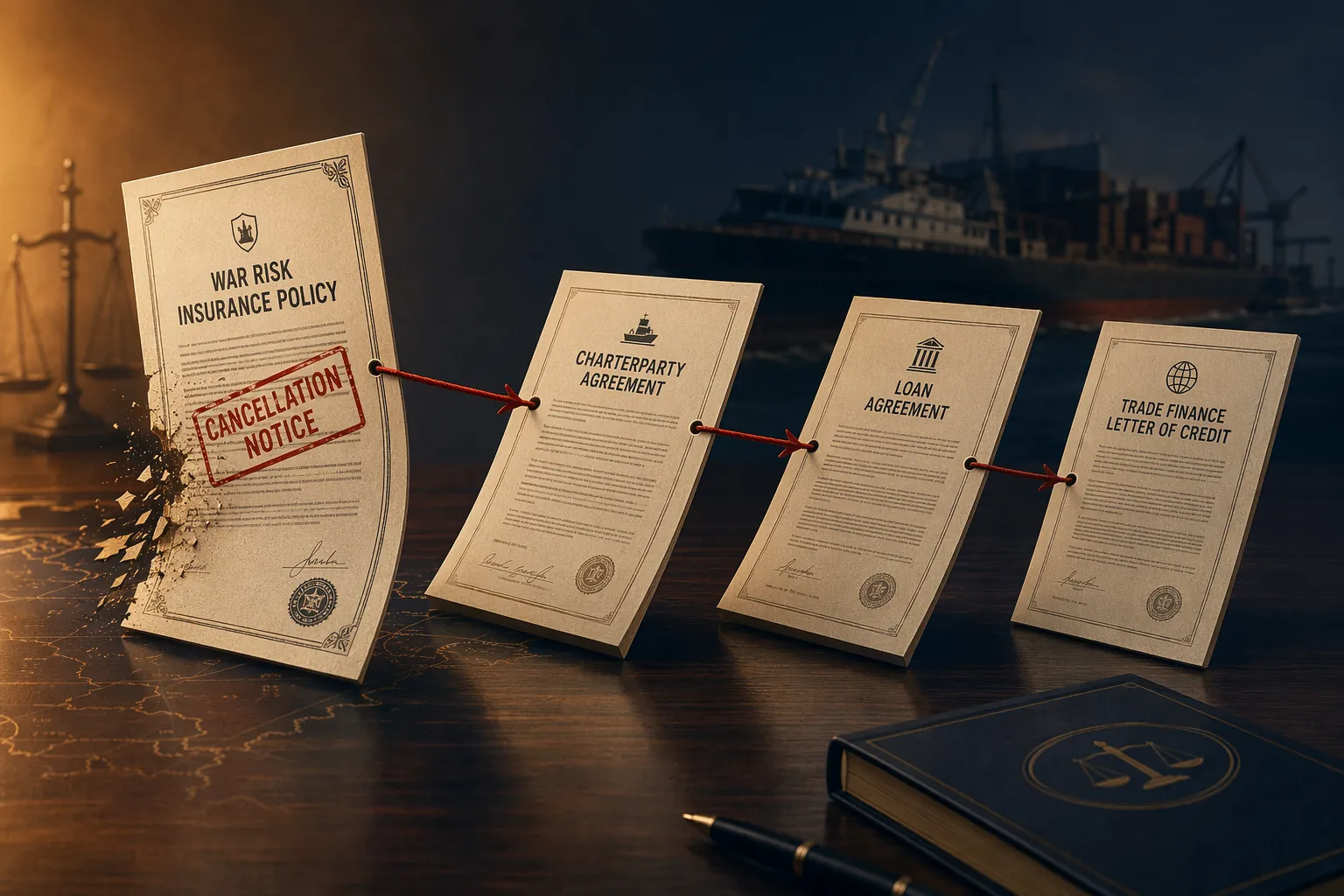
The first mistake is to ask only whether the vessel has been physically damaged. The second is to ask only whether there is “war risk insurance.” In many files, the loss that arrives first is not hull damage, cargo damage, or a formally declared frustration of the voyage. It is delay, precautionary rerouting, additional premium, changed documentation, and a dispute over who had the contractual right to avoid the route.
The uninsured loss often starts with delay, not impact
Standard marine cargo policies are primarily built around physical loss or damage to cargo, and standard business interruption cover is usually tied to insured damage or a specified insured peril. Pure delay, loss of market, deterioration in a delivery schedule, or precautionary rerouting will often sit outside ordinary cover unless the policy has been specifically extended or written on terms that respond to that kind of interruption.
That distinction matters because it changes the legal conversation. If the cargo is hit, the file moves toward named perils, exclusions, causation, sue and labor, general average, salvage, and subrogation. If the vessel is not hit but diverts around the Cape, the immediate loss may be freight economics, missed delivery windows, demurrage, additional bunkers, financing deadlines, or documentary mismatch. Those losses may be very real without being insured losses under the policies the commercial team expected to lean on.
The qualification is important. Some bespoke cargo programs, delay-in-start-up products, trade disruption policies, political risk placements, or carefully drafted all-risk wordings may respond differently. The point is not that delay can never be covered. It is that no one should assume that a Red Sea rerouting loss is covered merely because the word “war” appears somewhere in the insurance schedule.
Start the audit with the cancellation notice
Reported insurer conduct is now part of the contract analysis. Insurance Business reported seven-day cancellation notices and withdrawal of war risk cover for Gulf and Red Sea transits in the current market.[2] A notice of that kind is not just an insurance administration point. It may be the document that starts the clock on a charterparty breach, a loan covenant issue, or a failure to provide conforming trade finance documents.
Counsel should pull the notice itself, not rely on a broker summary. The necessary checks are mechanical but consequential: who gave notice, under which cancellation or alteration clause, when the notice is effective, whether it applies to the particular area, whether cover is cancelled entirely or only amended, whether additional premium is available, whether the assured must notify mortgagees or charterers, and whether certificates already issued remain accurate.
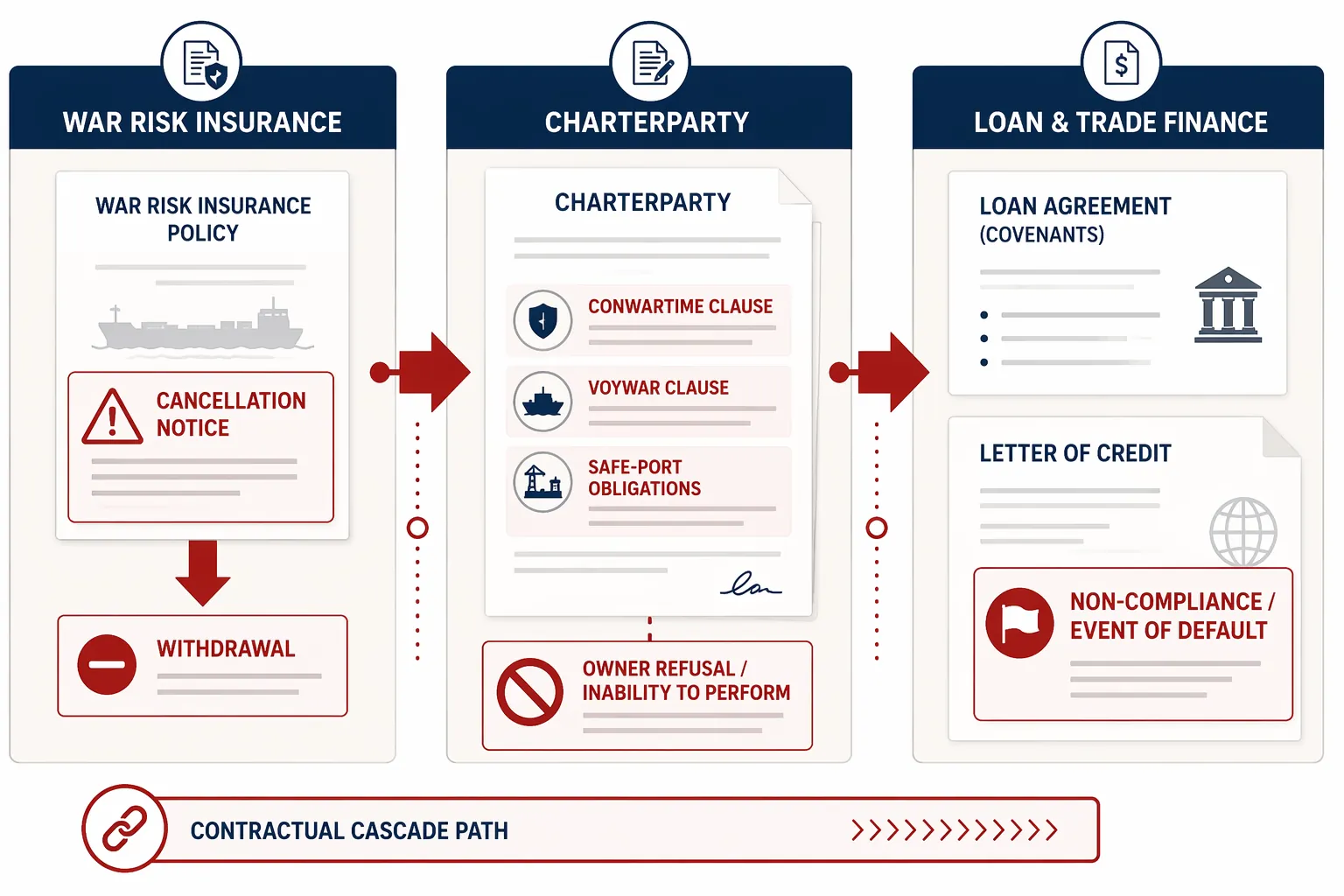
| Document | Question to answer first | Why it matters |
|---|---|---|
| War risk policy | Has cover been cancelled, withdrawn, restricted, or made subject to additional premium? | The answer controls whether the vessel can comply with insurance-maintenance obligations. |
| Charterparty | Who bears the risk of entering, refusing, delaying, or diverting from the area? | The answer controls orders, off-hire, detention, deviation, and additional expense claims. |
| Loan agreement | Does the insurance change breach any covenant to maintain approved cover? | The answer controls default risk, waiver timing, and lender consent. |
| Letter of credit | Do insurance certificates and transport documents still match the credit? | The answer controls documentary compliance and payment. |
This is the point at which oil price movement and chokepoint headlines matter legally: they increase the pressure to choose a route quickly. But the legal exposure usually turns on the documents that follow that choice.
Charterparty wording decides whether avoidance is a right or a breach
The charterparty is usually the hardest part of the cascade because it is where safety, insurance, routing, time, and expense meet. A shipowner may say it is entitled to refuse an order into the Red Sea or Gulf region. A charterer may say the risk is commercially manageable, that cover remains available at a price, or that the owner is using market volatility to escape an unfavorable voyage. Both positions are useless until the actual form and rider clauses are read.
CONWARTIME 2013 and VOYWAR clauses are central because they may give owners rights to refuse orders into areas affected by war risks and to recover detention, diversion, or additional expenses. The scope of those rights depends on the exact wording and on whether the relevant events fall within the clause’s treatment of war risk, piracy risk, terrorism, hostilities, blockade, seizure, or similar perils.[3][4]
That last classification is not academic. If the clause responds to “war risks” in one way and “piracy risks” in another, counsel has to resist the temptation to describe every armed maritime incident in the same vocabulary. The Asana chemical tanker hijacking tests maritime piracy law article is a useful separate verification path for that problem, because piracy labels can affect insurance and charterparty consequences without answering every Red Sea blockade question.
The safe-port analysis also has to be kept distinct from the war-risk clause. A port or route may become commercially unattractive without necessarily becoming legally unsafe for the purposes of the particular charterparty. Conversely, a route may present a risk that triggers an express war-risk refusal right even if the safe-port dispute would be more difficult. The owner’s evidential file should therefore include notices, Joint War Committee or market area designations where relevant to the policy wording, threat information available at the time of the order, broker communications on cover, and the commercial consequences of available alternatives.
MV Polar is a useful warning against over-reading the presence of a war-risk regime. The UK Supreme Court decision in MV Polar [2024] UKSC 2 clarified that charterparty war-risk arrangements do not necessarily prevent recovery from charterers for general average contributions after security incidents; the result turned on the contractual allocation of risk rather than a broad proposition that war-risk insurance always supplies the exclusive remedy.[5] The case is not a Red Sea blockade decision and should not be stretched into one. Its value here is methodological: read the insurance bargain together with the charterparty wording before declaring that one party has absorbed the whole risk.
Questions that should be answered before positions harden
- Does the clause require an objective danger, the owner’s reasonable judgment, or another threshold before refusal is permitted?
- Does the wording distinguish war, terrorism, piracy, blockade, seizure, mines, and malicious acts?
- Who pays additional war risk premium if cover remains available but only at a materially higher price?
- Are detention, deviation, extra bunkers, security costs, and additional insurance premium expressly recoverable?
- Does the charterparty require notice before refusing orders, changing route, or claiming additional expenses?
- Is the vessel off-hire during waiting, deviation, or insurance-driven delay?
A charterparty answer reached after the voyage may still matter in arbitration. A charterparty answer reached before the routing decision may prevent the rest of the cascade.
Insurance-maintenance clauses can turn market disruption into default risk
Many shipping finance documents require the borrower to maintain insurances of specified kinds, amounts, markets, brokers, deductibles, and mortgagee protections. A war risk cancellation or restriction may therefore be more than a premium problem. It may place the borrower in breach unless replacement cover is obtained, lender consent is secured, or a waiver is agreed within the relevant cure period.
The practical difficulty is timing. A seven-day cancellation notice can expire faster than a credit committee can approve a waiver. If the vessel is already committed to a voyage, the borrower may be trying to negotiate additional premium, reroute, satisfy charterparty obligations, and keep lenders comfortable at the same time. A legal team that waits until the insurance certificate is formally amended may have lost the best window for lender engagement.
The loan review should be narrow and disciplined. Identify the insurance covenants, approved broker and insurer requirements, war risk endorsements, mortgagee notice provisions, assignment of insurances, minimum value provisions, material adverse change language, sanctions covenants, and event-of-default triggers tied to loss or impairment of insurance. Then compare them against the actual notice and the proposed route.
A temporary increase in premium is not automatically a default. Withdrawal of a required class of cover, failure to maintain mortgagee-approved terms, or sailing into an area excluded by the amended policy is a different matter. The drafting decides which category the file belongs in.
The trade finance problem is documentary, not atmospheric
Letters of credit do not pay because everyone understands why the voyage changed. They pay against documents. That is why the less obvious Red Sea exposure may sit in the insurance certificate, bill of lading, shipment period, named ports, transshipment language, route description, or required coverage terms.
Gibson Dunn has flagged the trade finance gap created when insurance certificates change because of rerouting or altered cover, causing possible documentary non-compliance under letters of credit.[5] In practice, this can arise even when the underlying commercial parties agree that diversion was sensible. The bank’s document checker is not deciding whether the master acted prudently in avoiding a missile threat. The checker is comparing documents against the credit.
The uncomfortable point is that a lawful and commercially sensible rerouting can still produce a payment problem. If the credit requires a certificate showing named war risk cover, a particular voyage, a stated port pair, or cover from warehouse to warehouse on specified terms, a revised certificate may no longer comply. If the bill of lading date shifts beyond the shipment window, the problem may be independent of insurance. If the credit prohibits transshipment or requires a named vessel and the logistics response changes the carriage chain, the finance document may fail even though the cargo is safe.
The answer is not to ask the bank informally whether it understands the situation. Counsel should obtain the credit, amendments, insurance certificate requirements, latest policy evidence, bills of lading, charterparty routing notices, and any proposed documentary changes in one file. If a credit amendment is needed, it should be requested before shipment documents are presented, not after a discrepancy notice lands.
Force majeure will not repair inconsistent documents
Force majeure may matter in sale contracts, terminal contracts, logistics contracts, and long-term supply arrangements. It may also fail on notice, causation, mitigation, foreseeability, or the wording’s list of covered events. But it is a poor substitute for the document-by-document audit required here.
A force majeure notice does not, by itself, restore cancelled war risk cover. It does not rewrite a CONWARTIME or VOYWAR clause. It does not cure a loan covenant breach if required insurance is no longer maintained. It does not make a discrepant letter of credit presentation compliant. Treat it as one possible contract remedy, not as the organizing theory of the file.
For readers working on systemic risk evaluation rather than a single file, the Bab al-Mandab Strait Disruption Tests Legal and AI Risk Models article is the better place to test how chokepoint disruption is being mapped across legal and operational systems. The present task is narrower: identify which signed documents are already reacting to the insurance change.
Sanctions sit on top of the cascade
Sanctions should be flagged early, but they should not be allowed to blur the insurance and charterparty analysis. Houthi designation issues, Iranian sanctions overlays, payment restrictions, insurer compliance requirements, and bank screening can affect whether cover is written, whether a claim is paid, whether additional premium can be collected, and whether a trade finance bank will process documents. Those questions may be jurisdiction-specific and fact-specific.
The practical handling is to run sanctions as a parallel workstream. Do not wait for the sanctions answer before preserving charterparty notices, lender communications, and documentary amendment rights. Equally, do not advise that a clause permits or requires performance without checking whether payment, insurance, or claims handling is separately blocked or delayed by compliance rules.
The audit path
The useful file note is not a geopolitical summary. It is a chronology with documents attached. The sequence should begin with the latest broker and insurer communications, then move through the charterparty, finance documents, and trade documents in the order in which obligations are triggered.
- Collect the withdrawal, cancellation, alteration, and additional premium notices, including effective dates and geographic scope.
- Confirm the current policy wording, certificates, endorsements, exclusions, cancellation provisions, and any mortgagee or charterer notice requirements.
- Test the charterparty under the exact war-risk, piracy-risk, safe-port, off-hire, deviation, detention, additional premium, and expense recovery clauses.
- Check whether the insurance change, route change, or threatened sailing creates a breach or potential default under loan covenants.
- Compare letters of credit and other trade finance instruments against any changed insurance certificates, shipment windows, vessel details, ports, routing, and transport documents.
- Run sanctions screening as a parallel check on underwriting, premium payment, claims payment, banking channels, and counterparties.
The legal exposure is not confined to the vessel that is hit. It sits in the vessel that diverts, the certificate that changes, the covenant that assumes uninterrupted cover, and the letter of credit that still asks for the original documents. Counsel who can put those documents in sequence will usually find the real breach risk before it is described as a surprise.
References
- Red Sea war insurance costs rise after Houthi blockade, sources say, Reuters, July 20, 2026
- Houthis declare Red Sea blockade — and insurers face a two-front crisis, Insurance Business, June 2026
- Global shipping considers legal impact of Red Sea attacks, Hill Dickinson
- The Middle East Conflict: Key Legal Considerations for Investors and Commercial Operators, Paul Hastings
- Commercial and Supply Chain Implications of the Gulf Conflict: Shipping Contracts and Insurance, Gibson Dunn
Related records
Tool profile
Browse tool evaluations →Governing regulation
Browse the obligations tracker →Preventive workflow
Browse verification workflows →
Report a correction or tip
Spotted an outdated figure, a misstated fact, or a ruling this case record should reflect? Public comments are disabled for this content given the professional cost of a misreported case outcome, penalty amount, or rule text — use the structured correction channel instead.
Report a correction or tip for this record →