
Legal Implications of Reddit Posts in Murder-Suicide Cases
The Karolkiewicz murder-suicide case raises critical questions about authenticating pseudonymous Reddit posts as evidence. This analysis examines the FRE 901(b)(4) pathway, hearsay exceptions, and the unresolved gaps in digital-forensic standards that litigators must navigate.
- Jurisdiction
- Michigan
- Court
- Michigan state court
- AI tool named
- Ruling date
- Jul 30, 2026
- Source document
- View primary court order ↗
- Last verified
- Jul 30, 2026
Lex Machina Review is an independent risk-tracking and reference resource. Nothing on this site is legal advice, and using it does not create an attorney-client relationship. Every record is reviewed against primary sources but may not reflect the most current status of a matter — always verify directly against the cited court order, rule text, or a licensed attorney before relying on it.
Companion explanation — secondary to the source document above
As of July 30, 2026, the Karolkiewicz investigation remains unresolved in the only way that matters for evidence law: no court has ruled that the Reddit account MandyK1179 belonged to Mandy Karolkiewicz, no court has ruled that the posts are admissible, and no criminal trial is expected if the alleged perpetrator died by suicide. The legal analysis therefore begins with restraint. Media outlets have matched the account against details from Mandy Karolkiewicz’s public life; her family has also said it cannot confirm that she wrote the posts. Both facts have to stay in the file.
The central evidentiary question is narrower than the online discussion around the case: could a pseudonymous victim account be authenticated through circumstantial characteristics under Federal Rule of Evidence 901(b)(4), and under parallel Michigan Rule of Evidence 901 principles, before anyone reaches hearsay? On the present public record, the answer is conditional. There is a plausible authentication path. There is also a serious provenance problem if counsel has only ordinary screenshots, copied text, or media images of the posts.
The account is not proven, but the matching details matter
The public authentication theory depends on accumulation, not on a single dramatic clue. Reports about the MandyK1179 account have pointed to overlapping characteristics: the poster and Mandy Karolkiewicz were both described as 38; the account discussed six children; the family lived in Grand Haven Township; the wedding timeline lined up with public reporting; and the account’s references to the husband’s employment history appeared to match Kristopher Karolkiewicz’s background as reported by local outlets.[1][2]
That is exactly the kind of evidence Rule 901(b)(4) is built to consider: contents, distinctive characteristics, internal patterns, and surrounding circumstances. A pseudonymous handle is not self-authenticating. But a post can carry identity evidence in the ordinary texture of a life: number of children, place, marriage chronology, job references, and the kind of details a fabricator would have had to gather and align before the event became public.
It would still be a mistake to call that proof of authorship. Emily Jones, identified in reporting as a family spokesperson, said: “I do want to make it clear that we have no way to confirm that was Mandy that made the posts.”[1] That sentence is not a footnote to the story. It is the evidentiary dispute.
| Publicly reported matching point | Why it may matter under a 901(b)(4) theory | What it does not prove by itself |
|---|---|---|
| Age reported as 38 | A basic biographical match can narrow the universe of possible authors. | Many people share an age; it is weak standing alone. |
| Six children | A specific family composition is more distinctive than a generic marital complaint. | It does not establish who had access to the account. |
| Grand Haven Township residence | Location can connect the posts to a real household and local timeline. | It does not exclude someone else with knowledge of the family. |
| Wedding timeline | Marriage chronology can help link posts to public records and family history. | It does not authenticate the capture of the posts. |
| Employment history references | Work details may function as distinctive internal characteristics. | They still require a witness or records foundation. |
The table is not a scorecard. Courts do not authenticate social media by counting matching details as if they were points. The better use is cumulative: each characteristic supplies another circumstance from which a factfinder could infer that the account was what the proponent claims it was. The opposing party would press the same list in reverse: public details can be copied, family facts can be known by more than one person, and a shared device or borrowed login can complicate authorship.
In a live prosecution, that argument might be developed through subpoenas, account records, device extractions, IP information, witness testimony, and forensic review. The Karolkiewicz posture is different. Public reporting is doing the work a courtroom foundation has not yet done. For news readers, the match may feel persuasive. For litigators, it is only the beginning of a foundation.
A plausible identity theory does not cure a weak capture
The most vulnerable point is not necessarily whether the account looks like Mandy Karolkiewicz’s. It is whether the version offered in court is the same digital material that existed online, captured at a known time, by a known process, without alteration.
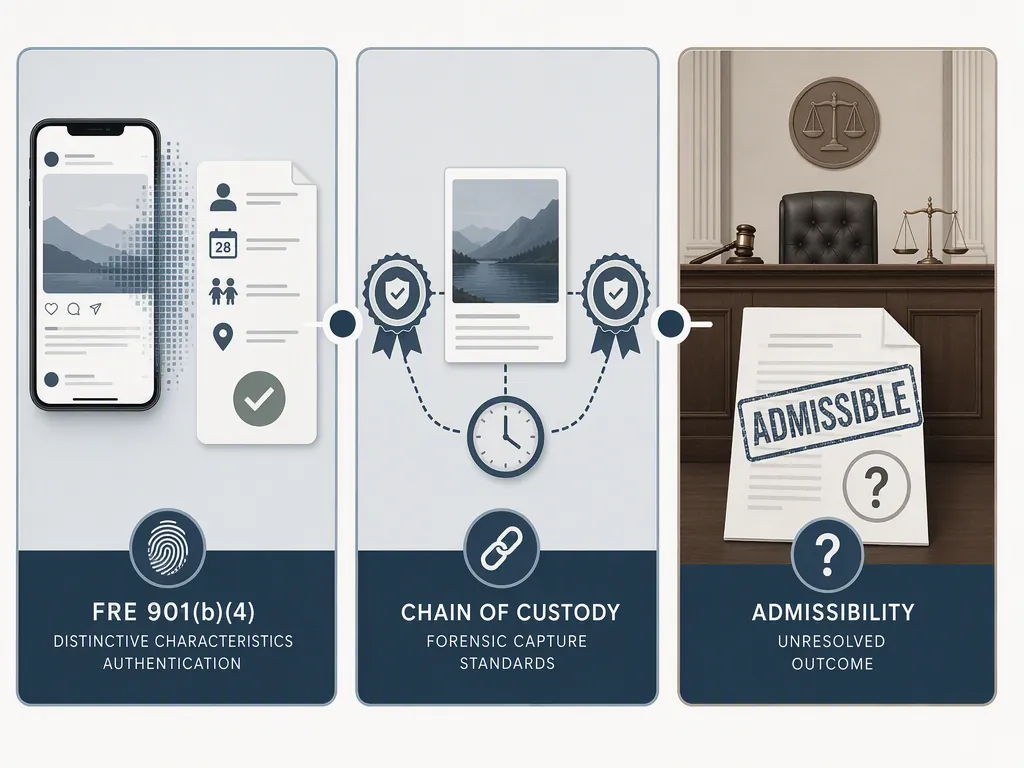
Ordinary screenshots are useful investigative leads. They are weaker as courtroom exhibits when nobody can say who captured them, when they were captured, what page or URL they came from, whether surrounding comments were omitted, whether the account page changed, whether metadata was preserved, or whether the image was altered after capture. A copied Reddit post in a news article has an additional layer: the litigant may be trying to authenticate not the original post, but a media reproduction of a post.
Digital-forensic guidance increasingly treats that gap as avoidable. The TrueScreen 2026 admissibility guide describes ISO/IEC 27037-aligned practices such as metadata preservation, cryptographic sealing, and qualified timestamps for forensic-grade capture of online evidence.[3] That guidance is not binding law. A vendor guide cannot turn a bad exhibit into an admissible one by vocabulary. But it identifies the questions counsel should expect: what was preserved, how integrity was maintained, and whether the capture can be independently checked.
This is where Rule 901(b)(4) should not be treated as a shortcut. Distinctive characteristics may help prove that MandyK1179 was Mandy Karolkiewicz. They do not prove that Exhibit 12 is a complete and accurate representation of what appeared on Reddit on a particular date. Identity and integrity are related, but they are not the same foundation.
What a cleaner record would preserve
A defensible preservation record would not have to be exotic. It would have to be boring in the way evidence foundations are supposed to be boring: repeatable, documented, and reviewable. Counsel would want the account URL, post URLs, visible timestamps, capture date and time, the full page context, user profile context, comments if relevant, hash values for captured files, metadata, the identity and qualifications of the person who captured the material, and a chain showing where the files went afterward.
If platform records can be obtained, they are better than screenshots. If a forensic capture can be completed before deletion or account changes, it is better than a later archive. If a witness saw the posts contemporaneously, that witness may help, but a memory of viewing a post is not the same thing as a technical integrity record. Each layer can support the other. None should be asked to do all the work.
Proposed Federal Rule of Evidence 707, released for public comment in August 2025, points in the same direction by calling for provenance scrutiny of digital evidence for signs of fabrication or tampering.[3] It has not been adopted. Its present value is not as a rule counsel can invoke, but as a warning about where evidentiary fights are moving: courts are being asked to look harder at how digital material came into the courtroom.
Only after authentication does hearsay become interesting
The reported contents of the MandyK1179 posts include allegations about the husband’s affair, fear about leaving the marriage, marital distress, and the poster’s statement that she stayed because the couple had six children.[4] Those details invite a hearsay analysis, but hearsay is not the first gate. An unauthenticated statement does not become admissible because it sounds like a state of mind.
If authorship were established, portions of the posts would fit naturally within the Rule 803(3) category for then-existing state of mind, emotion, intent, or plan. A statement such as fear of leaving is different from a statement offered to prove that another person committed a past act. The former may show the declarant’s condition; the latter risks being used as proof of the husband’s conduct. The distinction matters.
| Reported content | Possible evidentiary use | Likely pressure point |
|---|---|---|
| Fear about leaving | Then-existing emotional condition under a state-of-mind theory. | Requires proof the decedent authored the statement. |
| Decision to stay because of six children | Intent, motive, or state of mind of the declarant. | May be admitted for limited purpose, not as a general narrative of fault. |
| Alleged affair | Context for the declarant’s emotional state. | More vulnerable if offered for the truth of the alleged infidelity. |
| Marital distress | Condition of the relationship as perceived by the declarant. | May require limiting instructions or redaction depending on proceeding. |
The careful proponent would not offer the entire Reddit history as one undifferentiated confession from beyond the grave. The careful opponent would not need to defeat every line. A few statements may be admissible for state of mind; other statements may be excluded or limited if they are being used to prove external facts. The authentication fight determines whether the court ever reaches that parsing.
The missing criminal trial changes the objections, not the evidence problem
If the alleged perpetrator is dead, the ordinary confrontation question recedes because there is no criminal defendant to confront the declarant in a homicide trial. That does not make the posts legally irrelevant. Probate disputes, wrongful-death litigation, insurance questions, custody-related records, public-record requests, and collateral civil proceedings can all create reasons for a court, agency, or lawyer to ask what the posts are and whether they can be relied upon.
The admissibility posture may also shift the incentives. A prosecutor preparing for trial might build an account foundation through platform subpoenas and forensic device work. A probate lawyer may encounter the same posts as attachments forwarded by relatives. A wrongful-death lawyer may receive a folder of screenshots collected after the case became public. An insurer may see excerpts in press coverage. The legal risk rises each time the material moves farther from the original account and closer to a copied image detached from its capture history.
That is why the Karolkiewicz fact pattern is useful even before any ruling. It shows how quickly public narrative can outrun legal foundation. The posts may become central to how outsiders understand the household. They may also remain inadmissible, limited, or unproven in any formal proceeding if nobody preserved them in a way the court can trust.
Why this issue will recur
The evidentiary problem is not limited to Reddit, and it is not limited to this family. Everytown Research has reported that intimate-partner homicide-suicide occurs with firearms in about 85% of cases and that states with the weakest gun laws have rates three times higher than states with the strongest gun laws.[5] Separate reporting has described family annihilations as occurring every five days in the United States, and The Guardian, citing Gun Violence Archive data, reported the Karolkiewicz killings as at least the eighth such event in 2026.[6][7]
Those numbers are not a substitute for admissibility analysis. They explain why the same problem keeps appearing. In cases where both the victim and alleged perpetrator are dead, courts and lawyers may have no living central witness. The remaining record can be made of texts, searches, posts, drafts, deleted accounts, location data, and screenshots taken by people who were not thinking like evidence custodians when they hit save.
The temptation is to make the digital trace carry more certainty than it can bear. A pseudonymous post can be emotionally powerful and legally fragile at the same time. A screenshot can be accurate and still poorly authenticated. A family’s inability to confirm authorship does not disprove the account, but it prevents responsible lawyers from treating the account as settled fact.
The practical litigation answer
On the public facts now available, the MandyK1179 posts could plausibly be authenticated through distinctive characteristics if a proponent can connect the account to Mandy Karolkiewicz by cumulative biographical and circumstantial evidence. The reported matches—age, six children, residence, wedding timeline, and employment references—are the right kind of material for a Rule 901(b)(4) argument. They are not, by themselves, a final ruling.
If authenticated, some statements could fit a state-of-mind hearsay exception, especially statements about fear, intent, and reasons for staying. Statements offered to prove the husband’s alleged conduct would require more care. The absence of a criminal trial against a deceased alleged perpetrator reduces confrontation concerns, but it does not eliminate authentication, hearsay, relevance, prejudice, or completeness objections in other proceedings.
The weak link is provenance. Litigators who may need social media evidence in a murder-suicide, wrongful-death, probate, or insurance matter should preserve first and argue later: capture the original pages where possible, document the capture method, maintain metadata, hash the files, timestamp the preservation, identify the custodian, and seek platform or device records when available. Media screenshots and informal copies may help investigators find the path. They may not be sturdy enough to walk into evidence.
References
- ClickOnDetroit report on the MandyK1179 Reddit account and Karolkiewicz case — ClickOnDetroit, July 28, 2026
- Holland Sentinel report on the Karolkiewicz case and MandyK1179 account — Holland Sentinel, July 27, 2026
- Admissibility of Digital Evidence in Court — TrueScreen, 2026
- People.com coverage of the Karolkiewicz case and reported Reddit posts — People.com, July 28–29, 2026
- Dual Tragedies — Everytown Research
- Indianapolis Star report on family annihilations in the United States — Indianapolis Star, December 2023
- The Guardian report citing Gun Violence Archive data on 2026 family annihilation events — The Guardian, July 28, 2026
Related records
Tool profile
Browse tool evaluations →Governing regulation
Browse the obligations tracker →Preventive workflow
Browse verification workflows →
Report a correction or tip
Spotted an outdated figure, a misstated fact, or a ruling this case record should reflect? Public comments are disabled for this content given the professional cost of a misreported case outcome, penalty amount, or rule text — use the structured correction channel instead.
Report a correction or tip for this record →