
Legal Risks in the Reflecting Pool No-Bid Contract
This analysis maps the procurement, historic preservation, and ethics violations alleged in the National Mall Reflecting Pool renovation, with the contract's 'unusual and compelling urgency' justification under scrutiny as litigation and congressional investigations proceed.
- Jurisdiction
- U.S. District Court for the District of Columbia
- Ruling date
- May 11, 2026
- Source document
- View primary court order ↗
Lex Machina Review is an independent risk-tracking and reference resource. Nothing on this site is legal advice, and using it does not create an attorney-client relationship. Every record is reviewed against primary sources but may not reflect the most current status of a matter — always verify directly against the cited court order, rule text, or a licensed attorney before relying on it.
Companion explanation — secondary to the source document above
The legal problem in the Reflecting Pool no-bid contract starts before the public controversy over the pool’s color or condition. It starts with a procurement sequence: an initial National Park Service award to Atlantic Industrial Coatings, identified in reporting from USASpending.gov data as CONT_AWD_140P2026C0028, with an initial value of $6.9 million and later reported growth to $14.7 million; a separate no-bid $1.7 million cleaning contract to Green Water Solutions, identified as CONT_AWD_140P2026C0031; and a later decision not to seek new bids for repair work after the first effort failed to deliver a stable result.[1]
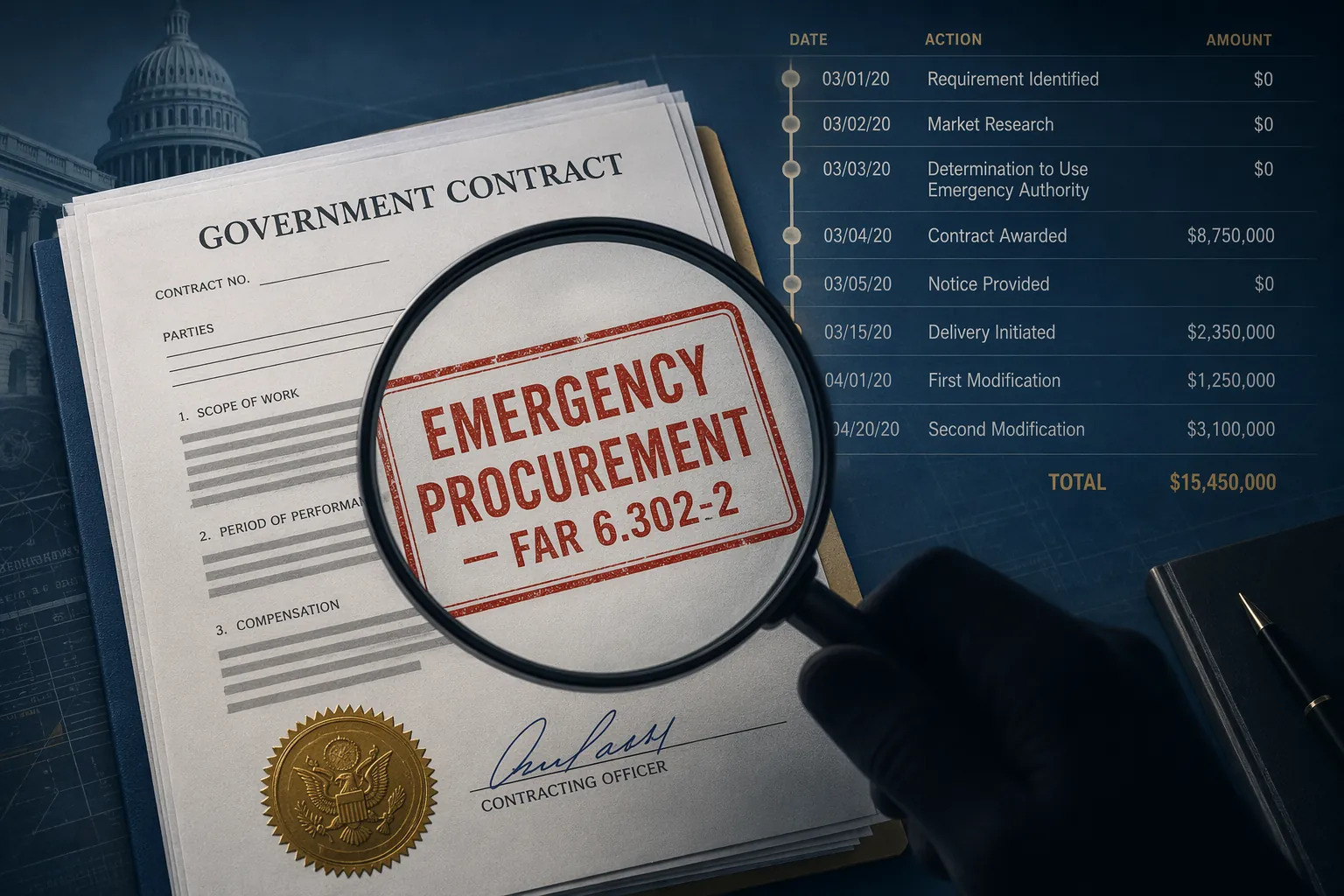
That timeline matters because the government did not merely choose a contractor. It invoked an exception to competition. FAR 6.302-2 permits other-than-full-and-open competition when an agency’s need is of “unusual and compelling urgency.” The exception is real, and sometimes necessary. It is also narrow. The administrative record has to show why delay for competition would cause unacceptable harm, why the selected procurement path was limited to what the emergency required, and why the agency did not convert urgency into a general license to avoid the market.
The Procurement Record Carries the Legal Weight
The first uncomfortable date is April 3, 2026, when the Atlantic Industrial Coatings contract was signed. The date becomes more important because Trump later publicly described the work at a lower cost than the figures reported in the contract record, while subsequent reporting showed the award expanding far beyond the initial $6.9 million figure.[1]
The government’s own cost concern is harder to treat as outside noise. The New York Times reported on May 27, 2026, that an internal National Park Service contracting specialist’s analysis found a 20% profit margin in the reflecting-pool contract, compared with a standard range of 6% to 12%, and that the margin added at least $850,000 in excess costs.[2] That is not, by itself, a judicial finding of illegality. It is, however, the kind of internal procurement record that investigators read closely because it connects price reasonableness, source selection, and the asserted need to move quickly.
The no-bid pattern did not end with the original contractor. CBS News reported that Green Water Solutions, a company owned by Trump donor John J. Cafaro, received a $1.7 million no-bid contract for a nanobubble ozone cleaning system, and that the reflecting pool was the system’s first pool application.[3] CBS also reported Cafaro’s prior guilty plea in a bribery case involving a congressman.[3] Donor status and an old guilty plea do not prove a tainted award. They do raise the due-diligence burden, especially where the government is already relying on an exception to competition.
| Procurement fact | Why it matters legally |
|---|---|
| Atlantic Industrial Coatings award signed April 3, 2026 | Tests whether urgency was contemporaneous or later rationalized |
| Initial $6.9 million value later reported at $14.7 million | Raises price-reasonableness and modification-scope questions |
| NPS analysis reported 20% profit margin versus 6% to 12% norm | Creates an internal record of possible overpricing |
| Green Water Solutions received separate $1.7 million no-bid cleaning award | Extends the competition concern beyond one vendor |
| Repair work reportedly proceeded without new bidding | Makes the failure response part of the same procurement-risk chain |
FAR 6.302-2 Is Not a Magic Word
The Competition in Contracting Act starts from a preference for full and open competition. FAR 6.302-2 is one of the escape valves, but it does not eliminate the need for a justification. The agency still needs a record that explains the urgent need, connects that urgency to the particular acquisition, and limits the departure from competition to what the circumstances require.
On the known facts, the vulnerability is not simply that the government used a no-bid contract. The vulnerability is that the emergency rationale has to carry several burdens at once: the April 3 award date, the later public cost representations, the internal profit-margin concern, the cost growth, the selection of a second no-bid vendor, and the decision not to rebid repair work after performance problems emerged.
A procurement lawyer defending the record would likely try to separate those events. The original coating contract may have had one justification; the cleaning contract another; the repair work a third. That separation can matter. But investigators do not have to pretend the pattern is invisible. If the same project repeatedly avoids competition, and if the documentary record shows internal concern about price, the question becomes whether the agency had a genuine urgency problem or a procurement-preference problem.
The reported cost growth is especially important because an emergency exception does not excuse price analysis. A short-fuse acquisition may justify moving faster than usual, but it does not make a 20% profit margin uninteresting when an agency specialist compared it unfavorably with a 6% to 12% standard range.[2] The more the contract grows after award, the more the record must explain why competition remained impracticable and why the government’s chosen path remained reasonable.
Cost Growth and Failure Response Strengthen the Pretext Argument
Pretext is not established by a high price alone. Federal projects can become more expensive for legitimate reasons, particularly where site conditions, preservation limits, weather, sequencing, or technical failure alter the work. The problem here is cumulative. The same record that contains the urgency justification also contains reported cost escalation and a government-side profit-margin warning.
Senator Richard Blumenthal’s Senate Permanent Subcommittee on Investigations press release in May 2026 described the project cost as having ballooned to $13.1 million and announced an inquiry into the reflecting-pool work.[4] That figure differs from the later reported $14.7 million figure tied to USASpending data, which is why any live compliance review should check current USASpending modifications rather than rely on a single news snapshot.[1][4]
CNN reported on June 25, 2026, that a firm involved in a prior reflecting-pool renovation passed on the Trump project after deeming it unfeasible.[5] That fact does not decide the legality of the award to Atlantic Industrial Coatings. It does, however, sharpen a procurement question: if a known market participant viewed the work as unfeasible, what did the government’s acquisition team know about feasibility, timing, technical risk, and price before choosing a no-bid route?
The later repair decision makes the record harder to defend cleanly. PBS NewsHour reported in July 2026 that the administration would not seek new bids to repair the Reflecting Pool.[6] Time likewise reported on July 6, 2026, that repairs were awarded to the same no-bid contractor.[7] For compliance purposes, that is not merely an operational update. Once the first performance path has produced a need for repair, the agency’s obligation to explain continued noncompetition becomes more demanding, not less.
Where False Claims Act Risk Could Enter
The False Claims Act is not a general bad-procurement statute. A flawed acquisition does not automatically become an FCA case. The theory would need to connect the alleged procurement misconduct to claims for payment: for example, invoices, certifications, implied compliance representations, pricing submissions, or statements that were material to the government’s decision to pay.
The reported profit-margin analysis is relevant because it points toward price reasonableness and possible overcharging, but it is not enough on its own to prove a false claim.[2] A viable FCA route would require more: evidence that a contractor knowingly submitted false or misleading pricing information, concealed material facts, misrepresented technical capability, or billed for work inconsistent with contract requirements. The same caution applies to the emergency justification. If the allegedly pretextual urgency rationale came only from agency officials, contractor FCA exposure would depend on what the contractor knew, said, certified, or caused to be submitted.
That distinction matters because the current public record points to risk, not completed liability. Congressional document production, FOIA releases, and litigation discovery could change the posture if they show that vendor communications shaped the urgency narrative, that internal objections were suppressed, or that invoices depended on certifications contradicted by the underlying record. Without that bridge, the stronger claim may remain an administrative or oversight critique rather than an FCA complaint.
The Preservation Claim Is Separate, Not Decorative
The Cultural Landscape Foundation filed a complaint on May 11, 2026, in the U.S. District Court for the District of Columbia, docketed as case 1:26-cv-01593, alleging that the government bypassed National Historic Preservation Act Section 106 review when it painted the reflecting-pool basin “American Flag Blue.”[8] The complaint also points to a 1999 National Park Service Cultural Landscape Report identifying the dark-tiled basin as a character-defining feature.[8]
That claim should not be treated as a side argument about taste. Section 106 is procedural, but procedure is the point. The agency must account for effects on historic properties and consult before committing to an undertaking in a way that forecloses meaningful review. If the alleged facts are borne out, the legal issue is not whether blue was popular, patriotic, or visually jarring. It is whether the agency changed a character-defining landscape element before completing the consultation process required for a historic federal site.
The preservation lawsuit also interacts with procurement risk. If consultation should have occurred before the work was authorized, the acquisition record should show how preservation constraints were identified, priced, sequenced, and communicated to contractors. A procurement file that treats the work as urgent while a preservation file suggests foreclosed consultation leaves agency lawyers defending two records that may not align.
Ethics Exposure Depends on Decision Authority
The ethics strand is easy to overstate and too important to ignore. CBS reported that Green Water Solutions was owned by Trump donor John J. Cafaro, and also reported Cafaro’s prior guilty plea in a bribery case involving a congressman.[3] Those facts raise obvious vetting questions for a politically visible no-bid federal contract. They do not, standing alone, establish a violation of 18 U.S.C. §208 or any other conflict statute.
Section 208 turns on personal and imputed financial interests of federal employees participating personally and substantially in a particular matter. A contractor’s political support for an elected official is not the same thing as a covered financial interest held by a federal decision-maker. The useful question is therefore narrower: who approved the Green Water Solutions award, who reviewed the vendor’s background, who certified the competition exception, and whether any official with a covered financial relationship participated in the decision.
There is also a procurement-integrity question that does not require proving a statutory conflict. A no-bid award to a politically connected vendor using a technology reportedly receiving its first pool application creates a due-diligence problem even if the conflict statute never reaches it.[3] For agency counsel, the immediate issue is whether the file documents capability, past performance, technical fit, price reasonableness, and the reason competition could not be used.
What the Investigations Can Actually Reach
Several enforcement and oversight routes are now operating at once, but they do different work. The TCLF lawsuit can test the preservation process and potentially the adequacy of agency compliance with NHPA Section 106.[8] Congressional investigations can force document production, expose decision chains, and build a public record, but they do not themselves void a contract. FOIA can surface justification-and-approval documents, emails, acquisition plans, modification records, and preservation-review materials. A False Claims Act case would need a payment-linked falsehood and materiality, not just an ugly procurement story.
The public statements around cost are part of that evidentiary environment. FactCheck.org reported in June 2026 that Trump exaggerated previous spending on the Reflecting Pool.[9] For a political audience, that may be a messaging correction. For a compliance audience, it is another reason to separate public explanation from the acquisition file. The legally operative question is not which speech was rhetorically inflated. It is what the agency knew, what it wrote down, and what it certified when it chose noncompetition and approved payment.
The House Oversight and Senate PSI inquiries may become especially important if they obtain the contemporaneous justification for invoking FAR 6.302-2, any internal objection from contracting personnel, communications with the White House or political appointees, and modification approvals showing why the scope and price changed. The strongest procurement challenge would not be a generalized complaint that the project looked political. It would be a record showing that the stated emergency did not match the decision process.
The Current Legal Posture
As of July 24, 2026, the known record supports a serious compliance-risk assessment, not a final liability finding. The procurement theory remains contested because the government may still produce a contemporaneous urgency justification that explains timing, scope, vendor selection, and repair decisions. The preservation theory is already in court through TCLF’s D.D.C. complaint. The ethics theory depends on decision authority and covered interests, not merely political proximity. Any False Claims Act theory still needs the missing link between procurement irregularity and a knowingly false or misleading claim for payment.
Still, the urgency rationale appears vulnerable because the same project presents more than one compliance problem at the same time: an April 3 no-bid award, reported cost expansion from $6.9 million to figures above $13 million and $14 million, an internal profit-margin concern, a second no-bid vendor with political and vetting issues, alleged bypass of historic-preservation consultation, and a decision to continue without new competition after repairs became necessary.[1][2][3][4][6][7][8]
The next documents matter more than the next speeches. Watch live USASpending modifications for both award IDs, filings in TCLF v. federal defendants, Senate PSI and House Oversight document production, FOIA releases, and any procurement-record disclosures identifying who approved the FAR 6.302-2 justification and who authorized the follow-on work.
References
- USASpending.gov contract data, USASpending.gov, https://www.usaspending.gov/
- Reflecting Pool Contract Has Inflated Profit Margin, Government Analysis Finds, The New York Times, May 27, 2026, https://www.nytimes.com/
- Company owned by Trump donor won $1.7 million no-bid Reflecting Pool cleaning contract, CBS News, June 18, 2026, https://www.cbsnews.com/
- Blumenthal Launches Investigation Into Trump Administration’s Lincoln Memorial Reflecting Pool Contract, U.S. Senate Permanent Subcommittee on Investigations, May 2026, https://www.hsgac.senate.gov/subcommittees/investigations/
- Exclusive: Firm that worked on past Reflecting Pool renovation passed on Trump project after deeming it unfeasible, CNN, June 25, 2026, https://www.cnn.com/
- Trump’s administration won’t seek new bids to repair the Reflecting Pool, PBS NewsHour, July 2026, https://www.pbs.org/newshour/
- Lincoln Memorial Reflecting Pool Repairs Awarded to Same No-Bid Contractor, Time, July 6, 2026, https://time.com/
- The Cultural Landscape Foundation files lawsuit over Lincoln Memorial Reflecting Pool work, The Cultural Landscape Foundation, May 11, 2026, https://www.tclf.org/
- Trump Exaggerates Previous Spending on Reflecting Pool, FactCheck.org, June 2026, https://www.factcheck.org/
Related records
Tool profile
Browse tool evaluations →Governing regulation
Browse the obligations tracker →Preventive workflow
Browse verification workflows →
Report a correction or tip
Spotted an outdated figure, a misstated fact, or a ruling this case record should reflect? Public comments are disabled for this content given the professional cost of a misreported case outcome, penalty amount, or rule text — use the structured correction channel instead.
Report a correction or tip for this record →