
Regulatory Gaps and Liability in the 2026 Cyclospora Outbreak
The delayed FSMA traceability rule and reduced CDC surveillance did not create a standalone private right of action, but they provide admissible context for negligence and punitive-damages arguments in the 2026 Cyclospora outbreak. This article assesses how plaintiffs and defense counsel can use these regulatory gaps in litigation.
- Jurisdiction
- United States
- Court
- Various
- AI tool named
- None
- Ruling date
- Jul 25, 2026
- Source document
- View primary court order ↗
- Last verified
- Jul 25, 2026
Lex Machina Review is an independent risk-tracking and reference resource. Nothing on this site is legal advice, and using it does not create an attorney-client relationship. Every record is reviewed against primary sources but may not reflect the most current status of a matter — always verify directly against the cited court order, rule text, or a licensed attorney before relying on it.
Companion explanation — secondary to the source document above
The 2026 Cyclospora outbreak now presents a narrow litigation problem: whether lawyers can use a delayed food-traceability rule and a weakened surveillance program as evidence against private defendants without pretending either policy choice created automatic liability. The answer is useful but limited. The regulatory gaps do not supply negligence per se. They do, however, give plaintiffs a serious evidentiary path into records, notice, causation, and corporate awareness.
The dates matter more than the map. FDA’s Food Traceability Final Rule had an original compliance date of January 20, 2026, but Congress directed FDA not to enforce it until July 20, 2028. The first known illnesses in the 2026 Cyclospora outbreak began May 1, 2026, inside the window the rule was originally supposed to cover. A product was not publicly named until July 16, when Taco Bell voluntarily removed iceberg lettuce and FDA traced the outbreak to a Taylor Farms de Mexico facility.[1][2]
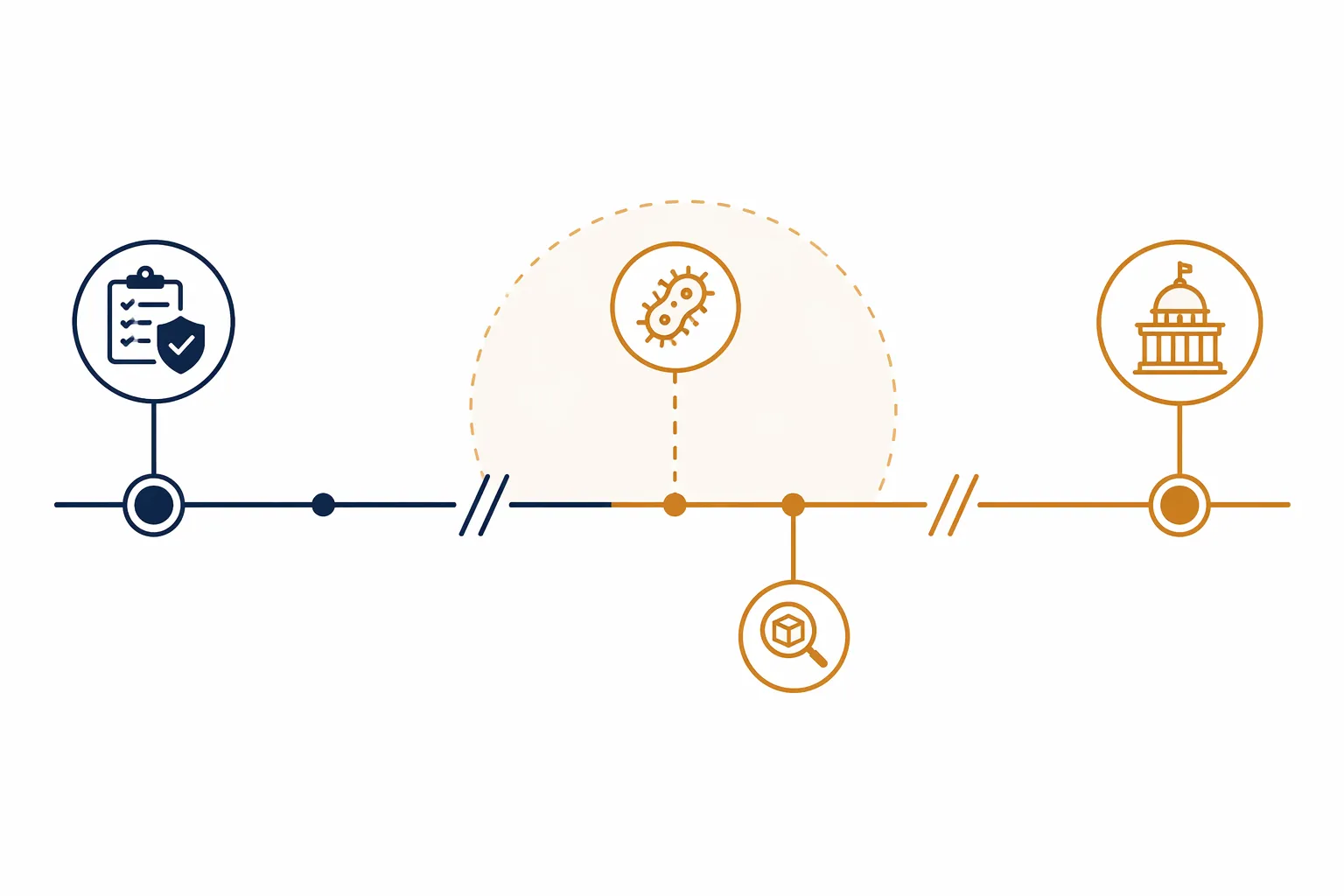
| Date | Event | Why it matters in litigation |
|---|---|---|
| January 20, 2026 | Original FSMA Food Traceability Rule compliance date | Plaintiffs will argue this date helps define what reasonable traceability systems should have been able to do. |
| May 1, 2026 | First illnesses began | The outbreak arose after the original compliance date but before delayed enforcement. |
| July 16, 2026 | Taco Bell removed iceberg lettuce; FDA traced the outbreak to Taylor Farms de Mexico | The delay between illness onset and source identification becomes the causation battleground. |
| July 20, 2028 | Congressional enforcement block expires | Defendants will argue non-enforcement reflects federal policy, not private breach. |
That timeline is not a shortcut around duty, breach, or causation. It is a way to ask better questions. What records would have existed if the traceability rule had been implemented on the original schedule? Did the company already maintain comparable internal records? Did executives, food-safety officers, insurers, customers, or trade associations discuss the gap between legal enforceability and practical traceability? If those records are missing, who decided they did not need to be created?
The Traceability Delay Is Stronger Than the Surveillance Cut
The FSMA traceability delay sits close to private conduct. It concerns supply-chain records, product movement, lot identification, and the ability to reconstruct the route of a high-risk food. Those are the kinds of documents that appear in discovery requests, custodial searches, Rule 30(b)(6) notices, and spoliation fights.
Susan Mayne, former director of FDA’s Center for Food Safety and Applied Nutrition, gave plaintiffs a clean causation phrase without overstating the statute. She said she was “confident that having the traceability rule in effect now would have greatly facilitated FDA’s ability to more quickly trace suspect product back to the field in Mexico.”[1] That is not a judicial finding. It is not proof that any one defendant caused any one illness. But it is the sort of expert-facing statement that can support the relevance of discovery into traceability systems and delay.
The CDC FoodNet change is different. As of July 1, 2025, CDC reduced mandatory FoodNet pathogen surveillance from eight pathogens to two: Salmonella and STEC. Cyclospora reporting became optional at the federal level, and the 2026 outbreak was first detected by state epidemiologists in Michigan rather than through federal surveillance.[3][4] That matters, but mostly as context. It explains why detection and reporting were fragmented. It does not, by itself, say what a grower, processor, distributor, restaurant, or supplier should have recorded before anyone got sick.
The distinction will matter in motion practice. A defendant can plausibly argue that CDC surveillance policy is several steps removed from private-party duty. The traceability rule, even delayed, points more directly at the defendant’s own files: shipping records, lot codes, supplier communications, harvest information, commingling decisions, and recall scope. That is why traceability has more litigation force than the surveillance cut, even though both may appear in the same narrative.
Maps and Case Counts Need Authentication, Not Drama
Outbreak maps are tempting demonstratives and dangerous evidence. They give jurors a picture of scale, but they do not explain who was tested, which jurisdictions require reporting, or whether a count is confirmed or probable. In this outbreak, the CDC confirmed count was 4,173 cases as of July 24, 2026, while Michigan alone reported 7,664 cases including probable cases.[5][6] Those numbers are not interchangeable.
The reporting structure also limits what the map can prove. CDC reported that Cyclospora is mandatorily notifiable in 47 states, the District of Columbia, and New York City, while Pennsylvania reporting is voluntary.[5] That makes the confirmed federal count a floor, not a ceiling. It also makes a state-by-state map a starting point for deposition questions, not a complete damages model.
Plaintiffs can use the discrepancy to show why early warning was weaker than it looked on paper. Defense counsel can use the same discrepancy to challenge overbroad claims about geographic spread, exposure, and attributable illness. The useful question is not whether the map looks alarming. It is whether the map rests on comparable reporting obligations and comparable case definitions.
How Plaintiffs Turn Delay Into Discovery
The strongest plaintiff use of the delayed traceability rule is not “you violated a rule.” It is “you knew the rule identified a recordkeeping problem, you knew enforcement had been delayed, and you chose not to build or preserve the records needed to trace a high-risk product quickly.” That theory still requires evidence. It does not become true because Congress postponed enforcement.
Discovery will likely aim at the gap between legal minimum and operational capability. A defendant that can produce clean, contemporaneous traceability records may turn the delay into a non-event. A defendant that cannot reconstruct product movement may face a different question: whether the absence of records was an unavoidable artifact of a not-yet-enforceable rule or a business-risk decision made with notice of the hazard.
- Internal implementation plans for the Food Traceability Final Rule before and after the congressional enforcement block.
- Communications with suppliers, distributors, customers, insurers, auditors, and trade associations about traceability readiness.
- Records showing whether the company voluntarily followed parts of the delayed rule or decided to wait.
- Incident-response timelines showing when suspect product, lots, facilities, and customers could actually be identified.
- Document-retention policies covering shipment data, lot information, supplier certificates, testing records, and recall communications.
The litigation value is practical. If a company had the records, the case turns toward what the records show. If it did not, plaintiffs will ask whether the missing trail slowed public-health response, widened recall uncertainty, or prevented sick consumers from connecting their exposure to a product. For comparison, the same traceability pressure appears in recall-scope disputes where lot numbers determine the legal scope of a food recall. The legal fight is rarely about the existence of a label alone; it is about whether the label connects to a usable chain of custody.
Punitive-Damages Theories Need Corporate Knowledge, Not Just a Bad Calendar
Bill Marler’s formulation captures why the delay will appear in pleadings: “The Traceability Rule was supposed to be law in January. This cyclospora outbreak started in May.”[7] As rhetoric, that is sharp. As a punitive-damages theory, it is incomplete until plaintiffs connect the date collision to corporate knowledge and conduct.
The better punitive-damages discovery lane asks whether the defendant, its executives, or its trade associations treated delayed enforcement as permission to postpone traceability investments despite known operational weaknesses. Lobbying may matter if it shows awareness of the very recordkeeping burden later claimed to be unforeseeable. Board materials may matter if they show the company priced the risk of slower traceback against the cost of compliance. Audit reports may matter if they warned that lots, shipments, or supplier paths could not be reconstructed quickly.
That is still a demanding route. A trade association position does not automatically become a member company’s state of mind. A delayed compliance date does not prove conscious disregard. A company may have had a reasonable phased implementation plan, or it may have maintained traceability systems that exceeded the delayed federal floor. Plaintiffs who skip that evidentiary work will have a motion problem.
The records question remains central because punitive damages are less likely to turn on public frustration with Congress and more likely to turn on internal proof: who knew the traceability trail was weak, who had authority to fix it, and whether the company consciously accepted the risk that investigators and consumers would be left waiting.
The Defense Response Is Not Cosmetic
Defense counsel have real answers. Congress directed FDA not to enforce the traceability rule until July 20, 2028.[1] A court may treat that as a policy judgment and exclude any argument that asks jurors to punish a private company for obeying the law as it stood. The delayed rule cannot be converted into a private cause of action by changing the label to negligence.
The CDC surveillance reduction is an even weaker basis for private duty. CDC workforce reductions, terminated grants, and FDA staffing losses may help explain why public-health detection was strained; CIDRAP reported that CDC’s workforce was down more than 25% since January 2025, that 444 CDC grants worth $5.78 billion had been terminated, and that more than 4,300 FDA staff had been fired.[3][4] Those are institutional facts, not private acts. They may be admissible background. They do not prove a lettuce supplier or restaurant breached a duty to a consumer.
Causation is also not settled. Taylor Farms has disputed part of the testing story, saying FDA apologized after retracting a false-positive lettuce sample, while FDA maintained that traceback, epidemiology, and the recall remained intact.[4] That dispute does not erase the traceability-delay argument, but it does limit any claim that the traceback record is uncontested. In individual cases, admissibility may turn on whether plaintiffs can connect a consumer’s illness to a product, location, time period, and supply path with enough reliability.
Defendants will also separate adoption from effectiveness. A traceability rule can require records without guaranteeing instant source identification. A surveillance program can collect reports without preventing illnesses. The plaintiff who says “the rule would have existed” still has to show what records would have existed, how those records would have shortened the traceback, and why the delay mattered to the injuries claimed.
Admissibility Turns on Purpose
The same evidence can be admissible for one purpose and improper for another. The delayed traceability rule is vulnerable if offered as a substitute for breach: “the law was supposed to apply, therefore defendant was negligent.” It is stronger if offered to explain industry notice, reasonable-care benchmarks, the foreseeability of traceability problems, or why certain records should have existed even before enforcement.
The FoodNet reduction has a narrower use. It can explain why state epidemiologists carried more of the detection burden, why confirmed federal counts lagged or undercounted the apparent outbreak, and why early public information may have been incomplete. It is less persuasive as evidence of what any private defendant should have done before the outbreak. That difference should shape motions in limine, expert reports, and jury instructions.
For plaintiffs, the cleanest framing is proportional: the federal timeline made traceability risk visible; the company’s own records show whether it responded reasonably. For defendants, the cleanest framing is equally proportional: federal non-enforcement and surveillance cuts are not admissions of private fault, and causation still depends on product-specific proof. Courts are more likely to tolerate the timeline when it helps the jury understand the factual setting than when it invites punishment for national policy choices.
Where the Risk Actually Lands
The regulatory gaps are unlikely to establish liability by themselves. They are too indirect for that, and no court has yet settled how delayed-traceability-rule evidence should be handled in this setting. But they make the absence of traceability records harder to treat as harmless background. A company that cannot reconstruct the path of a high-risk product after an outbreak will have to explain more than legal non-enforcement.
The practical exposure is not limited to the named supplier. Restaurants, distributors, and brands that rely on upstream assurances may still face questions about their own recall controls and customer communications, especially where public-facing safety statements outpace the underlying documentation. That issue overlaps with the broader lettuce-liability problem discussed in Lettuce Brands Safe from Cyclospora Still Face Legal Liability Risks and with recall documentation disputes like those in the Midwest Poultry Egg Recall 2026 legal guide.
The litigation risk, then, is evidentiary before it is doctrinal. Plaintiffs get a timeline that supports discovery into missing records, delayed identification, and corporate knowledge. Defendants get a strong argument that Congress and CDC made policy choices for which private companies are not insurers. The cases that survive will be the ones that move from the public timeline to the defendant’s own paper trail.
References
- Cyclospora Hunt Highlights Need for Delayed Food-Tracing Rule, Bloomberg Law, July 22, 2026.
- CDC Investigation Update, Centers for Disease Control and Prevention.
- CDC cuts back foodborne illness surveillance program, CIDRAP.
- What we truly know about the huge US Cyclospora outbreak—and what we don't, CIDRAP.
- HAN-00531, Centers for Disease Control and Prevention.
- Michigan Cyclosporiasis page, Michigan Department of Health and Human Services.
- Publisher’s Platform: The Traceability Rule was supposed to be law in January. This cyclospora outbreak started in May., Food Safety News, July 2026.
Related records
Tool profile
Browse tool evaluations →Governing regulation
Browse the obligations tracker →Preventive workflow
Browse verification workflows →
Report a correction or tip
Spotted an outdated figure, a misstated fact, or a ruling this case record should reflect? Public comments are disabled for this content given the professional cost of a misreported case outcome, penalty amount, or rule text — use the structured correction channel instead.
Report a correction or tip for this record →