
The Litigation Conduct Risk in Brittany Renner's Child Support Case
This article examines the procedural and reputational risks of aggressive service-of-process tactics in interstate family law through the Renner v. Washington case, where a lawyer allegedly threatened to serve court papers during a nationally televised NBA game. It provides a cautionary analysis for litigators and ethics counsel on when creative service crosses into actionable litigation conduct, even absent a judicial ruling.
- Jurisdiction
- California, United States
- Court
- California Superior Court
- AI tool named
- None
- Ruling date
- Feb 1, 2026
- Source document
- View primary court order ↗
- Last verified
- Jul 25, 2026
Lex Machina Review is an independent risk-tracking and reference resource. Nothing on this site is legal advice, and using it does not create an attorney-client relationship. Every record is reviewed against primary sources but may not reflect the most current status of a matter — always verify directly against the cited court order, rule text, or a licensed attorney before relying on it.
Companion explanation — secondary to the source document above
The most important fact in the reported Renner-Washington child support dispute is not the support number, the celebrity coverage, or the existence of an interstate family-law fight. It is the alleged Nov. 14, 2025 email: a written service plan in which Renner's counsel allegedly described buying all available visitor-bench tickets, reportedly at an average price of $2,317, for Los Angeles Lakers and Clippers games so P.J. Washington could be served with court papers in an NBA setting.[1]
That allegation comes from media reports describing court filings, not from a judicial finding. Yahoo Sports, Us Weekly, Complex, and Hollywood Unlocked reported on filings and accusations tied to the California proceeding; no court ruled that the alleged service tactic was improper because Renner voluntarily dismissed the California case in February 2026 before the issue was adjudicated.[1][2][3][4]
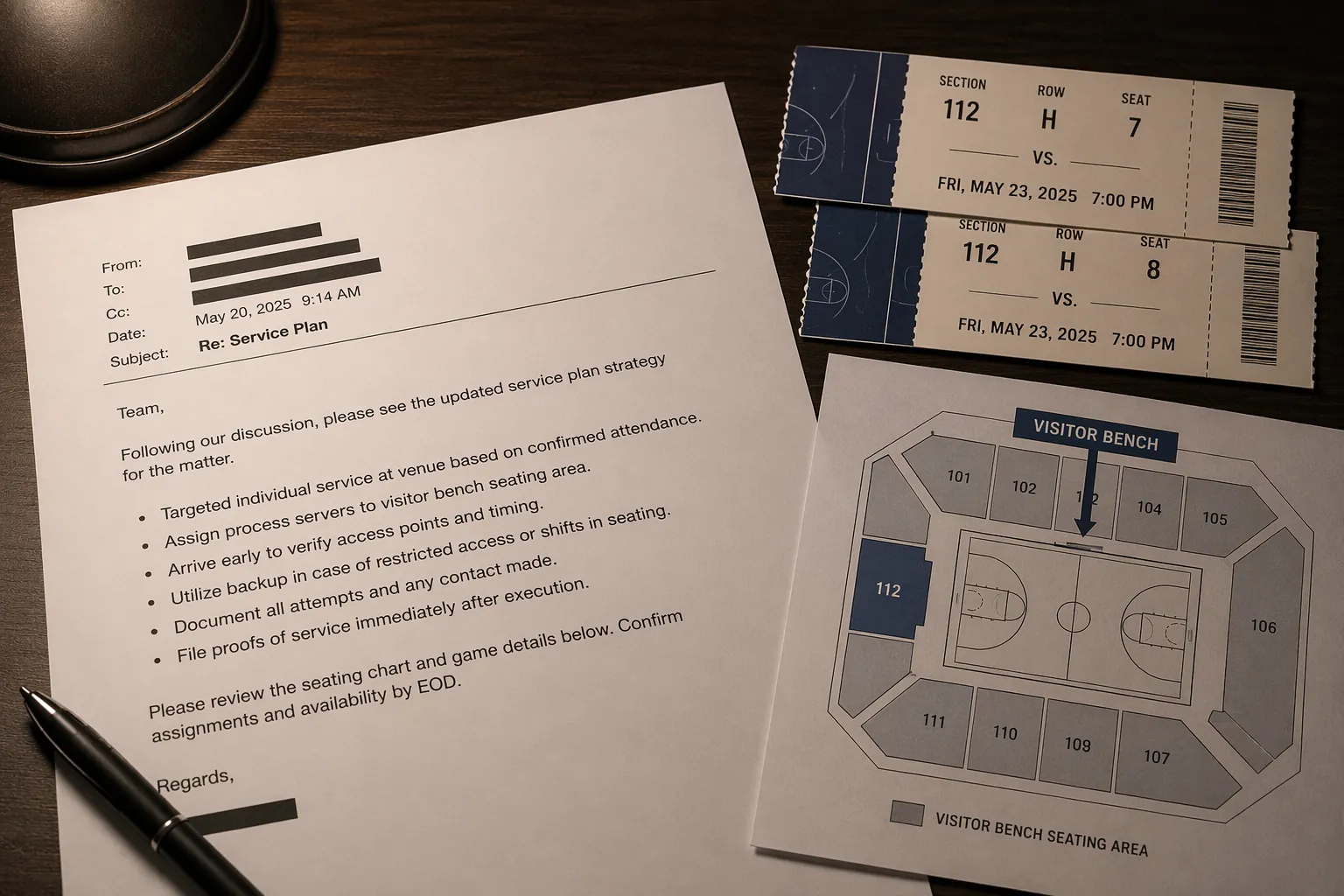
That distinction matters. A filed allegation is not an ethics ruling. A reported email is not a sanctions order. But in litigation-conduct risk analysis, the absence of a ruling is not the same as the absence of risk. Once a tactical plan is written, quoted, and tied to a contested procedural advantage, it stops being private bravado and becomes usable material for the other side.
The Service Plan Was Not Procedurally Neutral
Service of process is supposed to do a plain job: give a party notice in a form the law recognizes. Lawyers routinely choose practical, even uncomfortable, places to accomplish that job when a party is difficult to reach. A public setting is not automatically improper simply because it is embarrassing. Litigation does not require the recipient's preferred mood lighting.
The Renner-Washington allegation sits in a harder category because Washington was not merely objecting to being served in public. He was contesting California personal jurisdiction while also claiming the threatened arena service was designed to pressure him into consenting to that jurisdiction. Us Weekly reported that Washington challenged California jurisdiction by arguing limited California ties, that the child was conceived in North Carolina, and that he played fewer than 10 games per year in California.[2] Hollywood Unlocked and Yahoo Sports reported that Washington characterized the threatened service as an effort to "coerce" him into accepting California jurisdiction.[1][3]
That is the hinge. Serving a party to start or advance a case is one thing. Designing a service event that allegedly uses a televised workplace spectacle to produce jurisdictional pressure is another. The risk is not that every creative service effort becomes misconduct. The risk is that the tactic can be reframed as leverage aimed at procedural consent rather than neutral notice.
The more operational detail the writing contains, the easier that reframing becomes. A vague threat to serve papers at a game would have made a smaller target. A reported email identifying visitor-bench tickets, Lakers and Clippers games, and an average ticket price gave the allegation structure, price, venue, and intent.[1] Those are the elements that make a filing legible to a judge, a reporter, a client, and later risk reviewers.
Why Jurisdiction Made the Tactic More Dangerous
Interstate family litigation often turns on ordinary procedural questions before anyone reaches the more emotionally charged support dispute. Which state can hear the case? Which prior order controls? Which party has enough contacts with the forum? Those questions are not housekeeping. They decide where the case lives and which court will supervise the next phase.
Here, the reported posture was unusually sensitive. Renner sought to modify a November 2024 North Carolina consent order that reportedly required Washington to pay $5,500 per month in child support plus a $130,000 lump sum.[2] TMZ reported that Renner later sought an increase to $35,000 per month and $50,000 in attorney fees, citing Washington's $90 million Dallas Mavericks extension as changed circumstances.[5]
Those figures explain why a new forum fight mattered, but they do not answer it. A professional athlete's contract extension may be relevant to support modification; it does not automatically establish personal jurisdiction in California. A parent may have a serious reason to seek increased support; that does not make every pressure tactic safe. The procedural and substantive questions remain separate, and the service allegation became risky precisely because it appeared to blur them.
| Issue | What The Reports Support | What They Do Not Establish |
|---|---|---|
| Support modification | Renner reportedly sought to increase support from a North Carolina consent-order amount to $35,000 per month plus attorney fees. | The reports do not establish that the requested amount was legally warranted or unwarranted. |
| California jurisdiction | Washington reportedly challenged California jurisdiction based on limited contacts, North Carolina conception, and fewer than 10 California games per year. | The reports do not include a court ruling accepting or rejecting that jurisdictional challenge. |
| Service tactic | Washington alleged Renner's counsel threatened NBA-game service, including a ticket-purchase plan described in a Nov. 14, 2025 email. | The reports do not establish a judicial finding that the alleged tactic violated any rule. |
| Case outcome | Renner voluntarily dismissed the California case in February 2026. | The dismissal did not resolve the merits of support, jurisdiction, or litigation conduct. |
A lawyer defending the alleged plan might say that service at an NBA game would have been efficient because Washington's presence was predictable. That argument is not frivolous in the abstract. Public schedules can solve service problems. The difficulty is the alleged packaging: buying visitor-bench tickets near a nationally visible professional setting, then having that threat appear in filings while jurisdiction was under active dispute.
When the opposing party is arguing that the forum itself lacks authority over him, a service tactic that appears calibrated for embarrassment can be recast as an effort to extract procedural surrender. That recasting may or may not win a motion. It can still damage the credibility of the party using the tactic and force counsel to spend valuable motion practice explaining why the spectacle was necessary.
The Support Numbers Raised the Stakes, Not the Answer
The support dispute should not be flattened into either outrage or entitlement. A parent seeking modification after a claimed change in financial circumstances is not doing something inherently improper. Nor is a parent resisting a new forum necessarily dodging support. The available reports show a fight over modification and jurisdiction, not a court-determined bad actor.
The reported move from $5,500 per month plus a $130,000 lump sum under the North Carolina consent order to a requested $35,000 per month in California was substantial.[2][5] The reported $90 million Mavericks extension made the financial context obvious.[5] But the fact pattern still required forum analysis before the California court could become the place where that modification fight unfolded.
That sequencing is where litigation conduct risk often hides. Lawyers under pressure to solve the next procedural problem may focus on whether a tactic can produce the immediate result: service accomplished, appearance forced, consent obtained, hearing preserved. Risk review asks a different question: if the method becomes the exhibit everyone remembers, does it help the client get where the client needs to go?
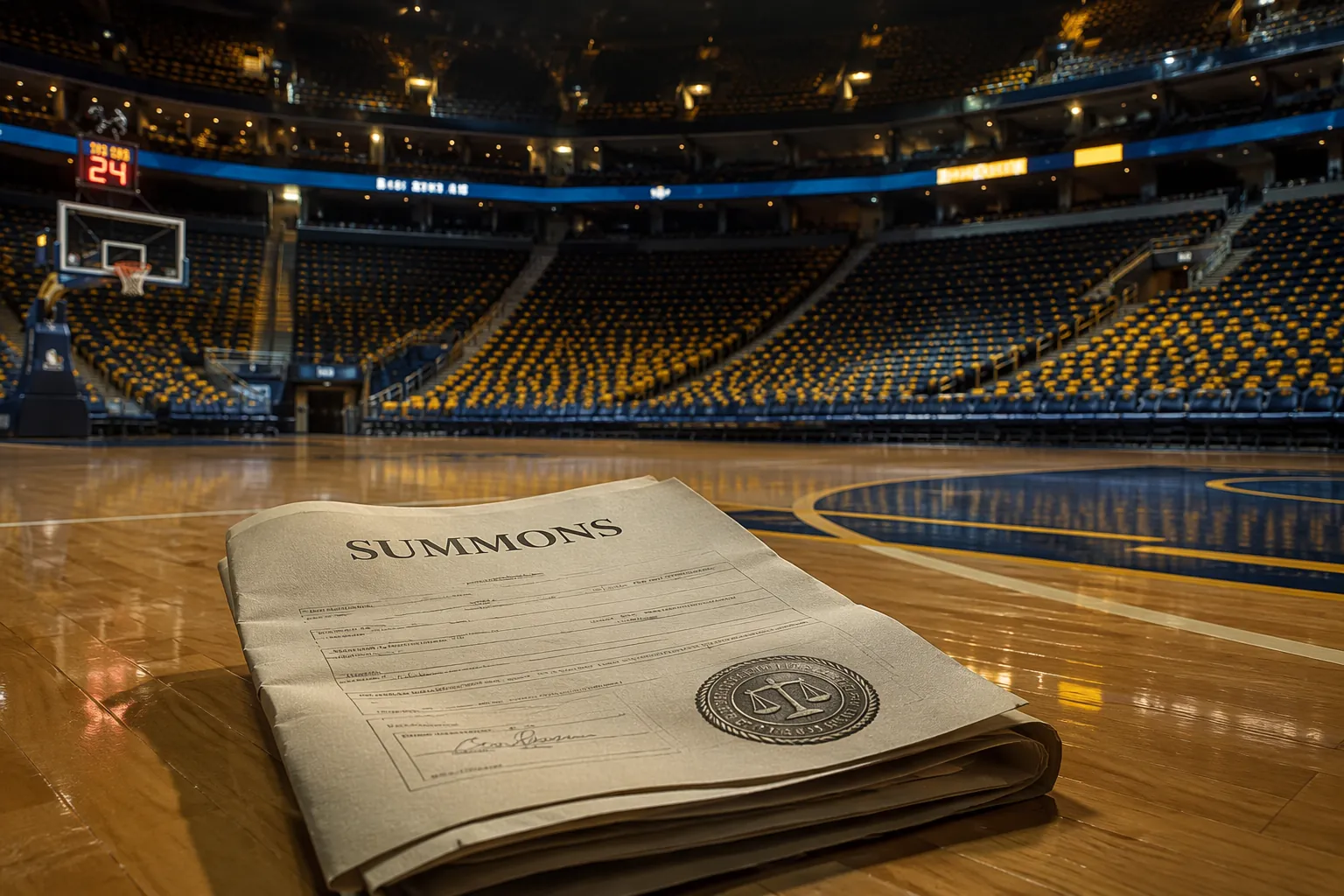
In this case, the alleged method became more memorable than the legal standard. A reader can forget the jurisdictional factors and still remember the image of process service near an NBA bench. That is not a sentimental objection. It is a practical problem for the side that needs the court to view its procedural conduct as orderly and its merits position as serious.
No Ruling, But Not No Consequence
Complex reported that Renner dropped the child support case in February 2026, and that she said on her podcast that she "never needed money to be happy."[4] That remark predictably traveled well in celebrity coverage. For litigation-risk purposes, though, the more durable afterimage is that the case ended without a court resolving the jurisdictional challenge or the propriety of the alleged service threat.
Dismissal can reduce immediate litigation exposure. It can also preserve ambiguity. There was no sanctions ruling, no discipline finding, and no merits determination on whether counsel's alleged plan crossed any enforceable line. But the allegation remained filed, reported, searchable, and easy to summarize.
That is a familiar risk pattern. Some litigation conduct never receives a formal ruling because the case settles, dismisses, transfers, or becomes moot. The conduct still circulates. It may appear in future conflicts checks, client pitches, media searches, judicial memory, insurer discussions, or internal firm reviews. The question shifts from "Was there a finding?" to "What would we have to explain if this email were read aloud?"
For counsel, the alleged Nov. 14 email is the part that would require explanation. Not because aggressive service is categorically forbidden, and not because Washington's jurisdictional position was necessarily correct. The problem is evidentiary: the writing allegedly connected a high-visibility service plan to a contested procedural objective at a moment when the other side could plausibly argue coercion.
The Risk Line Is Drawn Before a Judge Names It
Lawyers often evaluate hardball tactics by asking whether a rule clearly prohibits them. That is necessary, but incomplete. Litigation conduct risk forms earlier. It forms when a tactic is likely to distract from the merits, invite a motion, create a bad document, or let the opposing party describe the lawyer's conduct more simply than the lawyer can defend it.
The Renner-Washington matter illustrates four risk signals that do not depend on a final ruling:
- The service plan was reportedly reduced to operational detail, including venue choice, ticket availability, and average ticket price.[1]
- The service pressure was allegedly tied to a jurisdictional dispute rather than only to notice.[1][3]
- The proposed location created a public spectacle capable of overwhelming the underlying procedural explanation.
- The case ended before any ruling could separate permissible strategy from impermissible pressure.[4]
None of those signals proves misconduct. Together, they describe a zone where counsel should expect the tactic to become the issue. Once that happens, the client may win no advantage from the drama. The forum dispute still has to be litigated. The support modification still has to be justified. The lawyer's method has now given the opponent a clean narrative that is easier to understand than personal jurisdiction.
This is especially true in high-publicity family disputes involving professional athletes, influencers, and nationally visible schedules. The court may care about doctrine; the public record also cares about images. A bench-side service attempt during an NBA game is too vivid to remain a procedural footnote, even if the underlying objective is ordinary service of process.
Source Limits Matter Here
The available public account is limited. The details cited here come from media reports describing court filings, not from an independent docket review for this article. Before relying on the case as a training example, sanctions comparator, or ethics-risk entry, licensed counsel should verify the pleadings, exhibits, dismissal papers, and hearing history against the actual docket records.
That verification would not change the basic risk lesson unless the reported filings were materially inaccurate. The lesson is not that Renner's counsel was found to have violated a rule. There was no such reported ruling. The lesson is that an unadjudicated allegation can still become the defining fact of a case when it is documented, media-legible, and connected to a disputed procedural advantage.
Aggressive service may be lawful in many circumstances. It may even be necessary. But in interstate family litigation with a live jurisdictional challenge and a public figure's schedule, counsel should assume any written service plan could later function as an exhibit, a headline, and a credibility problem before any judge has the chance to rule on it.
References
- Dallas Mavericks' PJ Washington Accuses Brittany Renner of Threatening to Serve Him Court Papers at NBA Game, Yahoo Sports,
- P.J. Washington Fights Ex Brittany Renner's $35K Support Demand, Us Weekly,
- PJ Washington Claims Brittany Renner Threatened Court Papers at NBA Game, Hollywood Unlocked,
- Brittany Renner Drops Child Support Case, Complex,
- Brittany Renner Wants Increase in P.J. Washington Child Support Payments, TMZ,
Related records
Tool profile
Browse tool evaluations →Governing regulation
Browse the obligations tracker →Preventive workflow
Browse verification workflows →
Report a correction or tip
Spotted an outdated figure, a misstated fact, or a ruling this case record should reflect? Public comments are disabled for this content given the professional cost of a misreported case outcome, penalty amount, or rule text — use the structured correction channel instead.
Report a correction or tip for this record →