
When Are Kroger and Target Liable for Contaminated Fruit?
When a fruit product sold at Kroger or Target is recalled for contamination, the retailer's legal exposure depends on whether it processed the fruit, the state's liability doctrine, and whether a warning could have prevented harm. This article maps the three exceptions to the default negligence rule that in-house counsel need to assess litigation risk.
- Jurisdiction
- United States
- Ruling date
- Jun 1, 2019
- Source document
- View primary court order ↗
Lex Machina Review is an independent risk-tracking and reference resource. Nothing on this site is legal advice, and using it does not create an attorney-client relationship. Every record is reviewed against primary sources but may not reflect the most current status of a matter — always verify directly against the cited court order, rule text, or a licensed attorney before relying on it.
Companion explanation — secondary to the source document above
The recall notice is the wrong moment to ask only whether Kroger or Target sold the fruit. That fact matters, but it is not enough. Counsel has to know what kind of fruit product is involved, whether the retailer changed it, what state law governs, when the retailer learned of the hazard, and whether any customer could have avoided injury if the warning chain had worked.
The recent examples make the problem look simpler than it is. PT Organics recalled fruit pouches sold at Target, Kroger, and Meijer from March 6 to July 13, 2026, because of a possible plastic liner defect that could leave plastic pieces in the product; that is a packaging-defect recall, not a classic microbial fruit-contamination case.[1] Tru Fru's 2025 recall involved freeze-dried fruit snacks and possible metal fragments, sold nationwide at Target and Kroger; that is processed snack food, not loose fresh produce.[2] Kroger's 2019 recall of select Private Selection frozen berries involved a possible Hepatitis A risk and is the cleaner fruit-contamination example, but it is older and tied to frozen private-label berries rather than fresh fruit handled at store level.[3]
So the useful first question is not, "Was there a fruit recall at Kroger or Target?" It is: which liability pathway is open on these facts? A sealed third-party pouch, a freeze-dried snack, a frozen private-label berry blend, a store-cut melon cup, and a smoothie made in the store can all arrive under the same public word, "recall." They do not create the same defense file.
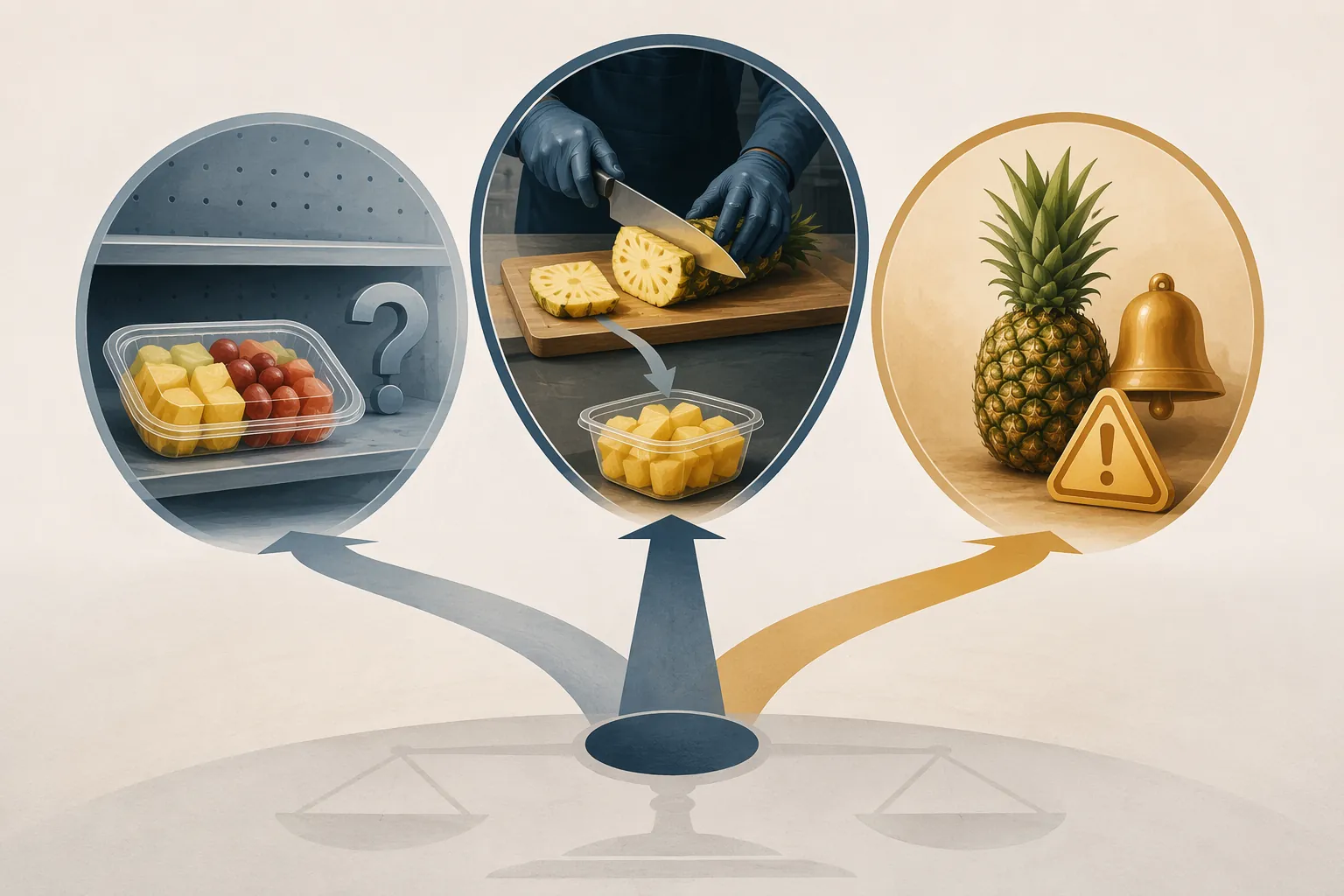
The first split: seller negligence or chain-of-distribution liability
For an unaltered fruit product made by someone else, the ordinary retailer defense begins with a simple proposition: selling the product is not, by itself, the same as causing the contamination. Marler Clark's practitioner summary draws the central distinction this way: most states require a plaintiff to prove negligence by the retailer when the retailer did not manufacture the product, while a minority of states allow strict liability against entities in the product's chain of distribution.[4]
That distinction controls the first litigation budget conversation. In a negligence state, the plaintiff needs a retailer-specific failure: mishandling, improper storage, ignoring a recall, failing to remove product, making a misleading representation, or having knowledge the retailer did not act on. The complaint may name the retailer because the store is local, solvent, familiar, or easier to serve. Naming the retailer does not eliminate the plaintiff's burden to prove what the retailer did wrong.
In a chain-of-distribution strict-liability state, the first defensive posture is less comfortable. The retailer may be in the case because it placed the defective product into the stream of commerce, even if the retailer did not know about the contamination and did not create it. That does not mean the retailer has no indemnity claim, no supplier tender, no contractual defense, or no statutory seller protection. It does mean the exposure analysis cannot stop at "we only sold it."
The operational file should reflect that split from the start. Counsel needs the state of sale, state of injury, state of purchase, retailer entity, supplier identity, product label, private-label involvement, distribution agreement, hold notice, recall notice, removal time, register-block timing, customer notice steps, and any store-level exception reports. Those facts are not clerical details. They determine whether the retailer is defending a negligence theory, a strict-liability seller theory, a warning theory, or a hybrid complaint drafted to preserve all three.
| Initial fact | Why it changes the liability analysis |
|---|---|
| Retailer sold a sealed third-party fruit product without altering it | Most states point the plaintiff toward retailer negligence rather than automatic strict liability. |
| State law imposes chain-of-distribution strict liability | The retailer may face liability as a seller even without proof that it caused the contamination. |
| Retailer cut, mixed, juiced, plated, or otherwise processed the fruit | The retailer may be treated more like a manufacturer or food preparer than a passive seller. |
| Retailer had notice of the hazard before the injury or continued sale | Failure-to-warn and failure-to-remove theories become central. |
Unaltered fruit products: the negligence file still matters
When the product is a sealed bag of frozen berries, a packaged fruit pouch, or a processed fruit snack made offsite, the retailer's first factual question is whether it did anything beyond ordinary sale. Did store employees open the case, repackage the product, relabel it, break cold chain, miss an expiration control, or keep selling after notice? If the answer is no, the retailer may still be sued, but the plaintiff's negligence case has to find a retailer act or omission.
This is where recall writing often gets careless. A fruit contamination recall is not automatically a strict-liability event against every retailer in every jurisdiction. Nor is the retailer automatically insulated because the supplier made the product. The practical answer sits between those positions. The retailer's exposure turns on doctrine first, then conduct.
For the PT Organics recall, counsel would also separate the defect theory from the foodborne-illness framework. Possible plastic pieces from packaging implicate product defect, foreign material, warning, and removal questions.[1] They do not prove that the fruit itself carried a pathogen. If a complaint later describes the case as "contaminated fruit," the retailer should not let the label blur the theory.
The same narrowing applies to Tru Fru. Freeze-dried fruit snacks with possible metal fragments raise a serious foreign-object issue, but the product is processed and packaged before retail sale.[2] That matters for tracing who controlled the product when the hazard entered it. It also affects what records are useful: purchase orders, lot codes, vendor notices, distribution center handling, and store removal logs may matter more than produce-department handling practices.
Kroger's 2019 Private Selection berry recall is more directly within the fruit-contamination lane because FDA's notice identified select frozen berries and a possible Hepatitis A risk.[3] Even there, the legal work is not finished by saying "Kroger" and "berries" in the same sentence. A private-label product can raise additional questions about specifications, supplier oversight, label control, and apparent manufacturer status. Those questions are not the same as saying a store employee contaminated fruit in the aisle.
When the retailer becomes more than a seller
The harder exposure often begins at the prep table. A retailer that cuts melon, assembles fruit platters, fills fruit cups, blends smoothies, presses juice, or repackages bulk fruit into store-branded containers is no longer just passing along someone else's sealed product. It has added labor, equipment, sanitation controls, temperature controls, employee training, and a new point at which contamination can be introduced or allowed to multiply.
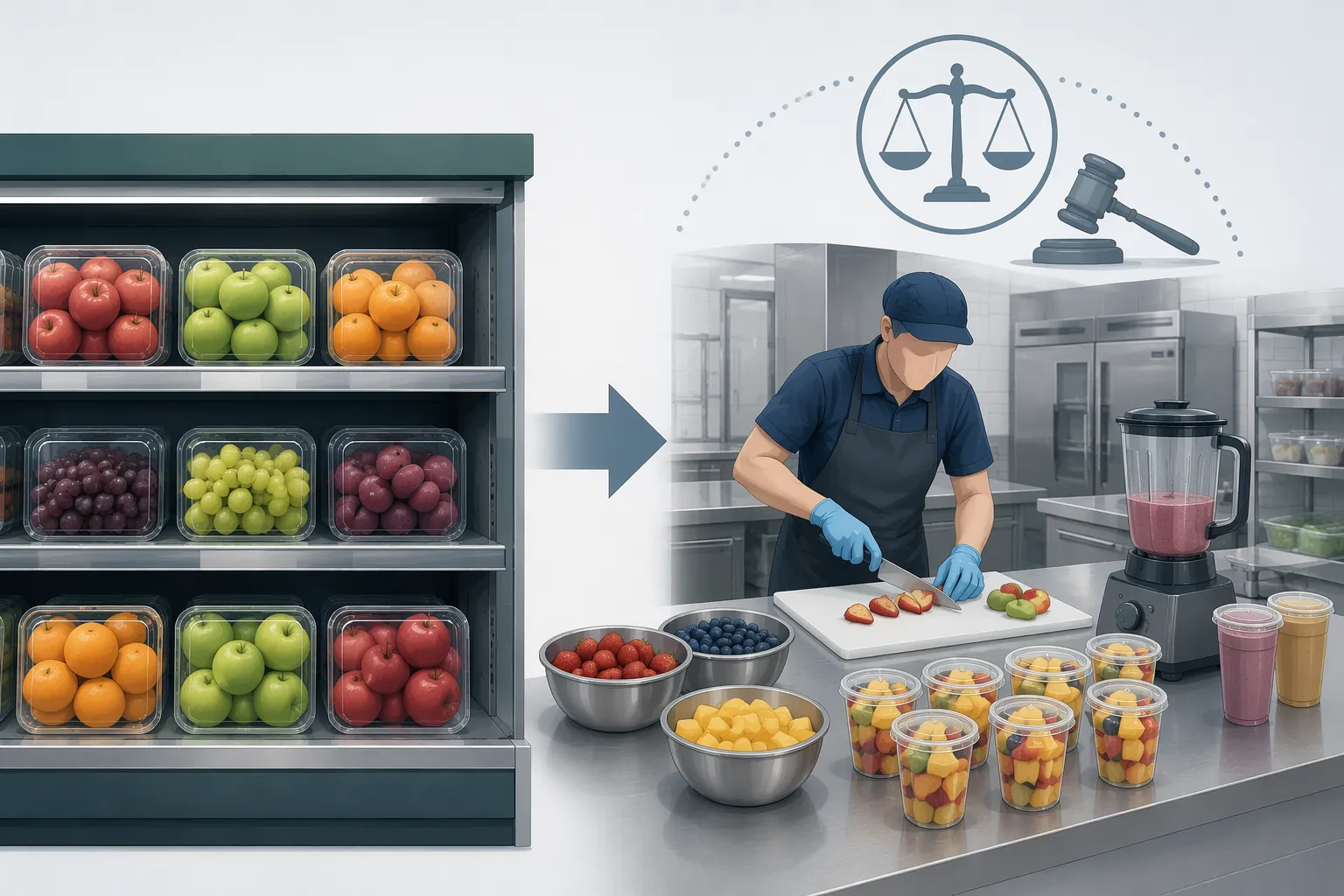
That shift changes the defendant's character. The retailer may be treated as a food preparer or manufacturer for the item it created, and the fact file starts to look less like a passive-seller case. Counsel needs cleaning logs, cutting-board practices, employee illness reports, time-and-temperature records, supplier lot tracking, prep-room video retention, department training, and prior complaint history. The ugly fact is usually not one document; it is the missing chain between the incoming fruit and the ready-to-eat product handed to the customer.
Pre-cut fruit deserves special attention because it removes a consumer step. A whole melon sold intact leaves washing, cutting, and serving to the buyer. A cup of cut melon sold ready to eat tells the customer, in practical terms, that the retailer has already performed the preparation step. If contamination is tied to the retailer's knife, sink, glove practice, display temperature, or shelf life decision, the defense cannot be built around passive retail sale.
This is also where brand language matters. A store-branded fruit cup, a retailer-prepared platter, or a smoothie sold under the store's own food-service program may create expectations that are different from a nationally branded sealed package on a shelf. The issue is not public relations. It is who controlled the last meaningful safety step before consumption.
Warning failure is its own route, not a footnote
Recall timing can turn an otherwise defensible seller case into a warning case. Once a retailer receives notice that a fruit product may be contaminated or contain foreign material, the analysis shifts from origin of defect to response. Who received the notice? Which system logged it? When did stores pull the product? Were point-of-sale blocks activated? Were online listings removed? Were prior purchasers contacted if the retailer had loyalty or delivery data? Were customer-service scripts updated?
Those questions matter because failure to warn is usually a negligence pathway. The alleged wrong is not that the retailer manufactured the contaminated fruit. The alleged wrong is that the retailer learned enough to act and did not act quickly or clearly enough to prevent a later sale, consumption, or injury. A strong warning defense is therefore built in hours, not months, even if the lawsuit arrives much later.
The removal record should be specific enough to survive a store-level deposition. "We followed recall procedures" is not the same as showing when the relevant lot was identified, when inventory was quarantined, who confirmed removal, whether any units remained in backstock, and whether the register block covered all UPCs and substitutions. In a multi-state retailer, counsel also has to watch for uneven execution. A clean corporate policy does not erase a local miss.
The warning pathway can also change causation. If the customer bought the product before the retailer had notice, the plaintiff may struggle to connect the retailer's later recall response to the injury. If the customer bought it after notice, or consumed it after a warning reasonably could have reached them, the warning record becomes the center of the case.
Why "we only sold it" may still be expensive
The SoyNut Butter litigation is the cautionary example, even though it is not a fruit case. Marler Clark reported lawsuits against Kroger, Safeway, and Target in connection with the 2017 E. coli outbreak tied to SoyNut Butter products; the manufacturer, Dixie Dew, had entered bankruptcy, its insurer had exhausted policy limits, and the bankruptcy court valued all claims at $70 million.[5]
That fact pattern explains why retailers remain in the plaintiff's line of sight. If the manufacturer is insolvent, underinsured, dissolved, unreachable, or outside an easy enforcement path, the retailer may be the only meaningful recovery target left. The legal theory still has to work. But the retailer will spend money proving why it does not work, and the defense may unfold after the supplier tender has failed or become largely symbolic.
SoyNut Butter should not be stretched into a fruit precedent. Nut butter, frozen berries, cut melon, fruit pouches, and freeze-dried snacks involve different products, processing environments, pathogens or foreign materials, and regulatory records. Its value here is narrower and more practical: secondary retailer exposure becomes real when the primary manufacturer cannot carry the loss.
The same restraint applies to high-dollar injury examples. Allen & Allen describes a $75 million lawsuit against Target involving contaminated food and serious personal injury allegations.[6] That kind of case is useful as an exposure-ceiling reminder, not as a valuation model for every recall. A recall without illness, a foreign-object case without consumption, a limited lot withdrawal, and a catastrophic injury case do not belong in the same settlement bucket.
The assessment sequence after a fruit recall notice
A useful retailer assessment moves in sequence. First, identify the product with precision: fresh, frozen, freeze-dried, pouch, private-label, national brand, store-prepared, or food-service item. Second, identify the alleged hazard: pathogen, foreign material, allergen, packaging defect, temperature abuse, or warning omission. Third, decide whether the retailer sold the product unaltered or changed it before sale.
Only then does the legal question sharpen. If the product was sold unaltered, the controlling state-law question is whether the jurisdiction follows the majority negligence approach for retailers or permits chain-of-distribution strict liability. If the retailer processed the fruit, the case shifts toward preparation controls and manufacturer-like exposure. If the retailer had notice before sale or consumption, warning and removal conduct may carry the case even when the original contamination occurred elsewhere.
The practical documents should match those pathways. For passive-sale cases, preserve supplier contracts, indemnity provisions, purchase records, certificates, lot tracing, distribution-center records, and communications with the manufacturer. For store-processing cases, preserve sanitation, temperature, employee, training, equipment, and prep records. For warning cases, preserve recall notices, timestamps, escalation logs, register-block records, customer communications, store acknowledgments, and proof of product removal.
That sequence leaves less room for both panic and false comfort. Most retailer exposure for an unaltered third-party fruit product still depends on negligence in most states. The risk changes sharply if the state imposes chain-of-distribution strict liability, if the retailer processed or repackaged the fruit, or if a warning failure can be tied to known contamination. Before this framework is treated as publication-ready doctrine, it still needs jurisdiction-specific verification and academic support; the current source base is practitioner-oriented, and food recall liability is not a close cousin of AI-risk coverage simply because both belong in a risk file.
References
- Fruit pouches sold at Kroger, Target, Meijer recalled for potential plastic pieces, WSFA, July 22, 2026.
- Recall: Fruit recalled, freeze-dried Target Kroger nationwide dangerous metal contamination pieces fragments FDA, CBS Austin, September 2025.
- Kroger Recalls Select Frozen Private Selection Berries for Possible Health Risk, U.S. Food and Drug Administration, June 2019.
- Strict Liability and Negligence and when they apply and chain of distribution liability, Marler Clark.
- Marler Clark Files Lawsuits Against Kroger, Safeway and Target in SoyNut Butter Outbreak, Marler Blog.
- $75M Target Contaminated Food Lawsuit, Allen & Allen.
Related records
Tool profile
Browse tool evaluations →Governing regulation
Browse the obligations tracker →Preventive workflow
Browse verification workflows →
Report a correction or tip
Spotted an outdated figure, a misstated fact, or a ruling this case record should reflect? Public comments are disabled for this content given the professional cost of a misreported case outcome, penalty amount, or rule text — use the structured correction channel instead.
Report a correction or tip for this record →